What is Salame Milano?
Salame Milano is a pure pork salami, finely ground, seasoned with salt, pepper, garlic and wine, cased and aged for one to three months depending on diameter.
The defining feature is the grind. Lean and fat go through the same plate at roughly three millimetres, so the white specks and the red specks are the same size, the effect Italians call grana di riso, rice grain. No other Italian salami looks like this, and the look is the whole point: it slices cleanly, machines well, and holds together at any thickness.
The diameter is large, seven to nine centimetres against the four to six of a Felino or a Napoli, and a whole piece weighs 1.5 to 3.5 kg.
Unlike almost every salami it competes with, Milano has no PDO or PGI protection. The name describes a method, not an origin. Anyone anywhere can legally make and sell salame Milano, which is exactly why it became the most exported Italian salami and why quality varies more than in any other category.
If you have eaten "Italian salami" in a supermarket in Ohio or Ontario, this or its close relative Genoa was almost certainly what you ate.
What does it taste like?
Mild, salty and rounded, with garlic present but sitting behind the pork rather than leading it. There is no chilli, no fennel, no smoke and no paprika, so nothing interrupts the meat.
The texture is the differentiator. Because the fat is dispersed evenly at the same scale as the lean, a slice melts uniformly rather than in pockets. It does not feel greasy the way a coarse salami can, and it does not have the pleasing unevenness of a knife-cut grain either: it is consistent by design.
Against Felino it is saltier and more assertive; against Napoli it has none of the heat; against Spanish chorizo it shares nothing except pork, since chorizo is defined by pimentón.
Good Milano finishes clean and slightly nutty. Cheap Milano finishes sour, a giveaway of fast fermentation, and can leave a waxy film on the roof of the mouth, which means poor-quality fat.
How to use it
Slice it thin, about a millimetre and a half. The fine grind holds together at thicknesses where a coarse salami crumbles, which is the one genuine advantage Milano has over its rivals.
The Milanese way is a sandwich and nothing else: salami inside a michetta, the hollow, crusty city roll, with no butter, no cheese and no condiment. The bread is neutral and crisp and the salami is salty and fatty, and that is the entire idea.
On a board it can hold its own against pickles, giardiniera and semi-soft Lombard cheeses like taleggio or quartirolo, which would flatten a milder salami.
Milano is the one aged salami that genuinely cooks well, because evenly dispersed fat renders evenly. Dice it into risotto, fold it into a frittata, bake it into a savoury tart, or add it to pizza in the last minute of the bake.
The end stub that nobody wants to slice is the best part for cooking. Cut it into cubes and render it as the base of a tomato or bean sauce.
How long it keeps
A whole salame does not need a refrigerator. Hung in a cool, airy room between 12 and 16 degrees it keeps for months and simply goes on drying, losing weight and concentrating. Once you cut into it, press waxed paper or film against the exposed face and work through it over two or three weeks; the cut end hardens into a dry plug, and the usual answer is to sacrifice the first half centimetre and carry on. Vacuum-packed halves, how most shops abroad sell it, run to the date on the pack and go on the least cold shelf of the fridge.
Cold works against the taste, not the keeping. The fine fat of a Milano stays waxy below about 15 degrees and the aroma stays locked in it, so take the piece out half an hour before slicing. Over weeks the lean darkens and the piece firms. A dry white bloom on natural casing brushes off with a cloth. Diced for cooking, Milano freezes better than most cured salami for about three months; sliced for the board, it does not. Dates belong to the pack and the producer.
Spot the real thing
Milano is defined by its grain, so look at a slice first. The white specks of fat should be the same size as the red grains of lean, like coarse salt scattered through the meat; large ragged lumps of fat mean a different salame, an Ungherese, a Cremona or a farmhouse nostrano. The lean runs red to ruby, and a dark ring around the rim comes from drying that went too fast. The fat should be white and firm and leave no film on your fingers at room temperature. On the nose it is round, with pepper and garlic behind rather than in front and no sharp yoghurt tang.
The casing is worth a glance: natural gut sits slightly irregular and carries mould that has actually taken hold, while synthetic casing is perfectly smooth and cylindrical. On the label, milk derivatives, added proteins and starches point to the budget end. In American delis the default is Genoa salami, coarser and more wine-forward, with pepperoni and soppressata further away still. Expect 12 to 22 dollars a pound; Milano carries no DOP or IGP, so the maker is the guide.
How to pronounce Salame Milano
sah-LAH-meh mee-LAH-noh
Salame ends in 'e', because salami is the Italian plural, so one piece is a salame and two are salami. English borrowed the plural and made it singular. Milano stresses the middle syllable, mee-LAH-noh, and the 'i' is a clean 'ee' sound, never 'my'.
Salame Milano compared
vsSalame Napoli
North against south, and the clearest contrast in the Italian salami repertoire. Milano is fat and mild: large diameter, fine even grind, garlic and wine, nothing else. Napoli is thin and loud: narrow calibre so it dries fast, a medium grind, chilli and often paprika in the mix and, in the traditional method, a light cold smoking that no northern salami has. Milano is a background salami you can eat a lot of; Napoli is a foreground one. On a board with strong cheese, Napoli survives and Milano disappears.
| This | Salame Napoli | |
|---|---|---|
| Diameter | 7-9 cm | 4-6 cm |
| Grind | Fine, 3 mm, rice grain | Medium-fine |
| Seasoning | Salt, pepper, garlic, wine | Chilli, paprika, pepper, garlic |
| Smoke | None | Traditionally light cold smoke |
| Heat | None | Mild to moderate |
| Ageing | 30-90 days | 30-45 days |
| Colour of slice | Pale pink, white flecks | Deeper brick red |
vsSalame Felino IGP
Same country, opposite intent. Felino is made by subtraction: coarse grain, natural pork casing, barely any garlic, dry white wine, and a shape that curves because nobody straightened the intestine. Milano is made by control: fine grind, uniform calibre, often artificial casing, garlic forward, industrial ageing cycles that deliver the same slice every time. Felino is protected by PGI and tied to the province of Parma; Milano is protected by nothing and made everywhere. Neither is better in the abstract, but only one of them is a tasting product.
| This | Salame Felino IGP | |
|---|---|---|
| Grain | Fine and uniform, 3 mm | Medium-coarse, 8-10 mm, some knife-cut |
| Casing | Often artificial | Natural pork casing |
| Shape | Straight, perfectly regular | Curved, uneven ends |
| Garlic | Noticeable | Minimal |
| Wine | White or red, house recipe | Dry white |
| Protection | None, generic name | PGI, province of Parma |
| Price | 12-18 EUR per kg whole | 18-26 EUR per kg whole |
vsGenoa salami (American deli)
The confusion worth clearing up. Genoa salami is an American category, not an Italian one: there is no protected salame di Genova in Italy. It was built by Italian-American producers on the Milano model and sits very close to it: pork, fine to medium grind, wine, garlic, mild. Where they differ, Genoa is usually softer, moister, a little more wine-forward and less aged, and it is often sold as a thinner stick. In practice they are interchangeable in a sandwich, and a US shopper who cannot find Milano should simply buy Genoa.
| This | Genoa salami (American deli) | |
|---|---|---|
| Origin of the name | Milan, as a market | American coinage, not Italian |
| Grind | Fine, 3 mm | Fine to medium |
| Moisture | Drier, firmer slice | Softer, moister |
| Wine | Present, restrained | More forward |
| Availability | Import shelves | Every US supermarket |
Salame Milano substitutes
- Genoa salami
The obvious swap in the US and the closest in flavour and grind. Slightly softer and more wine-forward. If the recipe or board calls for Milano and you are in North America, this is the answer.
1:1 - Salame Cremona PGI or a northern Italian nostrano
Cremona is coarser and a little more garlicky but occupies the same mild-northern space. Any Lombard or Piedmontese nostrano works when the salami is a component rather than the point.
1:1 - Hungarian salami (Szegedi or Pick)
Similar fine grind and large calibre, but seasoned with paprika and cold-smoked, so it brings colour and smoke the Milano does not have. Excellent, and noticeably different, so use it where a smoky note is welcome.
1:1 - Saucisson sec
The French equivalent by role: mild, pork, garlic and wine, eaten sliced with bread. The grain is coarser and the flavour drier and more fermented. Good on a board, less good diced into a hot dish.
1:1 - Halal or no-pork: beef salami
Halal beef salami produced by the same dry-cured method slices and behaves similarly. It is leaner and firmer, and the flavour is more mineral than sweet, so add a fatty cheese alongside to compensate on a board.
1:1 - Turkey salami
Widely stocked in US and UK supermarkets and pork-free. Much leaner, so it dries at the edges quickly: slice it thicker, dress it lightly with olive oil if serving on a board, and use it in cooked dishes rather than raw.
1:1, sliced thicker
Where to buy it
In the US, Milano is on the import shelf at Italian delis, Eataly and larger supermarkets, usually at 12 to 22 dollars per pound whole and more in sliced packs. Domestic Genoa salami sits next to it at half the price and is a reasonable everyday alternative.
In the UK, supermarkets carry it widely at roughly 18 to 30 pounds per kilo, with delicatessen versions in natural casing running to 35 or more.
Because the name is not protected, the label matters more here than with any other Italian salami. Read the ingredients: milk derivatives, added proteins, starches and a long list of additives all indicate the cheap end. Pure pork, salt, pepper, garlic, wine and a starter culture is what you want.
Check the casing. Natural casing gives a slightly irregular shape and holds a real white bloom; synthetic casing is perfectly cylindrical and often shows no mould at all.
Buy a half piece vacuum-packed rather than sliced trays. The price per kilo is roughly half and the aroma survives, because sliced salami loses most of it within two days.
Where to eat it in Italy
Milan itself, at the historic delicatessens in the centre and the covered markets, Porta Romana and Piazza Wagner among them, where salami is still sold by the piece and sliced in front of you.
The salami and michetta sandwich survives in neighbourhood bars and the old latterie rather than in the fashionable centre. Ask for a panino col salame and expect no negotiation about additions.
Outside the city, the farms and small producers of the Lodigiano and the Pavia lowlands sell at the door, and the gap between that salami and the supermarket version is immediately obvious. In Brianza and around Bergamo, trattorie open lunch with a board of local salami and cheese as a matter of routine.
The village festivals across the Lombard plain from September to November are the best single opportunity: small producers bring out the previous year's salami and sell it whole.
Further reading
Frequently asked questions
Is salame Milano PDO or PGI protected?
Neither. The name describes a production method (a fine three-millimetre grind, garlic and wine seasoning, large calibre) rather than a place of origin. It can legally be produced anywhere in the world, which is why quality varies so widely.
What is the difference between Milano and Genoa salami?
Genoa salami is an American category built on the Milano model; there is no protected salame di Genova in Italy. Genoa is usually softer, moister and more wine-forward, and sold in a thinner stick. In a sandwich the two are interchangeable.
Why is Milano salami so uniform-looking?
Because the lean and the fat are ground together through the same three-millimetre plate, so every speck is the same size. Italians call it grana di riso, rice grain. It is the technical definition of the type and the reason the slice never crumbles.
Can you cook with salame Milano?
Yes, and it is the aged salami best suited to it. Evenly dispersed fat renders evenly, so diced Milano works in risotto, frittata, savoury tarts and on pizza added at the end of the bake. Coarse-grained salami separates instead.
How do you pronounce salame Milano?
sah-LAH-meh mee-LAH-noh. Salame with a final 'e' is the singular; salami is the Italian plural that English adopted as a singular.
Related foods
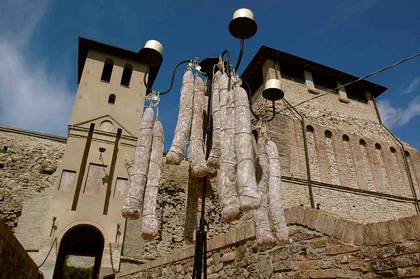 Cured meatsSalame FelinoSalame Felino IGP comes from a village of four thousand people in the hills above Parma.
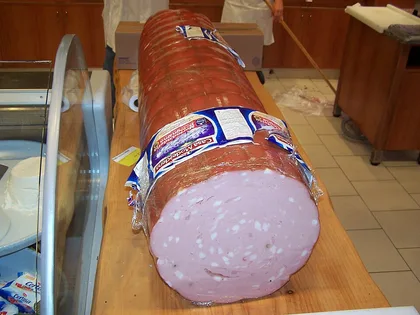 Cured meatsMortadellaThe white cubes are not just any fat: they are jowl, the firmest part of the pig, and they stay whole…
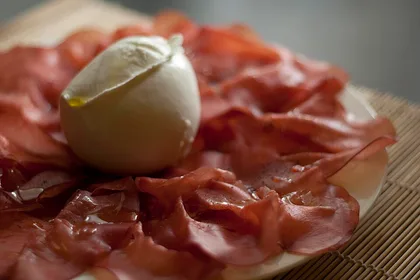 Cured meatsBresaolaOne lean muscle from the hind leg, dry-cured with salt, pepper, juniper and cinnamon, then left in the dry…Cured meatsPancettaPancetta is Italian cured pork belly: salt, pepper and warm spices, dried for months, never smoked.
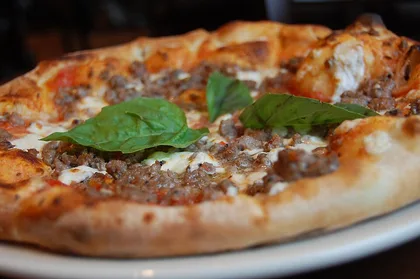 Cured meatsSalsicciaCoarsely ground pork, salt, pepper, wine and usually garlic, packed into natural hog casing and sold raw.Cured meatsSalame d'Oca di MortaraGoose salami from Mortara began in the Jewish communities of the Lombard rice plains as a cured sausage…
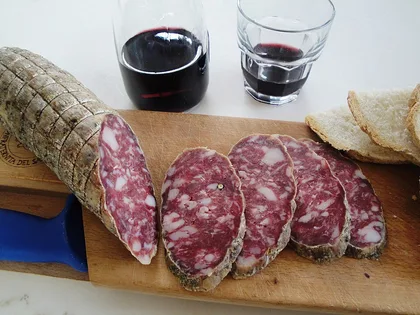 Cured meatsSalame di VarziSalame di Varzi is a DOP salami from the Staffora valley in Lombardy's Oltrepò Pavese.Cured meatsViolino di CapraViolino di capra is a goat leg cured like a ham in the natural rock cellars of Valchiavenna, in the Italian…