What is Violino di Capra?
Violino di capra della Valchiavenna is a whole goat leg, bone in, dry-cured with salt and warm spices and aged for two to four months in the cold cellars of northern Lombardy. Functionally it is a prosciutto: cured raw meat, sliced thin, eaten without cooking. The animal is simply a goat rather than a pig, which makes it one of the very few Italian dry-cured hams that is naturally pork-free.
The name is a description of a technique. The piece weighs one to two and a half kilos and tapers to a protruding shank bone that looks like the neck of an instrument. To carve it you rest the body on your shoulder, hold the shank in your left hand and draw a long flexible knife horizontally along the muscle with your right, the motion of a bow across strings. It is not marketing. It is the practical way to slice a small, awkwardly shaped leg without a machine, and it is still how it is done in the valley.
A ritual grew around the gesture. The violino travels round the table: whoever holds it cuts a slice, offers it to the person beside them, and passes it on. The host or the oldest person at the table starts, and anyone who has never played is shown how. Presidio Slow Food status since 2001 protects the breed, the origin of the meat and the minimal use of preservatives, and the total production runs to a few thousand pieces a year.
What does it taste like?
Lean, intense and noticeably spiced. The first impression is close to a very dry, very savoury prosciutto, then the goat arrives underneath, faintly wild and mineral, the way well-aged mutton or good venison is wild without being unpleasant.
What separates it from every Italian pork ham is the spice rack. Cinnamon, clove and nutmeg were traded over the Alpine passes and ended up in the cure, so a slice carries a warm, almost mulled-wine background that Parma or San Daniele simply do not have. Juniper and bay sit alongside them.
Texture is dry and firm, because this is a very lean animal, so there is almost no fat to melt on the tongue. Cut thick it is chewy and salty; cut correctly, meaning almost transparent, it is silky and the spices come forward. Salt level is high, higher than prosciutto, which is why it is eaten with bread and butter rather than on its own.
How to use it
Slice it by hand, as thin as you physically can, starting at the wide end and working towards the shank. A long flexible knife matters here more than with pork: goat muscle is fibrous and a short blade tears it. Keep the first, drier outer slices for cooking.
Eat it raw, at room temperature, with nothing on it. In Valchiavenna it is served with rye bread and mountain butter, sometimes with a piece of alpine cheese alongside. Dressing it with oil, lemon or rocket is regarded locally as an expensive way to waste it.
The outer slices earn their keep in the kitchen. Crisp them briefly and fold them into pizzoccheri in place of pancetta, melt them into a risotto with Valtellina Casera cheese, or lay them over a barley and vegetable soup. When the leg is finished, simmer the bone with vegetables for a stock with real character: it is the base of the rye soups made north of Chiavenna.
Do not pan-fry proper slices. With almost no fat to protect it, goat turns to leather in half a minute. Use heat only to soften, never to cook.
How long it keeps
A whole violino has no need of a fridge. Hung in a cool, dark, ventilated room between 10 and 14 °C it keeps for months, improving up to a point and then simply drying on from there. A fridge works too, wrapped in a cotton cloth. Once it has been started, the cut face needs protecting: a film of fat or butter smeared across it, or a sheet of greaseproof tied on with string, and never cling film in contact. Cut into regularly, an opened violino lasts six to eight weeks before the exposed face dries faster than you get through it.
A dry white bloom on the skin is part of the ageing and comes away with a cloth dipped in vinegar. Grease surfacing on the outside and an acrid smell both indicate that the storage temperature ran too high, and anything past that is a question for whoever cured it. Slices left over are eaten the same day: goat this lean, cut thin and left in the air, oxidises quickly and picks up a metallic edge within hours.
Spot the real thing
The shape gives it away: long and tapering towards the shank, the bone left in and showing, the string tie still on. A boned, squared-off piece can be very good but it is not a violino in the strict sense. Cut, the meat is dark red heading towards bordeaux with almost no fat, and the cut face should look compact and faintly moist rather than glassy. The smell is pungent, and it is meant to be, with the goat coming through filtered by the spices. Nothing on the nose means either a short cure or meat swapped for something more docile.
Read the label closely, because violino on its own identifies nothing. There are violini of chamois, venison, lamb and, increasingly and cheaply, sheep, while the Slow Food Presidium covers only Valchiavenna goat. What you want printed is the species alongside the commune of production. Press it: a good one gives a little under the thumb near the bone and stays firm at the centre, whereas hard all over means it dried too fast and the slices will come out woody.
How to pronounce Violino di Capra
vee-oh-LEE-noh dee KAH-prah
Six syllables in total. Violino is the ordinary Italian word for violin: 'vee-oh-LEE-noh', stress on the third syllable, not 'vy-oh-lee-no'. Capra is 'KAH-prah' with a short, clipped first 'a' and a rolled 'r'. The whole phrase simply means 'goat violin'.
Violino di Capra compared
vsMocetta
The two closest relatives in the Italian Alps, one valley apart in spirit. Both are lean, non-pork, herb-cured legs eaten raw with rye bread. Mocetta from Valle d'Aosta is boned into single muscles and cured with juniper, sage and rosemary for a resinous, forest profile; violino keeps the bone, the shape and the ritual, and is cured with warm trade spices (cinnamon, clove, nutmeg) for something rounder and more exotic.
| This | Mocetta | |
|---|---|---|
| Region | Valchiavenna, Lombardy | Valle d'Aosta |
| Animal | Goat, always in the protected version | Beef most often, goat sometimes |
| Cut | Whole leg, bone in | Single boned muscles |
| Cure | Salt, juniper, cinnamon, clove, nutmeg | Salt, juniper, sage, rosemary, garlic |
| Ageing | 60–120 days in natural rock cellars | 2–4 months in ventilated rooms |
| How it is served | Carved at the table, passed hand to hand | Pre-sliced on a board |
| Status | Presidio Slow Food since 2001 | PAT regional traditional product |
vsProsciutto crudo (Parma, San Daniele)
Same idea, different animal and a completely different balance. A pork prosciutto is sweet, fatty and gentle, cured with salt alone and aged twelve to thirty-six months. Violino is lean to the point of austerity, saltier, spiced, and aged for a fraction of the time because there is far less mass and almost no fat to protect it. If you like prosciutto for its melting fat, violino will surprise you; if you like it for its concentration, you will get on immediately.
| This | Prosciutto crudo (Parma, San Daniele) | |
|---|---|---|
| Animal | Goat | Pig |
| Fat | Minimal, no fat cap | Substantial, essential to the texture |
| Cure | Salt plus juniper, bay and warm spices | Salt only, by regulation |
| Ageing | 2–4 months | 12–36 months |
| Flavour | Savoury, spiced, faintly wild | Sweet, nutty, mellow |
| Weight of a whole piece | 1–2.5 kg | 7–10 kg |
| Suitable without pork | Yes | No |
vsFenalår and other cured leg of lamb
Norway's fenalår, a salted and sometimes smoked air-dried leg of lamb, is the closest thing most northern Europeans have already eaten. Both are small legs from a lean grazing animal, cured whole and carved at the table. Fenalår is often lightly smoked and leans on salt and juniper; the Valchiavenna violino is never smoked and carries the sweet-spice signature instead.
| This | Fenalår and other cured leg of lamb | |
|---|---|---|
| Animal | Goat | Lamb or mutton |
| Smoke | None in the traditional version | Common, though not universal |
| Spicing | Cinnamon, clove, nutmeg, juniper, bay | Salt, juniper, sometimes sugar |
| Ageing environment | Natural rock cellars at about 8 °C | Cold sheds and drying lofts |
| Served | Paper-thin, with rye bread and butter | Thicker slices, with flatbread and sour cream |
Violino di Capra substitutes
- Mocetta from Valle d'Aosta
The nearest Italian equivalent and the one to reach for first. Leaner in appearance but similar in salt and drying, and also pork-free. It lacks the sweet spice, so add a pinch of ground cinnamon and a crushed clove to the plate if you want to close the gap.
1:1 - Bresaola della Valtellina
From the neighbouring valley, so the mountain logic is identical, but it is beef and considerably milder. Widely available and inexpensive by comparison. Expect a cleaner, sweeter, less wild slice.
1:1 - Fenalår (Norwegian cured lamb leg)
Structurally the closest non-Italian option: a small cured leg from a lean grazing animal, carved by hand. Choose an unsmoked one if you can find it. Easy to source across Scandinavia and in Nordic delis in the UK.
1:1 - Cecina de León
Spanish IGP cured beef from the hind leg, lightly smoked and deeply savoury. Not goat, but it matches the salt level and the dryness better than prosciutto does, and it is far easier to buy in the US and UK.
1:1 - Goat or lamb prosciutto from artisan producers
A handful of American and British charcuterie makers cure goat and mutton legs the same way, usually sold as 'goat prosciutto' or 'cured mutton'. Quality varies more than with the Italian original, so buy from someone who will let you taste first.
1:1 - Vegetarian: spiced cured celeriac
No plant reproduces cured goat, but salt-cured celeriac gets the register right. Salt whole celeriac with juniper, bay, cinnamon and clove for 24 hours, rinse, roast slowly wrapped in foil, chill and slice thin. Dry, savoury, warm-spiced, and it takes the same bread and butter.
Where to buy it
In Italy, buy it in Chiavenna or from the producers along the valley floor at Gordona, Samolaco and Mese, or up the Valle Spluga at Campodolcino. Look for the Presidio Slow Food mark and a declared species, because 'violino' on its own is not a guarantee, since sheep, chamois and deer versions all exist and sheep is much cheaper.
Outside Italy it is close to unobtainable. When it does reach the United States through specialist importers it costs 45 to 60 dollars per pound; in the UK, 70 to 95 pounds per kilo. Several Valchiavenna producers ship within the EU, which is the realistic route for European buyers.
Buy the whole bone-in leg if the ritual is any part of the appeal, and a vacuum-packed boned half only if it is not. Pre-sliced packs push the price per kilo past 120 euro and lose the aromatics within days of opening.
Where to eat it in Italy
Chiavenna, an hour and a half north of Milan and twenty minutes from the Swiss border, is the place. The crotti around the town are public eating houses built into natural rock cavities where a constant draught called the sorel keeps the air at about eight degrees year round, the same cellars where the violino ages. Nearly all of them serve it on a board with local brisaola and cheese.
The Sagra dei crotti in September opens private cellars as well and turns the town into a continuous tasting route. Upvalley, Campodolcino and Madesimo in the Valle Spluga, and Piuro and Villa di Chiavenna towards Switzerland, all serve it in mountain inns and refuges.
Ask to carve it yourself. In a valley osteria that is not an odd request: it is what they are waiting for you to do.
Further reading
Frequently asked questions
Why is it called a violin?
Because of how it is carved. You rest the leg on your shoulder, hold the shank bone in your left hand like the neck of a violin, and draw a long knife horizontally across the meat like a bow. The name describes the gesture, not the shape.
What does violino di capra taste like?
Like a very lean, very savoury prosciutto with a wild edge and a warm spice background. Cinnamon, clove, nutmeg and juniper come from the cure; the faint gaminess comes from the goat. It is saltier and drier than pork ham, so it is served with bread and butter.
Is violino di capra pork-free?
Yes. It is made from goat, and it is one of the very few Italian dry-cured hams suitable for people who avoid pork. Check the label anyway, since cheaper 'violini' made from sheep exist and some producers cure other meats in the same style.
Is it smoked?
The traditional Valchiavenna version is not. It air-dries for two to four months in crotti, the natural rock cellars ventilated by a constant cold draught. A few producers in nearby valleys smoke lightly, but that falls outside the Slow Food Presidium.
How do you pronounce violino di capra?
vee-oh-LEE-noh dee KAH-prah. It is the ordinary Italian word for violin followed by 'of goat', with the stress on the third syllable of violino and the first of capra.
Related foods
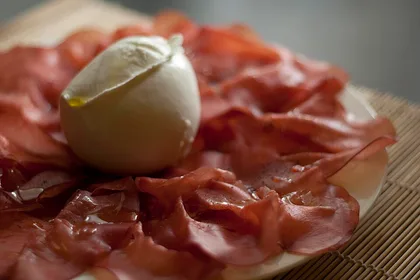 Cured meatsBresaolaOne lean muscle from the hind leg, dry-cured with salt, pepper, juniper and cinnamon, then left in the dry…
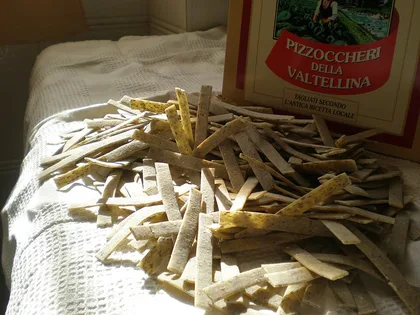 Pasta and breadPizzoccheriBuckwheat rather than wheat, which is where the dark colour and the nutty taste come from.
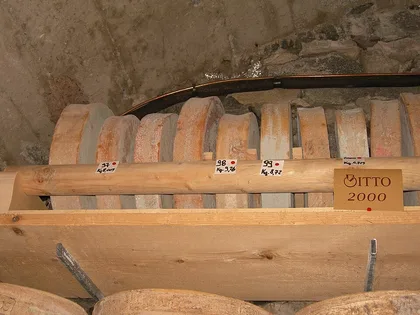 CheeseBittoBitto DOP can only be made between 1 June and 30 September, on high summer pasture, in a dismantlable stone…Cured meatsPancettaPancetta is Italian cured pork belly: salt, pepper and warm spices, dried for months, never smoked.
 Cured meatsSalsicciaCoarsely ground pork, salt, pepper, wine and usually garlic, packed into natural hog casing and sold raw.Cured meatsSalame MilanoSalame Milano is the salami most of the world pictures when it hears the word: large diameter, mild, evenly…Cured meatsSalame d'Oca di MortaraGoose salami from Mortara began in the Jewish communities of the Lombard rice plains as a cured sausage…
 Cured meatsSalame di VarziSalame di Varzi is a DOP salami from the Staffora valley in Lombardy's Oltrepò Pavese.