What is Salsiccia?
Salsiccia is fresh, uncured pork sausage. The classic ratio is 70% lean meat (shoulder, leg, and the trim from other cuts) to 30% fat, taken from belly and jowl. That number matters: below about 25% fat the sausage cooks out dry and mealy, because nothing is keeping the meat moist as the proteins tighten.
The base seasoning is short and fairly constant the length of the country: salt at roughly 18 to 22 grams per kilo of meat, black pepper, white or red wine, and usually garlic. Everything else is regional. Wild fennel or fennel seed in Tuscany and much of the south, chilli in Calabria and Basilicata, anise seed in some southern versions, a heavy hand with garlic in Norcia. In the north, fennel is almost entirely absent, which is the single biggest surprise for anyone whose reference point is an American supermarket.
It is stuffed into natural hog casing, 28 to 34 mm across. There is no rusk, no breadcrumb, no starch and no water added, which is what separates it from a British banger. And it is raw meat: fresh salsiccia is ground pork in a tube and has to be cooked through. Salsiccia secca, the dried and aged version you slice onto a board, is a different product entirely.
What does it taste like?
Straightforwardly porky, salty and peppery, with a sour-sweet lift from the wine and a garlic note underneath. There is no smoke, no sugar and no maple: nothing in a good salsiccia is trying to be sweet. The grind is coarse enough that you chew distinct pieces of meat rather than a smooth paste, and the fat gives it a juicy, slightly slippery bite.
Cooked slowly, the casing tightens and browns while the inside stays soft and releases its own fat. Grilled over embers it picks up a bit of char that plays well against the pepper. Crumbled into a sauce it dissolves into something meatier and rounder than plain ground pork, because the salt and wine have already done their work.
Compared with what you may know: a bratwurst is milder, finer and tastes of nutmeg and marjoram; a British sausage is softer and bulked with rusk; an American Italian sausage tastes first and foremost of fennel. Salsiccia from Lombardy tastes of pork, pepper and wine and very little else. A Calabrian one will take the roof of your mouth off.
How to use it
Do not prick it. This is the one instruction that matters and the one most recipes get wrong. Piercing the casing lets out the fat that keeps the meat moist and leaves you with dry crumbs inside an empty skin. Casings only burst when the heat is too high.
For the pan: start in a cold, dry pan or one with the barest film of oil, over medium-low heat, with a finger's depth of water or white wine in the bottom. The sausage steams first, then browns in its own rendered fat once the liquid has gone. Twenty to twenty-five minutes in total, turned two or three times, to an internal temperature of 71-75C, which is 160-167F. Ground pork needs to be cooked through: there is no medium-rare salsiccia.
For the grill: never directly over flame. Cook it to the side of the heat or over embers that have calmed down, or you will get a black skin over a raw centre.
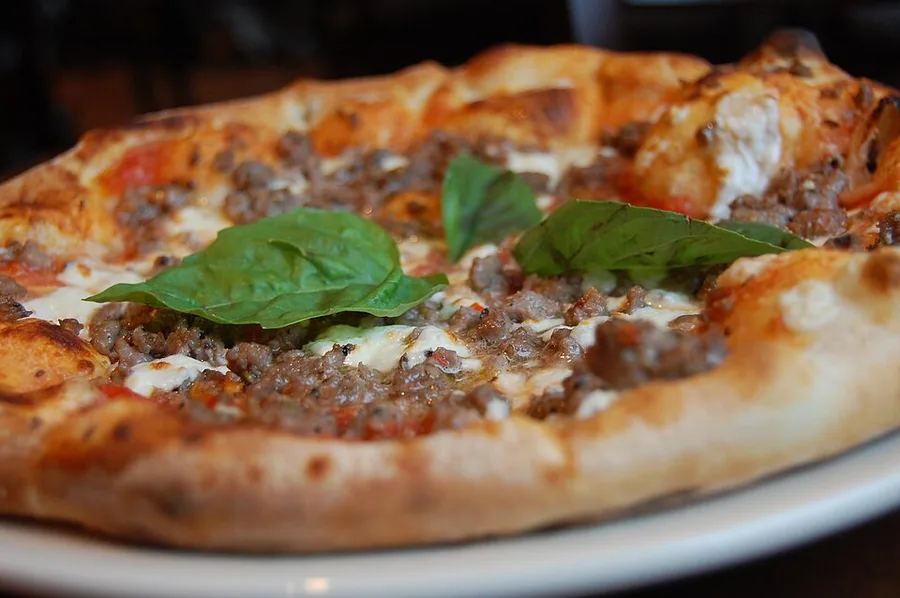
Crumbled, with the casing stripped off, it becomes a different ingredient: browned and deglazed with wine, it is the base of a white ragu, of orecchiette with broccoli rabe, of a pizza topping, and of risotto alla monzese with saffron. The classic whole-sausage dishes are worth knowing too: salsiccia e friarielli in Naples with bitter greens, garlic and chilli; sausages braised with cannellini beans, tomato and sage in Tuscany; polenta and luganega across the north; sausage with Castelluccio lentils in Umbria.
How long it keeps
Fresh salsiccia is minced meat and behaves like it: two to three days in the coldest part of the fridge at zero to four degrees, and on a vacuum pack the printed date, usually seven to ten days out, is the reference. Keep it on a covered plate rather than tight in cling film, so moisture does not sit against the casing. Left in open air the surface darkens as the pigment oxidises, and the casing dries and tightens around the filling.
It freezes, but not for long. Pork fat oxidises even at minus eighteen degrees, and past two or three months the flavour turns. Wrap single portions individually and thaw overnight in the fridge. Thawing releases water the fibres no longer hold, so a second freeze leaves the mixture looser and drier. Cooked, it holds two days and comes back best in a pan. Dried salsiccia follows its own rules: hung in a cool ventilated room at 12 to 15 °C it keeps for months, while a fridge hardens it and vacuum packing removes the airflow the drying depends on.
Spot the real thing
Colour says most of it. A fresh salsiccia is bright pink-red, not dark red and not grey at the edges, and a deep, perfectly even red usually means nitrites were added to fix it. The fat should read as distinct white granules through the meat rather than smeared into it: filling that looks like a pink cream was worked warm or ground twice. Natural casing is thin, matte, slightly uneven in calibre and clings to the meat; collagen casing is perfectly cylindrical and chews rubbery.
At an American counter the neighbour is Italian sausage, loaded with fennel and anise and often sweetened. In Britain it sits beside bangers, which carry rusk and turn springy and pale. A short ingredient list is the good one: pork, salt, spices, wine. Rusk, starch, milk protein, dextrose and generic flavourings are there to hold water, and E250 and E252 are sodium nitrite and nitrate. A butcher who mixes his own can tell you the fat percentage, and the answer is around thirty.
How to pronounce Salsiccia
sahl-SEE-chah
Three syllables, stress on the second. The double 'cc' before an 'i' is a soft 'ch' as in 'cheese', and the 'i' itself is swallowed: it is there to soften the c, not to be pronounced. The two usual English mistakes are 'sal-SICK-ee-a', which hardens the c, and 'sal-see-CHEE-a', which puts the stress in the wrong place and adds a syllable. The plural is salsicce, 'sahl-SEE-cheh': the final e is pronounced. The Lombard variety, luganega, is 'loo-GAH-neh-gah', stress on the second syllable.
Salsiccia compared
vsAmerican Italian sausage
They share a name and very little else. American Italian sausage is a fixed recipe: fennel seed, a finer grind, a sweet or hot version, often a little sugar, sold in a fatter casing. Italian salsiccia has no fixed recipe at all: it changes region by region, and in the north it usually contains no fennel whatsoever.
| This | American Italian sausage | |
|---|---|---|
| Fennel | Only in Tuscany and much of the south; absent in Lombardy, Emilia, Veneto | Almost always: it is the defining flavour |
| Grind | Medium to coarse, 4-8 mm; the best is cut by knife | Fine and uniform, machine-ground |
| Sugar | None | Often dextrose or corn syrup solids |
| Wine | White or red, worked into the mix | Rarely, and usually as flavouring |
| Casing | Natural hog, 28-34 mm | Natural or collagen, typically 32-38 mm |
| Sweet vs hot | Not a category: regional recipes vary continuously | The two standard supermarket options |
| Typical use | Grilled whole, braised with wine, crumbled into ragu, with beans or polenta | Sausage and peppers, pizza topping, pasta sauce |
vsSalsiccia di Norcia (Umbria)
Two of Italy's best-known regional sausages, and a good illustration of how far the word stretches. The column on this side is the Lombard luganega and its short cousin the salamella; the other is the Umbrian salsiccia di Norcia, from the town whose butchers gave Italian the word norcino for a pork butcher.
| This | Salsiccia di Norcia (Umbria) | |
|---|---|---|
| Where | Lombardy: Monza, Brianza, Mantua, and on into the Veneto | Umbria: Norcia and the Valnerina |
| Shape | One continuous unlinked coil, sold by the metre | Short tied links |
| Grind | Medium machine grind | Often cut by knife, so you see the pieces |
| Seasoning | Salt, pepper, wine; grana and broth in some Monza recipes | Salt, pepper, heavy garlic, wine |
| Fennel or chilli | No | No: garlic is the signature instead |
| Signature dish | Risotto alla monzese, with saffron and crumbled luganega | Grilled, or with Castelluccio lentils |
| Also sold | Fresh only | Fresh and air-dried as salsiccia secca |
vsSalsiccia secca (dried and cured)
The same mixture, taken down two very different roads. Fresh salsiccia is raw meat that must be cooked; salsiccia secca has hung for weeks, lost a third of its weight and become a salume you slice thin and eat as it is. Buying one when you wanted the other is a common and expensive mistake.
| This | Salsiccia secca (dried and cured) | |
|---|---|---|
| State | Raw: must be cooked through | Air-dried 3-8 weeks, eaten raw |
| Weight loss | None | 30-40% of its starting weight |
| Casing | Plump, soft, smooth | Shrunken and wrinkled, tight to the meat |
| Curing salts | Not needed in an artisan version | Nitrate or nitrite is standard and necessary |
| Keeps | 2-3 days refrigerated | Months hanging at 12-15C |
| Eaten | Grilled, braised, crumbled into sauce | Sliced on a board with bread and cheese |
| Regional examples | Luganega, salamella, salsiccia di Norcia | Salsiccia secca calabrese, salsiccia sarda, Umbrian stagionata |
Salsiccia substitutes
- Sweet Italian sausage with the fennel left out
The easiest swap in the US if you have a butcher who grinds in-house: just ask. From a packet, split the casings, pick out the visible fennel seed and add a splash of dry white wine to the pan; you will not remove all of it, but you will get close enough for a ragu.
1:1 by weight - Fresh bratwurst, fat drained off
Structurally right and widely available. It is finer, milder and seasoned with nutmeg, mace and marjoram, so brown it gently, pour off the rendered fat before anything else goes in the pan, and steer it with a crushed garlic clove and a spoonful of white wine.
1:1 - Homemade, from ground pork
The best substitute outside Italy, and it needs no casing for any crumbled use. Per kilo: 700 g pork shoulder and 300 g belly or fatback, ground coarse; 18-20 g fine salt; 3 g coarsely ground black pepper; one or two crushed garlic cloves; 40-50 ml dry white wine. Mix cold, rest it covered in the fridge overnight so the salt can work, then use it loose or stuff it.
1 kg of meat replaces 1 kg of sausage - Turkey or chicken sausage
A workable lean option that behaves differently. At 8-12% fat it dries out fast, so cook it lower and shorter, and add a tablespoon of olive oil per 500 g to make up some of the missing richness. Fine in a tomato sauce, disappointing on a grill.
1:1, plus 1 tbsp olive oil per 500 g - Fresh Mexican chorizo
Right texture, right fat, wrong flavour: the pimenton and dried chilli dominate everything they touch. It works in beans, lentils and a rustic ragu, and it is completely wrong for risotto alla monzese or anything delicate. It is also usually saltier, so hold back the salt elsewhere.
1:1, but expect a different dish - Vegetarian: lentil or mushroom sausage plus fennel seed
Nothing reproduces cured pork fat, but a firm lentil or mushroom sausage crumbled and fried hard in olive oil gets the texture. Toast a teaspoon of fennel seed and a sliced garlic clove in the oil first, deglaze with white wine, and you have the aromatic frame of a southern salsiccia.
Where to buy it
In the US the best route is an Italian butcher or an Italian market, where you can ask for a coarse grind and no fennel, and most will make it that way on request. Eataly and Italian delis in most large cities carry it, and specialist online butchers ship frozen. Supermarket Italian sausage runs about $5-8 per pound; a proper butcher's is $9-15.
In the UK, Italian delicatessens and shops such as Lina Stores carry Italian-style fresh sausage, and several supermarkets sell a 'Sicilian style' version with fennel. Expect £7-11 per kilo for the industrial versions and £12-18 in a deli. Read the label for rusk or breadcrumb: British sausage law permits it, Italian salsiccia contains none, and its presence tells you immediately what you have bought.
Whatever you buy, look for distinct white grains of fat rather than a smooth pink paste, a bright pink-red colour rather than a deep uniform red, and a short ingredient list: pork, salt, spices, wine. Nitrite (E250) is legal but unnecessary in fresh sausage. And check whether you are picking up fresh or dried: salsiccia secca is wrinkled, firm and meant to be sliced raw.
Where to eat it in Italy
Monza and the Brianza, north of Milan, for risotto alla monzese, saffron risotto with crumbled luganega, still on the menu in the older trattorie. Milan itself in winter for cassoeula, the cabbage and pork stew that uses small sausages called verzini. Around Mantua, the summer village festivals run on salamella grilled over coals and eaten in a bread roll with a glass of Lambrusco.
Norcia, in the Umbrian mountains, is the pilgrimage. Its pork butchers gave Italian the word norcino, the shops open straight onto the main square, and they sell fresh and dried sausage from the same counter. Late February brings Nero Norcia, the black truffle fair, when the whole town is essentially a pork and truffle market. Castelluccio, on the plateau above, grows the lentils that go with it.
Naples for salsiccia e friarielli, which you will find in neighbourhood rosticcerie, in pizzerias as a topping and inside a panuozzo. And anywhere at all between June and September: the Italian sagra circuit runs on grilled sausage, and there are hundreds of them.
Further reading
Frequently asked questions
Should you prick Italian sausage before cooking?
No. Pricking releases the fat that keeps the meat moist and leaves you with a dry sausage in a slack skin. Casings split only when the heat is too high, so cook over medium-low heat with a little water or wine in the pan and leave the skin alone.
How long does salsiccia take to cook?
About twenty to twenty-five minutes in a pan over medium-low heat, turned two or three times, or roughly the same on a grill set to the side of the coals. It is fresh ground pork, so cook it through to 71-75C (160-167F) at the centre, with no pink.
Can you eat salsiccia raw?
Fresh salsiccia, no. It is raw ground pork and needs to be fully cooked, exactly like any other ground pork. Dried and aged sausage, salsiccia secca, is a different product designed to be eaten as it is, and one regional oddity, the veal salsiccia di Bra in Piedmont, is traditionally eaten raw under an old exemption.
Is salsiccia the same as Italian sausage?
Not really. American Italian sausage is a specific recipe built around fennel seed, ground fine and sold as sweet or hot. Italian salsiccia has no single recipe: garlic, pepper and wine are the constants, fennel appears mainly in Tuscany and the south, and northern versions rarely contain it at all.
Can you freeze fresh Italian sausage?
Yes, for two to three months. Pork fat goes rancid even at freezer temperatures, so beyond that the flavour turns. Freeze it in single portions, wrapped individually, thaw it overnight in the fridge rather than on the counter, and do not refreeze it once thawed.
Related foods
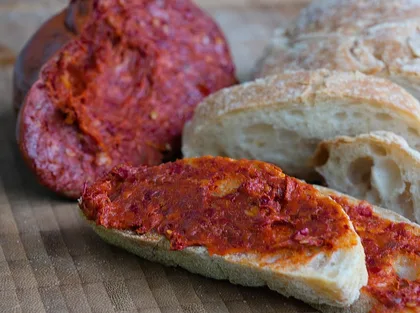 Cured meats'Nduja'Nduja is a soft, spreadable Calabrian pork salume that is up to 40% chilli.
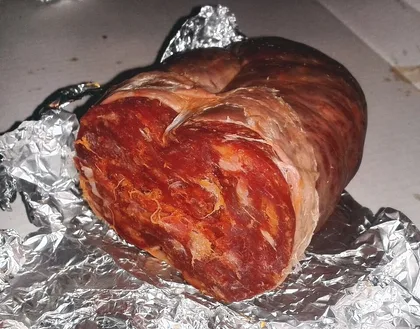 Cured meatsSoppressataSoppressata is a coarse-ground dry salami from southern Italy, pressed flat between boards while it dries…
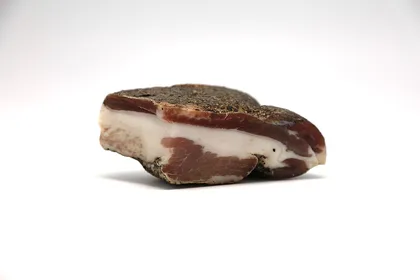 Cured meatsGuancialeGuanciale is cured pork jowl: unsmoked, rubbed with salt and pepper, aged for one to three months.Cured meatsPancettaPancetta is Italian cured pork belly: salt, pepper and warm spices, dried for months, never smoked.
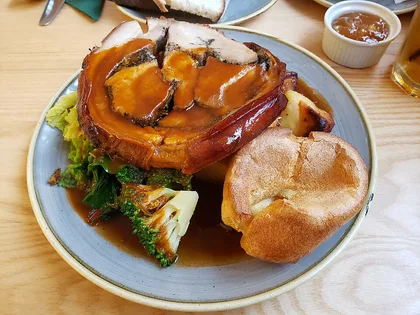 Cured meatsPorchettaSix to eight hours in a wood oven to reach two opposite textures in one piece of meat: skin that shatters…
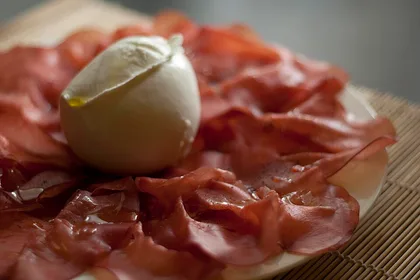 Cured meatsBresaolaOne lean muscle from the hind leg, dry-cured with salt, pepper, juniper and cinnamon, then left in the dry…Cured meatsSalame MilanoSalame Milano is the salami most of the world pictures when it hears the word: large diameter, mild, evenly…
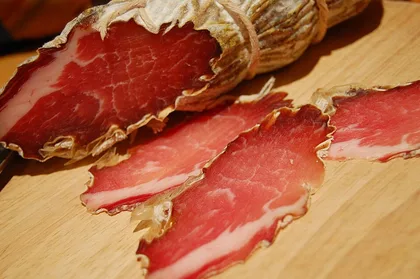 Cured meatsLonzinoLonzino is whole pork loin, dry-salted and air-cured for two to four months: the leanest cut on the animal…