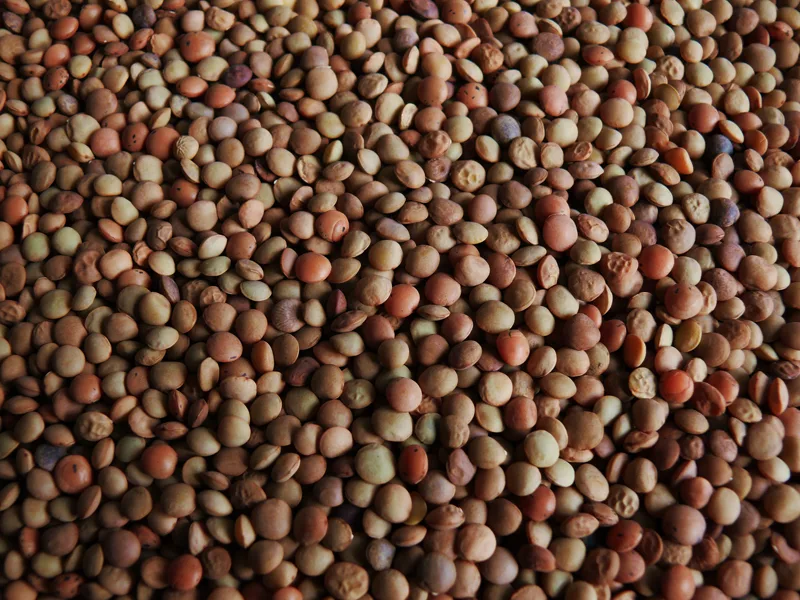
What is Castelluccio Lentils?
Lenticchia di Castelluccio di Norcia is a protected geographical indication, granted in 1997, covering lentils grown on the high plateaus around the hamlet of Castelluccio, part of the commune of Norcia in Umbria: the Pian Grande, the Pian Piccolo and the Pian Perduto.
It is a local ecotype rather than a commercial variety. The seed is very small, two to six millimetres across and mostly under four, and the colour is deliberately inconsistent. A single handful contains pale green, olive, hazel and mottled seeds, and that variegation is part of the specification, not a sorting failure.
The real distinction is the seed coat. It is fine enough to be almost imperceptible between the teeth, and that has two consequences that explain how these lentils are used: they need no soaking, and they hold their shape in the pot. Anyone who has cooked supermarket lentils knows both problems. Here they do not exist.
The cause is altitude. At 1,300 to 1,500 metres the season is compressed, the seed stays small, and the ratio of surface to volume leaves the skin proportionally thinner. Nothing is done to the lentil to achieve this: it is height, cold and a short summer.
What does it taste like?
Earthy but clean, with a mineral edge and a nutty finish, and far less of the muddy heaviness people associate with lentils. The flavour is concentrated rather than loud, and it does not need rescuing with bacon or tomato.
Texture is where they win. Properly cooked they stay whole, and the skin gives way without any of the papery resistance of a brown supermarket lentil, while the inside is creamy. Eaten warm with raw olive oil poured over and a grinding of black pepper, they need nothing else. In a soup they stay lentils; in a salad they behave; under a piece of fish they keep their bite.
How to use it
Do not soak them. This is the one instruction that overrides everything you have read about lentils: the skin is fine enough that soaking splits it and turns the whole batch to mush. Rinse, check quickly for the occasional stone that escaped hand-sorting, and put them straight in the pan.
Start in cold water, roughly three times their volume, with a peeled garlic clove, a bay leaf, a celery stalk and half an onion. Bring to a gentle simmer and cook 20 to 30 minutes depending on how recent the harvest is. Fresh-crop lentils are done under 25 minutes; two-year-old ones take longer.
Salt goes in at the end, in the last five minutes, and so does anything acidic. Tomato or vinegar added early will toughen the skins and add twenty minutes to the cooking.
The classic pairing is with Norcia sausage or cotechino on New Year's Eve, where the round lentils stand in for coins. But the dish that shows them off best is the plainest: cooked with a few aromatics, served warm with raw extra virgin olive oil and black pepper. No sofrito, no tomato. They also work in a farro soup over garlic-rubbed toast, warm in a salad with red onion and vinegar, or under river trout. Keep the cooking water: it is stock.
How long it keeps
In a closed glass jar, dark and dry, they hold about two years. The date is not really the point: as they age they lose water, the skins toughen, and the cooking time stretches. Lentils from the latest harvest cook in twenty minutes, while the same lentils two years on can ask for forty. That is the argument for small packets and for looking at the harvest year where a producer prints it, which tells you more than a best before date does. Keep them out of the fridge, because damp is the thing that starts mould in dried pulses, and a cool cupboard shelf is enough.
If the kitchen gets very hot in summer, two days in the freezer at minus eighteen is the standard way to deal with bean weevil eggs, after which they go back to the cupboard completely dry. Cooked lentils keep three or four days in the fridge sitting in their own liquid, and freeze in portions for about three months. They are better on the second day than the first: resting lets them absorb the seasoning, and the texture firms slightly as the skins take up liquid.
Spot the real thing
Size first: under four or five millimetres and noticeably flat. A lentil the size of a fingernail did not come from Castelluccio. Then colour, which should not be uniform. A bag where every seed is the same shade of green has been sorted industrially; a mountain ecotype mixes pale green, olive, hazel and mottled seeds in the same handful. Then the label. The rules require sealed packs carrying the European IGP logo, the full name Lenticchia di Castelluccio di Norcia, the consortium reference and a lot number, so loose lentils from an open sack cannot be IGP by construction.
Abroad the nearest neighbour is the French lentille verte du Puy, small, mottled, AOP protected, and a genuinely good substitute. Generic green or brown lentils from Canada or Turkey are the ones sold under borrowed place names. Price is the plainest test: real ones run around $12 to $20 for 500 g, and the cheap sacks at a roadside stall are something else. The last check happens in the pot, where after twenty five minutes they should still be whole, skins intact and centres creamy.
How to pronounce Castelluccio Lentils
len-TEEK-kyeh dee kah-stel-LOOT-choh
Lenticchie has four syllables with a hard 'k' sound in the middle: len-TEEK-kyeh, and the final 'e' is pronounced. In Castelluccio the double 'cc' before 'i' is a soft 'ch' as in 'church', held slightly long: kah-stel-LOOT-choh. Norcia is NOR-chah, two syllables, not 'nor-SEE-ah'.
Castelluccio Lentils compared
vsStandard brown or green lentils
The everyday lentil sold in every supermarket, usually Canadian, Turkish or Indian, grown on irrigated flat land, bred for yield and uniformity. It is a perfectly good ingredient and about a fifth of the price. The differences that matter in a kitchen are the soaking and the collapse.
| This | Standard brown or green lentils | |
|---|---|---|
| Seed size | 2-6 mm, mostly under 4 | 5-8 mm |
| Skin | Very fine, almost imperceptible | Thicker, papery |
| Soaking | Never: it ruins them | Often recommended, 2-4 hours |
| Cooking time | 20-30 minutes from cold | 35-50 minutes |
| Holds shape | Yes, reliably | Tends to break down |
| Colour | Mixed green, olive, hazel, mottled | Uniform by grade |
| Price | 15-25 euro per kilo | 2-4 euro per kilo |
vsBeluga lentils
Black beluga lentils are the other lentil famous for holding its shape, and the comparison is fair. Beluga is a modern cultivar, mostly North American, glossy and near-spherical; Castelluccio is an old mountain ecotype, matte and flattened. Beluga looks more striking on a plate and tastes less complex.
| This | Beluga lentils | |
|---|---|---|
| Origin | Umbrian plateaus, ecotype | Canada and US, modern cultivar |
| Colour | Mottled green to hazel, matte | Uniform glossy black |
| Shape | Small and flattened | Round, like caviar |
| Soaking | None | None needed either |
| Cooking time | 20-30 minutes | 20-25 minutes |
| Flavour | Earthy, mineral, nutty | Milder, slightly sweet |
| Price | Higher | Moderate, widely stocked |
vsLentilles vertes du Puy AOP
The closest relative anywhere outside Italy, and the substitute to reach for first. Both are small, thin-skinned, grown on poor volcanic or karst soil at altitude, and both stay whole. Puy is more peppery and slightly firmer; Castelluccio is creamier inside and more variegated in colour.
| This | Lentilles vertes du Puy AOP | |
|---|---|---|
| Where | Pian Grande, 1,300-1,500 m | Velay plateau, Auvergne, ~700-1,000 m |
| Colour | Green to hazel, mixed | Slate green with blue marbling |
| Skin | Very fine | Fine |
| Texture cooked | Creamy inside, intact | Firmer, more al dente |
| Flavour | Earthy and mineral | Peppery, distinctly mineral |
| Protection | IGP since 1997 | AOC 1996, AOP 2008 |
Castelluccio Lentils substitutes
- Lentilles vertes du Puy AOP
The best substitute by a distance. Same size, same behaviour in the pot, same refusal to disintegrate. Slightly peppery, so go easier on the black pepper at the end.
1:1, same cooking time - Beluga (black) lentils
Holds shape just as well and is easy to buy everywhere. Milder and sweeter, and the black colour bleeds into pale sauces, so keep it for dishes where dark looks intentional.
1:1, add 2-3 minutes - Other Italian mountain lentils
Colfiorito, Onano, Santo Stefano di Sessanio, Ustica and Villalba are small thin-skinned ecotypes that behave nearly identically; Sessanio is the smallest and fastest.
1:1, check at 18 minutes - Pardina lentils (Spain)
Small, brown, thin-skinned and cheap: the best value stand-in. Slightly softer when done, so pull them off two minutes early.
1:1 - Standard brown lentils
Workable but not equivalent: expect a longer cook and a proportion that breaks down. Skip the soaking, salt only at the end.
1:1, allow 40 minutes - Red split lentils
Not a substitute where shape matters: no skin, and they dissolve completely. Keep them for purées and dal.
Not recommended for whole-lentil dishes
Where to buy it
In the US, Italian specialists such as Gustiamo, Eataly and Market Hall Foods carry the certified product, and it turns up in better cheese shops and delis. In the UK, Italian delicatessens and online grocers stock it, usually in 400 or 500 gram packs.
Expect 12 to 20 dollars per pound in the US and 22 to 35 pounds per kilo in the UK. In Italy at source it is 12 to 18 euro per kilo, rising to 18-25 in specialist shops.
Check three things on the pack: the full wording Lenticchia di Castelluccio di Norcia IGP with the EU mark; a lot number, since the specification requires sealed packaging; and the lentils themselves through the window (small, flattened, visibly mixed in colour). A uniformly green, uniformly sized lentil has been graded industrially.
Price is the most reliable test. Certified output is a few hundred tonnes a year for the entire world market, so anything cheap under this name is something else. Loose lentils at Apennine roadside stalls least of all.
Where to eat it in Italy
Castelluccio di Norcia and the Pian Grande, with one honest caveat: the hamlet was destroyed by the earthquake of 30 October 2016 and rebuilding is still under way. You will eat in temporary structures and in farms down on the plain, not in an intact village. The plateau itself is undamaged and the drive in, down from Forca di Presta or up from Norcia, is reason enough to go.
The flowering, between late June and mid-July, is the spectacular window and also the crowded one. On peak weekends access to the plateau is managed with shuttle buses and traffic restrictions, so check before setting off.
Norcia, twenty-five kilometres below, is the practical base. Lentils there are eaten with the town's celebrated pork butchery, with black truffle, and in soups, and the old shops in the centre sell them loose and packed. The Valnerina valley beyond (Preci, Cascia, Sant'Anatolia di Narco) rounds out the trip.
Late August, just after the harvest, brings the village lentil festival: the most direct way to taste them cooked the way people here actually cook them.
Further reading
Frequently asked questions
Do Castelluccio lentils need soaking?
No, and this is the point of them. The seed coat is so fine that soaking breaks it and reduces the batch to purée. Rinse them, put them in cold water, bring to a gentle simmer, and they are done in 20 to 30 minutes with every lentil still whole.
When are they sown and harvested?
Sowing runs from late March to early May, as soon as snow clears the plateaus. Flowering is June into the first days of July, and harvest falls between the end of July and the first ten days of August. Everything after that is cleaning and hand-sorting.
Why are they so expensive?
Yields are 800 to 1,200 kilos per hectare against 2,500 to 3,000 for irrigated lowland lentils, the final sorting is done by hand, and the whole protected area is under a thousand hectares.
How do I know they are genuine?
Small flattened seeds under five millimetres, visibly mixed in colour, in sealed packaging bearing the full name Lenticchia di Castelluccio di Norcia IGP, the EU mark and a lot number. And the price: under about 10 euro a kilo, roughly 6 dollars a pound, they cannot be.
How much do I need per person?
Eighty grams dry, about three ounces, makes a generous side or a bowl of soup, and they roughly double in weight cooked. A 500 gram pack feeds six, which puts the cost per serving far below what the price per kilo suggests.
Sources
Where to check what you just read.
- 1
Il regolamento del 12 giugno 1997 che registra «Lenticchia di Castelluccio di Norcia» come IGP, nello stesso allegato del Prosciutto di Norcia.
- 2
La misura che spiega perché sono così piccole (mille semi pesano circa 23 grammi) e la delimitazione della zona: i piani di Castelluccio a 1400 metri, fra Norcia e Castel Sant'Angelo sul Nera.
Related foods
 Vegetables and fruitGarfagnana FarroFarro della Garfagnana IGP is emmer wheat, Triticum dicoccum: the grain the Romans called far, still sown in…
 Vegetables and fruitLamon BeansLamon beans are mountain-grown borlotti with a skin so thin it disappears in the mouth and flesh that turns…Vegetables and fruitCicerchia (Grass Pea)The grass pea is the oldest and most awkward legume in Italy.Vegetables and fruitTrevi Black CeleryTrevi black celery is not black: it is a dark, almost blue-green.
 Cured meatsGuancialeGuanciale is cured pork jowl: unsmoked, rubbed with salt and pepper, aged for one to three months.
 Cured meatsPorchettaSix to eight hours in a wood oven to reach two opposite textures in one piece of meat: skin that shatters…
 Cured meatsSalsicciaCoarsely ground pork, salt, pepper, wine and usually garlic, packed into natural hog casing and sold raw.
 Cured meatsLonzinoLonzino is whole pork loin, dry-salted and air-cured for two to four months: the leanest cut on the animal…