What is Trevi Black Celery?
Sedano nero di Trevi is a local landrace of Apium graveolens grown exclusively on the plain at the foot of Trevi, a hill town in the province of Perugia, Umbria. It is a Slow Food Presidium and a recognised traditional product of the region.
The name misleads, so deal with it first. The plant is not black. The upper stalks and leaves are a very dark green with a bluish cast; the base, kept covered with earth as the plant grows, blanches to pale green or near white. In the local dialect the words for dark and black are the same, and the name stuck.
The scale is the second surprise. A mature plant stands eighty centimetres to a metre and weighs one to two kilos, with stalks four to five centimetres wide and genuinely thick and fleshy. This is not a bunch of celery: it is a vegetable you cut into pieces.
The trait that explains everything else is the absence of strings. The stalks carry none of the fibrous bundles that force you to peel ordinary celery, and they are solid rather than hollow. You can eat them raw with no preparation at all, and that is precisely why the local kitchen treats them as a container to be stuffed rather than an aromatic for the stock pot.
What does it taste like?
Sweet, clean and juicy, with far less of the soapy, aggressive green note that puts people off celery. There is a mineral edge and a faint aniseed lift, and no bitterness at the base at all, because the blanching removes it.
The texture is the thing. A stalk snaps cleanly, with an audible crack and nothing stringy left behind, and the flesh is dense enough to hold a filling through frying and twenty minutes in sauce. Raw, it eats like a very good crisp apple stalk; braised, it holds its shape where a supermarket celery would collapse.
The leaves are strongly aromatic (closer to lovage than to ordinary celery tops) and are used rather than discarded.
How to use it
The dish Trevi built around this vegetable is stuffed celery, and the string-free stalk exists to make it possible. Cut the ribs into eight to ten centimetre lengths, blanch two minutes to soften them, dry them, and fill with minced beef and pork, chicken livers, egg, parmesan and nutmeg. Press two pieces together into a parcel, flour them, dip in beaten egg and fry. Finish for twenty minutes in a light tomato sauce and serve with grilled Umbrian sausage.
Raw needs no recipe. Cut the ribs into batons and dip them in new-pressed Trevi olive oil with salt and black pepper. It is the fastest way to understand why this celery has a name of its own.
Braised, it behaves far better than ordinary celery. Quarter a whole head lengthways, brown it in olive oil, add stock and cook covered for thirty minutes: it holds together and turns silky. Gratinated with béchamel and parmesan is the Sunday version.
Keep the leaves. They are strongly aromatic, close to lovage, and belong in stock, in bean and lentil soups, or chopped raw over a lentil purée. The cleaned root end makes better vegetable stock than you would expect.
How long it keeps
Whole, with the roots trimmed but still attached, it keeps about a week in a cool damp room, wrapped in a wet cloth or standing in two fingers of water like a bunch of flowers. That is the household method and it beats refrigeration. In the fridge, rolled in a damp tea towel in the vegetable drawer, it holds eight to ten days. Avoid a sealed plastic bag, because condensation gathers at the cut base and the tissue there softens and darkens first.
Over those days it loses water: the ribs bend instead of snapping, the outer ones go ridged and the leaves yellow. Limp ribs are not the end: cut into batons and left in iced water for an hour, they draw the water back and regain the snap. Freezing needs two minutes in boiling water and a plunge into ice first, after which it holds six months, but what comes out belongs in broths and braises rather than raw or stuffed: the rib no longer has the rigidity to hold a filling. The leaves dry in the shade or a low oven and keep all winter.
Spot the real thing
Size comes first. A black celery plant stands eighty centimetres to a metre and weighs one to two kilos, so a half-kilo head, however dark, is not this. Then the colour, which should work in two registers: very dark green with a blue cast at the top and through the leaves, pale green to almost white at the base where the earthing up did its job. A uniformly light plant was never earthed up, and a uniformly dark one was not earthed up enough.
The test that settles it is the strings. Snap a rib in half rather than cutting it: it should break clean with an audible crack and leave no threads between the halves, and any filaments mean ordinary celery. In cross-section the rib should be fleshy and solid rather than the thin hollow crescent of a supermarket stick, and that thickness is what lets it be stuffed. Last, the calendar. Trevi black celery exists from October to the end of November, and in any other month the name covers something else. Outside Umbria you will not find it, and Pascal celery is what the shops have.
How to pronounce Trevi Black Celery
seh-DAH-noh NEH-roh dee TREH-vee
Sedano takes the stress on the first syllable in Italian speech but the middle vowel is the long one: SEH-dah-noh, close to 'seh-DAH-noh' for an English ear. Nero is NEH-roh with a rolled 'r'. Trevi is TREH-vee, stress on the first syllable, the 'e' open as in 'bed', not 'TRAY-vee' and nothing to do with the Roman fountain.
Trevi Black Celery compared
vsOrdinary green celery
The supermarket bunch is bred for uniformity, transport and year-round supply, and it is a perfectly good soffritto vegetable. It is also stringy, hollow-ribbed, often bitter and roughly a tenth of the price. The Trevi plant is a different proposition: bigger, solid, sweet and structurally strong enough to be stuffed.
| This | Ordinary green celery | |
|---|---|---|
| Head weight | 1-2 kg | 400-700 g |
| Height | 80-100 cm | 30-40 cm |
| Strings | None | Prominent, need peeling |
| Rib section | Thick and solid | Thin, hollow crescent |
| Flavour | Sweet, mineral, no bitterness | Green, often bitter |
| Season | October to late November | Year round |
| Best use | Stuffed, raw, braised whole | Soffritto, stock, snacking |
vsFenland celery PGI
The closest parallel anywhere, and a useful one for British readers. Fenland celery is trench-grown on drained peat fen in Cambridgeshire, earthed up to blanch it, and lifted in autumn and winter. Same principle, same kind of soil history, same sweetness. It is more slender and paler; Trevi's is bigger and darker at the top.
| This | Fenland celery PGI | |
|---|---|---|
| Soil | Drained marsh, deep and dark | Drained peat fen |
| Blanching | Earthed up from September | Trench-grown and earthed up |
| Season | October to November | October to December |
| Size | 1-2 kg, very large | Slender, moderate |
| Colour | Dark green top, pale base | Pale green throughout |
| Protection | Slow Food Presidium | PGI since 2013 |
vsSedano bianco di Sperlonga IGP
Italy's other protected celery, grown on sandy coastal soil in southern Lazio and picked young from winter into spring. It is pale, slim, tender and mild, sold as a raw eating vegetable. Trevi's is the opposite end of the same species: heavy, autumnal, structural, and grown for cooking as much as for the crudité plate.
| This | Sedano bianco di Sperlonga IGP | |
|---|---|---|
| Where | Inland plain, 200 m, Umbria | Coastal sandy soil, Lazio |
| Season | October to November | January to May |
| Colour | Very dark green to pale base | Uniformly pale |
| Size | 1-2 kg | Small and slender |
| Protection | Presidium, no EU mark | IGP |
Trevi Black Celery substitutes
- The outer ribs of a large green celery
The practical everyday swap. Choose the biggest head you can find, take the thick outer ribs, and peel them thoroughly with a vegetable peeler to remove the strings. Blanch two minutes before stuffing.
1:1 by weight, peel first - Fenland or trench celery
The best match if you can get it, in the UK from October to December. Blanched, sweet and string-free at the base, though slimmer, so you may need two ribs per parcel when stuffing.
1:1 - Cardoon
For the stuffed-and-fried dish specifically, cardoon stems are the closest structural equivalent and behave beautifully in the oven. Blanch them in acidulated water for ten minutes first to remove the bitterness.
1:1, blanch 10 minutes - Chard ribs
Wide, fleshy and string-free, which is exactly what a stuffed dish needs. Softer than celery and much milder, so season the filling more assertively and shorten the frying.
1:1, cook 2 minutes less - Chinese celery
Not a substitute for the stuffed dish (far too slim), but excellent where the aromatic flavour matters, in stocks, soups and braises. It is considerably stronger, so use about half.
1:2, half the quantity
Where to buy it
Honestly: only in Umbria, and only in autumn. Roughly ten hectares are grown, the harvest runs six weeks, and effectively all of it is sold at farm gate, at markets in Trevi, Foligno and Spoleto, and at the October festival. Nothing is exported.
In Italy it is priced by the plant rather than the kilo because the heads are large: 4 to 10 euro each, working out at roughly 3 to 6 euro per kilo. The festival on the third Sunday of October is the best place to buy, with growers selling plants lifted that morning.
Outside Italy, buy for the characteristics. In the UK, Fenland or trench celery from October to December is the closest thing available, at 6 to 12 pounds per kilo where you can find it. In the US there is no direct equivalent, so take the largest, thickest-ribbed green celery you can find and peel the strings off. Expect 5 to 9 dollars per pound for anything sold as heirloom or trench-grown.
Whatever you buy, look for solid ribs rather than thin hollow crescents, and snap one: a clean break with no strings is the whole point.
Where to eat it in Italy
Trevi, in the province of Perugia, on the third Sunday of October, when the black celery and sausage festival takes over the town. Stuffed and fried ribs, grilled sausage, growers selling plants pulled that morning, and the new olive oil pressing starting in exactly those weeks.
The town earns the trip anyway: a vertical medieval borgo on a spur above the Umbrian valley, with a museum devoted to olive culture and a view that explains without words why oil is taken seriously here.
Five kilometres north are the Clitunno springs, the resurgent water that feeds the plain the celery grows on, praised in turn by Virgil, Byron and Carducci, with a small Lombard temple alongside.
The wider valley packs a lot into thirty kilometres: Foligno, Spoleto, Bevagna, and Montefalco for Sagrantino. The second half of October is the moment: celery at its peak, olives going into the mill, the vintage just finished.
Frequently asked questions
Why is it called black celery when it is green?
In the local dialect the words for dark and black are the same, and the upper part of the plant is a green dark enough to look blue-black in the field. The base is the opposite (pale, almost white) because it is kept buried under earth as the plant grows.
What does 'no strings' actually mean?
The stalks lack the fibrous bundles that force you to peel ordinary celery. A rib snaps cleanly with nothing stretching between the halves, and it can be eaten raw with no preparation. That structural quality is why Trevi stuffs and fries the ribs rather than dicing them into a soffritto.
When is it in season?
October to the end of November, peaking in mid-October. Seed goes into a nursery bed in March, plants are set out in June, and earthing up starts in September. The first hard frosts end the season, and it cannot be extended.
Why can it only be grown there?
The plain below Trevi is drained marshland with deep, dark, organic-rich soil and a high water table fed by the Clitunno springs. The same seed grown a few kilometres away produces a smaller, stringier plant. The seed itself is not commercially available: each grower saves their own from the best plants every year.
What can I use instead?
Fenland or trench celery in the UK is the closest by growing method and flavour. Otherwise take the thick outer ribs of the largest green celery you can find and peel them well. For the stuffed dish specifically, cardoon or chard ribs work better than thin celery.
Related foods
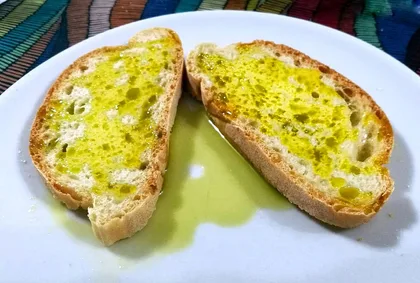 Oil and preservesExtra Virgin Olive OilTwo exams have to be passed, and one of them is carried out by people.
 Cured meatsSalsicciaCoarsely ground pork, salt, pepper, wine and usually garlic, packed into natural hog casing and sold raw.
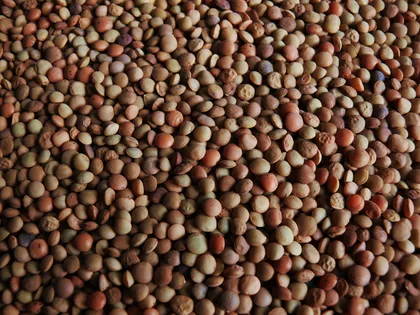 Vegetables and fruitCastelluccio LentilsCastelluccio lentils grow at 1,400 metres on the Pian Grande, a treeless karst plateau inside the Sibillini…Vegetables and fruitCicerchia (Grass Pea)The grass pea is the oldest and most awkward legume in Italy.
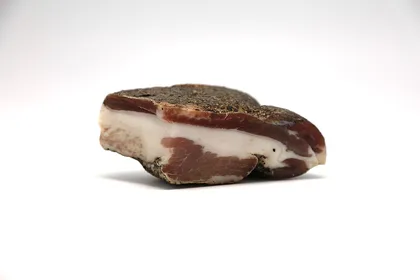 Cured meatsGuancialeGuanciale is cured pork jowl: unsmoked, rubbed with salt and pepper, aged for one to three months.
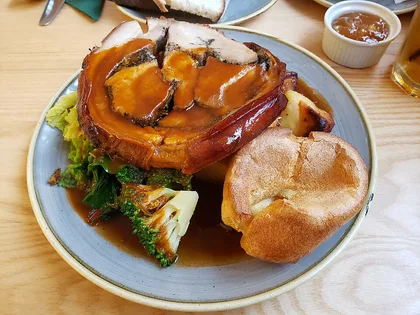 Cured meatsPorchettaSix to eight hours in a wood oven to reach two opposite textures in one piece of meat: skin that shatters…
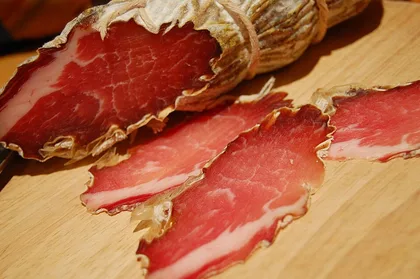 Cured meatsLonzinoLonzino is whole pork loin, dry-salted and air-cured for two to four months: the leanest cut on the animal…
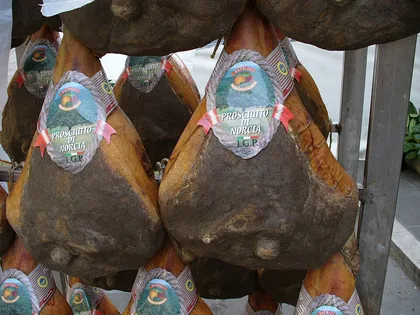 Cured meatsProsciutto di Norcia IGPProsciutto di Norcia IGP is Italy's mountain dry-cured ham, aged for at least twelve months between 400 and…