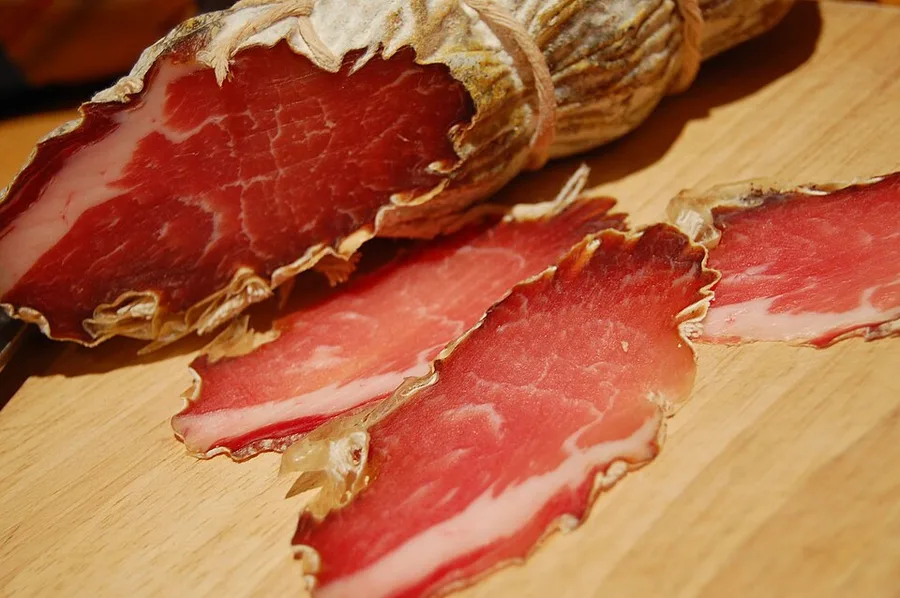
What is Lonzino?
Lonzino is made from the loin: the long muscle running above the ribs along the pig's back, the same cut that yields pork chops and roast loin. It is boned, trimmed, dry-salted with pepper and aromatics, wrapped or cased, and hung for two to four months.
It is a lean product by any standard: four to eight per cent fat, against roughly twenty-five to thirty for coppa and around sixty for pancetta. There is no intramuscular fat to render during ageing and soften the salt, so any error in curing shows immediately. Italian butchers treat it as a test piece.
The finished shape is a long cylinder, six to nine centimetres across, weighing one to two kilos. The slice is uniform deep pink with, at most, a thin outer rim of fat left on deliberately.
The name shifts by region: lonzino in the Marche, lonza in Umbria, Lazio and Tuscany, capolonza in some districts. American charcuterie makers usually call it lonza.
One warning for anyone searching in Italian: lonzino di fico is a completely different food (a Marche sweet of dried figs, almonds and cooked grape must, shaped like a salami and wrapped in fig leaves). No pork involved.
What does it taste like?
Clean, dense and sweet, tasting more of pork than any other Italian cured meat precisely because nothing is in the way. There is no fat coating the palate, no smoke, no chilli, and the seasoning (pepper, garlic, sometimes fennel or juniper) sits at the edge rather than at the centre.
The texture is firm and slightly springy, close to bresaola but with a rounder, sweeter finish where bresaola runs mineral and beefy. A good slice bends without breaking.
Because it is lean, it dries on the plate. Slices cut and left out for twenty minutes turn leathery, so it should be cut to order and eaten at once.
The common flaw is a hard, darker ring around the edge of the slice: case hardening, from drying too fast. It tastes noticeably saltier and tougher than the centre, and it is the fastest way to judge a producer.
How to use it
Slice it under a millimetre and serve immediately at room temperature. Lean cured meat dries out on the plate within twenty minutes, so cut only what will be eaten.
In the Marche it goes inside crescia sfogliata, the layered flatbread of Urbino cooked on a griddle and filled while hot. In Umbria the equivalent is torta al testo, a flatbread baked on a stone disc, split open and stuffed steaming. Warm bread is the standard partner because it compensates for what the meat lacks.
On a board, always give it a fatty neighbour: ciauscolo, lardo, a piece of capocollo. Alone it is impressive for four slices and monotonous by the eighth.
With fruit it genuinely works rather than being a tourist-menu gesture: figs, melon, ripe pears. Sweetness stands in for the missing fat.
It is not a cooking meat. With no fat to render it will not build a base for anything, and heat turns it stringy. The one exception worth trying is a slice laid over a hot bean or chickpea soup at the table, where the steam releases the aromatics without cooking the meat.
How long it keeps
Lonzino is the leanest of the cured pork family and that governs everything about keeping it. A vacuum sealed whole piece holds two to three months in the fridge, to the date on the pack. Once opened, wrap it in butcher paper or a clean cloth, never cling film against the cut face, and work through it within two to three weeks. Cut only what goes on the plate: the exposed face is where it dries, and a slice left out for twenty minutes stiffens visibly.
With so little fat to slow it down, moisture leaves fast. The cut face hardens into a dry crust within days, the colour there deepens towards brick, and the slices go from silky to brittle, snapping instead of draping. Trimming a thin layer off the face before each session gets you back to the soft meat behind. The small fat rim oxidises separately and turns from white towards yellow with a flat smell. Freezing is possible for a whole vacuum sealed piece, three months or so, but it costs texture, and the sliced product does not survive it at all.
Spot the real thing
Lonzino is a whole cured pork loin, so a slice is almost entirely lean: an even deep rose to garnet colour, close grained, with little or no marbling and at most a thin white fat cap along one edge. That is the fastest way to separate it from coppa or capocollo, which come from the neck and show a mosaic of fat pockets running through the lean, and from prosciutto, which is the leg and arrives in a wide irregular slice. The piece is a smooth cylinder, firm and dense, giving slightly under a thumb.
The name moves around. Lonzino in the Marche and Umbria is lonza in Lazio, and American producers label the same cut lonza or simply cured pork loin, while the Spanish equivalent on the same shelf is lomo embuchado, usually rubbed with pimentón and quite different in flavour. Look for a natural casing, a surface rubbed with pepper, fennel or garlic, and a short ingredient list. Price is a fair guide, since a loin loses about a third of its weight in curing: $28 to $45 a pound in the US for artisanal versions.
How to pronounce Lonzino
lon-TSEE-noh
The 'z' in central Italian is a 'ts' sound, not the English 'z': lon-TSEE-noh, not lon-ZEE-no. It is the diminutive of lonza (LON-tsah), so the literal sense is 'little loin'. Stress falls on the middle syllable.
Lonzino compared
vsCapocollo
The single most useful distinction in Italian cured pork, and the one most often got wrong abroad. They are cured almost identically (dry salt, spices, months of air-drying, whole muscle) but they are different muscles. Lonzino is the loin, the lean strip above the ribs. Capocollo, called coppa in the north and sold in American delis as capicola, is the neck, which is naturally threaded with fat. That single anatomical fact drives everything: fat content, texture, price, and how each behaves on a board.
| This | Capocollo | |
|---|---|---|
| Muscle | Loin (longissimus dorsi), above the ribs | Neck and shoulder collar |
| Fat content | 4-8% | 25-30% |
| Slice | Uniform deep pink, thin fat rim | Marbled mosaic of red and white |
| Mouthfeel | Firm, dense, dries on the plate | Melts, coats the palate |
| Ageing | 2-4 months | 3-6 months or more |
| Yield | Low: magro loses water fast | Higher: fat holds moisture |
| Serve with | Something fatty alongside | Plain bread, nothing needed |
vsBresaola
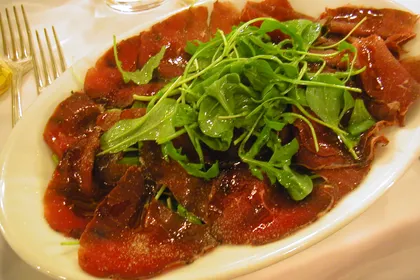
The two lean whole-muscle cures of Italy, one pork and one beef. Bresaola comes from the top round of beef, is cured with wine, juniper and spices in the Valtellina and ages one to three months into something almost fat-free and deep burgundy. Lonzino is pork, marginally fattier, sweeter and paler. Bresaola is nearly always dressed with lemon, oil, rocket and shaved Parmigiano, while lonzino is eaten plain. If you like one you will almost certainly like the other, and gym-adjacent shoppers buy both for the same reason.
| This | Bresaola | |
|---|---|---|
| Animal | Pork | Beef |
| Cut | Loin | Top round |
| Fat content | 4-8% | Under 3% |
| Colour | Deep pink | Dark burgundy, translucent |
| Flavour | Sweet, porky, peppery | Mineral, beefy, wine-scented |
| Served | Plain, with bread | Dressed with lemon and oil |
| Protection | None, regional PAT listing | PGI (Valtellina) |
vsLomo embuchado (Spanish)
The same cut, cured under a different flag, and the easiest way for a shopper outside Italy to picture lonzino. Spanish lomo is pork loin dry-cured and stuffed into casing, seasoned with pimentón and garlic, which makes it noticeably redder, smokier and more aromatic. Lonzino leaves the pork alone. Where a recipe or a board calls for one, the other works, provided you accept that pimentón will announce itself.
| This | Lomo embuchado (Spanish) | |
|---|---|---|
| Cut | Pork loin, identical | Pork loin, identical |
| Seasoning | Pepper, garlic, wine, fennel or juniper | Pimentón, garlic, oregano |
| Colour | Deep pink | Brick red from paprika |
| Smoke | None | Often, via smoked pimentón |
| Availability abroad | Italian delis, US craft charcuterie | Widely stocked in US and UK |
| Price | 18-34 USD per pound | 16-30 USD per pound |
Lonzino substitutes
- Lomo embuchado or caña de lomo
The closest substitute by cut and the easiest to find outside Italy. Expect paprika and, in the smoked versions, a smoky note that lonzino never has. Serve it the same way and adjust the accompaniments away from anything else Spanish.
1:1 - Bresaola della Valtellina PGI
Similar leanness, similar slicing behaviour, different animal. Beefier and more mineral. Good in salads and on boards; if the dish relies on pork sweetness, wrapped around figs for instance, it will taste sharper.
1:1 - Capocollo or coppa
Same curing method, fattier cut. Use it when you want the richness and do not need the leanness. On a plate it takes over from anything served alongside, so reduce the quantity slightly.
0.8:1 - Prosciutto crudo
Widely available and reliable, but saltier and with a different fibre. Fine in a sandwich or wrapped around fruit; less convincing where the lonzino was chosen for its mildness.
0.8:1 - Halal or no-pork: cured beef eye of round
Essentially bresaola by another name, made by several halal producers in the US and UK. Slices identically and is naturally lean. Add a little olive oil when serving on a board, since it has even less fat than lonzino.
1:1 - Cured duck or turkey breast
Pork-free, widely stocked, and structurally the nearest poultry equivalent: lean muscle, dry-cured, sliced thin. Duck is gamier and has a fat cap that helps; turkey is drier and benefits from being served with something rich.
1:1
Where to buy it
In the US it is usually labelled lonza rather than lonzino, and American craft charcuterie makers produce excellent versions, often easier to find and fresher than Italian imports. Italian delis and online specialists carry both. Expect roughly 18 to 34 dollars per pound.
In the UK, Italian delicatessens and online grocers stock it at about 28 to 45 pounds per kilo. Availability is patchier than for prosciutto or salami, so it is often simplest to order a whole vacuum-packed piece.
Check the cut face before buying sliced. The colour should be even from rim to centre; a darker, drier ring around the edge means case hardening, and those slices will be tough and salty.
Be wary of anything cheap. Loin is an expensive cut even fresh, so a low price usually means a short cure and brine injection rather than dry salting. Look for a short ingredient list: pork, salt, pepper, aromatics, curing salts.
A one- to two-kilo whole piece is the practical size. It slices better than pre-packed trays, keeps three or four weeks once started, and costs substantially less per kilo.
Where to eat it in Italy
The inland Marche: Sarnano, Amandola, Cingoli and the villages under the Sibillini mountains, where butchers still cure their own and the board arrives with hot crescia.
Fabriano and its hinterland have a serious butchery tradition, and lonzino is best tasted there beside salame di Fabriano, a lard-studded salami that is its exact opposite in richness.
In Umbria, Norcia is the reference. The old shops under the arcades of the main square display lonze, hams and salami by the dozen, and the Valnerina around it (Cascia, Preci, Scheggino) serves them with torta al testo and black truffle.
Late spring is the best season, when loins cured after the winter slaughter have finished ageing. In autumn, the truffle and chestnut festivals across the Apennine villages bring every producer in the district into one square.
Both regions are underbooked compared with Tuscany next door, which is the main practical argument for going.
Further reading
Frequently asked questions
What is the difference between lonzino and capocollo?
The cut. Lonzino is the loin, the lean muscle above the ribs, while capocollo, sold in American delis as capicola, is the neck, naturally marbled with fat. Lonzino is 4-8% fat, capocollo 25-30%. The cure is nearly identical; the eating experience is not.
Is lonzino the same as lonza?
Yes, they are regional names for the same product: lonzino in the Marche, lonza in Umbria, Lazio and Tuscany. Be aware that in a few parts of central Italy 'lonza' is used loosely for capocollo as well, so it is worth asking which cut a piece comes from.
Is lonzino eaten raw?
Yes. It is a dry-cured product, sliced thin and eaten as it is, like prosciutto or bresaola. It is not a cooking meat: with almost no fat to render, heat simply turns it stringy.
Is lonzino healthy?
It is among the leanest cured meats available, at four to eight per cent fat with a high protein content, which is why it turns up in high-protein diets. It remains a salt-cured product, so the sodium content is comparable to other charcuterie.
What is lonzino di fico?
A sweet from the Marche, not a cured meat. Dried figs, almonds, cooked grape must and aniseed are pressed into a salami shape and wrapped in fig leaves. It borrowed the name from the pork product because of the resemblance.
Related foods
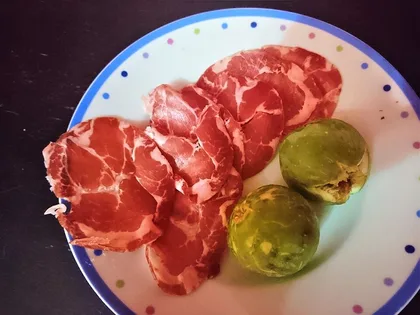 Cured meatsCapocolloCapocollo is the pork neck muscle, salted whole and aged in casing.
 Cured meatsCiauscoloCiauscolo is the Italian salami you spread with a knife. From Le Marche, IGP since 2009, ground three times…
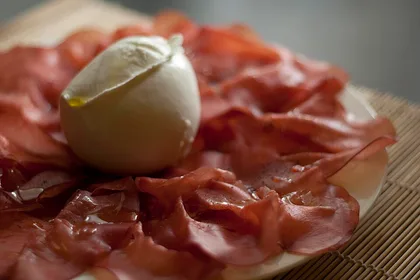 Cured meatsBresaolaOne lean muscle from the hind leg, dry-cured with salt, pepper, juniper and cinnamon, then left in the dry…
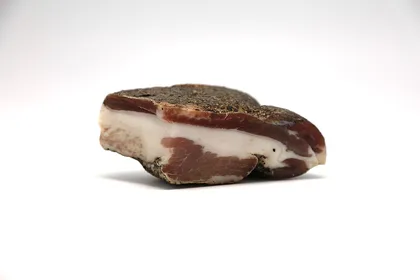 Cured meatsGuancialeGuanciale is cured pork jowl: unsmoked, rubbed with salt and pepper, aged for one to three months.
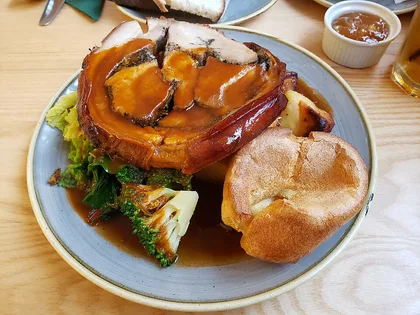 Cured meatsPorchettaSix to eight hours in a wood oven to reach two opposite textures in one piece of meat: skin that shatters…
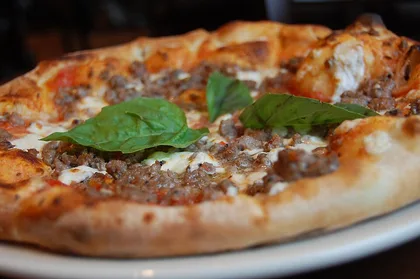 Cured meatsSalsicciaCoarsely ground pork, salt, pepper, wine and usually garlic, packed into natural hog casing and sold raw.
 Cured meatsProsciutto di Norcia IGPProsciutto di Norcia IGP is Italy's mountain dry-cured ham, aged for at least twelve months between 400 and…Cured meatsSalsiccia di FegatoSalsiccia di fegato is Italian pork liver sausage: coarsely chopped liver, pork fat, salt and spices in…