What is Crescia Sfogliata (Urbino Layered Flatbread)?
Crescia sfogliata is a disc of dough twenty-five to thirty centimetres across and only a few millimetres thick, cooked on a searing griddle and served hot, folded around a filling. It belongs to Urbino and the Montefeltro, the hill country of the northern Marche.
The dough contains flour, water, eggs, lard, salt and, non-negotiably, a great deal of ground black pepper, enough to register on the first bite. But the word that names it refers to the method: the dough is rolled thin, smeared with lard, rolled into a cylinder, coiled and rolled out again, so that it separates into fine sheets on the griddle. Sfogliata means exactly that, leafed.
The result behaves unlike any other Italian flatbread. Where a piadina is uniform and yields in one piece, a crescia flakes: you feel separate leaves under your teeth, and the fat between them keeps them distinct even once a filling has been added.
The word crescia, from crescere, to rise, is unfortunately ambiguous in central Italy, where it also names entirely different products. The layered griddle version is the Urbino one, and it is listed among the Marche's traditional food products.
What does it taste like?
Rich, savoury and unmistakably peppery. The eggs give it a faint yellow warmth, the lard gives it a rounded, almost meaty background, and the black pepper cuts a clean line through both. Nothing about it is neutral: this is bread with an opinion.
The texture is what people remember. Fresh off the griddle the edges are crisp and the surface blisters dark, while the interior comes apart in flexible, buttery-feeling sheets. Pull a piece and it separates rather than tears, closer to a paratha or a good croissant crumb than to any Western bread.
Warm, folded around cured ham and a soft sheep's-milk cheese, it eats as a whole dish rather than as a wrapper: the pepper meets the salt of the prosciutto and the fat of the cheese, and the layers stop it turning soggy.
Cold it loses a great deal: the lard sets and the sheets stiffen. Eat it within minutes of it leaving the heat.
How to use it
Fill it hot and fold it in half. In Urbino the historic filling is prosciutto crudo from nearby Carpegna with casciotta d'Urbino, a soft mixed sheep-and-cow cheese that melts slightly against the hot bread, plus a little rocket if it is around.
The other traditional filling is vegetable: wild greens (chicory, sow thistle, bladder campion) wilted in a pan with garlic and oil. It is the farmhouse version and it plays unusually well against the pepper in the dough.
Crumbled sausage cooked on the same griddle works, as do aged pit-cured cheeses and grilled vegetables. Twenty kilometres away at Acqualagna they dig white truffles, and shaved truffle over a hot crescia with a little butter is the most expensive and most defensible thing you can do with it.
It is also good empty, served as bread beside a plate of meat or a board of salumi, where the pepper makes it far more interesting than a neutral loaf.
Timing is the whole discipline. Eat it within minutes of cooking. Reheating works after a fashion but the second heat dries the sheets and seals them, and you lose the flaking that justifies the technique. Do not attempt to roll it like a wrap: it will crack along the layers.
How long it keeps
It is at its best within minutes of coming off the stone, while the lard between the layers is still liquid. Stacked as they come off and kept under a cloth they hold each other's steam and stay soft for a few hours; left singly on a rack they dry at the edges and stiffen as the fat sets. Sealing one in plastic while it is hot is the thing to avoid, because the trapped steam condenses on the surface and the blistering goes soft within minutes.
In a bag in the fridge they keep two or three days, and the change is easy to feel: the lard solidifies, the round goes firm and the layers press together so they no longer separate cleanly. Thirty to sixty seconds a side in a dry hot pan melts the fat again and the flexibility comes straight back, while a microwave first steams them and then leaves them tough. Cooked and cooled, interleaved with paper, they freeze for one to two months and reheat from frozen in a dry pan. Raw rolled discs also hold a day wrapped in the fridge.
Spot the real thing
Tear one in half rather than looking at it: the crescia sfogliata should come apart into thin distinct leaves, which is the whole meaning of sfogliata and the result of folding lard through the dough and rolling it out several times. It is a round of 20 to 25 centimetres, cooked on a hot stone or griddle so both faces carry scorched blistered patches, and it stays pliable rather than crisp. Eggs and a heavy hand with black pepper are in the dough, so it tastes richer and sharper than any plain flatbread.
The neighbour it is most often taken for is piadina romagnola, which is a single layer, has no eggs and no pepper, and is thinner and plainer. Indian paratha is the closest thing by technique, folded and griddled in the same way. Focaccia is leavened and oven baked. Within the Marche and Umbria the word crescia also covers a leavened oven bread and, separately, the sweet crescia fogliata, so the name alone settles nothing. At a kiosk in Urbino a filled one costs 3.50 to 6 euro; supermarket packs run 2 to 4 euro.
How to pronounce Crescia Sfogliata (Urbino Layered Flatbread)
KREH-shah sfoh-LYAH-tah
In crescia the 'sc' before an 'e' makes an English 'sh' sound, so it is KREH-shah, never 'kres-kee-a' or 'kreh-see-a'. The 'i' is silent, softening the 'sc'. In sfogliata the 'gli' is the Italian palatal l, closest to the 'lli' in 'million': sfoh-LYAH-tah, not 'sfog-lee-ata' and not 'sfoh-gee-ata'. Stress on KREH and on LYAH. Plural: cresce sfogliate, KREH-sheh sfoh-LYAH-teh.
Crescia Sfogliata (Urbino Layered Flatbread) compared
vsPiadina romagnola
The comparison everyone makes and the one that matters, because the two territories are neighbours and menus outside Italy use the words interchangeably. They are not the same. A piadina is a plain dough of flour, water, salt and lard or oil, rolled once and griddled: dense, uniform, pliable. A crescia adds eggs and a serious amount of black pepper, and it is laminated: lard is spread across the rolled dough, which is coiled and rolled again so it bakes into separate leaves. The crescia is richer, flakier and shorter-lived; the piadina is plainer and more practical.
| This | Piadina romagnola | |
|---|---|---|
| Eggs | Yes, roughly one per 250-300g flour | None |
| Pepper | Generous, in the dough | None |
| Lamination | Yes: greased, coiled, re-rolled | No: rolled once |
| Texture | Flakes into sheets | Yields as one piece |
| Region | Urbino and the Montefeltro, Marche | Romagna |
| Reheats | Poorly: the layers seal | Well |
vsFlour tortilla
Both are unleavened, fat-enriched, griddled discs, and a tortilla is the easiest thing to reach for abroad. The differences are richness and structure. A flour tortilla contains no egg, far less fat, and is rolled once into a thin, flexible sheet designed to wrap tightly. A crescia is thicker, layered, peppery and structurally stiffer: it folds in half rather than rolling around a filling, and it will crack if you try to burrito it.
| This | Flour tortilla | |
|---|---|---|
| Fat | Lard, inside the dough and between layers | A little lard or shortening |
| Eggs | Yes | No |
| Structure | Laminated, flaky | Single sheet, pliable |
| Thickness | 3-5mm | 1-2mm |
| How it is used | Folded in half around a hot filling | Rolled or wrapped |
| Seasoning | Salt and black pepper | Salt only |
vsParatha and roti canai
Functionally the closest relative anywhere in the world, and the resemblance is not a coincidence so much as convergent engineering: spread fat on rolled dough, coil it, roll it out again, cook it on a hot plate, and you get separable leaves. Lachha paratha and Malaysian roti canai do this with ghee or margarine; the crescia does it with lard and adds eggs and pepper. If you have eaten a good flaky paratha, you already know what a crescia feels like.
| This | Paratha and roti canai | |
|---|---|---|
| Fat used | Lard | Ghee, oil or margarine |
| Eggs in dough | Yes | Usually not |
| Seasoning | Black pepper | Salt, sometimes none |
| Served | Folded around a savoury filling | Alongside curry, torn by hand |
Crescia Sfogliata (Urbino Layered Flatbread) substitutes
- Piadina romagnola
The nearest Italian relative and the easiest to buy abroad, since vacuum-packed piadine are exported widely. You lose the layers, the eggs and the pepper, so grind fresh black pepper over the filling to recover some of the character.
1:1 - Lachha paratha or roti canai
Structurally the best stand-in available. Frozen parathas from an Indian or Malaysian grocer cook on a dry pan in three minutes and flake correctly. Choose a plain one, not a stuffed or sweetened version.
1:1 - Large flour tortilla
Everywhere, and the weakest option here: thin and unlaminated, so it wraps rather than flakes. Brush with melted lard and heat hard on a dry pan for some blistering.
2 tortillas per crescia - Home-made, which is the real answer
Mix 300g flour, one egg, 120ml warm water, 30g lard, salt and a heaped teaspoon of black pepper. Rest, divide into two, roll thin, smear with soft lard, roll into a cylinder, coil, rest twenty minutes, roll out and griddle three minutes a side. No special equipment beyond a heavy pan.
About 170g of dough per crescia - Vegetarian: olive oil lamination
Swap the lard for the same weight of a firm fat: solidified coconut oil works better than olive oil, which soaks into the dough and blurs the layers. Keep the eggs and the pepper; those carry most of the flavour.
1:1, lard replaced by weight
Where to buy it
In the Marche, from a crescieria or a bakery in the Montefeltro. A filled crescia at a stall in Urbino runs 4 to 7 euros depending on what goes inside, and around 5 for the standard ham and casciotta; plain cooked cresce cost 1 to 2 euros each, or 8 to 12 euros per kilo. Student prices, because Urbino is a university town.
Supermarkets in the region sell packs of four for 3 to 5 euros. They are acceptable in an emergency, but almost none are genuinely laminated. Outside the Marche the product is rare and sits above 15 euros per kilo in specialist shops.
Outside Italy it does not exist commercially. There is no export market and no frozen version worth ordering. If you want one, either buy exported piadine and add pepper, buy frozen parathas from a South Asian grocer at roughly 4 to 7 dollars or 3 to 5 pounds a pack, or make it yourself: this is one of the few Italian regional breads that a home cook with a heavy frying pan can reproduce properly.
The one ingredient worth sourcing carefully is the lard: rendered leaf lard from a butcher behaves far better between the layers than the supermarket block.
Where to eat it in Italy
Urbino, inside the walls. The crescerie cluster in the old town between piazza della Repubblica and the climb towards the Ducal Palace, small places with a griddle in view that stay open late for the students.
Go for the palace regardless: it holds the Galleria Nazionale delle Marche and Piero della Francesca's Flagellation, and the building itself is one of the founding statements of Renaissance architecture. The crescia afterwards is the natural close to the day.
Across the Montefeltro the bread is everywhere: Urbania, Sant'Angelo in Vado, Macerata Feltria, Sassocorvaro, all within forty minutes of Urbino by car. Acqualagna, half an hour away, adds white truffles and holds its national truffle fair from late October into November.
Mid-August brings the Festa del Duca, when Urbino stages a Renaissance procession and fills with stalls: the busiest week of the year, and the crescia is on every corner.
On the coast at Pesaro and Fano it coexists with Romagnol piadina and the boundary blurs. Inland is where the distinction still means something.
Frequently asked questions
What is the difference between crescia sfogliata and piadina?
Three things. Crescia contains eggs and black pepper; piadina contains neither. Crescia is laminated, spread with lard, coiled and re-rolled to create layers, while piadina is rolled once. The result is that crescia flakes apart into sheets while piadina yields as a single piece.
Why is it called crescia if it does not rise?
The name comes from crescere, to rise, and in the Marche it is applied loosely to several griddle doughs, some leavened and some not. The Urbino version usually contains little or no yeast: its volume comes from layers separating during cooking, not from fermentation.
Can crescia be made without lard?
You can use butter or oil, but the result changes. Lard is solid at room temperature and stays put between the layers until the water in the dough turns to steam and forces them apart. Oil is absorbed into the dough and blurs the lamination; butter gives an intermediate result and a different flavour.
What goes inside a crescia?
In Urbino, prosciutto crudo from Carpegna with casciotta d'Urbino cheese. The rural alternative is wild greens sauteed with garlic and oil. Sausage, pit-cured cheeses and grilled vegetables all work. Sweet fillings are a tourist invention and the pepper in the dough argues against them.
How many different breads are called crescia?
At least three. Crescia sfogliata is the layered griddle bread of Urbino. Crescia di Pasqua is a leavened cheese bread eaten with salami on Easter morning. In Umbria the griddle bread torta al testo is sometimes called crescia too. They share a name and nothing else.
Related foods
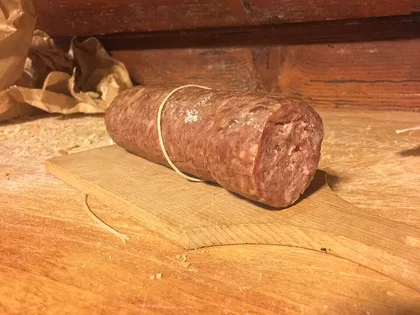 Cured meatsCiauscoloCiauscolo is the Italian salami you spread with a knife. From Le Marche, IGP since 2009, ground three times…
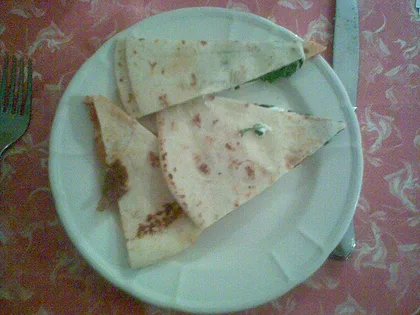 Pasta and breadPiadina RomagnolaNo yeast and no waiting: flour, water, salt and lard, rolled thin and cooked dry on a hot plate for two…
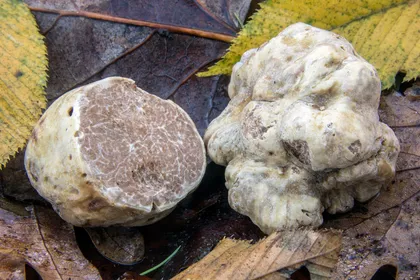 Vegetables and fruitWhite truffleThe Italian white truffle, Tuber magnatum Pico, is the most expensive of Italy's truffles: in 2025 the Alba…
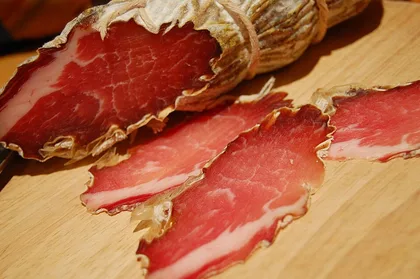 Cured meatsLonzinoLonzino is whole pork loin, dry-salted and air-cured for two to four months: the leanest cut on the animal…Vegetables and fruitCicerchia (Grass Pea)The grass pea is the oldest and most awkward legume in Italy.CheeseCasciotta d'UrbinoCasciotta d'Urbino is a two-milk cheese: 70 to 80 per cent sheep's milk, the rest cow's, a ratio written into…Fish and seafoodPortonovo Wild MusselsMoscioli are wild mussels that settle on the rocks of the Conero headland, south of Ancona, and grow there…
 Pasta and breadBucatiniBucatini are thick spaghetti with a hole running through the middle.