What is Casciotta d'Urbino?
Casciotta d'Urbino DOP is a semi-cooked cheese made throughout the province of Pesaro e Urbino in the northern Marche. It was protected in 1996, in the first group of Italian cheeses recognised by the EU.
The defining feature is the blend: 70 to 80 per cent whole sheep's milk, 20 to 30 per cent whole cow's milk, both from the same area. This is not a shortcut or a cost-saving measure. Sheep's milk brings fat, structure and a lanolin warmth; cow's milk brings sweetness and softens the paste. The result tastes like neither a pecorino nor a cow's milk table cheese.
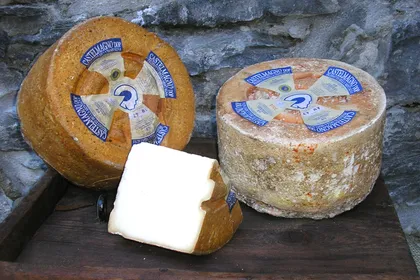
The shape is a short cylinder with convex, slightly bulging sides: 12 to 16 centimetres across, 5 to 7 tall, weighing between 800 grams and 1.2 kilos. The rind is thin, pale straw-yellow and soft enough to eat.
Ageing is deliberately short: 20 to 30 days at 10 to 14 degrees in high humidity. This is a cheese meant to be eaten young, soft and sweet, and it is not built to mature further. The rennet is calf rennet.
What does it taste like?
Gentle, and that is the point. The first impression is sweet milk and butter, then a soft sheep's milk warmth arrives underneath without any of the salt-and-sharpness that people expect from an Italian sheep's cheese. There is a faint lactic tang on the finish and a mushroom note from the thin rind, which is edible and worth eating.
The texture is soft but not spreadable: it yields under a finger, slices cleanly, and has a slight moist give that comes from the semi-cooked curd. Scattered irregular eyes, no crumble, no squeak.
If you know Pecorino Toscano fresco, this sits below it in intensity and above a young cow's milk caciotta in depth. It is the cheese to hand someone who says they do not like sheep's cheese, and the one to skip if you want something that fights back.
How to use it
Mostly, eat it as it is, at room temperature, cut in thick slices. In the Marche it goes with crescia sfogliata, Urbino's flaky griddle flatbread, alongside Carpegna ham and wild greens sautéed with garlic. Those three things on one plate are the province in summary.
It takes honey well, acacia or chestnut, and fresh broad beans in spring. With truffle from Acqualagna, half an hour up the road, it is the standard winter pairing in local restaurants: white truffle in autumn, black in winter.
In cooking it melts creamily without stringing, which makes it good in baked passatelli, over tagliatelle, in savoury tarts and on hot crostini. It stands in for fontina in a lighter fondue and adds body to vegetable fillings without dominating them.
One thing not to do: grate it. The paste is too moist and clogs a grater into a sticky mass. If a recipe wants a hard grating cheese, this is not it.
How long it keeps
Fridge, on the least cold shelf, between 4 and 8°C (39 and 46°F), wrapped in greaseproof paper or in the paper it came in. Never film pressed against it: the rind is thin and alive, and under plastic it sweats and takes on the smell of the wrapping.
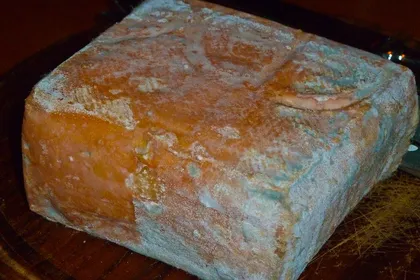
A whole wheel holds two or three weeks, a cut piece a week or a little more, and the pack carries the dairy's own date. This is not a cheese built to be kept. It was made to be eaten young, and every extra week dries the paste, firms the texture and pushes the acidity forward. When the cut face dries, scrape off a thin veil. White or greyish bloom on the rind comes away with a damp cloth; anything black or pink is a different kind of surface growth, and the shop that sold it is the place to ask.
Half an hour out of the fridge before serving makes an enormous difference on a cheese this delicate: cold, almost nothing comes through. Freezing is not the route, since the moist paste thaws grainy and weeping.
Spot the real thing
The convex side is the first sign: the flanks of the wheel are not straight but slightly bellied, a consequence of the process that industrial imitations do not reproduce. Diameter should run twelve to sixteen centimetres, weight around a kilo.
The rind is thin, straw yellow, soft and untreated. A thick, hard or waxed rind belongs to a cheese aged much longer, or to another cheese entirely. Cut it and the paste is white to barely straw, soft, with sparse irregular eyes, and it should yield under a finger without springing back. Deep yellow points to more cow milk in the blend or a longer ageing; a chalky paste that breaks instead of bending points to acidification that went off track.
The nose is fresh sheep milk, butter and a background of grass, and the flavour is sweet and mild, low in salt, with a faint acidity at the close. On the wheel or the pack, look for the DOP mark with the dairy number. The word caciotta, spelt with one t and carrying no mark, is free for anyone anywhere to use.
How to pronounce Casciotta d'Urbino
kah-SHOT-tah dur-BEE-noh
The 'sci' is a single 'sh' sound, as in 'shot', not 'ka-SEE-otta'. Hold the double 't'. In 'd'Urbino' the apostrophe means the two words run together as one: 'dur-BEE-noh', stress on BEE. And yes, the 's' in Casciotta is correct: it records the local dialect pronunciation of caciotta.
Casciotta d'Urbino compared
vsCaciotta (generic)
The most useful thing to know about this cheese is that caciotta is not a protected name. Anyone anywhere in Italy can make a small, short-aged wheel, call it caciotta, use any milk in any proportion, and sell it for eight euros a kilo. Casciotta d'Urbino is a DOP with a legally fixed recipe: sheep's milk at 70 to 80 per cent, cow's milk for the rest, both from one province, semi-cooked curd, 20 to 30 days of ageing. The names differ by one letter; the products differ by everything.
| This | Caciotta (generic) | |
|---|---|---|
| Legal status | DOP since 1996 | Free name, no rules |
| Milk | 70-80% sheep, 20-30% cow, fixed | Anything the maker chooses |
| Area | Province of Pesaro e Urbino only | Anywhere in Italy |
| Curd | Semi-cooked to 43-45 C | Unspecified |
| Ageing | 20-30 days, defined | Days to months |
| Price | EUR 14-23 per kg | EUR 8-12 per kg |
vsPecorino Toscano DOP
The nearest well-known relative and the clearest way to place Casciotta on a shelf. Pecorino Toscano is pure sheep's milk and comes in a fresh version aged 20 days and a mature one aged four months or more. Casciotta always has cow's milk in it, always stays young, and is therefore softer, sweeter and less saline. Fresh Pecorino Toscano is the closer of the two, but even that is firmer and more clearly a sheep's cheese.
| This | Pecorino Toscano DOP | |
|---|---|---|
| Milk | Sheep plus 20-30% cow | 100% sheep |
| Ageing | 20-30 days only | 20 days (fresh) or 4 months+ (aged) |
| Texture | Soft, yielding | Firm, becoming hard when aged |
| Salt | Low | Moderate to high |
| Rind | Thin and edible | Thicker, often oiled or tomato-rubbed |
| Grating | No: too moist | Yes, when aged |
vsFormaggio di Fossa di Sogliano DOP
The other two-milk cheese of this stretch of Italy, made a short drive north on the Marche-Romagna border, and a useful contrast because it starts from similar milk and goes somewhere completely different. Fossa cheese is buried in tufa pits from August to November, where it ferments under pressure without oxygen, emerging pungent, amber and intense. Casciotta stays on a wooden board for three weeks and stays sweet. Same countryside, opposite philosophies.
| This | Formaggio di Fossa di Sogliano DOP | |
|---|---|---|
| Milk | Sheep and cow blended | Sheep, cow, or both |
| Maturing | 20-30 days on boards | About 90 days buried in tufa pits |
| Flavour | Sweet, mild, milky | Pungent, savoury, long |
| Texture | Soft and moist | Crumbly, dry, irregular |
| Season | All year | Unearthed from late November |
Casciotta d'Urbino substitutes
- Pecorino Toscano DOP fresco
The closest thing on most counters: young, mild, sheep-led. It is firmer and slightly saltier, so if you are serving it plain, add a drizzle of honey to bridge the gap.
1:1 - A good Italian caciotta, sheep or mixed
Fine for cooking, where the point is a soft melting cheese rather than a specific flavour. Check the label for the milk: a cow's-milk-only caciotta will be noticeably blander.
1:1 - Half young pecorino, half young Asiago or fontina
The best home approximation of the two-milk balance. Grate or dice both and combine them; the cow's milk cheese softens the sheep's milk exactly as the original blend intends.
3 parts pecorino to 1 part cow's milk cheese - Young Manchego or Ossau-Iraty jeune
Widely available outside Italy and sheep-based, though both are pressed harder and taste more concentrated. Serve at room temperature and cut thick to soften the difference.
1:1 - Vegetarian: no DOP version
Casciotta d'Urbino requires calf rennet, as do all the protected cheeses of the Marche. There is no vegetarian version within the denomination. The realistic alternatives are microbial-rennet young cheeses: a vegetarian Caerphilly or a young Wensleydale for the texture, a vegetarian-rennet sheep's cheese for the flavour.
Where to buy it
In the Marche it costs 14 to 19 euros a kilo at the dairy and 17 to 23 in a good shop. Since a wheel weighs about a kilo, you buy the whole thing for around twenty euros, which is the right way to buy it.
Elsewhere in Italy expect 20 to 28 euros a kilo. In the US a few specialist importers list it at roughly 16 to 28 dollars per pound; in the UK, 22 to 34 pounds per kilo from Italian delicatessens, with patchy availability, since a cheese aged three weeks does not suit long supply chains.
Production is small and concentrated: a few hundred tonnes a year from a handful of certified dairies clustered between Urbino, Urbania, Sant'Angelo in Vado and Fossombrone.
The trap at the counter is the name. Generic caciotta sells for 8 to 12 euros a kilo and looks almost identical. Check for the DOP mark and the dairy number, and check the sides of the wheel: Casciotta bulges outward, most industrial caciotte have straight sides.
Where to eat it in Italy
Urbino is the obvious base, and the Palazzo Ducale, with Piero della Francesca's Flagellation and Federico da Montefeltro's inlaid studiolo, justifies the trip on its own. Shops in the old town sell the cheese next to Carpegna ham and crescia.
Urbania, the Casteldurante where Michelangelo bought his farms, has the historic dairies and an old majolica tradition. Sant'Angelo in Vado and Acqualagna are the truffle towns, with fairs filling the streets in October and November.
The Montefeltro hills are worth a day: San Leo, with its fortress on a vertical block of rock, Carpegna and its DOP ham, and the Furlo gorge, where the Romans cut a tunnel through the rock for the Via Flaminia. Several farms in these valleys make cheese on site and sell at the gate.
In Pesaro and Fano the cheese is in every market and deli, and in summer it turns up alongside the coast's fish cooking rather more successfully than you would expect.
Further reading
 InvestigationItalian raw milk cheeses: the full listWe counted: 19 of 43 declare raw milk, and 16 of those 19 carry a protected designation.
 GuideCan you eat cheese rind?On some wheels the rind is the same paste, dried out. On others it is paraffin.
 ExplainerWhich Italian cheeses contain no lactoseItaly sets a legal threshold, and long-aged cheeses clear it on their own, with no treatment involved.
Frequently asked questions
Why is it spelled Casciotta and not caciotta?
Because the denomination wrote down the local Marche dialect pronunciation rather than standard Italian. It is not a typo. It also has a practical benefit: it separates the protected cheese from the countless generic caciotte made across Italy under an unregulated name.
Did Michelangelo really love this cheese?
Yes, and unusually for a food anecdote there is paperwork. In 1554, in his eighties and living in Rome, Michelangelo bought farmland near Casteldurante, today's Urbania, and family letters record wheels of the cheese being sent to him. Whether the land purchase was mainly about cheese is the local telling; the purchase and the shipments are documented.
Is Casciotta d'Urbino a pecorino?
Not strictly. It must contain 20 to 30 per cent cow's milk by law, which softens the paste and sweetens the flavour. It is a two-milk cheese, and in practice it is the right choice for anyone who finds pecorino too aggressive and cow's milk table cheeses too neutral.
How long does it keep?
A whole wheel keeps two to three weeks refrigerated; a cut piece about a week. It does not improve with time: the paste dries and the acidity sharpens. Wrap it in waxed paper rather than cling film and take it out of the fridge half an hour before serving.
Is it vegetarian?
No. Calf rennet is required by the specification, as it is for every protected cheese in the Marche. Vegetarian cooks need to look outside the denomination, at unprotected cheeses that declare microbial rennet on the label.
Sources
Where to check what you just read.
- 1
L'allegato del 12 giugno 1996 dove il formaggio di Urbino entra fra le DOP italiane, insieme a Gorgonzola, Taleggio e Parmigiano Reggiano.
- 2
Il disciplinare in PDF con la grafia ufficiale «Casciotta»: proporzione fra latte ovino e vaccino, peso della forma e giorni minimi di maturazione.
- 3Consortium · interested partyConsorzio Tutela Casciotta di Urbino DOP
Il consorzio pubblica disciplinare e piano dei controlli in PDF, e delimita la zona: provincia di Pesaro-Urbino più alcuni comuni del Riminese.
Related foods
 Cured meatsCiauscoloCiauscolo is the Italian salami you spread with a knife. From Le Marche, IGP since 2009, ground three times…
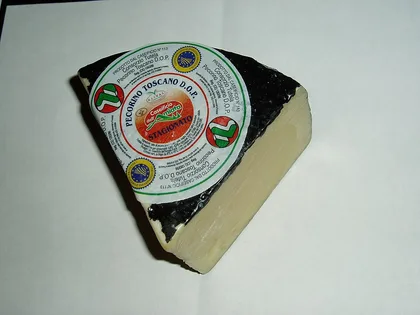 CheesePecorino ToscanoPecorino Toscano DOP is the mild one. Whole sheep's milk, calf rennet, a brief salting: soft-paste wheels…
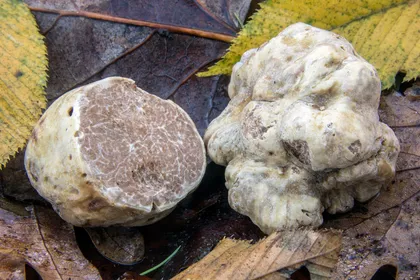 Vegetables and fruitWhite truffleThe Italian white truffle, Tuber magnatum Pico, is the most expensive of Italy's truffles: in 2025 the Alba…
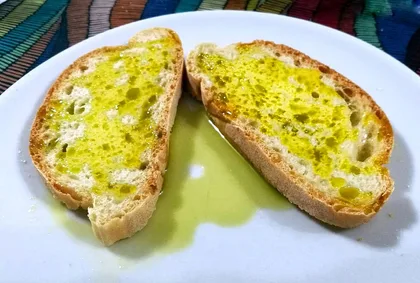 Oil and preservesExtra Virgin Olive OilTwo exams have to be passed, and one of them is carried out by people.
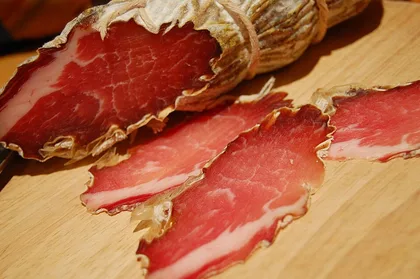 Cured meatsLonzinoLonzino is whole pork loin, dry-salted and air-cured for two to four months: the leanest cut on the animal…Vegetables and fruitCicerchia (Grass Pea)The grass pea is the oldest and most awkward legume in Italy.Pasta and breadCrescia Sfogliata (Urbino Layered Flatbread)Crescia sfogliata is the layered griddle flatbread of Urbino, in the Marche hills.Fish and seafoodPortonovo Wild MusselsMoscioli are wild mussels that settle on the rocks of the Conero headland, south of Ancona, and grow there…