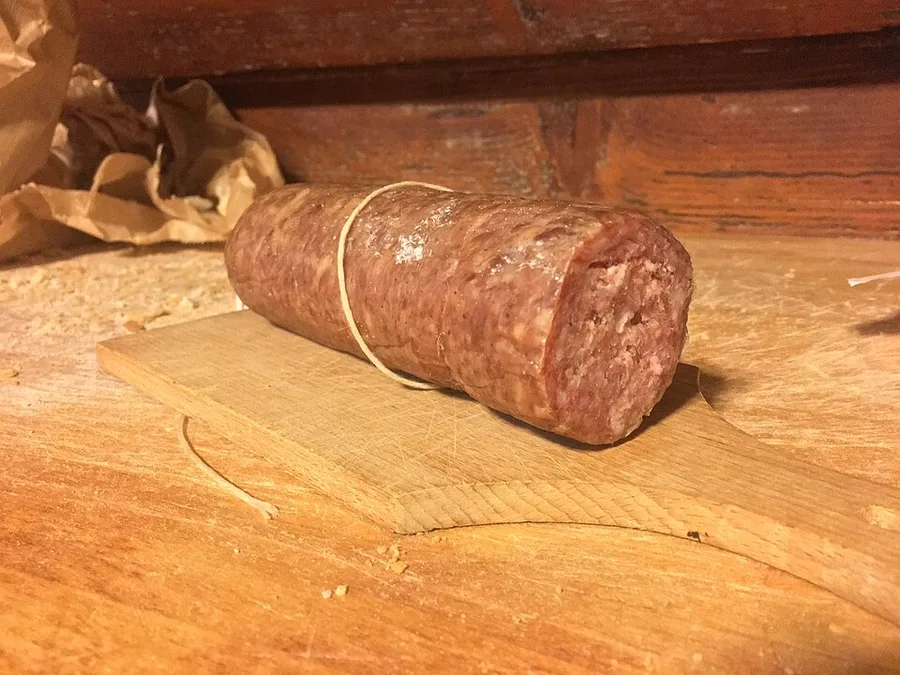
What is Ciauscolo?
Ciauscolo is a soft, spreadable cured pork sausage from Le Marche, on Italy's Adriatic side. It is made from pork belly, shoulder and lean trimmings, ground repeatedly through progressively finer plates until it becomes a paste, seasoned with salt, black pepper and garlic steeped in wine, stuffed into natural casing and cured for only two to four weeks.
Three things make it spreadable: a fat content of roughly 40 to 50 per cent, an extremely fine grind, and a short cure that stops before the paste dries out. Ordinary salami loses moisture for months and firms up; ciauscolo is caught halfway, while the emulsified fat still holds everything soft.
The name comes from the Latin cibusculum, 'little food': it was the mid-morning snack of farm workers, spread on a slab of bread and eaten in the field without a plate or a knife worth the name. It has held Protected Geographical Indication status since 2009.
What does it taste like?
Deeply porky, gently salty, with garlic sitting well in the background and black pepper coming through at the end. The texture is the surprise: silky and dense, like a cross between a rustic pâté and softened butter, but with a clean cured-meat flavour rather than the mineral note of anything containing liver.
The mountain versions carry a thin thread of smoke from juniper or beech, which reads as woody rather than bacon-like. Lowland versions skip it and taste sweeter and simpler.
Spread on warm bread it turns semi-liquid at the edges and becomes noticeably richer. That is the intended way to eat it, and it is a different experience from tasting it cold off a knife.
How to use it
Take it out of the fridge at least an hour before eating. Cold ciauscolo is stiff and tastes of very little; at room temperature the fat softens and the aroma opens up.
Slit the casing lengthways with a knife, peel it back like a case, and spread the paste straight onto bread. In Le Marche the bread is pane sciapo, made without salt, which lets the salume do the work. Warm or grilled bread is better still, since the heat melts the fat slightly.
As a cooking ingredient it is powerful. A tablespoon melted gently in a pan, loosened with pasta water and finished with pecorino makes a complete sauce for two. It is also excellent stirred into scrambled eggs, spooned onto hot polenta, or spread on bread and flashed under a grill for thirty seconds until a crust forms.
Do not cook it hard or long: the fat separates and leaves a dry, useless residue. Low heat, briefly, then serve.
How long it keeps
Whole and uncut it keeps in the least cold part of the fridge, 4 to 8 C, for four to six weeks, wrapped in greaseproof paper or a tea towel rather than plastic. It does not sit still: it goes on drying, the fat firms and it becomes less spreadable, so a piece bought for the knife is at its best within the month. A vacuum pack carries a date and that date is the maker's.
Once it is open, cover the cut face with film pressed against it or a sheet of baking paper and work through the piece within a week. The exposed surface oxidises and turns dark brown within a day; a millimetre scraped off gets back to the pink. It freezes whole or in halves for three months with little change, thawed slowly overnight in the fridge and then left an hour at room temperature before the casing is opened. Dry white bloom on the casing is part of the process and lifts with a cloth dipped in vinegar; anything else on the surface is a question for the shop and the label.
Spot the real thing
The shape gives it away first: short, chubby pieces of 300 grams up to a kilo and a half, in a wrinkled natural casing tied by hand and therefore unevenly. Anything long, slim and cylindrical is not ciauscolo. Pressed, the piece should yield like firm dough. If it feels hard the ageing has gone past the spreadable stage, and if your finger sinks in and stays it is young and wants a few more days. Cut, the paste is an even pink-rose without the white flecks of fat you see in ordinary salame: the fat is there in quantity, emulsified into the meat, and slight browning near the casing is normal.
On the IGP sticker, look for the consortium mark and for the cuts named on the label, which should include belly and shoulder. Flours, starches, milk powder or added proteins mean a factory version imitating the texture instead of getting it from fat. Abroad the two things it gets mixed up with are nduja, which is Calabrian, softer still and red with chilli, and generic spreadable salami sold in tubs, which costs a fraction of an IGP piece.
How to pronounce Ciauscolo
chah-OOS-koh-loh
Four syllables, stress on the second. The opening 'cia' is one sound, like the start of 'ciao'; the 'au' splits into ah-oo. Common mistakes: 'see-OWS-ko-lo' and a hard 'k' at the start. In the south of Le Marche you will also hear ciavuscolo, chah-voo-SKOH-loh.
Ciauscolo compared
vsOrdinary salami
Same animal, opposite intention. Salami is ground coarse and cured for months so it can be sliced thin; ciauscolo is ground to a paste and cured for weeks so it can be spread. Trying to slice a ciauscolo is the fastest way to identify a tourist.
| This | Ordinary salami | |
|---|---|---|
| Grind | Fine, 2-3 mm, repeated 2-3 times | Coarse, visible fat cubes |
| Fat content | 40-50%, emulsified and invisible | 25-30%, in distinct white specks |
| Curing time | 15 days to 4 weeks | 2 to 6 months |
| Texture | Soft paste, yields to a finger | Firm, holds a clean slice |
| How to serve | Spread on bread with a knife | Sliced thin on a board |
| Shape | Short, stubby, hand-tied | Long, even cylinder |
vs'Nduja
Italy's other spreadable salume, from Calabria at the opposite end of the country. Both are soft enough to spread; the resemblance stops there. 'Nduja is roughly a third chilli by weight and burns; ciauscolo has no chilli at all.
| This | 'Nduja | |
|---|---|---|
| Region | Le Marche, central Adriatic | Calabria, deep south |
| Heat | None | Considerable: 25-30% chilli |
| Colour | Pale pink | Bright brick red |
| Seasoning | Salt, pepper, garlic in wine | Salt and Calabrian chilli |
| Typical use | On bread, as an antipasto | Melted into sauces and on pizza |
| Casing | Natural pork casing, hand-tied | Larger casing, often blind gut |
vsSobrassada and Teewurst
The two closest things outside Italy: Mallorca's paprika-red spreadable sausage and Germany's smoked, fine-ground Teewurst. Teewurst is the nearest match in texture and mildness, sobrassada the nearest in role: both are eaten on bread and nothing else.
| This | Sobrassada and Teewurst | |
|---|---|---|
| Grind and texture | Fine paste, spreadable | Both fine and spreadable |
| Spice | Pepper and garlic | Sobrassada: paprika. Teewurst: mild |
| Smoke | Optional, light, juniper | Teewurst: always beechwood |
| Colour | Pink | Sobrassada: orange-red. Teewurst: pale |
| Cure length | 2-4 weeks | Sobrassada: 1-6 months |
| Availability abroad | Italian delis, some importers | Widely stocked in the UK and US |
Ciauscolo substitutes
- Teewurst
The best available stand-in in northern Europe and the US: fine-ground, gently smoked, spreadable, and mild enough that the pork leads. Add a small crushed garlic clove and a heavy grind of black pepper to close the gap.
1:1 by weight - Sobrassada de Mallorca
Same job on the plate, different seasoning: paprika dominates. Excellent on toast, and easier to find in the UK than ciauscolo. Use less than you would of ciauscolo, since the paprika builds.
3:4 by weight - Pork rillettes
Shredded rather than ground, and cooked rather than cured, so the flavour is roast pork rather than cured pork. Texturally close enough for a bread-and-antipasto course. Season with extra salt and pepper.
1:1 by weight - 'Nduja, thinned
Only if heat is welcome. Beat one part 'nduja into two parts soft lardo or unsalted butter to tame it, and you get a spreadable red paste that behaves the same way on toast.
1 part 'nduja to 2 parts fat - Pâté de campagne
Widely available and structurally similar, but almost always contains liver, which brings a mineral note ciauscolo does not have. Choose a coarse country pâté without liver if you can find one.
1:1 by weight - Vegetarian: white bean and smoked paprika spread
No plant version reproduces cured pork, but cannellini beans blended with roasted garlic, smoked paprika, olive oil and plenty of black pepper give you the same rich, spreadable, savoury role on warm bread.
Where to buy it
In Italy, buy it from a norcino in Le Marche or at the weekly markets in Macerata, Fermo and Ascoli Piceno, where producers sell directly and will let you taste before buying. Artisan IGP ciauscolo runs 18 to 28 euro per kilo, and small mountain producers reach 30 to 34. Supermarket vacuum packs cost 12 to 16 euro per kilo.
Abroad it is a specialist item. Italian delicatessens and online importers in the UK stock it seasonally at roughly 28 to 40 pounds per kilo; in the US it appears at Italian specialists and online shops at around 20 to 32 dollars per pound, though availability is patchy and it sells out.
Check the label for the IGP mark and for the cuts: belly and shoulder should be listed. Flour, starch, milk powder or added proteins signal an industrial product engineering the texture rather than getting it from fat and grinding.
Buy whole pieces of 400 to 800 grams rather than pre-sliced anything: ciauscolo is never sliced, and a package of thin slices means you are being sold a different sausage.
Where to eat it in Italy
The inland Macerata province and the Sibillini mountains are the heartland: Visso, Camerino, Sarnano, San Ginesio, Amandola. These are small towns badly hit by the 2016 earthquakes, where a number of historic butchers have rebuilt and are working again.
Festivals dedicated to ciauscolo cluster between February and May, tied to the traditional winter pig slaughter.
Along the Adriatic coast, from Senigallia down to San Benedetto del Tronto, almost every trattoria opens its antipasto with ciauscolo, fried olive ascolane and inland cheeses. It is one of the easiest regional specialities to encounter without hunting for it, provided you are in Le Marche.
The region is under-visited by foreign travellers, which is part of the appeal: prices are lower than in Tuscany or Emilia and the producers are used to explaining their work.
Further reading
Frequently asked questions
What is ciauscolo?
A soft, spreadable cured pork sausage from Le Marche in central Italy. It is ground to a fine paste, contains 40 to 50 per cent fat, and is cured for only two to four weeks, so it stays soft enough to spread on bread with a knife. It has held IGP status since 2009.
How do you pronounce ciauscolo?
chah-OOS-koh-loh, with the stress on the second syllable. The opening sound is the same as in 'ciao'.
Do you slice ciauscolo or spread it?
Spread it. Slit the casing lengthways, peel it back and spread the paste onto bread, ideally warm. It is too soft to hold a slice, and trying to cut it into rounds simply produces a mess.
Is ciauscolo the same as 'nduja?
No. Both are spreadable Italian cured sausages, but 'nduja is Calabrian and roughly a quarter chilli by weight, so it is fiery and bright red. Ciauscolo is from Le Marche, has no chilli at all, and is pale pink and mild.
Is ciauscolo safe to eat without cooking?
Yes: it is a cured product, salted and fermented, and it is meant to be eaten as it is. Cooking is optional and best done briefly, since prolonged heat separates the fat.
Sources
Where to check what you just read.
- 1
L'atto del 10 agosto 2009 che ha iscritto «Ciauscolo» fra le IGP nella classe 1.2 dei prodotti a base di carne: fissa la data da cui il nome è protetto.
- 2
Il PDF del disciplinare vigente, dove si verificano tagli di suino ammessi, grado di macinatura, percentuale di grasso e stagionatura minima.
- 3
Il comunicato del 4 giugno 2025 con cui il Ministero riconosce il Consorzio: fino a quella data la IGP non aveva un ente di tutela incaricato della vigilanza.
Related foods
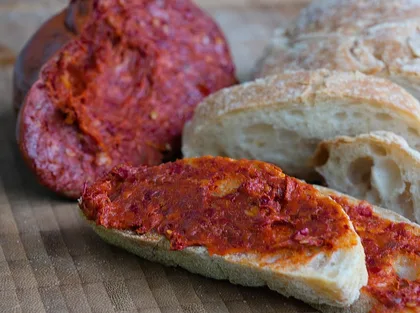 Cured meats'Nduja'Nduja is a soft, spreadable Calabrian pork salume that is up to 40% chilli.
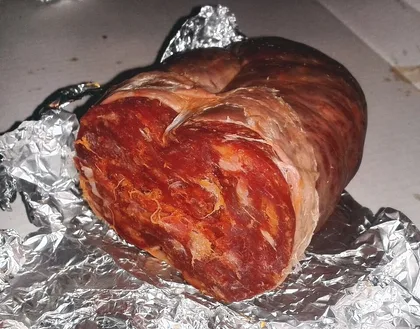 Cured meatsSoppressataSoppressata is a coarse-ground dry salami from southern Italy, pressed flat between boards while it dries…
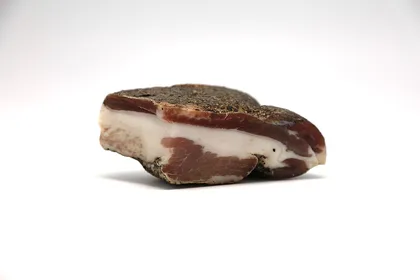 Cured meatsGuancialeGuanciale is cured pork jowl: unsmoked, rubbed with salt and pepper, aged for one to three months.
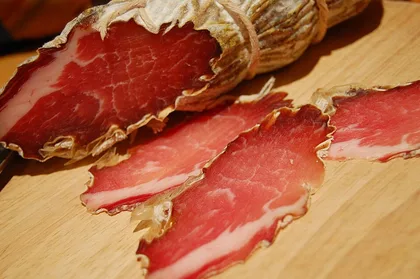 Cured meatsLonzinoLonzino is whole pork loin, dry-salted and air-cured for two to four months: the leanest cut on the animal…
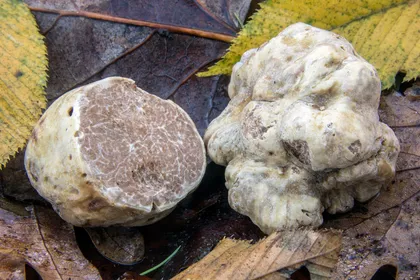 Vegetables and fruitWhite truffleThe Italian white truffle, Tuber magnatum Pico, is the most expensive of Italy's truffles: in 2025 the Alba…Vegetables and fruitCicerchia (Grass Pea)The grass pea is the oldest and most awkward legume in Italy.CheeseCasciotta d'UrbinoCasciotta d'Urbino is a two-milk cheese: 70 to 80 per cent sheep's milk, the rest cow's, a ratio written into…Pasta and breadCrescia Sfogliata (Urbino Layered Flatbread)Crescia sfogliata is the layered griddle flatbread of Urbino, in the Marche hills.