What is Portonovo Wild Mussels?
A mosciolo is Mytilus galloprovincialis: the same species as the mussel in every fishmonger's window. Nothing about the animal is different. What is different is that nobody farmed it.
Farmed mussels start as seed, get packed into mesh socks and hang from longlines in sheltered water, growing suspended, unbattered and constantly fed. Moscioli attach themselves to limestone rock beneath the Conero cliffs, anywhere from the surface down to seven or eight metres, and stay there for two or three years taking every storm the Adriatic sends.
That life is legible in the shell: thick, rough, brown-black, densely ridged, usually crusted with lime and small organisms, because it grew slowly and had to hold on. The meat yield is low: a kilo of moscioli gives under 200 grams of meat, against 300 or more for farmed mussels, and the meat itself is small, firm and deep orange rather than pale cream.
The bed is finite by definition: it is as big as the rock. Harvesting is regulated, the Slow Food Presidium dates from 2004, and a whole season is measured in tens of tonnes.
What does it taste like?
Salt first, then iodine, then a mineral, almost metallic depth that farmed mussels simply do not have. If a farmed mussel tastes of the sea in a gentle way, a mosciolo tastes of the sea the way an oyster does: bracing, and clearly from somewhere.
The texture is the second surprise. The meat is dense and slightly chewy, closer to a clam than to the soft plumpness of a rope-grown mussel, and it holds its shape in a hot pan instead of shrinking into a pale scrap.
The liquor they release is concentrated enough to season a plate of pasta on its own, which is exactly how Ancona uses it. Do not salt anything until you have tasted that liquid.
They are also less sweet than farmed mussels. Nobody eats a bowl of moscioli and thinks of butter; the register is bitter sea and stone.
How to use it
Take away, do not add. Moscioli are salty, iodine-rich and already flavoured; anything assertive simply buries them.
The Ancona baseline is alla marinara: a wide pan, olive oil, a crushed garlic clove, a grind of black pepper, lid on, and off the heat the moment they open. The liquor they release is the sauce: strain it and dress spaghetti with it, with parsley and nothing else. Tomato is allowed in tiny quantities, two cherry tomatoes rather than a sauce.
The local speciality is in porchetta, which in the Marche means cooked with wild fennel and garlic, often with a handful of breadcrumbs. It is the same seasoning the region uses for rabbit and for stockfish, and it works because fennel can stand up to iodine.
Two rules of timing. Moscioli are tougher than farmed mussels and want an extra minute; one minute past that and they turn to rubber, so stand at the pan. And never salt the dish before tasting the liquor: it is usually salty enough on its own.
Raw with lemon is a genuine Ancona tradition, but raw bivalves remain the commonest vehicle for hepatitis A and norovirus. Purification reduces the risk without removing it, so treat it as an informed choice, and skip it entirely if you are pregnant, elderly or immunocompromised.
How long it keeps
They are bought live and cooked live, which makes this a matter of hours rather than days. Keep them in the least cold part of the fridge, in an open container so air reaches them, under a damp cloth. Never in fresh water, which kills them within half an hour, and never sealed inside a plastic bag. The usual span is twenty four hours from purchase, forty eight at the outside, and the dispatch centre label carries the date. Clean them shortly before cooking: pull the byssus towards the pointed end, scrape the shell and rinse under cold running water, without soaking, which waterlogs the flesh.
Standard practice before the pan is to set aside any with broken shells and any that stay open when you tap them, and after cooking to set aside any that stayed shut. Once cooked, they keep a day or two in the fridge, shelled and covered with their own filtered liquid, which stops the flesh drying and turning tough. Cooked and shelled they freeze for a couple of months. Raw they do not, because freezing forces the shells open and the flesh thaws stringy.
Spot the real thing
The shell tells the whole story. A mosciolo has a thick, rough shell, blue black tending to brown, with dense irregular growth lines and almost always some encrustation, because it grew clamped to a rock and fought the sea for years. A rope grown mussel has a thin, smooth, glossy, regular shell, since it hung suspended and never touched anything. The size is smaller and uneven too: in a crate of moscioli no two are identical, while farmed ropes give graded shellfish that look stamped out.
Cooking settles it. The wild flesh is compact and deep orange, sits in one corner of the shell and never fills it; the farmed one is bigger, paler, softer and fills the valve. Weigh them and the gap is obvious: three kilos of moscioli give roughly six hundred grams of meat, three kilos of farmed mussels almost double. Two checks at the counter. The dispatch centre label has to state where they were harvested, and if the Conero does not appear on it they are not Portonovo moscioli. And the price: in season, below about eight euros a kilo, the arithmetic does not work.
How to pronounce Portonovo Wild Mussels
moh-SHOH-lee dee por-toh-NOH-voh
The 'sci' in moscioli is one sound, 'sh' as in 'ship': three syllables, stress in the middle, and the final 'i' is 'ee'. The singular is mosciolo, moh-SHOH-loh. Portonovo takes the stress on the third syllable: por-toh-NOH-voh, not 'PORT-onovo'.
Portonovo Wild Mussels compared
vsFarmed mussels
Same species, opposite lives. A farmed mussel spends eighteen months suspended in calm water with food arriving on the current: it grows fast, fills its shell and stays mild and sweet. A mosciolo spends two or three years clamped to rock in open surf: it grows slowly, spends energy holding on, and ends up with a thick shell, half the meat and twice the flavour. Farmed mussels are better value and better for a big pot of moules; moscioli are better when the mussel is the point of the dish.
| This | Farmed mussels | |
|---|---|---|
| Origin | Wild, self-settled on rock | Seeded into mesh socks on longlines |
| Water | Open, wave-exposed coast | Sheltered bays and lagoons |
| Time to size | 2-3 years | 12-18 months |
| Shell | Thick, rough, encrusted | Thin, smooth, uniform |
| Meat yield | Under 20% of live weight | 30% or more |
| Flavour | Salty, iodine, mineral | Mild, sweet, rounder |
| Season | May to September only | Year round |
| Price | 10-18 EUR per kg | 3-6 EUR per kg |
vsDate mussels (datteri di mare)
Not a comparison so much as a warning. Lithophaga lithophaga bores into limestone and lives inside it, so the only way to harvest one is to break the rock open. Stretches of Italian coast were quarried bare for them, and a stripped reef takes decades to recolonise. Fishing, selling, buying and serving them has been illegal in Italy since 1988 and is banned across the EU, with protection under the Bern and Barcelona Conventions. If a restaurant offers them, it is committing a crime. The mosciolo is picked off the rock; the date mussel is dug out of it, and the rock does not come back.
| This | Date mussels (datteri di mare) | |
|---|---|---|
| Legal status | Legal, licensed, quota-managed | Illegal to fish, sell, buy or serve |
| How it lives | Attached to the rock surface | Bored inside the limestone |
| Harvest impact | Detached by hand, bed regenerates | Rock is smashed, reef is destroyed |
| Recovery time | One to two seasons | Decades, sometimes never |
| Growth rate | 2-3 years to 5-6 cm | Very slow: decades to full size |
vsBouchot mussels
The nearest thing northern Europe has to a mussel with a sense of place. French bouchot mussels grow on wooden posts driven into tidal flats, so they are exposed at low tide and work harder than rope-grown mussels: small, sweet, tender, with a good meat-to-shell ratio. They are still farmed, still sheltered and still sweet rather than mineral, so they are a fine mussel but not a stand-in for a wild rock mussel.
| This | Bouchot mussels | |
|---|---|---|
| Growing method | Wild on rock | Farmed on wooden posts in tidal flats |
| Size | 5-7 cm, irregular | 4-5 cm, uniform |
| Meat | Firm, deep orange | Tender, pale, plump for its size |
| Flavour | Salty and mineral | Sweet and delicate |
| Season | May to September | July to February |
Portonovo Wild Mussels substitutes
- Italian farmed mussels (Scardovari, Taranto, La Spezia)
The honest everyday swap. Cook them a minute less than you would moscioli, and hold back a little of the cooking liquid to reduce, since it is more dilute and less saline.
1 kg moscioli = 700 g farmed mussels for the same meat - Bouchot mussels
Small, sweet and dense, with the best meat ratio of any farmed mussel. Closest in eating quality, though noticeably sweeter. Add a pinch of salt or a few drops of colatura to push them towards the mineral side.
1:1 by weight - Galician or Cornish rope mussels
Large, plump and reliable, widely available in the UK. Better in a big pot with wine and garlic than in a dish where the mussel has to carry the plate on its own. Reduce the cooking liquor hard before dressing pasta with it.
1:1 by weight, expect more liquid - Vongole veraci (carpet-shell clams)
For spaghetti rather than for a bowl of mussels. Clams give the same firm bite and the same saline liquor, which is really what you are chasing when you substitute a wild mussel.
1 kg mussels = 800 g clams - New Zealand green-lipped mussels
Widely sold frozen on the half shell and the furthest from the target: large, soft and mild, usually pre-cooked. Usable in a gratin where breadcrumbs and garlic do the work, not much else.
Not recommended for pasta or marinara
Where to buy it
Realistically, in the Marche and nowhere else. The animals are sold alive, the season is short and the annual catch is tiny, so moscioli do not travel: outside Italy they are effectively unobtainable, and any UK or US supplier advertising them is almost certainly selling farmed mussels under a regional name.
In Italy, buy them between May and September at the Ancona fish market, at fishmongers in Ancona, Portonovo, Sirolo and Numana, or direct from the divers where local rules allow. Expect 10 to 18 euros per kilo (roughly 5 to 9 dollars per pound, or 9 to 16 pounds per kilo), against 3 to 6 euros for farmed mussels.
Check the label that must accompany all live bivalves: it states the species, the harvesting area and the date. If the area is not the Conero coast, they are not moscioli di Portonovo. If they are on sale in January, they are not moscioli at all.
Buy them the day you cook them, keep them in the fridge under a damp cloth, never in fresh water and never sealed in plastic, and discard any that do not close when tapped.
Where to eat it in Italy
Portonovo itself: a bay reached by a single hairpin road, with a Romanesque church, a Napoleonic fort, two brackish lagoons behind a white pebble beach, and a row of former fishermen's huts on the water that are now restaurants. Access by car is restricted in high season, so check before driving down.
The wild mussel festival in early September is the single best day for it: the whole repertoire cooked at once, with the divers on the quay. Sirolo and Numana, a few kilometres south, serve the same food with more beach.
In Ancona, the trattorie around the port and the old town cook moscioli alongside the city's other great dish, stoccafisso all'anconetana, a long-braised stockfish stew. The Mercato delle Erbe is where to look at them raw before ordering them cooked. The whole coast sits inside the Conero regional park, which is worth a walk between lunches.
Further reading
Frequently asked questions
What is the difference between moscioli and ordinary mussels?
The species is identical: Mytilus galloprovincialis. Moscioli are wild: they settle on the rocks of the Conero coast on their own and grow there for two or three years in open surf, while farmed mussels are seeded into socks and hang in sheltered water for twelve to eighteen months. Wild ones have thicker shells, under 20 per cent meat yield, firmer orange flesh and a much saltier, more mineral flavour.
When is the season?
May to September, sometimes into October. In spring the mussels are spawning and the meat is thin and milky; in winter the sea below the Conero cliffs is too rough to free-dive and the animals are lean anyway. June to August is the peak.
How are they harvested?
By free-diving. Around twenty licensed fishermen work with mask, fins and a small hook, down to seven or eight metres, detaching mussels from the rock one at a time and taking only those over five or six centimetres. Minimum size, daily quotas and closed periods are set by local rules and by the Slow Food Presidium protocol.
Are date mussels the same thing?
No, and they are illegal. Lithophaga lithophaga bores into limestone, so harvesting it means breaking the rock apart, which destroys the reef for decades. Fishing, selling, buying and serving date mussels has been prohibited in Italy since 1988 and is banned throughout the EU. A restaurant offering them is breaking the law.
Can I eat them raw?
It is traditional in Ancona, but raw bivalves are the most common food source of hepatitis A and norovirus, and purification lowers that risk without eliminating it. If you do it, use traceable, freshly harvested shellfish, and avoid it altogether during pregnancy, in early childhood, or with a compromised immune system.
Related foods
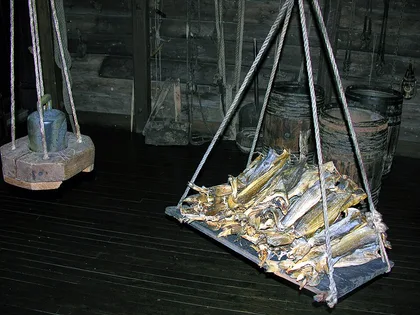 Fish and seafoodStoccafissoStoccafisso is cod air-dried on wooden racks in the Norwegian Lofoten Islands, with no salt at all, until it…
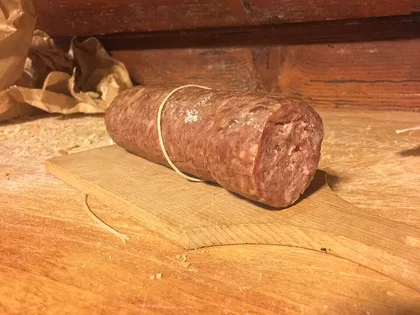 Cured meatsCiauscoloCiauscolo is the Italian salami you spread with a knife. From Le Marche, IGP since 2009, ground three times…
 Oil and preservesExtra Virgin Olive OilTwo exams have to be passed, and one of them is carried out by people.
 Vegetables and fruitWhite truffleThe Italian white truffle, Tuber magnatum Pico, is the most expensive of Italy's truffles: in 2025 the Alba…
 Cured meatsLonzinoLonzino is whole pork loin, dry-salted and air-cured for two to four months: the leanest cut on the animal…Vegetables and fruitCicerchia (Grass Pea)The grass pea is the oldest and most awkward legume in Italy.CheeseCasciotta d'UrbinoCasciotta d'Urbino is a two-milk cheese: 70 to 80 per cent sheep's milk, the rest cow's, a ratio written into…Pasta and breadCrescia Sfogliata (Urbino Layered Flatbread)Crescia sfogliata is the layered griddle flatbread of Urbino, in the Marche hills.