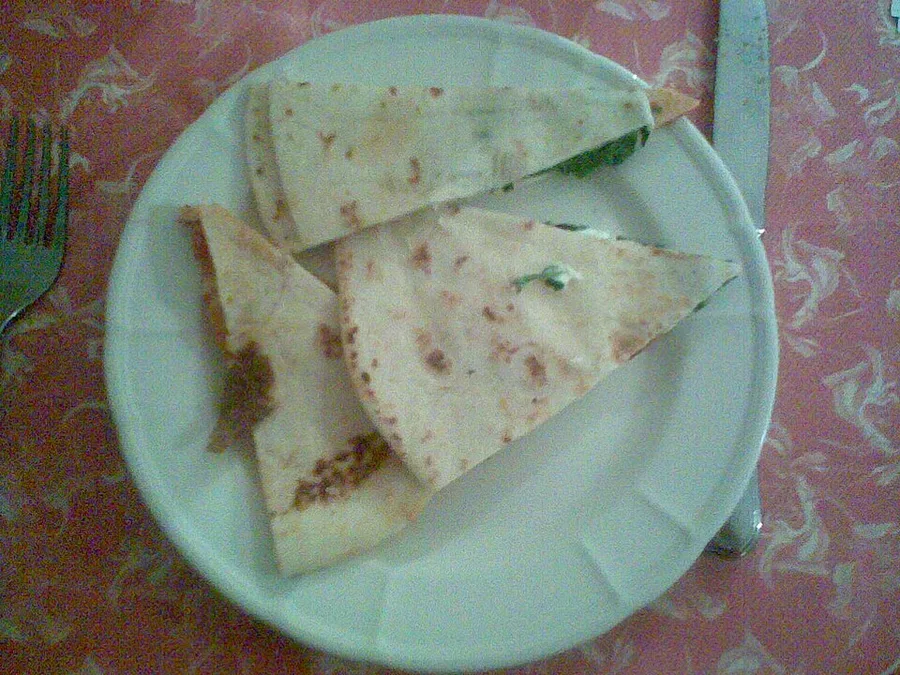
What is Piadina Romagnola?
Piadina is a round, soft flatbread cooked on a griddle and eaten hot, either folded around a filling or torn up alongside a meal. It is not a yeasted bread: at most it contains a chemical raising agent, which gives it blisters rather than a crumb.
The Piadina Romagnola IGP rules, granted in 2014, allow soft wheat flour, water, salt and fat (lard, olive oil, or both) plus optional raising agents. No milk, no eggs, no sugar.
There are two official versions. The classic Piadina Romagnola is 4 to 8 mm thick and 15 to 25 cm across: substantial, foldable, the style of Forlì, Cesena and Ravenna. The Piadina Romagnola alla Riminese is up to 3 mm thick and 23 to 30 cm across: thin enough to see light through, made to be rolled.
The protected zone covers the provinces of Rimini, Forlì-Cesena and Ravenna, plus the part of the province of Bologna east of the river Sillaro.
What does it taste like?
Like a soft, savoury flatbread with the richness of a good pastry. The lard is what you notice: it gives piadina a short, faintly flaky quality that no oil-based flatbread has, closer to a scone or a biscuit than to pita.
It is properly salty, which is the point: piadina was made as a bread substitute, so it seasons itself. The scorched brown blisters from the griddle add a toasted note, and a fresh one has a slight steam-softness inside that lasts about ten minutes.
It does not taste yeasty, sour or sweet. If yours does, it is not a piadina.
How to use it
Cook it dry. No oil in the pan: the fat is already in the dough. Get a heavy pan or a griddle properly hot, roll the dough thin, and cook two to three minutes a side, pricking the big bubbles with a fork as they rise. You are looking for pale bread with irregular brown blisters, not an even golden colour.
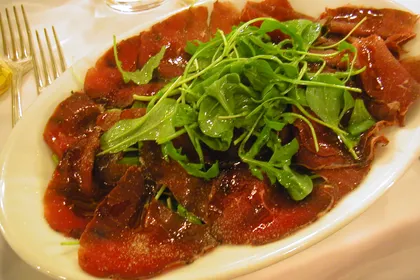
Fill it hot, straight off the heat, and eat it within a few minutes: piadina stiffens as it cools. The canonical filling is squacquerone cheese, rocket and prosciutto crudo: soft, tangy, bitter, salty, in that order. Sausage and onion, melted cheese with grilled vegetables, and Nutella for children are the other things every kiosk sells.
It also works simply cut into wedges and served hot in place of bread with a plate of salumi and cheese, which is how it is most often eaten at home in Romagna.
To reheat, use a dry pan for thirty seconds a side. Never the microwave, which turns it rubbery.
How long it keeps
Cooked, a piadina keeps a couple of days at room temperature wrapped in a clean tea towel or a food bag. The fridge is not its friend: the starch retrogrades and the disc goes stiff and papery, though a minute in a dry pan brings it back every time. A sealed industrial pack runs to the printed date, which on an IGP product is short by design, and once opened the discs lose water fast, curling and hardening at the rim within two or three days. Raw dough holds 24 hours in the fridge under film; past that the lard begins to separate and the dough rolls out unevenly.
Freezing works for both states. Cooked discs go in with a sheet of baking paper between each one and reheat straight from frozen in a hot dry pan. Raw ones are rolled out first, stacked with paper and frozen flat, then cooked without thawing with about a minute added. Left uncovered in the freezer the exposed edges dry, whiten and turn brittle, so double-bag them.
Spot the real thing
A good piadina is pale with irregular brown blisters, never evenly golden all over like a crêpe or a tortilla. It should fold cold without cracking: a disc that splits along the fold was either overcooked or made with too little water. The bite is short and crumbly rather than chewy, and chewiness almost always means brewer's yeast, which does not belong in the dough, or dough that was worked too hard. The IGP covers two shapes, the classic (smaller and thicker) and the Riminese (wide and thin), so the diameter alone tells you nothing.
Abroad it lands in the wrap aisle next to tortillas, and that is where the labels part company. Piadina Romagnola IGP means the recipe is fixed, the ingredient list is short (flour, water, lard or olive oil, salt) and the date is close. Generic piadina-style wraps lean on cheap vegetable oils, preservatives and ethyl alcohol to stretch shelf life, and they cost less for a reason. One more thing not to confuse it with: a cassone, also called crescione, is a piadina folded into a half moon around a filling and cooked already sealed.
How to pronounce Piadina Romagnola
pyah-DEE-nah
Three syllables, stress on the second. The 'pia' is a single glide, 'pyah', not 'pee-ah'. Never 'pee-ah-DYE-nah'. Romagnola is 'roh-mah-NYOH-lah', with the 'gn' as in 'lasagna'. The plural is piadine, 'pyah-DEE-neh'.
Piadina Romagnola compared
vsFlour tortilla
The closest thing most people outside Italy have eaten, and the substitution actually works. The differences are fat and thickness: piadina uses lard or olive oil and is two to four times thicker, so it is richer, softer and structurally sturdier under a wet filling.
| This | Flour tortilla | |
|---|---|---|
| Fat | Lard or extra virgin olive oil | Shortening, lard or vegetable oil |
| Thickness | 3–8 mm | 1–2 mm |
| Texture | Soft, short, slightly flaky | Thin, pliable, more elastic |
| Salt | Noticeably salty | Mild |
| Eaten | Hot off the griddle, folded | Warmed, rolled or folded |
| As a substitute | - | The best easy swap; buy the thickest you can |
vsPita and other flatbreads
Pita is yeasted and puffs into a pocket; piadina has no yeast and no pocket. Greek-style pita, the flat pocketless souvlaki kind, is much closer than the pocket variety. Naan is yeasted and enriched with yoghurt, which makes it softer and sweeter.
| This | Pita and other flatbreads | |
|---|---|---|
| Leavening | None, or chemical | Baker's yeast |
| Never | Pita: yes. Naan: no | |
| Fat | Lard or olive oil, generous | Pita: little or none. Naan: yoghurt and ghee |
| Cooked on | Dry griddle or terracotta testo | Oven or tandoor |
| Flavour | Rich, salty, short | Bready, mild, slightly sweet |
vsCassone (crescione)
The same dough, a different object. A cassone is a piadina folded into a half-moon around a filling and sealed before cooking, so the filling steams inside. A piadina is cooked first and filled afterwards, if at all.
| This | Cassone (crescione) | |
|---|---|---|
| When filled | After cooking, or not at all | Before cooking, sealed at the edge |
| Shape | Flat disc | Half-moon |
| Typical fillings | Squacquerone, rocket, prosciutto | Wild greens, pumpkin, potato, tomato and mozzarella |
| Name | Piadina everywhere | Cassone inland, crescione around Rimini |
Piadina Romagnola substitutes
- Make it yourself
Genuinely the best answer, because there is nothing to go wrong: 500 g plain flour, 100 g lard, 1 tsp salt, about 220 ml warm water, optional 1 tsp baking powder. Rest 30 minutes, divide into eight, roll to 4 mm, cook 2–3 minutes a side on a dry hot pan.
500 g of flour makes 8 piadine - Thick flour tortilla
The closest supermarket product. Buy the thickest and least sweet you can find, warm it dry in a pan rather than a microwave, and salt whatever you put inside it a little more than usual.
1:1 - Greek-style pocketless pita
Sold for souvlaki and gyros. Softer and slightly yeasty, but it folds and holds a wet filling well.
1:1 - Olive oil version, for a vegetarian or halal piadina
Swap the lard for 50–60 ml of extra virgin olive oil per 500 g of flour. This is allowed under the IGP rules, not a compromise: it is a little less flaky and slightly chewier, and it is what many Romagnoli use at home.
100 g lard becomes 55 ml olive oil - Gluten-free piadina
Use a gluten-free bread flour blend with a teaspoon of psyllium husk for pliability, and keep the dough wetter than you think. It will not be IGP piadina, since the rules require wheat, but it folds.
1:1 flour swap, plus 10–15% more water - Squacquerone substitute for the filling
The classic cheese is hard to find abroad. Mix stracchino or crescenza with a spoonful of full-fat cream cheese and a squeeze of lemon to get the same soft, tangy, spoonable texture.
2 parts stracchino to 1 part cream cheese
Where to buy it
Packaged piadina is exported and turns up in Italian delis and larger supermarkets in the US and UK, usually in packs of four or five for $4–7 or £3–5. Look for Piadina Romagnola IGP on the label; generic 'Italian flatbread' is typically made with cheap vegetable oil, preservatives and ethyl alcohol to extend shelf life, and it shows in the texture.
In the UK, Italian delicatessens and online grocers stock it; in the US, Eataly and Italian importers carry it, and some regional chains stock it near the tortillas.
Honestly, though: this is one Italian product that is better made than bought. The ingredient list is four items, it needs no proving, and a home version cooked in a cast-iron pan beats almost anything vacuum-packed.
Where to eat it in Italy
Romagna's roadside kiosks, the chioschi often painted in coloured stripes, are the institution, and they line the Via Emilia and the whole Adriatic coast from Ravenna down to Cattolica. Rimini, Riccione, Cesenatico and Cervia have the highest concentration.
Cervia holds Sapore di Sale in September, built around its historic salt pans, with the kiosks in full operation. Rimini hosts Al Meni in June, a street-food and chef festival where piadina is the constant. At Forlimpopoli, birthplace of Pellegrino Artusi, the Festa Artusiana in late June is the best week of the year to understand Romagnolo cooking generally.
Worth the detour: Montetiffi, above Sogliano al Rubicone, where a handful of artisans still hand-build the terracotta testi that piadina was traditionally cooked on.
Recipes with it
Further reading
Frequently asked questions
What is piadina?
An unleavened Italian flatbread from Romagna made with flour, water, salt and lard or olive oil, cooked on a dry hot plate. It is eaten hot, folded around fillings such as soft cheese, rocket and cured ham, or served instead of bread.
How do you pronounce piadina?
pyah-DEE-nah, stress on the middle syllable, with 'pya' as one sound. The plural, piadine, is pyah-DEE-neh.
Is piadina the same as a tortilla?
No, but a thick flour tortilla is the best easy substitute. Piadina is two to four times thicker, made with lard or olive oil, and noticeably saltier, which gives it a short, almost pastry-like bite that a tortilla does not have.
Does piadina contain yeast?
No. Traditional piadina uses no baker's yeast at all; the IGP rules allow only chemical raising agents such as baking powder or bicarbonate, and plenty of home cooks skip even those. That is why it takes half an hour rather than half a day.
What goes inside a piadina?
The classic is squacquerone, a soft tangy Romagnolo cheese, with rocket and prosciutto crudo. Sausage and onion, melted cheese with grilled vegetables, and simple salumi are the other standards. Outside Italy, mix stracchino with a little cream cheese and lemon to approximate squacquerone.
Sources
Where to check what you just read.
- 1
L'atto che il 24 ottobre 2014 iscrive «Piadina Romagnola / Piada Romagnola» nel registro delle IGP: la data e la forma esatta del nome tutelato.
- 2
Diametro e spessore ammessi per i due formati (classico e riminese), gli ingredienti consentiti e le temperature di cottura sulla piastra.
- 3Consortium · interested partyConsorzio di promozione e tutela
L'elenco dei produttori autorizzati a usare il marchio IGP, utile per capire chi sta davvero dentro la denominazione.
Related foods
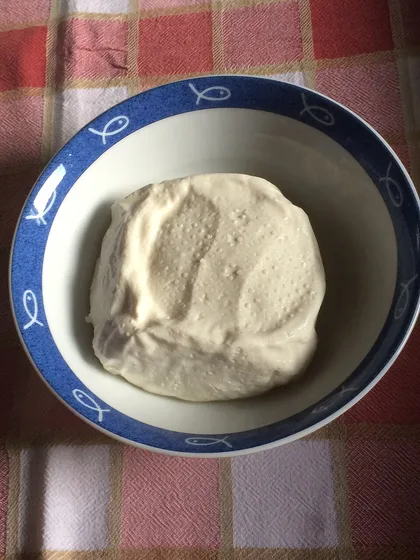 CheeseSquacquerone di RomagnaSquacquerone di Romagna DOP is a fresh cow's milk cheese so soft it cannot hold a shape: it takes the form of…
 Cured meatsProsciutto di ParmaProsciutto di Parma DOP is Italian ham made from three things only: pork, sea salt and at least 400 days.
 Cured meatsCulatello di ZibelloCulatello di Zibello is the heart muscle of a pork leg, boned out, sewn into a pig's bladder, tied by hand…
 Pasta and breadTortelliniTortellini are tiny ring-shaped egg pasta parcels filled with pork, prosciutto, mortadella and Parmigiano…
 Pasta and breadStrozzapretiStrozzapreti are hand-rolled Romagnolo pasta: strips of semolina-and-water dough twisted between the palms…
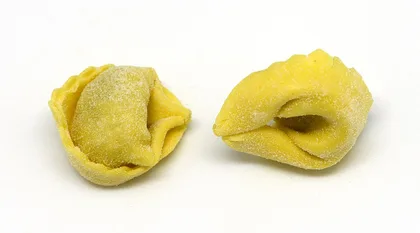 Pasta and breadTortelloniSeven-centimetre squares of egg pasta filled with ricotta and parsley, folded into a little hat.
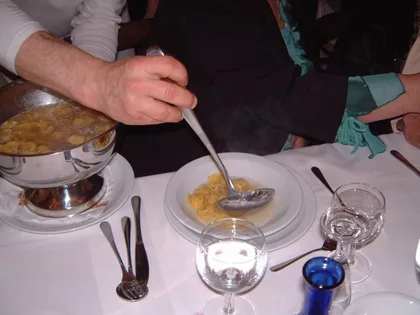 Pasta and breadCappellettiCappelletti are Emilia-Romagna's filled egg pasta, folded into the shape of a little hat and served in broth…
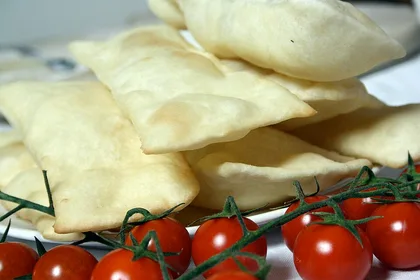 Pasta and breadGnocco FrittoEat it within a minute of the pan, because once it deflates it is over: a diamond of leavened dough fried in…