What is Tortelloni?
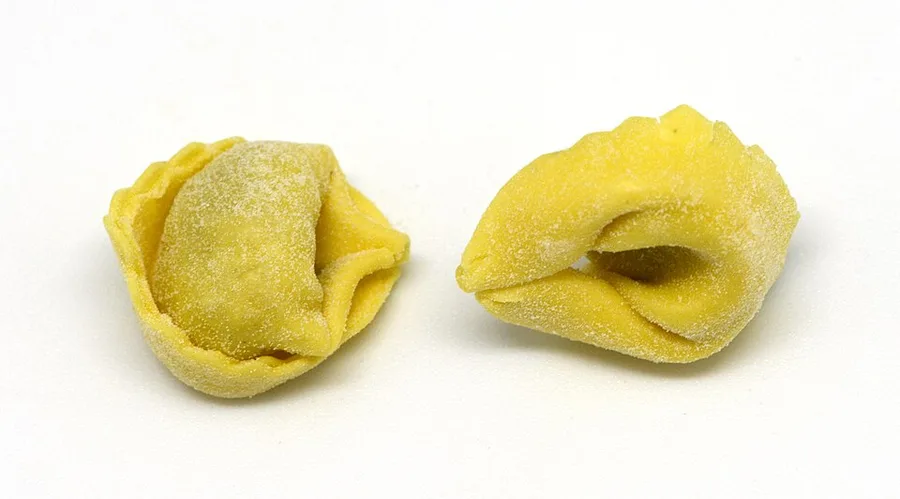
Tortelloni are fresh filled egg pasta from Bologna and Modena. A square of rolled dough seven to eight centimetres across and six to eight tenths of a millimetre thick takes a walnut of filling, ten to fourteen grams, is folded into a triangle, has its edge turned back on itself, and is wrapped around the index finger until the two points meet.
That fold creates three different thicknesses inside one mouthful: a single layer stretched taut over the filling, a double layer at the sealed edge, and a triple layer at the turned-back cuff that stays firm even after cooking. You feel the progression as you bite. It is the reason hand-shaped filled pasta eats differently from the machine-crimped kind, which has one thickness everywhere.
The Bolognese filling is di magro, meatless: fresh cow's-milk ricotta, chopped parsley, Parmigiano Reggiano, nutmeg, an egg yolk to bind. Tortelloni were the pasta of fast days, Fridays and Christmas Eve, while tortellini, small and filled with pork, were for feast days.
And here is the part most cooks get wrong. The flavour is already inside: rich ricotta, aged cheese, herbs. The sauce is not there to add a second layer of taste, only to lubricate the dough and carry it to the fork. A heavy ragù buries the filling and turns the dish into something else; a thin tomato sauce drowns the pasta and makes it slide off the fork. Melted butter, which lodges in the folds of that turned-back cuff, is the correct engineering answer.
What does it taste like?
Mild, rich and clean. The filling tastes of fresh dairy first, because good ricotta is faintly sweet and lactic, then of aged Parmigiano, then of parsley and a whisper of nutmeg. Nothing in a proper tortellone is assertive; the pleasure is in the balance and the texture.
The dough matters as much as the filling. Hand-rolled sfoglia has a slight roughness and a springy resistance from being worked with a rolling pin rather than pressed through steel rollers, and it holds butter on its surface instead of letting it run. A well-made one gives you soft filling, tender dome and a chewier cuff in the same bite.
Industrial versions taste flatter for a specific reason: the filling is usually extended with breadcrumb, potato or egg white to cut cost, which makes it dense and pasty rather than granular and moist. If your tortelloni taste of the pasta and not of dairy, that is why.
How to use it
Salt the water lightly, because the filling is already seasoned, and keep it at a bare simmer rather than a rolling boil, which knocks the pieces together and splits them. They need three to four minutes from the moment they float.
Lift them out with a spider or slotted spoon. Never tip filled pasta into a colander: the weight of the top layer bursts the bottom one.
The sauce should be minimal. Melted butter with sage, cooked just to the point where the butter smells nutty, plus grated Parmigiano off the heat. Or burro e oro, the Bolognese version, where a spoonful of tomato passata and a splash of cream turn the butter a pale orange. Or simply butter and Parmigiano, which is the strictest option and the best one when the filling is good.
Thirty seconds in the pan with a spoonful of pasta water is enough to emulsify the butter and coat everything. Do not toss filled pasta for long: it breaks.
What to avoid: ragù alla bolognese, which belongs on tagliatelle and buries the filling; thin tomato sauce, which drowns the dough; broth, which is where tortellini live. And heavy cream, which is a restaurant-menu addition rather than a tradition.
How long it keeps
Fresh tortelloni from a pasta shop go straight into the fridge on a tray, in one layer, dusted with semolina and covered loosely rather than sealed, and they hold a day or two on the printed date. What limits them is water moving out of the ricotta and into the dough: the bases go tacky, stick to the tray and tear when lifted, and the crests soften and lose their definition. Supermarket packs sealed under modified atmosphere carry a much longer date, but once the film is broken they behave exactly like fresh ones.
Freezing is the normal way to keep them, and the method matters more than the time. Spread them apart on a tray until they are hard, then bag them, and drop them into boiling water straight from frozen with an extra minute or two; thawed on the counter they release water, slump and split along the seams. After a month or two in the freezer the exposed surfaces dry out, turning chalky and white at the edges, and the dough cooks up tougher.
Spot the real thing
Size settles it first. A tortellone is four to five centimetres across and weighs eight to twelve grams, roughly three or four times a tortellino, and it is filled with ricotta and parsley rather than meat. The shape comes from folding a square of egg dough into a triangle, wrapping it round a fingertip and joining the two ends, so there is a ring with a raised crest standing up behind it. Hand rolled sfoglia looks pale yellow, faintly rough and dusted with flour, not slick and glassy, and in a good one the filling is close to half the weight.
In chilled cabinets abroad the same word covers a very different object: thick walled parcels with a small core of filling and weeks of shelf life, achieved by pasteurising and packing under modified atmosphere. Ravioli are flat and sealed on all sides, tortellini are small and meat filled, and cheese tortelloni often means a processed blend rather than ricotta. A Bologna pasta shop charges 14 to 20 euro a kilo; abroad reckon on £4 to £6 for 250g or $8 to $14 a pound at an Italian deli.
How to pronounce Tortelloni
tor-teh-LOH-nee
Four syllables, stress on the third. The double l is held slightly, and the 'o' in the stressed syllable is closed, closer to 'toe' than to 'taw'. It is already plural: one is a tortellone. The -one ending in Italian means 'big one', so tortellone is literally an enlarged tortello, and tortellini are the small ones.
Tortelloni compared
vsTortellini
Not the same pasta in two sizes, but two different dishes that happen to share a folding technique. Tortellini are tiny, filled with pork loin, mortadella and prosciutto, and served in capon broth; they are feast-day food. Tortelloni are eight times larger, filled with ricotta and parsley, and served dry with butter; they were fast-day food. Confusing them leads to the most common mistake in Italian home cooking abroad: serving ricotta tortelloni in broth, where the filling turns bland and watery, or drowning meat tortellini in cream.
| This | Tortellini | |
|---|---|---|
| Weight each | 20-25g | 2-3g |
| Filling | Ricotta, parsley, Parmigiano, nutmeg | Pork loin, mortadella, prosciutto, Parmigiano |
| Served | Dry, with butter | In capon or beef broth |
| Portion | 8-10 pieces | 35-45 pieces |
| Calendar origin | Fast days, meatless | Feast days, meat |
| Cook time | 3-4 minutes | 2-3 minutes in broth |
vsRavioli
Ravioli is the generic Italian word for filled pasta and covers hundreds of regional shapes; tortelloni is one specific shape from one specific place. The structural difference is the fold. Ravioli are two flat sheets pressed together around a filling, so the dough is one thickness and the pasta lies flat. Tortelloni are folded and wrapped, producing the three-thickness bite and a shape that traps butter in its cuff. Ravioli suit a sauce you want to pool on a flat surface; tortelloni suit a sauce you want caught in folds.
| This | Ravioli | |
|---|---|---|
| Construction | One sheet, folded and wrapped | Two sheets pressed together |
| Thicknesses per bite | Three: dome, seal, cuff | Two: top and bottom, plus sealed rim |
| Shape | Ring or hat, three-dimensional | Flat square or round |
| Sauce behaviour | Caught in the folds | Pools on the flat surface |
| Region | Bologna and Modena | All of Italy, under many names |
vsSupermarket refrigerated tortelloni
Worth understanding before you judge the dish by them. Industrial tortelloni are machine-crimped rather than folded, so there is no cuff and one uniform dough thickness; the sheet is roller-laminated, which makes it smooth and slightly slick. The bigger gap is the filling: at a pastificio it is more than half the total weight and is almost pure ricotta and Parmigiano, while supermarket versions often drop below 40% and extend the filling with breadcrumb, potato or whey. They are not bad food. They are a different, blander object, and they need more sauce to compensate.
| This | Supermarket refrigerated tortelloni | |
|---|---|---|
| Filling share | 50-60% of weight | Often under 40% |
| Filling base | Fresh ricotta and Parmigiano | Ricotta extended with starch or whey |
| Dough | Hand-rolled, matte, uneven | Roller-laminated, smooth, uniform |
| Shape | Folded with a cuff | Crimped, flat-edged |
| Price | €14-22 per kg | €8-14 per kg |
Tortelloni substitutes
- Ricotta and spinach ravioli
The closest widely available stand-in, with a very similar filling in a flatter package. Cook and sauce them exactly the same way. Expect slightly more dough per bite, so butter them a little more generously.
1:1 by weight - Cappellacci or tortelli di ricotta
Larger folded shapes from Ferrara, Parma and Reggio, closer in structure than ravioli because they are folded rather than pressed. Often filled with pumpkin in Ferrara, so check before buying if you want the plain ricotta version.
1:1 - Tortellini
Only if you accept it becomes a different dish: meat filling, much smaller, and traditionally served in broth. If you use them dry with butter, allow about 40 pieces per person and cut the butter slightly, since the meat filling is saltier.
1:1 by weight, roughly 4x the piece count - Agnolotti del plin
Piedmontese pinched parcels, smaller and usually meat-filled. Excellent with butter and sage, which is the point of overlap. Cook time drops to two minutes for the thinner dough.
1:1 by weight - Gluten-free filled pasta
A genuinely hard category, because gluten-free dough tears when stretched thin enough for filled pasta. Cappello's, Taste Republic and Schär make workable frozen versions in the US and UK. Cook them in barely simmering water, never a rolling boil, and lift them out with a spider: they burst far more easily than wheat pasta.
1:1
Where to buy it
In the US, refrigerated tortelloni from Rana and Buitoni are in most supermarkets at $6 to $9 a pound. Eataly's fresh pasta counters, Italian delis and specialist frozen brands run $10 to $18 a pound and are a genuine step up, mostly because the filling ratio is higher. Check the ingredient list: ricotta should be first, Parmigiano Reggiano should be named in full, and breadcrumb, potato, whey or starch near the top means the filling has been extended.
In the UK, Waitrose, Ocado and M&S carry fresh tortelloni at £12 to £20 per kilo, and Italian delis and Natoora sell artisan versions at £20 to £32 per kilo.
In Italy, a pastificio in Bologna or Modena charges €14 to €22 per kilo and supermarket fresh packs €8 to €14. A kilo feeds five people generously, since a portion is eight to ten pieces, or about 200g.
Frozen is usually better than long-life refrigerated: filled pasta deteriorates fast because the wet filling softens the dough from the inside, and freezing stops that clock.
Where to eat it in Italy
Bologna is the place. The sfoglia workshops in the old centre, around Via Oberdan, Via Drapperie and the Mercato di Mezzo quarter, roll dough in the window and sell by weight, and the trattorie between Via Broccaindosso and Santo Stefano serve tortelloni with butter and sage and no variations.
Modena works from the same school, with slightly sweeter, more Parmigiano-forward filling and Lambrusco on the table as a matter of course.
In the Bolognese Apennines, between Vergato and Porretta, late-summer village festivals still serve tortelloni rolled by hand by the local sfogline. It is the best value for hand-made filled pasta anywhere in Emilia, and worth timing a drive around.
Recipes with it
Frequently asked questions
What is the difference between tortelloni and tortellini?
Size and filling, and they are genuinely different dishes. Tortellini weigh two to three grams, are filled with pork, mortadella and prosciutto, and are served in broth. Tortelloni weigh twenty to twenty-five grams, are filled with ricotta and parsley, and are served dry with butter.
What sauce goes with tortelloni?
Butter and sage, or butter and Parmigiano, or the Bolognese burro e oro with a spoonful of tomato and a little cream. The filling already carries the flavour, so the sauce only needs to carry the pasta. Ragù buries it.
How do you pronounce tortelloni?
tor-teh-LOH-nee, stress on the third syllable. One piece is a tortellone; the -one ending means 'big one', which is exactly what distinguishes it from a tortellino.
Why do my tortelloni burst while cooking?
Usually air trapped inside when they were sealed, which expands with heat, or a filling that was too wet. A violent boil makes it worse. Press the air out towards the edge before sealing, drain the ricotta overnight if it is loose, and cook at a bare simmer.
Related foods
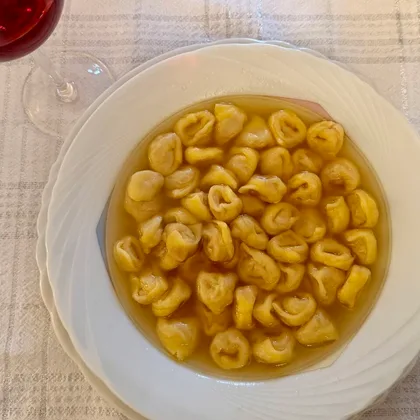 Pasta and breadTortelliniTortellini are tiny ring-shaped egg pasta parcels filled with pork, prosciutto, mortadella and Parmigiano…
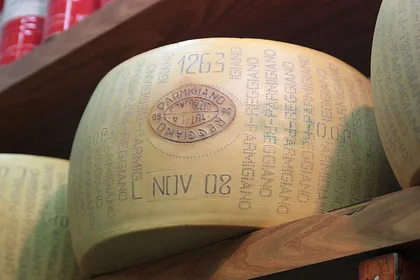 CheeseParmigiano ReggianoThree ingredients and no additives of any kind are permitted: raw cow's milk, salt and calf rennet, from five…
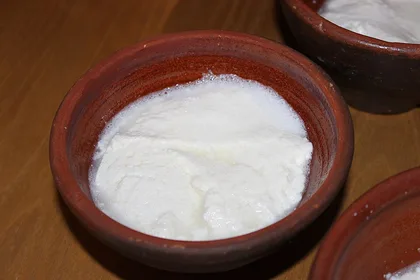 CheeseRicottaRicotta is not a cheese. It is a dairy product made from whey, the liquid left over after cheese has been…
 Pasta and breadCappellettiCappelletti are Emilia-Romagna's filled egg pasta, folded into the shape of a little hat and served in broth…
 Pasta and breadStrozzapretiStrozzapreti are hand-rolled Romagnolo pasta: strips of semolina-and-water dough twisted between the palms…
 Pasta and breadPiadina RomagnolaNo yeast and no waiting: flour, water, salt and lard, rolled thin and cooked dry on a hot plate for two…
 Pasta and breadGnocco FrittoEat it within a minute of the pan, because once it deflates it is over: a diamond of leavened dough fried in…
 Pasta and breadTigelleTigelle are small round breads from the Modena Apennines, cooked between two hot plates and served warm…