What is Tigelle?
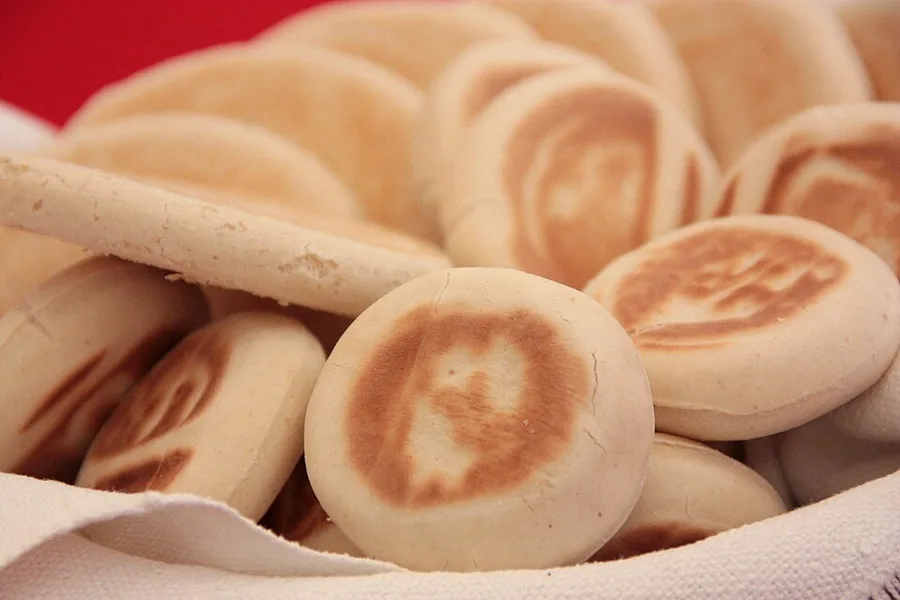
A tigella is a small leavened bread, eight to ten centimetres across and a little over a centimetre thick, made from soft wheat flour, water or milk, lard, yeast and salt. It is cooked by contact between two hot surfaces rather than in an oven, which is why the crust stays pale and thin and the crumb stays dense and slightly springy.
The naming is a live issue in the hills. A tigella is properly the terracotta disc (from the Latin tegula, roof tile) that was heated in the fireplace and stacked around the dough. The bread itself is a crescentina, from crescere, to rise. Around Zocca, Guiglia, Montese and Pavullo people still make the distinction; everywhere else in Italy, tigella won.
Both the old terracotta discs and modern cast-iron plates carry the same engraved motif: a six-petalled rosette known as the flower of life, printed onto the surface of the bread. It is how you identify a tigella in a photograph.
It is not table bread. It is a container: split while hot and filled immediately, so the heat melts whatever goes inside.
What does it taste like?
Mild, faintly milky and clean: the bread is deliberately understated because it is a vehicle. The lard gives it a short, tender crumb and a savoury richness that oil does not, and there is a slight sweetness from the milk in the dough.
The texture is the identifying feature: a thin, soft, matte crust with no crunch, and a close-grained crumb with almost no holes, denser than a bread roll and lighter than a scone. Warm, it is springy; cold, it goes firm and dull, which is why nobody serves it cold.
What you actually taste is usually the filling. The traditional one, cunza, is lard pounded with garlic and rosemary and mixed with grated Parmigiano Reggiano: it melts into the hot bread and turns the whole thing salty, herbal and unapologetically rich.
How to use it
Serve them hot, always, and fill them the moment they come off the plate: the heat is what melts the filling and it is the whole mechanism of the dish.
Make cunza first: pound 100 g of lardo with a garlic clove and a sprig of rosemary in a mortar, then stir in an equal weight of grated Parmigiano Reggiano. Split a hot tigella, spread a teaspoon inside, close it, wait ten seconds. That is the dish the bread was invented for.
Other fillings that belong: prosciutto crudo di Modena, mortadella, squacquerone with rocket, stracchino with speck, salami. Nutella is now standard for children and most adults, and it works.
Eat a filled tigella within a couple of minutes. Left standing, the fat runs and the bread goes soggy.
To revive leftovers: two minutes a side in a dry pan, or eight minutes at 180 °C / 355 °F. Never a microwave: the crumb turns rubbery in thirty seconds and does not come back.
How long it keeps
Fresh tigelle hold a day or two in a paper bag set inside a plastic bag left open at the top: the paper takes up the moisture they give off as they cool, the plastic slows the drying that otherwise leaves the crumb chalky by the second day.
They freeze very well already cooked, stacked in pairs with baking paper between them. They hold about three months, after which the surfaces dry and they begin to pick up freezer smells. Bring them back straight from frozen in a dry pan, five minutes with frequent turning, or eight minutes in a 180°C (355°F) oven. Raw dough freezes too, cut into discs and spaced out on a tray, which is the best way to have freshly cooked tigelle without mixing dough each time.
Never the microwave: the crumb goes rubbery inside thirty seconds and does not recover. Cunza, the lard, garlic and rosemary spread, keeps two weeks in a jar in the fridge under a film of oil, and wants half an hour out before it spreads.
Spot the real thing
A proper tigella is pale, close to white, with irregular golden patches and the six-petal rosette pressed into one face. Evenly golden all over means it was cooked too long; brown means it came out of an oven rather than off a hot plate.
Thickness should be one to one and a half centimetres once cooked. Industrial versions run taller and fluffier, closer to a milk roll: they split badly and the filling slides out. Open one and look at the crumb, which should be dense and fine grained, without big holes. Large holes point to an over-proved or over-hydrated dough. The surface should feel matte and slightly floury; a shiny one has oil in the dough or came off an oiled plate.
On supermarket packs, read the ingredients: many use vegetable oil in place of lard and add preservatives. In an English-speaking shop the lookalike is the English muffin, similar in size and also split and filled, but wetter in the dough, cooked in a ring and dusted with cornmeal. Piadina, on the same shelf, is flat and thin.
How to pronounce Tigelle
tee-JEL-leh
Three syllables, stress on the second. The 'g' before 'e' is soft, as in 'gem': English speakers almost always harden it to 'ti-GEL-uh', which is the single most common error. The final 'e' is 'eh'. One of them is a tigella (tee-JEL-lah). The mountain name, crescentine, is kreh-shen-TEE-neh, with a soft 'sh' in the middle.
Tigelle compared
vsPiadina
The two flatbreads of Emilia-Romagna, and people outside the region routinely confuse them. Piadina is unleavened, rolled thin and wide, cooked on a flat griddle and folded around a filling. Tigelle are leavened, small, thick, cooked between two plates, and split open like a bun. Piadina comes from Romagna, on the coastal side; tigelle from the Modena mountains inland.
| This | Piadina | |
|---|---|---|
| Where from | Modena Apennines, Emilia | Romagna, from Rimini to Ravenna |
| Leavened | Yes: hence 'crescentine' | No, or barely |
| Size | 8-10 cm across, 1-1.5 cm thick | 20-30 cm across, 2-5 mm thick |
| Cooked | Between two plates | On a single flat griddle or testo |
| Served | Split horizontally and filled | Folded in half around the filling |
| Classic filling | Cunza (lard, garlic, rosemary, parmesan) | Squacquerone, rocket, prosciutto |
| Fat in the dough | Lard, generously | Lard or olive oil, less of it |
vsGnocco fritto
The other thing that arrives on the same table in the same restaurants, and a completely different technique. Gnocco fritto is the same family of dough cut into diamonds and deep-fried until it puffs into a hollow pillow. It is eaten hot, immediately, draped with prosciutto that melts against it. Tigelle are baked on a plate, keep better, and are filled rather than wrapped.
| This | Gnocco fritto | |
|---|---|---|
| Cooking method | Pressed between hot plates | Deep-fried in lard or oil |
| Shape | Round disc, flat | Diamond or rectangle, puffed hollow |
| Texture | Soft, dense crumb | Crisp shell, hollow inside |
| How eaten | Split and filled | Torn, with cured meat laid over it |
| Shelf life | A day or two, freezes well | Ten minutes |
| Same territory | Modena and Bologna | Modena, Reggio, Parma |
vsEnglish muffin
Visually the closest thing in the English-speaking world, and a genuinely useful reference point: both are small round leavened breads cooked on a hot surface rather than in an oven, and both are split and filled. But an English muffin is made from a very wet dough, cooked in a ring, dusted with semolina and full of open holes; a tigella is a firm rolled dough, enriched with lard, with a close crumb and no holes at all.
| This | English muffin | |
|---|---|---|
| Dough | Firm, rolled and cut with a cutter | Very wet, scooped into rings |
| Fat | Lard, 8-10% of flour weight | Little or none |
| Crumb | Close and fine, no holes | Open, full of nooks |
| Surface | Smooth, printed with a rosette | Dusted with semolina or cornmeal |
| Split with | A knife, cleanly | A fork, to keep the texture |
| Eaten | Warm, with cured meat or cheese | Toasted, with butter |
Tigelle substitutes
- English muffins
The best supermarket stand-in for the job tigelle do: split, warm, fill. Toast them lightly rather than to a crunch, because a tigella has no crunch. The texture inside will be more open, so a soft filling will fall through.
1:1 - Homemade, in a dry frying pan
You do not need the special plate. Roll the dough 6 mm thick, cut 9 cm discs, prove them thirty minutes, and cook in a dry cast-iron pan for four to five minutes, turning halfway. You lose only the printed rosette.
1 kg flour : 500 g milk and water : 90 g lard : 15 g fresh yeast : 20 g salt, makes about 30 - Pita or Middle Eastern flatbread
Works structurally (it opens into a pocket), but it is thinner, drier and unenriched. Warm it properly and add a little butter or olive oil inside to compensate for the missing lard.
1:1 - Small focaccine or soft rolls
Any small, soft, low-crust roll will carry the fillings. Avoid anything with a hard crust or heavy sourdough tang: the point of a tigella is that it does not compete with what is inside.
1:1 - Vegetarian: the lard question
Traditional tigelle contain lard in the dough, and the classic filling is pounded lardo, so neither is vegetarian by default. Butter at the same weight makes an excellent dough, slightly less short than lard. For the filling, pound rosemary and garlic into softened butter or good olive oil with plenty of grated hard cheese; note that Parmigiano Reggiano itself uses calf rennet, so use a microbial-rennet grana if that matters.
Butter 1:1 for lard in the dough - Packaged tigelle
Sold across Italy and in some Italian delis abroad. They are taller, softer and usually made with vegetable oil rather than lard, which makes them closer to a milk bun. Refresh them in a dry pan for two minutes a side before filling; the microwave ruins them.
Where to buy it
Outside Italy this is a hard product to buy and an easy one to make. In the US, a few Italian importers ship vacuum-packed tigelle, and some Italian delis in the Northeast carry them; expect 6 to 10 dollars for a pack of eight to ten. In the UK, occasional stock at Italian delicatessens and online importers at 3 to 6 pounds a pack.
The cast-iron double plate is the thing worth buying, and it ships easily: 25 to 60 euros from Italian kitchenware suppliers, or the equivalent from online marketplaces. Electric tigelliere cost more and are less good. A plain cast-iron frying pan does 90 per cent of the job for nothing.
In Italy, a Modena bakery sells them at 6 to 10 euros a kilo, roughly 40 to 80 cents each, in bags of eight or ten. Supermarket packs run 2 to 3.50 euros for eight to ten and almost always list vegetable oil instead of lard.
What to check on a packet: lard (strutto) in the ingredients, thickness no more than 1.5 cm, and a pale colour with irregular golden spots. Uniform brown means oven-baked.
Where to eat it in Italy
In the Modena Apennines, and it is worth actually driving up. In Zocca, Guiglia, Montese and the villages of the Frignano, trattorie and village clubs cook crescentine to order, and several still keep the old terracotta discs for demonstrations.
Summer village festivals from June to September are the best window, and also the place to learn that tigella and crescentina are the same object seen from two altitudes: asking an elderly local in Zocca for 'tigelle' reliably produces a polite correction.
In Modena itself, the tigellerie cluster around the edge of the centre and are often open only in the evening. Bologna adopted the format over the last twenty years: more touristy, still good.
While you are up there, look for the borlengo, the paper-thin cousin from Guiglia and Zocca: a plate-wide wafer, crisp as a sheet of glass, dressed with the same cunza. Eating one after a tigella explains more about contact cooking than any description.
Recipes with it
Frequently asked questions
How do you pronounce tigelle?
tee-JEL-leh, three syllables, stress on the second. The 'g' is soft as in 'gem', not hard as in 'get': hardening it is the most common English mistake. The final 'e' is a clear 'eh'.
Are tigelle and crescentine the same thing?
Yes. Crescentine is the name of the bread; tigella was the hot terracotta disc it was cooked between. In the Modena mountains the distinction is still made, elsewhere in Italy tigella has become the everyday word for the bread itself.
What do you put in a tigella?
Traditionally cunza, also called pesto modenese: lard pounded with garlic and rosemary, mixed with grated Parmigiano Reggiano, spread inside while the bread is hot so it melts. Modern fillings include prosciutto, mortadella, squacquerone with rocket, stracchino, salami, and Nutella.
Can you make tigelle without the special iron?
Yes. A dry cast-iron pan over medium heat cooks them in four to five minutes, turning once. You lose only the six-petalled rosette printed by the plates and a little evenness at the edges.
Are tigelle vegetarian?
Not traditionally. The dough contains lard, and the classic cunza filling is pounded lardo. Butter substitutes well for lard in the dough at the same weight, and a rosemary-garlic butter or olive oil paste with hard cheese replaces the filling.
Related foods
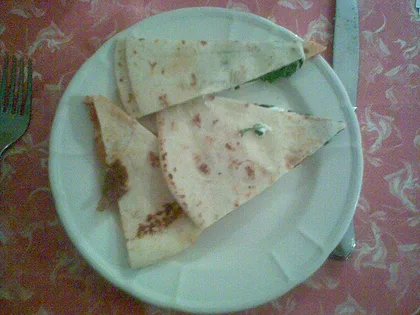 Pasta and breadPiadina RomagnolaNo yeast and no waiting: flour, water, salt and lard, rolled thin and cooked dry on a hot plate for two…
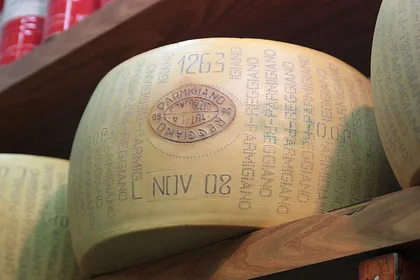 CheeseParmigiano ReggianoThree ingredients and no additives of any kind are permitted: raw cow's milk, salt and calf rennet, from five…
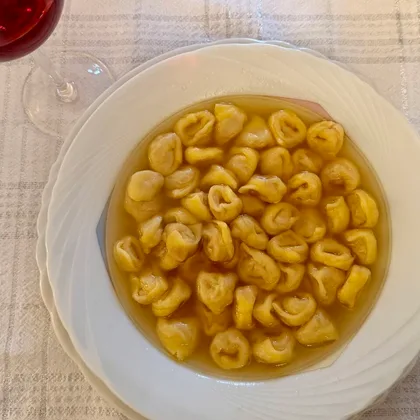 Pasta and breadTortelliniTortellini are tiny ring-shaped egg pasta parcels filled with pork, prosciutto, mortadella and Parmigiano…
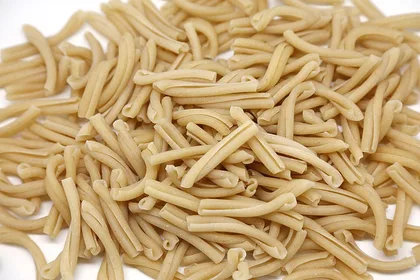 Pasta and breadStrozzapretiStrozzapreti are hand-rolled Romagnolo pasta: strips of semolina-and-water dough twisted between the palms…
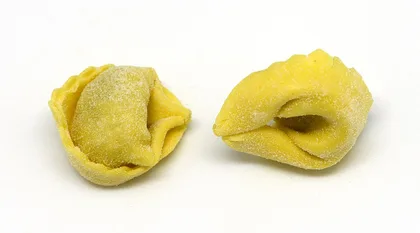 Pasta and breadTortelloniSeven-centimetre squares of egg pasta filled with ricotta and parsley, folded into a little hat.
 Pasta and breadCappellettiCappelletti are Emilia-Romagna's filled egg pasta, folded into the shape of a little hat and served in broth…
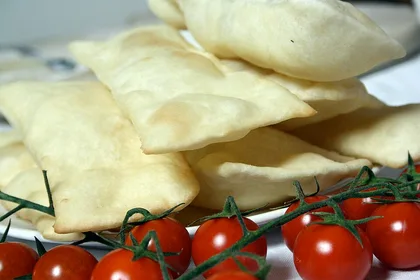 Pasta and breadGnocco FrittoEat it within a minute of the pan, because once it deflates it is over: a diamond of leavened dough fried in…
 Pasta and breadCoppia FerrareseCoppia ferrarese is a twisted, four-horned bread from Ferrara made with lard in the dough.