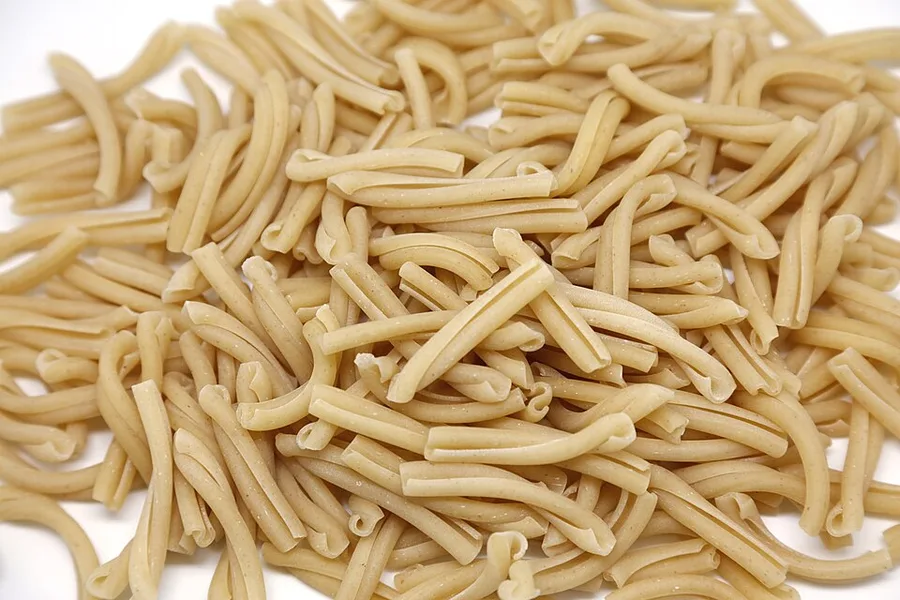
What is Strozzapreti?
Strozzapreti come from Romagna, the eastern half of Emilia-Romagna, and they are about as simple as pasta gets: durum semolina, water, salt. The dough is rolled out thick, cut into finger-wide strips, and each strip is rolled between the palms with a sharp twist and snapped off by hand.
What you get is a chunky, uneven twist with a partial hollow running through it. The roughness and the twist are the whole engineering: they hold thick meat sauces the way a smooth extruded shape cannot. Fresh, they cook in three or four minutes and stay firm, because there is no egg to soften them.
Dried, factory-made strozzapreti exist too, extruded through shaped dies. Versions of the shape also turn up in Umbria, Tuscany and Le Marche, sometimes shorter, sometimes with a little egg, but Romagna is where the shape is everyday food rather than a regional curiosity.
What does it taste like?
The flavour is pure durum wheat: nutty, faintly sweet, clean. What sets strozzapreti apart is the bite. The twist means each piece has thick and thin sections, so a single mouthful gives you a chewy core and softer edges at the same time, a texture no uniform extruded pasta produces.
They are noticeably firmer and more substantial than egg pasta like tagliatelle, and rougher on the tongue than dried penne. The twist and the hollow give a thick sauce somewhere to sit, which is the point.
Eaten plain with butter and Parmigiano they taste like good bread dough boiled: humble, wheaty, satisfying. Under a sausage ragù they disappear into the dish in the right way.
How to use it
Cook fresh strozzapreti for three or four minutes and dried for eight or nine, always a minute less than you think, because they finish in the pan. Salt the water hard: this is unsalted, eggless dough and it needs it.
Drain them early, keep a mugful of the cooking water, and toss them in the pan with the sauce over a lively heat for a minute. The semolina releases enough starch that a splash of that water turns any sauce glossy and makes it stick.
The canonical pairings are the drier Romagnolo meat ragù, or crumbled Italian sausage cooked out with a splash of Sangiovese and finished with rocket and fresh tomato. On the Adriatic coast, the same shape goes with clams, cuttlefish and peas, or a seafood ragù, in which case no cheese.
They are wrong for delicate cream sauces and wrong for anything that should coat a strand, like carbonara or a fine tomato passata. Use them where the sauce has texture.
How long it keeps
Dried strozzapreti keep to the date on the bag, generally about two years, in a cupboard away from light, heat and steam. Once the bag is open, move them to a jar or clip it shut: durum semolina draws in moisture from the air and takes on kitchen smells, and pasta that has sat open in a humid kitchen cooks unevenly and loses its snap. Fresh strozzapreti from a pasta counter run two or three days, dusted with semolina in a container that is not sealed tight, because in an airtight box they sweat and weld into a lump.
Raw fresh pasta freezes cleanly. Spread the pieces apart on a tray, freeze until hard, then bag them for up to two months and drop them into boiling water without thawing, allowing an extra minute. What you lose is a little surface texture, not shape. Cooked and dressed leftovers hold a day in the refrigerator, where the pasta keeps absorbing sauce and firms as it cools; a pan with a couple of spoons of water brings them back better than a microwave. The bag and the maker are the reference.
Spot the real thing
Hand-rolled strozzapreti are never twins. Length, thickness and the number of turns change piece to piece, and the ends are torn rather than cut, so a fresh-pasta tray of identical pieces came off a machine. In dried pasta the die does the talking: bronze leaves a chalky, matte, faintly floury surface, while a Teflon die gives a smooth glossy finish. Good bags state the wheat origin and the drying regime, and slow drying below fifty degrees is the one worth paying for. The colour should be soft straw; a deep golden yellow in a pasta with no egg on the label is worth questioning.
On a foreign shelf the shape most often sold under the name is really casarecce, machine-extruded, short and grooved with the same fold along its length in every piece. Gemelli, cavatelli and trofie are further neighbours. Note also that strangolapreti, the Trentino version of the name, is not pasta at all but a bread and spinach dumpling. Supermarket bags sit near two dollars for 500 grams; bronze-die artisan brands run three to four times that.
How to pronounce Strozzapreti
stroht-tsah-PREH-tee
Five syllables, stress on the fourth. The double 'z' is a hard 'ts' sound, held a beat longer than a single one, not the English 'z' buzz. 'Pre' rhymes with 'pray' but without the glide at the end, and the final 'i' is 'ee'. Common errors: 'strozza-PRAY-tee' with a drawled vowel, 'STROZZ-a-pretty', and treating the 'z' as in 'zebra'.
Strozzapreti compared
vsCasarecce
The two shapes get confused constantly because both are twisted and both suit chunky sauces, but they come from opposite ends of Italy and behave differently. Casarecce are Sicilian, short, machine-extruded into a neat rolled S, and uniform. Strozzapreti are Romagnolo, longer, hand-rolled and deliberately irregular. If a recipe calls for strozzapreti, casarecce are the best supermarket substitute, but expect a tidier plate.
| This | Casarecce | |
|---|---|---|
| Origin | Romagna (Emilia-Romagna) | Sicily |
| Shape | Twisted cylinder, uneven, torn ends | Rolled S-scroll, uniform, cut ends |
| Length | 4-6 cm, varies piece to piece | 2.5-3 cm, consistent |
| How made | Rolled between the palms | Bronze or teflon extrusion |
| Dough | Semolina and water, no egg | Semolina and water, no egg |
| Cook time | 3-4 min fresh, 8-9 dried | 9-11 min dried |
| Best sauces | Sausage ragù, meat, seafood | Pesto, tomato, ricotta, vegetables |
| Availability (US/UK) | Italian delis, some supermarkets | Most supermarkets |
vsCavatelli
Both are hand-formed semolina-and-water pastas from central-southern Italy, and both are made without any tool but your hands. Cavatelli are dragged with a thumb or two fingers into a small hollow shell; strozzapreti are rolled into a twist. Cavatelli catch sauce inside, strozzapreti catch it around. Cavatelli are far easier to find in the US, where Italian-American communities kept them alive.
| This | Cavatelli | |
|---|---|---|
| Origin | Romagna | Molise, Puglia, Basilicata, Campania |
| Shape | Rolled twist, 4-6 cm | Small hollow shell, 2-3 cm |
| Formed by | Rolling between the palms | Dragging with the thumb |
| Texture | Chewy, uneven bite | Denser, more uniform, very chewy |
| Classic sauce | Sausage ragù, seafood | Broccoli rabe, ricotta, tomato |
| US availability | Limited | Good: frozen and dried both common |
vsGemelli
Gemelli is the shape most American shoppers reach for when they cannot find strozzapreti, and it is a reasonable instinct: a short extruded twist that looks like two strands wound together, though it is actually one strand folded on itself. It is more regular, thinner and shorter, and lacks the irregular thick-thin bite. It works as a stand-in; it is not the same shape.
| This | Gemelli | |
|---|---|---|
| Type | Hand-rolled, regional | Industrial extruded, pan-Italian |
| Shape | Loose twist with partial hollow | Tight double-helix look, solid |
| Size | 4-6 cm | 3-3.5 cm |
| Bite | Uneven, thick core | Even, springy |
| Where the sauce sits | In the twist and the hollow | Around the coils |
| Price (US) | $5-9 per lb imported | $2-4 per lb |
Strozzapreti substitutes
- Casarecce
The closest widely available shape and the first thing to reach for. Slightly shorter and neater, identical dough, holds the same sauces. Cook it a minute short of the packet time and finish it in the pan with the sauce.
1:1 by weight - Gemelli
Available in almost every American supermarket and visually the nearest match. Denser and more regular, so the plate looks tidier and eats a little springier. Very good with sausage and cream sauces.
1:1 - Trofie
Ligurian rather than Romagnolo, thinner and more tapered, but also a hand-rolled twist of semolina and water. Best when the sauce is on the lighter side (pesto, vegetables, seafood) since trofie are smaller and get overwhelmed by a heavy ragù.
1:1, and reduce the sauce quantity by about a fifth - Cavatelli
A different geometry that solves the same problem. Frozen cavatelli sold in US Italian markets are excellent and cook straight from the freezer. Their hollow traps sauce inside rather than around, so a looser sauce works better.
1:1 - Fusilli or busiate
The default supermarket fallback. Busiate, the Sicilian long coil, is genuinely close in spirit; standard short fusilli is a compromise that at least keeps the twist. Both hold sauce reasonably; neither gives you the uneven bite.
1:1 - Make them yourself
Faster than shopping for a substitute. 300g fine semolina, about 150ml warm water, a pinch of salt, kneaded for ten minutes and rested for thirty. Roll out, cut finger-wide strips, roll each between your palms and snap. No tools, no egg, naturally vegan.
300g semolina + 150ml water serves three
Where to buy it
In the US, dried bronze-die strozzapreti from producers such as Rustichella d'Abruzzo, Sfoglini and Garofalo turn up at Whole Foods, Eataly and online, at roughly $5 to $9 per pound. Italian markets in the Northeast sometimes carry them fresh. If you cannot find the name, buy casarecce or gemelli and move on.
In the UK, Waitrose, Ocado and Italian delis carry dried strozzapreti at about £3 to £5 for 500g, or £6 to £10 per kilo. Natoora and several Italian importers ship fresh.
On a dried pack, bronze die (trafilata al bronzo) tells you the surface will be rougher. Slow drying (essiccazione lenta) is the maker's own claim: no law defines it. Both are usually printed on the front, because producers who do it charge for it.
Where to eat it in Italy
Romagna, and specifically the triangle between Santarcangelo di Romagna, Cesena and Forlì, where trattorie still roll pasta every morning. Ask for strozzapreti alla salsiccia and you will get the version most locals actually eat.
The inland village festivals of the Rimini hills, running from June to September, serve them under meat ragù in portions no restaurant would dare.
On the coast, from Cesenatico down to Cattolica, the seafood versions dominate: clams, cuttlefish, mantis shrimp. In Bologna you will find them on menus, but you are in tagliatelle and tortellini country there; strozzapreti are a visitor from down the road.
Recipes with it
Frequently asked questions
What does strozzapreti mean?
Priest-stranglers. Two stories circulate in Romagna, neither documented: that farmhouse cooks rolled the dough as if wringing the neck of the priest who claimed a share of the harvest, or that greedy priests choked on them. The region's long-standing anticlerical streak keeps the first version popular.
Do strozzapreti contain egg?
The traditional Romagnolo recipe does not: only durum semolina, water and salt, which makes them naturally vegan. Some Umbrian and Marchigiano versions add an egg or a splash of milk, and a few fresh-pasta brands do too, so check the label if it matters.
What is the difference between strozzapreti and casarecce?
Casarecce are Sicilian, short, uniform and extruded into a rolled S. Strozzapreti are Romagnolo, longer, hand-rolled into an irregular twist with torn ends. They suit the same sauces, which is why casarecce are the best substitute.
How do you pronounce strozzapreti?
stroht-tsah-PREH-tee, with the stress on the fourth syllable. The double z is a 'ts' sound, not an English z.
What sauce goes with strozzapreti?
Something with texture. Sausage ragù, a dry meat ragù, or a coastal sauce with clams or cuttlefish. Save the smooth, silky sauces for long strands: strozzapreti are built to trap chunks.
Related foods
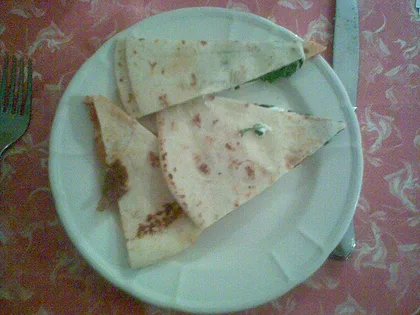 Pasta and breadPiadina RomagnolaNo yeast and no waiting: flour, water, salt and lard, rolled thin and cooked dry on a hot plate for two…
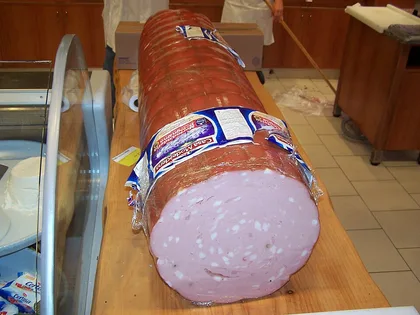 Cured meatsMortadellaThe white cubes are not just any fat: they are jowl, the firmest part of the pig, and they stay whole…
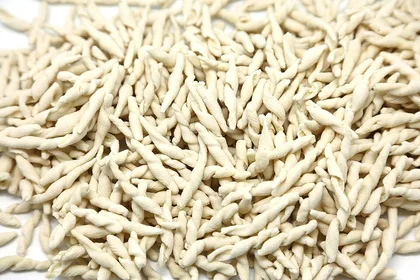 Pasta and breadTrofieTrofie are the pasta that pesto was made for: short, tapered twists of flour and water, rolled one by one…
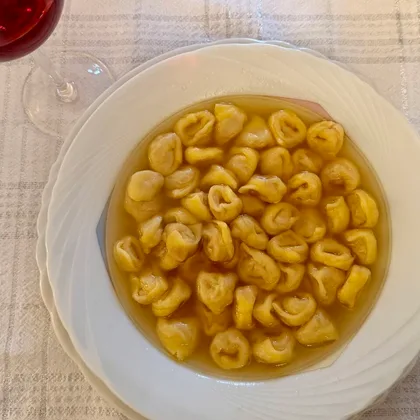 Pasta and breadTortelliniTortellini are tiny ring-shaped egg pasta parcels filled with pork, prosciutto, mortadella and Parmigiano…
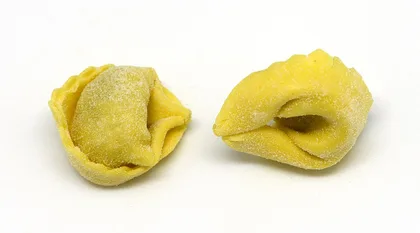 Pasta and breadTortelloniSeven-centimetre squares of egg pasta filled with ricotta and parsley, folded into a little hat.
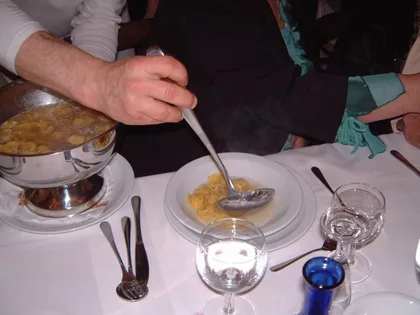 Pasta and breadCappellettiCappelletti are Emilia-Romagna's filled egg pasta, folded into the shape of a little hat and served in broth…
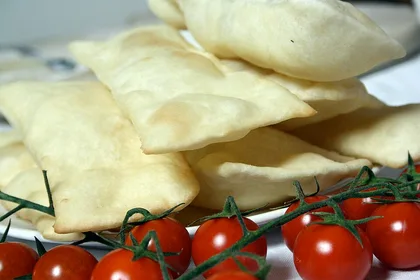 Pasta and breadGnocco FrittoEat it within a minute of the pan, because once it deflates it is over: a diamond of leavened dough fried in…
 Pasta and breadTigelleTigelle are small round breads from the Modena Apennines, cooked between two hot plates and served warm…