How Italian cheese is aged
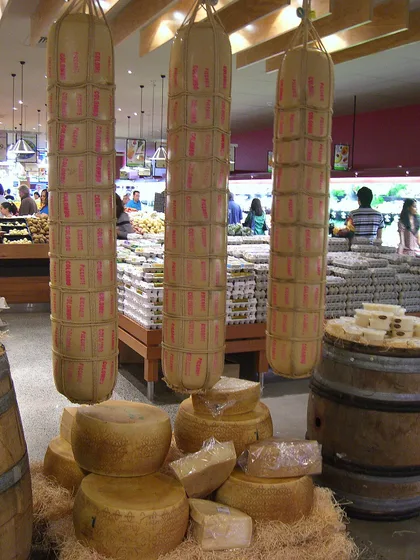
Ageing, stagionatura, is the controlled loss of water and the slow enzymatic breakdown of proteins and fats. Italian minimums are written into law: Parmigiano Reggiano at least 12 months, Grana Padano 9, Pecorino Romano 5, Taleggio 35 days, Gorgonzola dolce 50.
Three processes run at once in an ageing cheese. Water evaporates, so everything else concentrates, including salt. Proteolysis breaks casein down into peptides and then free amino acids, which is what produces savoury depth and, in a long-aged hard cheese, the crunchy white crystals people mistake for salt or sugar: they are tyrosine, an amino acid that has precipitated out. Lipolysis breaks fats into free fatty acids, which is the source of the piquancy in Pecorino and in aged provolone, particularly when the cheese was made with rennet paste rather than liquid rennet. None of this is decoration. It is why a 36-month wheel tastes nothing like a 12-month one cut from the same dairy.
The minimums are legal, not stylistic. Parmigiano Reggiano must age at least 12 months, and at that point every single wheel is inspected by the Consortium's esperti battitori, who tap it with a small hammer and read the sound for internal flaws. Wheels that pass are branded with the fire mark; second-choice wheels get parallel grooves cut into the rind and are sold as mezzano; wheels that fail lose their pin-dot markings entirely and cannot use the name. Commercially the interesting range starts later: 24 months for balance, 30-36 for concentration and crystals, beyond that for a specific taste. Grana Padano requires 9 months and its Riserva more than 20. Pecorino Romano requires 5 months, and 8 if it is sold for grating. Taleggio DOP needs 35 days, Gorgonzola DOP 50 for dolce and 80 for piccante, Asiago Pressato around 20 days against many months for Asiago d'Allevo in its mezzano, vecchio and stravecchio grades.
The room matters as much as the calendar. Wheels are salted first, usually in brine (Parmigiano spends around three weeks floating in saturated brine before it ever sees a shelf) then moved to cellars held at low temperature and high humidity, on wooden boards that host their own microflora and are one reason industrial-scale ageing on plastic behaves differently. Rinds are managed, not left alone: a natural rind is brushed and turned, a washed rind is wiped repeatedly with brine so a bacterial smear develops and the paste under it softens, as with Taleggio; other rinds are oiled, ashed or wrapped. Ageing is labour, and it is the reason a 36-month wheel costs what it costs.
Italy also ages cheese in places that make no obvious sense, which is where the tradition gets interesting. Formaggio di Fossa di Sogliano DOP is sealed into tufa pits in late summer and left underground in an anaerobic, humid environment until the pits are opened in late autumn, traditionally around 25 November, Saint Catherine's day; the cheese comes out deformed, greasy and enormously savoury. Ubriaco is buried in grape marc or bathed in wine. Pecorini are wrapped in walnut leaves, in hay, or matured in wooden barrels. Bitto DOP may be produced only between 1 June and 30 September, in mountain huts during the alpine grazing season, and can be aged for a decade. Castelmagno DOP left long enough in a cave develops blue veining on its own, with no inoculation at all.
Practical notes. Store hard cheese in waxed or parchment paper, then loosely in foil: cling film suffocates it and makes it sweat. The rind of Parmigiano Reggiano is not a coating but the cheese's own dried surface, and it is edible: the standard Italian use is to drop it into soup or broth. Break a hard cheese apart with an almond-shaped knife rather than slicing it, so the grain shows. Serve at room temperature, always. And resist the assumption that more months mean a better cheese: at 24 months Parmigiano still melts into pasta water, at 40 it will be brittle and salty and better on its own with a few drops of aged balsamic. Age is a variable to choose, not a score to maximise.
Guides that cover this
Frequently asked questions
What are the crunchy white bits in aged Parmigiano?
Tyrosine crystals, an amino acid released as proteins break down during ageing, which precipitates out as the cheese loses water. They are a sign of long maturation, not of salt or added sugar, and they are entirely edible.
Can you eat the rind of Parmigiano Reggiano?
Yes. The rind is the cheese's own dried surface, with no wax or coating. It is too hard to eat raw in quantity, but the standard use is to simmer it in soups and broths, where it dissolves slowly and adds savour.
How long is Parmigiano Reggiano aged?
At least 12 months by law, when every wheel is inspected and branded, downgraded or rejected. Most cheese sold as good eating Parmigiano is 24 months or older; 30-36 months gives the concentrated, crystalline style.
Does longer ageing always mean better cheese?
No. Ageing changes a cheese rather than improving it linearly. A 24-month Parmigiano melts and balances better in cooking, while a 40-month wheel is drier, saltier and more intense, which suits a cheese board rather than a sauce.