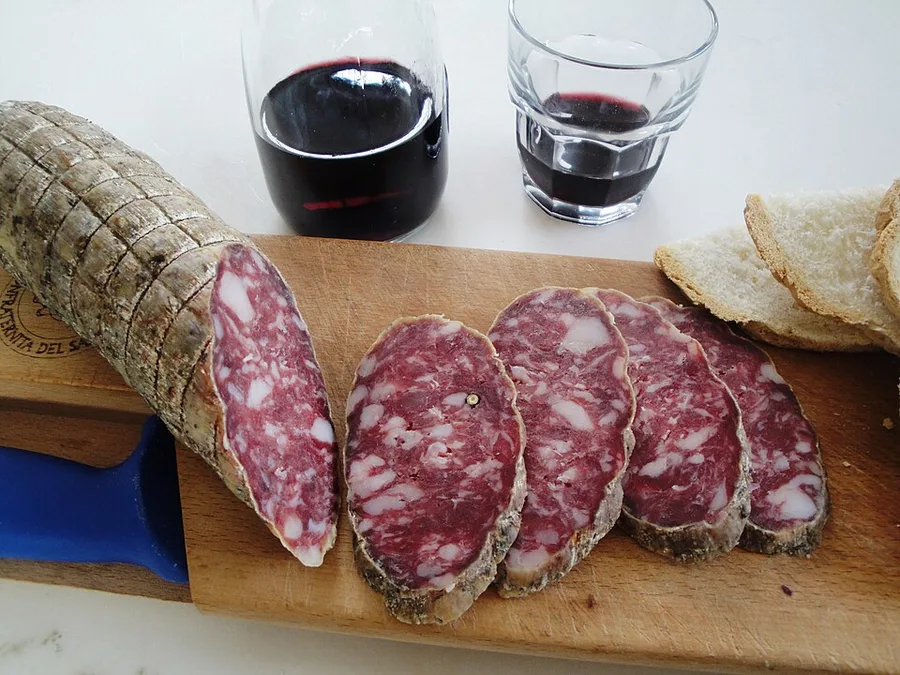
What is Salame di Varzi?
Salame di Varzi is made exclusively from Italian heavy pigs, ground to a medium grain, stuffed into natural casing and tied by hand. It has held DOP status since 1996, a level of protection very few Italian salami reach, and production is confined to around fifteen villages in the Staffora valley, in the province of Pavia.
The defining detail sounds trivial and is not. No chopped garlic goes into the mix. Crushed cloves are steeped in red wine for hours, the liquid is strained, and only that infusion is worked into the meat. You get the perfume of garlic without its bite, and without the aftertaste that lingers into the next day.
The second distinguishing choice is the meat. The rules require prime cuts (leg, shoulder, fillet, loin) with belly, jowl and coppa supplying fat. This is not a salami built from trimmings, which is why the slice stays red, firm and sweet after months in a cellar.
Four formats exist, and they are really four ageing lengths: filzetta, filzettone, sottocrespone and cucito, from half a kilo to a little over two. The casing changes, the diameter changes and the time changes, from six weeks to six months. The mixture never does.
What does it taste like?
Sweet, meaty and clean, with a soft aromatic haze rather than a spice hit. If you have eaten Italian salami mostly in the fennel-and-chilli register, Varzi will read as restrained: pepper is the only assertive seasoning, and it arrives in occasional cracked bursts rather than as a constant background.
The wine infusion is the interesting part. It gives a faint vinous sweetness up front and a rounded, almost floral finish, and the garlic sits behind it like a memory. People who dislike garlicky salami usually like this one and cannot say why.
Texture depends on format. A young filzetta is soft, moist and mild, closer to a fresh salami. A six-month cucito is firmer, darker and more concentrated, with the fat gone slightly translucent and a nutty depth that the small formats never develop.
How to use it
Slice it by knife, on the diagonal, three to four millimetres thick: enough body to hold the grain, thin enough for the fat to melt on the tongue. Take it out of the fridge half an hour before serving; cold fat is waxy and gives away nothing.
In Varzi it is eaten with the valley's plain wheat bread, with focaccia and, in the local combination outsiders never expect, with Apennine chestnut honey. The honey is bitter rather than sweet, and it pushes the meat's sweetness forward.
It cooks well, though using a six-month cucito for cooking is a waste. Dice a young filzetta into risotto or a chickpea soup; the ends and trimmings go into ravioli fillings and the vegetable tarts made all over the Oltrepò.
On a board, keep the neighbours quiet. Varzi is sweet and lightly spiced, and it vanishes next to hot sausage or smoked speck. Bread, pickled onions, a young goat cheese and a glass of fizzy Bonarda is the whole plate.
How long it keeps
An uncut salami hangs in a cool, dark, airy place at 10 to 15°C with moderate humidity, where it carries on doing what it has done since it was made: losing water, firming up and shrinking while the flavour concentrates. Vacuum packed, it sits in the fridge until the producer date, usually months out. From the moment you cut it, the exposed face is the part that moves, drying and darkening within a day or two, so cover it with baking paper or press a saved piece of casing against it rather than sealing it under film.
Peel the casing back only as far as you are cutting, since bare surface dries quickest. Over weeks the fat turns from white to ivory and then yellowish as it oxidises, the aroma sharpens and the pepper note fades. If a piece has hardened further than you want, the local habit is to wrap it in a cloth moistened with white wine for a few hours, which softens the outer centimetre. Sliced packs curl within hours of opening; slices freeze a couple of months, coming back slightly grainy in the fat.
Spot the real thing
The slice is coarse, with large clean cubes of pure white fat set in deep ruby meat, and it should be soft enough that the fat looks on the point of melting. The seasoning list is famously short: salt, whole and cracked black pepper, and a red wine infusion made with garlic. No fennel, no chilli, no paprika, no herbs. The casing is natural gut, hand tied with string, dusted with the white surface bloom of curing and peeled back a few slices at a time. The DOP name covers four formats by size and ageing: Filzetta, Filzettone, Sottocrespone and the sewn Cucito, aged around six months.
On a deli counter abroad it sits next to salamis it is nothing like. Milano is finely ground with fat the size of rice grains, Napoli is smoked and hot, Felino is coarse but differently seasoned and tied, and Genoa salami in American shops is a category rather than a place. Anything reading Varzi style is not the DOP. In the Oltrepò Pavese it runs 20 to 30 euro a kilo, and $22 to $35 a pound through Italian importers abroad.
How to pronounce Salame di Varzi
sah-LAH-meh dee VAR-tsee
The tricky part is the z: in Varzi it is a crisp 'ts', as in 'pizza', not the English 'z' of 'zebra'. VAR-tsee, stress on the first syllable. Salame ends in a pronounced 'eh': sah-LAH-meh, never 'sa-lah-may'.
Salame di Varzi compared
vsSalame Milano
The two most exported Lombard salami are opposites in texture. Milano is ground extremely fine, to a grain the classic reference puts at the size of a rice kernel, so the slice looks like a smooth pink field flecked with tiny white dots, and it is designed for the machine slicer and the sandwich. Varzi is ground two or three times coarser, so you see and feel individual pieces of meat and fat. Milano is seasoned with garlic and white wine directly; Varzi uses the strained red-wine infusion. Milano is made across a huge area; Varzi comes from fifteen villages.
| This | Salame Milano | |
|---|---|---|
| Grind | Medium-coarse, 6–8 mm | Very fine, rice-grain size |
| Garlic | Steeped in wine, then strained out | Added directly to the mix |
| Wine | Red | White, usually |
| Protection | DOP, area strictly limited | No DOP or IGP |
| Ageing | 45 days to 6 months | 3 weeks to 3 months |
| Slice | By knife, 3–4 mm | Machine, paper-thin |
| Best use | Board, with bread and Bonarda | Sandwiches, panini, pizza |
vsSalame Felino IGP
The closest relative, and the fairest comparison: both are sweet, low-spice, pork-only salami with natural casing and a hand-tied finish, from neighbouring stretches of the Po plain foothills. Felino, from the hills of Parma, uses dry white wine and only a whisper of pounded garlic, is slightly coarser and often curves with the shape of the gut. Varzi uses red wine with strained garlic, is a touch denser, and comes in four regulated formats. Felino carries an IGP, which protects the processing zone; Varzi carries a DOP, which is stricter.
| This | Salame Felino IGP | |
|---|---|---|
| Region | Oltrepò Pavese, Lombardy | Hills of Parma, Emilia |
| Wine | Red, as a strained garlic infusion | Dry white, added directly |
| Shape | Straight cylinder, four sizes | Slightly curved, one end thicker |
| Protection | DOP since 1996 | IGP since 2013 |
| Minimum ageing | 45 days (filzetta) | 25 days |
| Flavour | Sweet, vinous, faint garlic | Sweeter still, more delicate |
Salame di Varzi substitutes
- Salame Felino IGP
The nearest thing on the shelf, and reasonably easy to find outside Italy. Sweet, pork-only, low on spice. Slightly more delicate than Varzi, so it works anywhere Varzi does.
1:1 - Sopressa Vicentina or another sweet northern salami
Coarser and softer than Varzi, but in the same flavour family: no chilli, no fennel, no smoke. Cut it thicker than you would cut Varzi.
1:1 - Genoa salami (US supermarkets)
Widely available and closer than Milano-style in grain size, though usually more heavily garlicked and often tangier from faster fermentation. Choose the least tangy one you can taste before buying.
1:1 - Make the infusion yourself
If you cure at home, the Varzi trick is worth stealing: crush four garlic cloves into 100 ml of red wine, leave for six hours, strain, and use the liquid for a kilo of coarsely ground pork. Bin the solids.
100 ml wine and 4 cloves per kg of meat - Pork-free: beef or venison salami without spice
There is no cured beef equivalent, but an unspiced beef salami served with bread, chestnut honey and a lightly fizzy red reproduces the way Varzi is eaten in the valley. Expect a leaner, more mineral flavour.
1:1 - Halal or kosher certified salami
Varzi is pork, with no pork-free version. Certified beef or lamb salami is the practical answer, but be aware that these are entirely different products: buy them on their own terms rather than as an imitation.
Where to buy it
In Italy, buy in Varzi itself or from producers in the Staffora valley; delicatessens in Pavia and Milan carry it reliably. Look for the words Salame di Varzi DOP and the format name. Anything sold as 'Varzi-style' has no rules behind it at all.
Export volumes are small. In the US, specialist Italian importers list it at 24 to 36 dollars per pound when it appears; in the UK, expect 34 to 50 pounds per kilo at Italian delicatessens. Several valley producers ship within Italy and the EU, which is by far the cheapest route for European buyers.
If you are buying your first one, take a filzettone rather than a filzetta: it costs slightly less per kilo, has had a couple of months to settle, and still finishes before it dries out in a home kitchen.
Where to eat it in Italy
Varzi itself: a medieval hill town of two thousand people with towers, low arcades, cobbled lanes and the Malaspina castle. The salami shops and trattorie are all within the old walls, and differences between producers are audible enough that it is worth tasting in two or three before buying.
The DOP villages along the valley: Bagnaria, Ponte Nizza, Godiasco, Rivanazzano Terme, and higher up Fortunago, Zavattarello and Romagnese, all within half an hour of switchback road. Osterie there serve the salami as a first course and agnolotti straight after.
The wider Oltrepò Pavese makes an easy two-day trip from Milan or Pavia: Bonarda and Pinot Nero cellars around Santa Maria della Versa and Casteggio, the castle at Zavattarello, and Monte Penice on the Apennine ridge. On clear days from the crest above Varzi you can see the sea at Genoa.
Further reading
Frequently asked questions
Why can't you taste the garlic in Salame di Varzi?
Because there is no chopped garlic in it. Crushed cloves are steeped in red wine, the wine is strained, and only the liquid goes into the mince. The salami keeps the aroma and loses the sharp bite and the lingering aftertaste.
What are filzetta, filzettone, sottocrespone and cucito?
The four official formats, which differ in casing, weight and ageing. Filzetta is about half a kilo and ages six weeks; filzettone around two months; sottocrespone four; cucito, the largest at over two kilos, six months or more. The recipe is the same in all four.
Is Salame di Varzi spicy?
No. There is no chilli in it and no fennel. Black pepper is the only assertive seasoning, and the overall register is sweet and vinous. It is one of the mildest salami in the Italian repertoire.
What does the DOP guarantee?
That the salami is made in a defined group of villages in the Staffora valley, from Italian heavy pigs, using prime cuts rather than trimmings, with the wine-and-garlic infusion, natural casing, hand tying and minimum ageing set by format.
How do you pronounce Varzi?
VAR-tsee. The z is the crisp 'ts' sound of 'pizza', not an English z, and the stress falls on the first syllable.
Sources
Where to check what you just read.
- 1
Il regolamento del 12 giugno 1996 che iscrive Salame di Varzi fra le DOP dei prodotti a base di carne: è DOP, non IGP, e la differenza pesa.
- 2
Le cinque pezzature con la rispettiva stagionatura minima, dai 30 giorni del formato piccolo ai 180 del Cucito a budello doppio, e i comuni dell'Oltrepò Pavese ammessi.
Related foods
 Cured meatsSalame FelinoSalame Felino IGP comes from a village of four thousand people in the hills above Parma.
 Cured meatsCoppa PiacentinaCoppa Piacentina is dry-cured pork neck from the province of Piacenza, seasoned with cloves, cinnamon and…Cured meatsPancettaPancetta is Italian cured pork belly: salt, pepper and warm spices, dried for months, never smoked.
 Cured meatsBresaolaOne lean muscle from the hind leg, dry-cured with salt, pepper, juniper and cinnamon, then left in the dry…
 Cured meatsSalsicciaCoarsely ground pork, salt, pepper, wine and usually garlic, packed into natural hog casing and sold raw.Cured meatsSalame d'Oca di MortaraGoose salami from Mortara began in the Jewish communities of the Lombard rice plains as a cured sausage…Cured meatsViolino di CapraViolino di capra is a goat leg cured like a ham in the natural rock cellars of Valchiavenna, in the Italian…