What is Salame Felino?
Salame Felino is a pure pork salami, ground to a medium-coarse grain, seasoned with salt, whole and cracked black pepper, a very small amount of garlic and dry white wine, stuffed into natural pork casing and aged for at least twenty-five days.
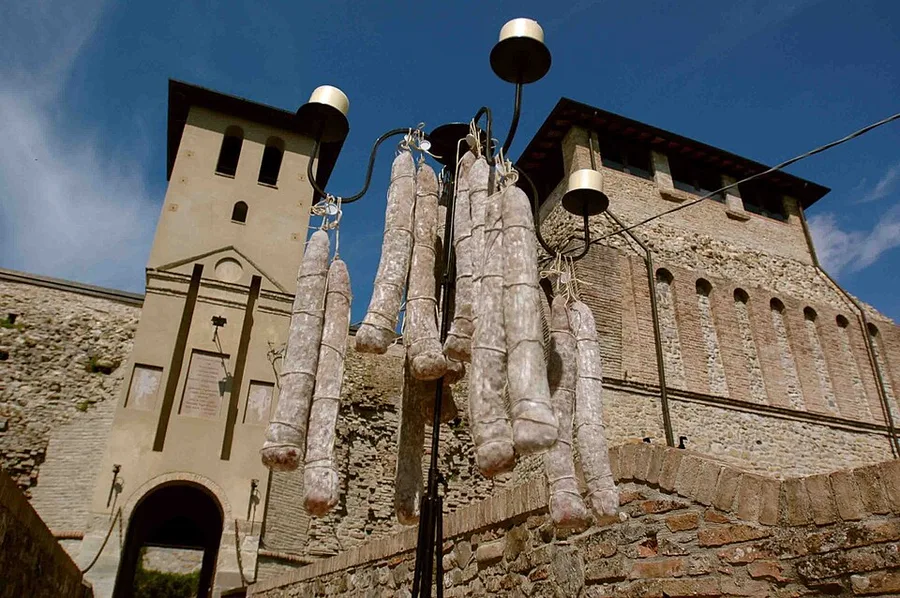
It is cylindrical, thicker at one end than the other, and slightly curved. The curve is not a flaw: it is what happens when you use the intestine as it comes rather than forcing it straight. Weights run from just under half a kilo to a kilo and a half.
What sets Felino apart from other Italian salami is what is left out. No chilli, no fennel, no spice cabinet, barely any garlic, no smoke, no milk powder or milk derivatives. The white wine binds the mix and lifts it; it is not there to perfume it.
The EU granted PGI status in 2013 after a long fight, because "salame tipo Felino" had drifted into use as a generic name. The rules now tie production, not pig rearing, to the province of Parma.
What does it taste like?
Mild, sweet and clean, closer to good roast pork than to the garlicky, fermented salami most people picture. Pepper is the only seasoning you actually taste, in flashes from the whole grains, and the garlic registers as background rather than flavour.
The texture does much of the work. The coarse grain means the lean and the fat stay separate on the tongue, and where the fat has been cut by knife rather than ground, it melts in irregular pockets instead of evenly.
Compared with Milano salami it is looser, sweeter and less salty; compared with a Napoli it has none of the chilli heat or the smoke. Against Spanish chorizo it is a different food entirely, with no paprika at all.
It should never be sour. A tang at the finish means fast fermentation, which is a mark of industrial production rather than of the real thing.
How to use it
Cut it on the diagonal, with the blade at roughly sixty degrees to the axis of the salami. This is the local convention and there is a reason for it: at the same thickness, an angled cut gives a wider, thinner slice with more surface area, which suits the coarse grain.
Slice it two to three millimetres thick. Shaved paper-thin on a machine, a coarse-grained salami falls apart.
Serve at room temperature with torta fritta (the puffed squares of fried dough that Parma serves with all its cured meats) or with plain white bread. A local habit worth copying: sweet butter spread on the bread under the slice.
Pickles work: giardiniera, mushrooms in oil, small pickled onions. Aged Parmigiano works. Fresh cheeses do not.
It is not a cooking salami, but the last stub is excellent diced into a risotto or a quick tomato sauce.
How long it keeps
A whole uncut salame is still drying when you buy it. Hung in a cool larder at 10 to 15 C with some humidity, it keeps losing water for weeks or months: it firms up, the casing shrinks and creases against the meat, the slices get smaller in diameter, and the salt and pepper concentrate. A chalky white bloom develops on natural casing in those conditions and is brushed back with a dry cloth before slicing; questions about what is on a particular piece belong to the producer or the shop that sold it.
Once it is cut the exposed face is the weak point, because it dries and darkens within hours. Cover just that face, with the flap of casing, a piece of paper or cling pressed on the cut only, and keep the piece at 4 to 12 C for two to three weeks. Over that time the fat shifts from white toward ivory and the aroma turns nuttier. Pre-sliced vacuum packs carry the maker's date and, once open, the slices curl and darken quickly. Freezing makes the texture crumbly and is not how this is kept.
Spot the real thing
The silhouette is the tell. Salame Felino IGP is tied by hand into a slightly irregular taper, thicker at one end and narrowing toward the other, in a natural casing that clings and wrinkles as it dries rather than sitting smooth like a plastic sleeve. Cut across, the grain is medium coarse: clean rosy-red lean with distinct white cubes of fat scattered through it, a few whole black peppercorns, and no fennel, no chilli, no visible herbs. The smell is mild, with garlic and white wine sitting behind the pork. Look for the IGP mark and the Felino name on the label or the tag.
American counters carry several things it is mistaken for. Genoa salami and hard salami are domestic factory products with a tangier profile and a uniform machine-cut mosaic. Milano is finer ground, wider and more regular. Soppressata is coarser and often spiced with chilli. Anything labelled simply Italian dry salami is likely made outside Italy. An imported IGP piece costs several times the deli block, and it is sold by the piece rather than pre-sliced.
How to pronounce Salame Felino
sah-LAH-meh feh-LEE-noh
Salame in Italian ends in 'e', not 'i': salami is the plural, so one piece is a salame. Felino stresses the middle syllable: feh-LEE-noh. The name has nothing to do with cats in this context; it is simply the name of the town.
Salame Felino compared
vsSalame Milano
The two are the poles of Italian salami. Milano is ground very fine, so the fat and lean read as one smooth pink paste flecked with white: the classic supermarket salami look. Felino keeps a medium-coarse grain with visible, irregular pieces of fat, some still cut by knife on an angle. Milano leans on garlic and red wine and is made industrially at scale in artificial casing; Felino uses barely any garlic, dry white wine and natural pork casing, which is why it curves. Milano is saltier and more uniform; Felino is sweeter and never quite the same twice.
| This | Salame Milano | |
|---|---|---|
| Grain | Medium-coarse, 8-10 mm, some knife-cut fat | Very fine, uniform paste |
| Casing | Natural pork casing | Usually artificial |
| Shape | Irregular, slightly curved, uneven ends | Straight and uniform |
| Garlic | Minimal | Noticeable |
| Wine | Dry white | Red |
| Ageing | 25 days to 3 months | Around 4-8 weeks, industrial cycles |
| Flavour | Sweet, delicate, peppery | Saltier, rounder, more garlicky |
| Price | 18-26 EUR per kg whole | 12-18 EUR per kg whole |
vsSalame Napoli
The southern answer, and the one furthest from Felino in intent. Napoli is seasoned with chilli and paprika, lightly smoked in the traditional method, and ground medium-fine into a distinctly red paste. Where Felino is built by subtraction, Napoli is built by addition. Both are excellent; only one of them will disappear if you put it next to a strong cheese.
| This | Salame Napoli | |
|---|---|---|
| Seasoning | Salt, pepper, trace of garlic, white wine | Chilli, paprika, pepper, garlic |
| Smoke | None | Traditionally light cold smoke |
| Colour of slice | Ruby red with white fat | Deeper brick red |
| Heat | None | Mild to moderate |
| Best with | Torta fritta, white bread, butter | Friselle, provolone, strong reds |
vsNatural casing vs artificial casing
The single most visible difference between artisan and industrial salami, and the reason a Felino looks the way it does. Natural pork intestine is permeable: it breathes, it lets the salami dry slowly and evenly, it shrinks with the meat and it produces the irregular, gently curved shape. Artificial casing is dimensionally perfect, sheds cleanly and dries at a uniform rate: better for machines, worse for flavour development.
| This | Natural casing vs artificial casing | |
|---|---|---|
| Breathability | Permeable: slow, even drying | Controlled, often less permeable |
| Shape | Curved, uneven, one end thicker | Perfectly straight and regular |
| Peeling | Clings, then lifts with a tug | Peels off cleanly in one piece |
| Surface mould | White bloom develops naturally | Often none, or applied |
| Cost | Higher: casing and labour | Lower, machine-fillable |
Salame Felino substitutes
- Salame di Cremona IGP or Salame Piacentino DOP
The closest northern Italian cousins. Cremona is coarse-grained and mild with a little more garlic; Piacentino is similar in grain with a slightly firmer bite. Either behaves the same on a board.
1:1 - Soppressata (northern style) or salame Toscano
Both coarse-ground and natural-cased. Tuscan salami has more pepper and often fennel; if the recipe depends on Felino's mildness, use a little less.
1:1, or 0.8:1 for Toscano - Salame Milano
Available everywhere and acceptable when the salami is an ingredient rather than the point: in a sandwich, diced into a sauce, on a pizza. On a tasting board the difference in texture is immediately obvious.
1:1 - Genoa salami (US)
The American deli standard, mild and wine-seasoned, closer to Felino than to Milano in intent though usually finer-grained and softer. The best everyday substitute in the US.
1:1 - Halal or no-pork: beef salami or sucuk
Halal beef salami made by the same dry-cured method works on a board, though it is leaner and firmer. Turkish sucuk is heavily spiced with cumin and garlic and is a substitute only in the loosest sense: better cooked than sliced raw.
1:1 for beef salami - Turkey or chicken salami
Widely available in the US and UK and free of pork. Much leaner, so it dries out on a board: slice it thicker and serve it with butter or a soft cheese to compensate.
1:1, sliced thicker
Where to buy it
In the US, Italian delis and online specialists such as Eataly and Gustiamo carry Felino, though American import rules mean many pieces are made under licence rather than shipped from Parma: check for the PGI mark. Expect roughly 16 to 28 dollars per pound whole, and more sliced.
In the UK, Italian delicatessens and online grocers stock it at about 25 to 40 pounds per kilo, with sliced packs proportionally dearer.
Check three things. The casing should be natural, which shows in the slight curve and the uneven ends; the slice should have visible, irregular white fat rather than an even pink paste; and the label should carry the blue-and-yellow PGI symbol and the consortium reference.
Avoid anything labelled "Felino style" or "tipo Felino". That wording exists precisely because the seller cannot use the protected name.
Buy a whole piece if you can. It keeps for months hanging in a cool place, improves slowly, and costs a third less per kilo than sliced trays.
Where to eat it in Italy
Felino itself, twenty kilometres from Parma, has a salami museum in the cellars of its castle and several producers who sell directly. The salami fair, at the turn of August into September, fills the centre with stalls and open kitchens.
The trattorie of the Baganza valley around it serve the full Emilian board: Felino, culatello, coppa, cooked shoulder and strolghino, all with hot torta fritta.
In Parma, the osterie of the old centre keep it permanently, and the city's food festivals in September are the easiest way to taste the province's cured meats side by side.
It is worth extending the trip down to the Bassa (Zibello, Polesine Parmense, Busseto) where culatello is cured in the river fog. Same province, entirely different climate, entirely different salumi.
Recipes with it
Further reading
Frequently asked questions
Why is Salame Felino so mild?
Because it is made by subtraction. There is no chilli, no fennel, no smoke and barely any garlic: just salt, black pepper and a little dry white wine. That leaves the pork itself as the flavour, which is also why the quality of the meat shows more than in a heavily spiced salami.
Why is it cut on the diagonal?
An angled cut of about sixty degrees gives a wider, thinner slice at the same thickness, with more surface area and a better bite for a coarse-grained salami. It is the local tradition and it genuinely improves the eating.
What is the difference between Felino and Milano salami?
Felino is medium-coarse ground in natural casing with minimal garlic and white wine, so it is irregular, slightly curved and sweet. Milano is very finely ground, usually in artificial casing, with more garlic and red wine, and is made industrially: smoother, saltier and perfectly uniform.
Is "salame tipo Felino" the same thing?
No. "Tipo Felino" means a salami made in the style but outside the PGI rules and usually outside the province of Parma. The protected product carries the EU PGI symbol and the consortium mark.
Does salami need refrigerating?
A whole piece does not. Hang it in a cool, dark, ventilated place at 12 to 16 degrees and it keeps for months, continuing to age slowly. Once cut, cover the exposed face and eat it within two or three weeks. Sliced salami loses its aroma within a couple of days.
Sources
Where to check what you just read.
- 1
Il regolamento del 5 marzo 2013 che registra «Salame Felino» come IGP e delimita la zona all'intero territorio della provincia di Parma.
- 2
I parametri analitici che il salame deve rispettare: proteine minime 23%, rapporto collagene/proteine massimo 0,10, pH sopra 5,3, peso fra 200 grammi e 4,5 chili.
- 3Consortium · interested partyConsorzio di Tutela del Salame Felino IGP
Il consorzio riconosciuto con decreto ministeriale del 19 giugno 2014: statuto, testo del disciplinare e aziende associate.
Related foods
 Cured meatsCulatello di ZibelloCulatello di Zibello is the heart muscle of a pork leg, boned out, sewn into a pig's bladder, tied by hand…
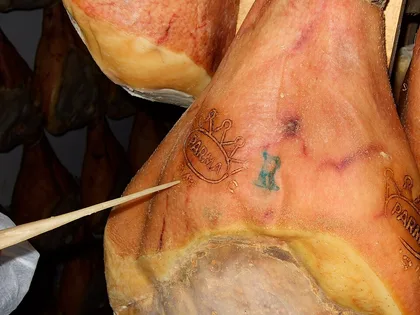 Cured meatsProsciutto di ParmaProsciutto di Parma DOP is Italian ham made from three things only: pork, sea salt and at least 400 days.
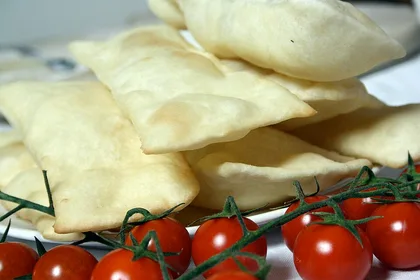 Pasta and breadGnocco FrittoEat it within a minute of the pan, because once it deflates it is over: a diamond of leavened dough fried in…
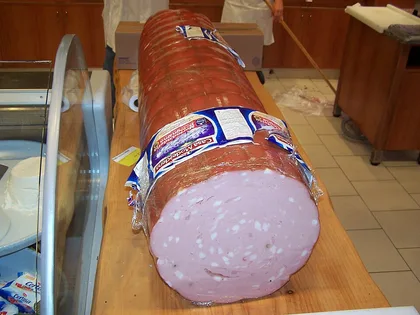 Cured meatsMortadellaThe white cubes are not just any fat: they are jowl, the firmest part of the pig, and they stay whole…Cured meatsPancettaPancetta is Italian cured pork belly: salt, pepper and warm spices, dried for months, never smoked.
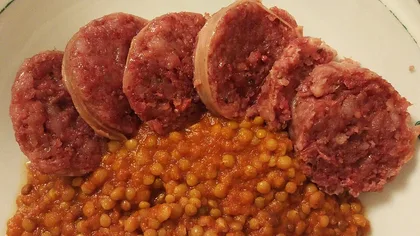 Cured meatsCotechinoCotechino is a large fresh pork sausage from Emilia-Romagna, made with pork meat, fat and rind, and always…
 Cured meatsZamponeZampone Modena IGP is spiced pork and rind forcemeat stuffed into a boned pig's trotter: same filling as…
 Cured meatsCoppa PiacentinaCoppa Piacentina is dry-cured pork neck from the province of Piacenza, seasoned with cloves, cinnamon and…