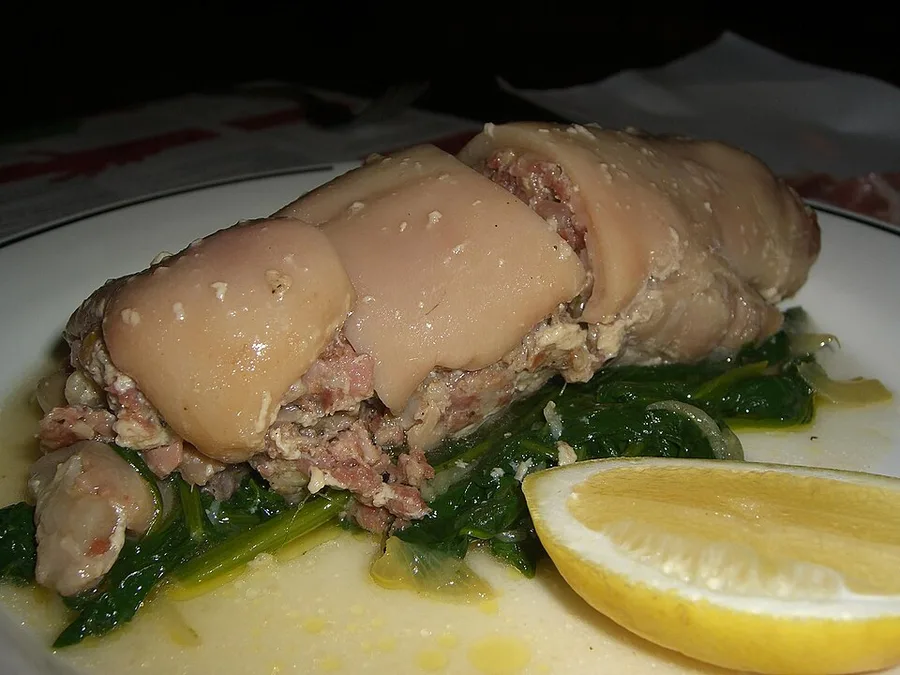
What is Zampone?
Zampone is a cooking sausage, not a slicing salami. The filling is lean pork from the head, shoulder and jowl, ground with pork rind and fat, seasoned with salt, pepper, nutmeg, clove, cinnamon and sometimes wine.
The casing is what names it: the front trotter of the pig, boned out and emptied but left whole, trotters and all. The filling is pushed in and the open end sewn shut.
Zampone Modena has held PGI status since 1999, protected alongside Cotechino Modena by the same consortium. The rules set the proportions of the mix, the permitted spices, the maximum share of rind and a production area covering Emilia-Romagna, Lombardy, Veneto, Piedmont, Friuli, the Marche and a handful of other northern provinces.
Weights run from half a kilo to a kilo and a half, and it is sold in two forms: raw, which needs four hours of poaching, and pre-cooked, which needs twenty to thirty minutes of reheating. They are the same product at two stages, and the difference on the plate is real.
What does it taste like?
Rich, gelatinous and warmly spiced, closer to a French boudin or a very good pork pie filling than to anything sliced cold. Nutmeg and clove are the flavours you notice first, then pork fat, then salt.
The texture is the point. Ground rind melts during the long cook and turns to gelatine, binding the meat into something that holds a slice but yields immediately. The trotter skin around the outside goes soft and slightly translucent and is eaten with the slice.
It is a fatty dish and it knows it, which is why it is always served with something earthy and acidic: lentils dressed with a little vinegar, mostarda, horseradish.
Pre-cooked zampone tastes a shade more uniform and firmer than a raw one poached at home; the raw version has a better skin and a looser, more distinct filling.
How to use it
For raw zampone, start the night before: twelve hours in cold water, changed once. It softens the skin and pulls out some salt.
Prick it with a toothpick under the trotters and along the sides, wrap it in a linen or cotton cloth and tie it, or use the cooking bag if one is supplied, then put it in plenty of cold water and bring it to the barest simmer. Four hours for a kilo, never at a rolling boil, which splits the casing.
Rest it ten minutes in its own water, unwrap, and slice a centimetre and a half thick with a very sharp knife, starting from the sewn end.
Pre-cooked zampone goes into simmering water in its unopened bag for twenty to thirty minutes. Do not open it early and do not microwave it: the skin turns to rubber.
Lentils are the canonical partner: Castelluccio or Onano lentils, cooked with celery, carrot, onion and a ladle of the cooking broth. Then mashed potato, buttered spinach, mostarda from Mantua or Cremona, and a few drops of traditional balsamic vinegar if you have it.
The cooking broth is worth keeping: strain it, chill it, lift the fat off and use it for the lentils or a risotto.
How long it keeps
The raw vacuum-packed version keeps in the fridge to the date printed on it, usually a few weeks out, and once the pack is open it is meant for the pot within a couple of days: this is raw stuffed meat, not a cured salume, so it never hangs at room temperature. The precooked sealed one is the opposite, sitting in a cupboard for months until its own date. Both dates belong to the maker. Left too long, a raw one darkens where the fat meets the skin and the surface fat yellows.
It freezes in either state. Raw, still in its vacuum, six months at minus 18 C; cooked, keep it whole or in thick slices sitting in its own broth, which stops the surface drying and going grey. Cooked leftovers keep two or three days in the fridge and reheat in broth or over a bain-marie, never at full power in a microwave, which turns the skin rubbery. The cooking broth is worth straining and chilling: the fat rises and sets in a solid cap you can lift off, and what is under it cooks lentils.
Spot the real thing
On a raw zampone the skin should be pale and dry to the touch, with no dark patches and no tacky spots, and the stitching that closes the trotter has to be intact, since a dropped stitch means it will open in the pot. The label gives raw weight, and a one-kilo zampone feeds six to eight as a main course. Cut, a cooked one shows a compact bound mixture, pink, held together by its own gelatine, with the skin soft and translucent; a slice that crumbles had too little rind or was cooked wrong.
On the pack, the European IGP logo and a reference to the Consorzio Zampone Modena Cotechino Modena are the real guarantee. Plenty of generic zamponi exist, legal but another product. Read the ingredients: pork, rind, salt and spices with little else is the shape of a good one, while starches, milk proteins, generic flavourings or a high declared water content mark the budget end. Abroad, almost everything on the shelf is the precooked foil-wrapped kind that appears at Christmas, and the near neighbour is cotechino, the same mixture in a plain casing without the trotter.
How to pronounce Zampone
tsam-POH-neh
The 'z' is a hard 'ts' as in 'cats', never a soft English 'z': tsam-POH-neh, not 'zam-pone'. Three syllables, stress on the second, final 'e' pronounced. It comes from zampa, meaning paw or trotter. Cotechino is koh-teh-KEE-noh, from cotica, meaning rind.
Zampone compared
vsCotechino
The same forcemeat in a different container, and the comparison every Italian family has at some point on 31 December. Zampone is stuffed into the boned front trotter, which keeps its shape, releases gelatine as it cooks and gives you an edible skin to eat with each slice. Cotechino uses ordinary sausage casing, so it cooks faster, slices more neatly and eats a little drier. Zampone looks impressive on the table and takes more work; cotechino is the everyday version and nobody in Emilia thinks less of it.
| This | Cotechino | |
|---|---|---|
| Casing | Boned front trotter, sewn shut | Natural or synthetic sausage casing |
| Shape | Recognisably a trotter | Plain cylinder |
| Filling | Pork, rind, fat, spices | The same mix |
| Gelatine | More: the trotter contributes its own | From the ground rind only |
| Cooking time (raw) | About 4 hours for 1 kg | About 3 hours for 1 kg |
| Serving | Skin eaten with the slice | Casing removed before slicing |
| Price | 14-22 EUR per kg raw | A few euros per kg less |
vsPre-cooked vs raw (4-hour) zampone
The practical decision at the shop. Raw zampone is soaked overnight, poached for four hours at barely a simmer, and rewards you with a better skin and a looser, more expressive filling. Pre-cooked zampone was cooked at the factory inside its own bag and only needs twenty to thirty minutes in simmering water, and it is what most Italian households actually eat on New Year's Eve, and it is a good product, just firmer and more uniform. Neither is a fake; only one takes a day of planning.
| This | Pre-cooked vs raw (4-hour) zampone | |
|---|---|---|
| Preparation | 12 h soak, then 4 h poaching | 20-30 min in simmering water |
| Skin | Softer, more gelatinous | Firmer, slightly rubbery if overheated |
| Filling | Looser, more distinct grain | More compact and even |
| Risk | Bursts if the water boils hard | Almost none: do not open the bag |
| Shelf life | Weeks, refrigerated | Months at room temperature |
| Availability | Butchers, mainly Nov-Feb | Every supermarket in December |
vsBoudin blanc, andouille and other stuffed pork traditions
Zampone belongs to a European family of cooked pork sausages that English speakers meet under other names. French boudin blanc is finer, milk-enriched and much paler; andouille and andouillette are made from tripe and chitterlings and taste nothing like it; German Eisbein is a cured whole hock rather than a stuffed one. The nearest relative in spirit is the Alsatian or Polish tradition of poached pork sausage served with lentils or sauerkraut.
| This | Boudin blanc, andouille and other stuffed pork traditions | |
|---|---|---|
| Filling | Pork, rind, fat, sweet spices | Varies: white meat and milk / offal |
| Binder | Melted rind gelatine | Bread, milk, eggs |
| Cooking | Poached whole, hours | Poached or grilled, minutes |
| Served with | Lentils, mash, mostarda | Apples, sauerkraut, mustard |
| Occasion | New Year's Eve | Christmas, everyday |
Zampone substitutes
- Cotechino
The obvious swap and the same filling. Cooks about an hour faster and slices more cleanly; you lose the edible skin and some of the gelatine. Widely sold pre-cooked outside Italy.
1:1 by weight - Musetto friulano or cappello del prete
Regional cousins from the same forcemeat family. Musetto is spicier and traditionally served with brovada, turnips fermented in grape must; cappello del prete is triangular and from Piacenza. Both cook like cotechino.
1:1 - French boudin blanc or a good poaching sausage
Not the same flavour, milder and milkier with no rind gelatine, but it fills the same place on a plate of lentils. Poach gently and do not prick it.
1:1, reduce cooking to 20-30 minutes - Fresh Italian sausage (salsiccia), coiled and poached
The fallback when nothing else is available. Coil it, tie it, poach it in stock for forty minutes and serve it on lentils. Leaner and without any gelatine, so add a knob of butter to the lentils.
1:1 - Halal or no-pork: beef or veal cotechino-style sausage
Made by halal charcutiers in Italy and elsewhere from beef with beef fat and the same spice mix. Lacks pork rind, so the texture is firmer and less gelatinous; poach it in a well-gelatinised stock to compensate.
1:1 - Vegetarian: lentils with a spiced walnut and mushroom loaf
There is no plant version of a trotter, but the point of the dish is spice, richness and lentils. A loaf of mushrooms, walnuts and the same nutmeg-clove-cinnamon mix, served on the same lentils, keeps the occasion intact.
Where to buy it
In the US, pre-cooked Zampone Modena IGP is imported by Eataly, Gustiamo and Italian delis, appearing in quantity from November through January and thinning out afterwards. Expect roughly 10 to 20 dollars per pound. Raw zampone is very hard to find outside Italian butchers, since it is a fresh product.
In the UK, Italian delicatessens and online grocers stock the pre-cooked version seasonally at about 15 to 28 pounds per kilo, usually in 500 to 1000 gram vacuum packs.
Check for the EU PGI symbol and the consortium mark for Zampone Modena. Plenty of generic zampone exists; it is legal and often cheaper, but the mix is looser and the ingredient list tells you why.
Read that list. A good zampone is pork, rind, salt and spices. Starches, milk proteins, generic "flavourings" and a high water percentage all point to a cheaper industrial product.
Order early if you want it for New Year's Eve: outside December it is largely a special-order item.
Where to eat it in Italy
Modena and its province, where the historic delis of the centre and the producers around Castelnuovo Rangone, a town with a statue of a pig, sell raw zampone to order all winter.
Mirandola, in the northern plain of the province, claims to have invented it during the siege of 1511 and marks the connection with pork-centred food events.
Emilian trattorie run zampone with lentils and mashed potato as a fixture from December into January, and some keep it on into February. After that it disappears until the autumn.
It is worth widening the circle: Cremona has its own cotechino, Friuli eats musetto with brovada, turnips fermented in grape must, and Piacenza closes the loop with cappello del prete, the same forcemeat in yet another shape.
Recipes with it
Further reading
Frequently asked questions
What is the difference between zampone and cotechino?
The filling is essentially identical: pork, rind, fat and spices. The container is not. Zampone is stuffed into the boned front trotter, which keeps its shape, adds gelatine and gives an edible skin eaten with each slice. Cotechino uses ordinary sausage casing, cooks about an hour faster and eats slightly drier and neater.
Should I buy raw or pre-cooked zampone?
Raw gives a better skin, a looser filling and a more defined flavour, but needs a twelve-hour soak and four hours of gentle poaching. Pre-cooked is heated in its bag in twenty to thirty minutes and is what most Italian households eat on New Year's Eve: a good product, just firmer and more uniform.
How long does zampone take to cook?
A raw one-kilo zampone needs about four hours in water held just below a simmer, after twelve hours soaking in cold water. Pre-cooked zampone needs twenty to thirty minutes in gently simmering water, in its sealed bag.
Why is zampone eaten at New Year with lentils?
Lentils look like coins and, in Italian tradition, promise prosperity for the coming year, while the richness of the zampone stands for abundance. It also works on the plate: earthy lentils with a little vinegar cut through the fat of the skin.
Can you eat the skin?
Yes, that is part of the point. After long cooking, the trotter skin turns soft and slightly translucent and is sliced and eaten along with the filling. If it is rubbery, the zampone was heated too fast or too briefly.
Sources
Where to check what you just read.
- 1
Il regolamento del 18 marzo 1999 che iscrive «Zampone Modena» fra le IGP: da verificare che sia IGP e non DOP, differenza che cambia i vincoli sul latte e sulla carne.
- 2
Il disciplinare dello Zampone Modena in PDF: tagli di suino ammessi nell'impasto, percentuale di cotenna, zona di trasformazione, precotto e crudo.
- 3Consortium · interested partyConsorzio Zampone e Cotechino Modena IGP
L'unico consorzio che tutela entrambi i prodotti: utile per capire dove finisce lo zampone e comincia il cotechino, visto che l'impasto è lo stesso.
Related foods
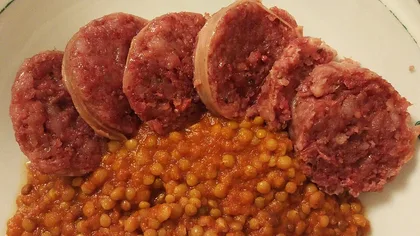 Cured meatsCotechinoCotechino is a large fresh pork sausage from Emilia-Romagna, made with pork meat, fat and rind, and always…
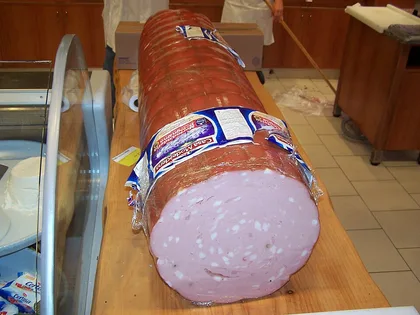 Cured meatsMortadellaThe white cubes are not just any fat: they are jowl, the firmest part of the pig, and they stay whole…
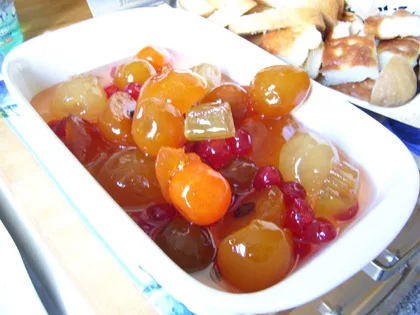 Oil and preservesMostardaMostarda is candied fruit suspended in sugar syrup and spiked with mustard essence.Cured meatsPancettaPancetta is Italian cured pork belly: salt, pepper and warm spices, dried for months, never smoked.
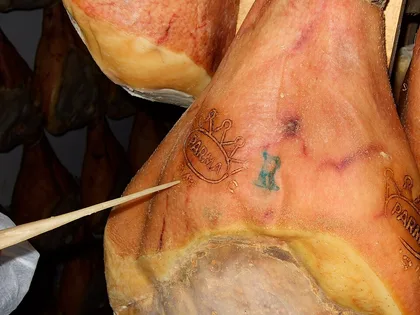 Cured meatsProsciutto di ParmaProsciutto di Parma DOP is Italian ham made from three things only: pork, sea salt and at least 400 days.
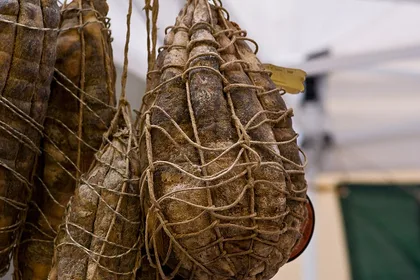 Cured meatsCulatello di ZibelloCulatello di Zibello is the heart muscle of a pork leg, boned out, sewn into a pig's bladder, tied by hand…
 Cured meatsSalame FelinoSalame Felino IGP comes from a village of four thousand people in the hills above Parma.
 Cured meatsCoppa PiacentinaCoppa Piacentina is dry-cured pork neck from the province of Piacenza, seasoned with cloves, cinnamon and…