What is Casoncelli?
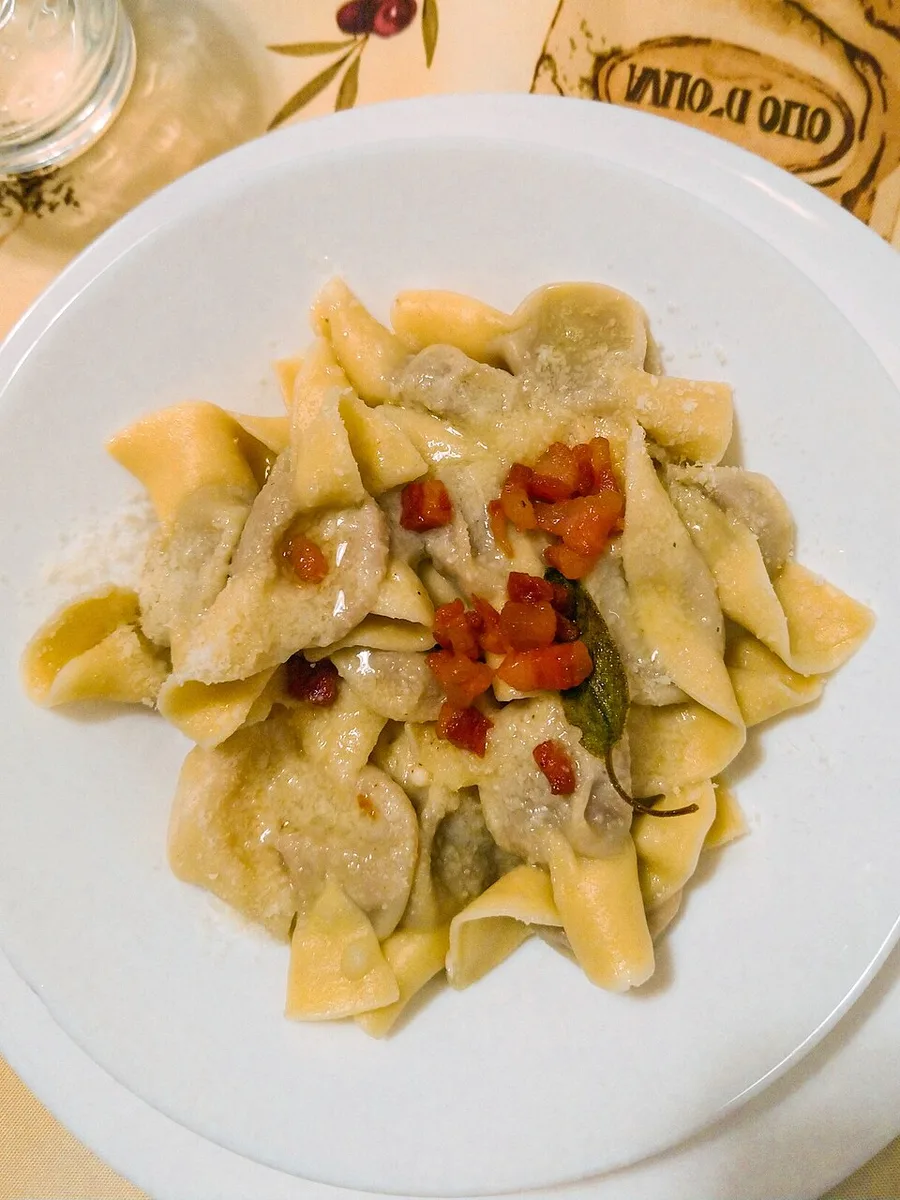
Casoncelli, casonsèi in the Bergamo dialect, are egg-pasta parcels with a filling that catches most people off guard. Braised beef and pork, local salami, grated Grana Padano, breadcrumbs and nutmeg go in, and so do crushed amaretti biscuits, sultanas and sometimes grated pear. The sauce is butter melted with sage leaves and cubes of pancetta fried until they crackle.
The shape matters as much as the filling. A rectangle of pasta is folded over the meat and pinched hard in the middle, leaving two ruffled wings on either side, so the finished piece looks like a wrapped sweet. The wings are double-thickness pasta that stays firmer in the water, giving the parcel a bite that an ordinary raviolo does not have.
The sweet-savoury profile is not a modern flourish. It is what survives of Renaissance Lombard cooking, when sugar, cinnamon and dried fruit went into meat dishes as a matter of course. Casoncelli and Mantua's pumpkin tortelli are the two best-known holdouts of that taste.
What does it taste like?
Rich, meaty and unexpectedly perfumed. The first impression is braised beef and cheese; a second later the amaretto arrives, almond and a faint bitterness, and then the sultanas give small bursts of sweetness. The butter and sage round it off and the pancetta adds salt and crunch.
It is not a sweet dish. Someone tasting it blind would call it savoury with an aromatic edge, closer to a Moroccan pastilla than to a dessert. The balance depends entirely on restraint: too many amaretti and it tips over, too few and it becomes an ordinary meat raviolo.
Texture-wise, expect a soft belly and firmer pleated edges in the same mouthful, with the butter clinging rather than pooling.
How to use it
Cook them in plenty of salted boiling water for three to four minutes if fresh, five from frozen. They are done when the pinched centre no longer looks pale. The pasta is thin and forgiving for about thirty seconds either side of that window, then it starts to split.
While they boil, cube 80 g of pancetta per four people and fry it dry until it crisps. Add 80 g of butter and six sage leaves and let the butter turn pale gold, not brown. Nut-brown butter overwhelms the amaretto, which is the point of the dish.
Drain the casoncelli, tip them into the pan with a spoonful of the cooking water, toss once and serve with plenty of grated Grana Padano and black pepper. Count ten to twelve pieces per person.
Do not add tomato, cream or garlic. Bergamo serves this one way, and the restraint is deliberate: the filling is already doing several things at once.
How long it keeps
Fresh, they hold two days at most in the fridge, spread on a floured tray under a tea towel, and never in a sealed box, where the trapped humidity makes them stick to each other and to the tray. A shop pack in modified atmosphere runs to its printed date, which is the maker's reference, and once it is opened the sheet starts drying at the edges within hours while the filling goes on wetting it from inside, so the pasta near the crimp turns translucent and slack.
Freezing is the right way to manage them. Space them out on a tray, freeze for an hour until firm, then transfer to a bag: three months, dropped into boiling water still frozen with barely a minute added. Thawing them first gives you a single glued mass. The filling on its own keeps two days in the fridge and improves overnight, as the amaretti finish drawing moisture out of the meat. Cooked and dressed they do not keep at all, since the butter sets and the pasta swells into something else.
Spot the real thing
A well-made casoncello has clearly crimped wings and a full but not swollen belly: a spherical parcel is overfilled and will burst in the water. The pasta is a deep yellow, which is what real yolks look like, and slightly rough to the touch rather than shiny. Cut one open and the filling should be compact but moist, with dark specks of raisin and pale grains of amaretto spread evenly through it; pale and uniform is the industrial filling, where the meat has been stretched with bread and potato.
At a Bergamo pasta shop you can spot them by how they are laid out, single on floured trays and never heaped, because the central fold is fragile. Modified-atmosphere packs are a fair compromise; anything dried for long shelf life has nothing to do with the original. Abroad the word rarely appears at all, and what sits nearest on the chiller shelf is generic meat ravioli, which is flat, square and filled with meat alone: the raisin and amaretto sweetness is the whole point of this one and no substitute carries it.
How to pronounce Casoncelli
kah-zohn-CHEL-lee
The single 's' between vowels is voiced, so it sounds like a 'z'. The 'ce' is soft, as in 'cello', and 'll' is a held l, not a y sound. Stress lands on the third syllable. Common mistakes: 'kah-son-SELL-eye' and treating it like Spanish 'casoncellos'.
Casoncelli compared
vsRavioli
Casoncelli are a kind of raviolo, but pinning them as 'Bergamo ravioli' misses what makes them theirs: the fold, the amaretti, and a sauce that never varies. Ravioli is a category; casoncelli is one recipe with a fixed identity.
| This | Ravioli | |
|---|---|---|
| Category | One specific recipe | A whole family of filled pasta |
| Shape | Pinched sweet-wrapper, ruffled ends | Square or round, sealed flat |
| Filling | Meat plus amaretti and sultanas | Anything: ricotta, meat, fish, greens |
| Flavour | Sweet-savoury, almond note | Usually straightforwardly savoury |
| Sauce | Butter, sage, pancetta only | Tomato, cream, ragù, butter |
| Where | Bergamo and Brescia | The whole country |
vsCasoncelli bresciani
Forty kilometres apart and genuinely different dishes. Bergamo builds a rich meat filling with dried fruit; Brescia, especially around Barbariga, keeps it lean (breadcrumbs, cheese, a little meat) and shapes it long rather than pinched.
| This | Casoncelli bresciani | |
|---|---|---|
| Filling base | Braised beef, pork, salami | Breadcrumbs, cheese, less meat |
| Amaretti | Essential | Absent |
| Sultanas | Usual | Rare |
| Shape | Pinched in the middle | Elongated or half-moon |
| Sauce | Butter, sage, pancetta | Butter and cheese, sometimes ragù |
| Festival | City events in early September | Barbariga sagra, summer |
vsTortelli di zucca
The other survivor of Renaissance sweet-savoury cooking, from Mantua an hour south. Both use amaretti, both unsettle first-time eaters, but one is built on meat and the other on pumpkin, and the tortello is far sweeter.
| This | Tortelli di zucca | |
|---|---|---|
| Filling | Meat, salami, cheese | Roast pumpkin, mostarda |
| Amaretti | A seasoning, in the background | A main flavour, up front |
| Sweetness | Mild, from sultanas | Pronounced |
| Sauce | Butter, sage, pancetta | Butter and sage, no meat |
| Season | Year-round, autumn and winter peak | Autumn, Christmas Eve |
| Suits vegetarians | No | Yes |
Casoncelli substitutes
- Agnolotti del plin
Piedmontese meat parcels, pinched by hand and served with butter or a spoon of roasting juices. The closest widely available stand-in: same size, same richness, without the almond note.
1:1 by weight - Tortelli di zucca
If what you want is the amaretti-and-pasta experience rather than the meat, this is the substitute. Also the obvious vegetarian route. Dress with butter and sage exactly the same way.
1:1 by weight - Meat ravioli plus a doctored butter
A working shortcut: buy good beef ravioli, then melt butter with sage, crisp pancetta and stir in a tablespoon of crushed amaretti at the end. It gets you most of the way there for ten minutes of effort.
1 amaretto biscuit per portion - Amaretti substitute: almond macaroons
If you cannot find amaretti di Saronno, use hard Italian-style almond macaroons and add two drops of bitter almond extract. Avoid soft French macarons, which are all sugar and no bitterness.
1:1 by weight - Vegetarian filling
Replace the meat with roasted celeriac and chestnut, keep the Grana Padano, breadcrumbs, sultanas and amaretti, and use a vegetarian rennet hard cheese if that matters. Swap the pancetta for browned hazelnuts.
- Pierogi ruskie
Not Italian and not remotely the same filling, but structurally very close: thin dough, dense filling, butter and fried onion. A reasonable fallback anywhere with a Polish shop and no Italian one.
1:1 by piece
Where to buy it
Fresh casoncelli travel badly, so outside Lombardy the realistic options are frozen or homemade. In Italy, any pastificio in Bergamo sells them fresh at 14 to 20 euro per kilo, and vacuum-packed versions turn up in supermarkets across the north at 9 to 13 euro per kilo.
Abroad, Italian delis and online importers occasionally stock frozen casoncelli: expect 14 to 22 dollars per pound in the US and 18 to 28 pounds per kilo in the UK. Check the ingredient list for amaretti: without them, you are buying generic meat ravioli under a Bergamo name.
Making them is the better plan, and the only unusual ingredient is amaretti biscuits, sold in most supermarkets and every Italian deli at around 15 to 25 euro per kilo. Everything else (beef, salami, breadcrumbs, sultanas, Grana Padano) is already in a normal kitchen.
Where to eat it in Italy
Bergamo is the place, and the best versions are not in the tourist heart of the upper town but in the trattorie of Borgo Santa Caterina and Longuelo, and in the villages ringing the city.
Go up into the valleys (Val Brembana, Val Seriana, Valle Imagna) and almost every osteria makes them in-house, usually followed by a board of mountain cheeses: branzi, formai de mut, taleggio from the valley that gave the cheese its name.
In Brescia province, the village of Barbariga holds a summer festival dedicated to its own leaner version, which is worth the detour precisely because it tastes so different.
Milan, an hour away by train, has Bergamo-run trattorie that do them properly, though the price roughly doubles.
Frequently asked questions
What are casoncelli?
Stuffed egg pasta from Bergamo in northern Italy, filled with braised meat, salami, cheese, crushed amaretti biscuits and sultanas, pinched into a sweet-wrapper shape and served with butter, sage and crisp pancetta.
How do you pronounce casoncelli?
kah-zohn-CHEL-lee, with the stress on the third syllable. The 's' is voiced like a 'z' and the 'ce' is soft, as in 'cello'.
Are casoncelli sweet?
No. They are savoury with a sweet-aromatic edge from amaretti and raisins, the way medieval and Renaissance meat cookery often was. A well-made one tastes of braised beef first and almond second.
Can I use ordinary ravioli instead?
You can eat well, but it is a different dish. If you want to get close, buy good beef ravioli and stir a tablespoon of crushed amaretti into the butter and sage sauce.
What wine goes with casoncelli?
Valcalepio Rosso, the local Bergamo red, is the traditional match. A Franciacorta rosé also works well, since the bubbles cut through the butter and pancetta.
Related foods
 CheeseGrana PadanoNine months is the floor the specification sets before a wheel may carry the name.
 CheeseTaleggioTaleggio DOP is a square, washed-rind cow's milk cheese from the Bergamo Alps, aged at least 35 days.
 Cured meatsBresaolaOne lean muscle from the hind leg, dry-cured with salt, pepper, juniper and cinnamon, then left in the dry…Pasta and breadGnocchiGnocchi are small boiled dumplings, in their modern form made of potato bound with a little flour.
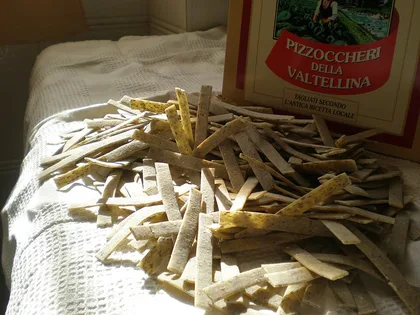 Pasta and breadPizzoccheriBuckwheat rather than wheat, which is where the dark colour and the nutty taste come from.Pasta and breadPolenta TaragnaPolenta taragna is the dark alpine polenta of Lombardy: cornmeal cut with buckwheat flour, stirred for the…Pasta and breadMichetta (Rosetta Roll)The michetta is Milan's hollow bread roll: five petals around a small central dome, and nothing at all inside.Cured meatsPancettaPancetta is Italian cured pork belly: salt, pepper and warm spices, dried for months, never smoked.