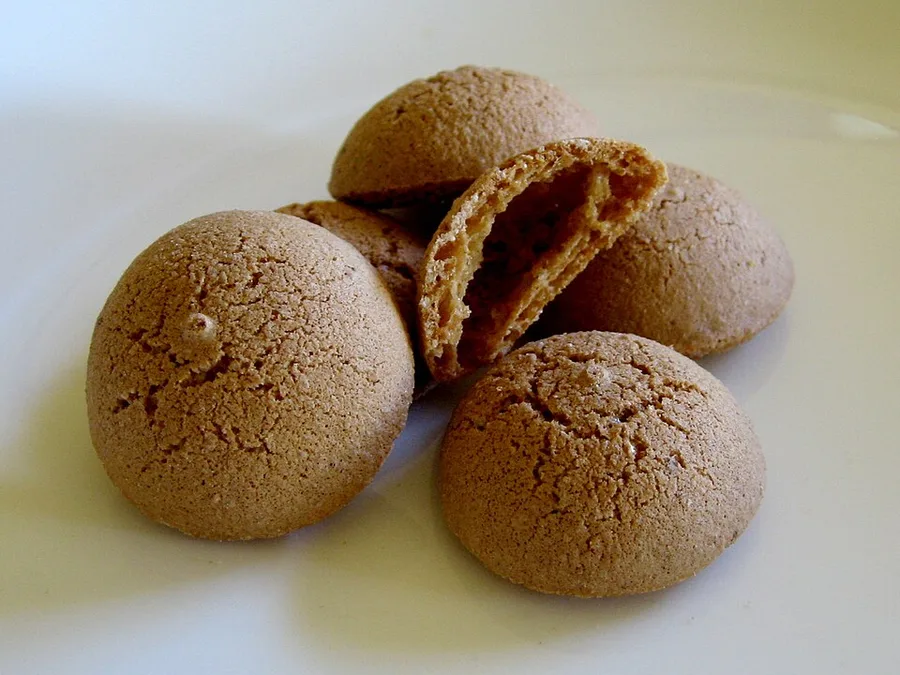
What is Amaretti?
An amaretto is made from ground sweet almonds, sugar and egg white, plus a small proportion of bitter almonds or armelline, the kernels found inside apricot stones. That bitter fraction is rarely more than five per cent of the dough, and it is the whole point: without it you have a pleasant almond biscuit and nothing more.
The division that matters is texture, not geography. Amaretti secchi are dry all the way through, snap cleanly, keep for months and were designed to be dunked or crumbled into other things. Amaretti morbidi have a crazed, cracked crust over a centre that yields under the tooth, almost fudgy; they last a few weeks and are eaten on their own.
Italians buy them for two different reasons. The soft ones are dessert. The hard ones are an ingredient: crushed into pumpkin tortelli filling in Mantua, into baked stuffed peaches in Piedmont, into bonet, into apple cakes across the north. Very few Italian biscuits are bought primarily to cook with; this is one.
What does it taste like?
Marzipan, then almond extract, then something faintly medicinal that arrives late and lingers: that last part is the apricot kernel, and it is what separates an amaretto from a macaroon. The sweetness is direct and unsubtle, the bitterness is the counterweight, and a good one keeps the two in balance for several seconds after you have swallowed.
The hard version is brittle and sandy, closer to a meringue than to a shortbread, with visible grains of almond. It shatters rather than crumbles, and it drinks coffee or dessert wine like a sponge. The soft version is dense and slightly sticky, with a thin sugared crust that gives way to a moist, marzipan-textured interior.
What neither tastes of is butter or flour. There is none of either in the traditional recipe, which is why amaretti taste cleaner and more intensely of almond than almost any other biscuit.
How to use it
For crushing, put dry amaretti in a bag and hit them with a rolling pin rather than using a processor: you want irregular gravel, not powder, so the filling keeps some texture. Crush them at the last moment; ground almond goes rancid quickly once exposed to air.
The three classic uses are worth learning as a set. Pumpkin tortelli from Mantua take roughly 100g of crushed dry amaretti per kilo of roasted, drained pumpkin flesh, with mostarda and grated Parmigiano; the bitterness is what stops the filling from tasting like dessert. Piedmontese stuffed peaches are simply halved yellow peaches, hollowed slightly, filled with crushed amaretti, cocoa and sugar, and baked for 45 minutes. Bonet, the Piedmontese chocolate custard, has amaretti in the mixture and more crumbled on top.
Beyond that, they carry cheese surprisingly well: crumble a soft amaretto over gorgonzola dolce and the sweet-bitter-salt combination works. And a spoonful crushed into a stuffing for guinea fowl or capon does what breadcrumbs do, only better.
Soft amaretti, by contrast, are not a cooking ingredient. Serve them at the end of a meal with a small glass of something and leave them alone.
How long it keeps
Crisp amaretti keep for months, to the date on the tin, provided the tin stays shut and out of steam and sunlight. The tissue-paper twist around each pair is not decoration: it slows the exchange of air and moisture. What happens over time is a straight water transfer. In a damp kitchen a dry amaretto pulls moisture out of the air, loses its snap and turns leathery; ten minutes in a low oven at 100 degrees drives the water back out and the snap returns.
Soft amaretti run the other way and run faster, two to four weeks in an airtight box at room temperature, drying at the edges and shrinking as the sugar crust hardens. The refrigerator is the worst place for either kind: the humidity makes soft ones rubbery, and almond readily takes on the smell of everything around it. Both freeze well in sealed bags and come back at room temperature in half an hour. Once crushed to crumbs for a recipe, use them the same day, because ground almond oxidises quickly and the aroma flattens. Dates belong to the tin and the baker.
Spot the real thing
Read the ingredient list first. Almonds and apricot kernels, the armelline that carry the bitter note, should sit at the top; if sugar comes first and bitter almond turns up as flavouring, the tin holds a scented sugar biscuit. Wheat flour is another marker: the classic recipe has none, which is why many amaretti are naturally gluten free, though some industrial lines add it as a binder. A dry amaretto snaps clean rather than powdering, and the break shows visible grains of almond instead of a uniform paste. A soft one has an irregular crazed surface, since identical cracks come from a mould, and gives under a finger without sticking to it.
The bitter note is the real test: it should arrive at the end like an echo and hold a few seconds after the last bite. Abroad the reference is the red Lazzaroni tin of crisp Saronno amaretti in tissue-paper pairs, 12 to 18 dollars; Sassello and Mombaruzzo are the soft school, rarer and dearer. Almond macaroons and French macarons are different things.
How to pronounce Amaretti
ah-mah-REHT-tee
Four syllables, stress on the third, and the double 't' is genuinely doubled: hold it a beat, 'ah-mah-REHT-tee', not 'ah-ma-RET-ee'. Singular is amaretto, ah-mah-REHT-toh. The word means 'a little bitter one', from amaro; it is not related to amore, so resist the urge to say 'ah-mo-RET-tee'.
Amaretti compared
vsAmaretti di Sassello (soft)
Same family, opposite texture. The Saronno style is the dry, crunchy, tin-packed biscuit most people outside Italy have met; the Sassello style is soft, moist and eaten fresh. If a recipe says to crush amaretti, it means the dry kind: soft ones turn to paste.
| This | Amaretti di Sassello (soft) | |
|---|---|---|
| Texture | Brittle, snaps, sandy inside | Cracked crust, chewy centre |
| Egg white | Less: a stiff, dry dough | More, plus honey or glucose |
| Bake | 140-150C for 20-30 minutes | 170-180C for 12-15 minutes |
| Shelf life | Six months sealed | Two to four weeks |
| Size | 8-12g, wrapped in pairs | 15-25g, loose or boxed |
| Best use | Crumbled into fillings and cakes | Eaten as they are, with a dessert wine |
vsFrench macaron
The macaron is the sandwich; the amaretto is the biscuit. Both start from ground almonds, sugar and egg white, but the macaron adds a smooth-piped shell, a filling of ganache or buttercream, and no bitterness at all. Amaretti are older, rougher and considerably less photogenic.
| This | French macaron | |
|---|---|---|
| Shape | Domed, cracked, irregular | Flat discs with a smooth top and 'foot' |
| Filling | None | Ganache, buttercream or jam |
| Bitter note | Essential: apricot kernel | Absent; flavour comes from the filling |
| Colour | Pale gold, undyed | Usually dyed to match the filling |
| Technique | Mix, rest, shape, dust, bake | Macaronage, resting for a skin, precise shells |
| Eaten | Loose, months after baking | Within 48 hours, matured in the fridge |
vsAmerican coconut macaroon
A false friend created by translation. Both words descend from the Italian maccherone, but the coconut macaroon replaced the almond entirely with shredded coconut. If an Italian recipe calls for macaroons, it means amaretti: using coconut ones will wreck the dish.
| This | American coconut macaroon | |
|---|---|---|
| Main ingredient | Ground almonds | Shredded coconut |
| Binder | Egg white and sugar | Egg white, often condensed milk |
| Flavour | Almond, bitter finish | Coconut, sweet finish |
| In Italian recipes | The intended ingredient | A substitution that changes the dish |
Amaretti substitutes
- Ratafia biscuits
The closest thing on a British shelf, and historically the same idea: small almond biscuits flavoured with bitter almond. Drier and less almond-dense than a good amaretto, so use a few more than the recipe says.
1.2:1 by weight - Almond biscotti or cantucci
Right flavour family, wrong bitterness. Crush them and add a drop of almond extract per 50g to fake the armellina note. They also carry flour, so a filling made with them will be starchier.
1:1 by weight, plus 2-3 drops almond extract per 50g - Homemade, in ten minutes
The most reliable fix. Whisk one egg white to soft peaks, fold in 125g ground almonds and 125g caster sugar with a quarter-teaspoon of almond extract, pipe walnut-sized mounds, dust with icing sugar and bake at 160C for 18 minutes. Naturally gluten-free.
Makes about 20 biscuits, roughly 250g - Ground almonds plus amaretto liqueur
For fillings only, where texture matters less than flavour. Toast 80g ground almonds until fragrant, then work in a tablespoon of amaretto liqueur and a teaspoon of sugar. Works well in pumpkin tortelli.
80g almonds replaces 100g crushed amaretti - Speculoos or Biscoff
Not almond at all, but the right structural behaviour: dry, sandy, dissolves into a filling. Use where the amaretti are a texture and a sweet-spice note rather than the headline flavour, such as in baked stuffed peaches.
1:1 by weight - Nut-free: crushed meringue and apricot jam
For an almond allergy, dry meringue gives the sandiness and a spoon of good apricot jam supplies the stone-fruit note that armelline provide. Not a copy, but it keeps a filling from tasting flat.
60g meringue plus 20g jam per 100g amaretti
Where to buy it
In the US, the classic tinned dry amaretti are stocked by most supermarkets with a decent Italian section, plus Eataly, Italian delis and the usual online importers; expect roughly 8 to 15 dollars for a 200g tin, which works out to 18 to 34 dollars per pound. Soft artisanal amaretti are harder to find and generally arrive by mail order from Piedmontese producers.
In the UK, dry amaretti are widely available in supermarkets and Italian delicatessens at around 12 to 22 pounds per kilo. Ratafia biscuits, sold near the baking aisle, are the traditional British stand-in and a reasonable one.
Whatever the market, read the ingredients before the label. Almonds and apricot kernels should lead the list. If sugar comes first and almond flavouring appears among the additives, you are buying a sugar biscuit with a scent. Wheat flour is another warning sign: the traditional recipe has none, which is why many amaretti are naturally gluten-free, though contamination and added flour both happen, so coeliacs should still check.
Where to eat it in Italy
Saronno, half an hour north of Milan, is the home of the dry style, and the historic shops near the sanctuary still sell them loose and wrapped in pairs of tissue paper. The paper is not decoration: it keeps air off the biscuit.
Mombaruzzo, in the hills of the Monferrato near Asti, is where the soft Piedmontese amaretto is made, in a handful of small workshops within walking distance of each other. Autumn is the moment to go, because the same trip takes in the truffle fairs. Sassello, inland from Savona on the Ligurian side of the same range, produces the other great soft amaretto: bigger, wetter and sweeter than the Piedmontese one.
Mantua is where you taste what amaretti do rather than what they are. Any decent trattoria in the centre serves tortelli di zucca, and the bitter almond running through the pumpkin filling is the reason the dish is a first course and not a pudding.
Frequently asked questions
What is the difference between hard and soft amaretti?
Hard amaretti (secchi) use less egg white and more sugar and bake slowly at low heat, so they dry through, snap cleanly and keep for months. Soft amaretti (morbidi) use more egg white plus honey or glucose and bake hot and fast, leaving a moist centre under a cracked crust. Recipes that call for crushed amaretti mean the hard kind.
Why do amaretti taste bitter?
Because of bitter almonds or armelline, the kernels inside apricot stones. They rarely exceed five per cent of the dough, but that fraction supplies the biscuit's name and its entire character.
Are amaretti gluten-free?
The traditional recipe contains no wheat flour, so many amaretti are naturally gluten-free. Some industrial versions add flour as a binder, and shared bakery equipment is a real risk, so anyone avoiding gluten should still check the packaging.
Can I use amaretti liqueur instead of the biscuits?
Only for flavour, never for structure. The liqueur shares the bitter-almond note, since it is made with apricot kernel oil, but adds liquid and no texture. In a tortelli filling, a tablespoon of liqueur worked into toasted ground almonds gets closer than the liqueur alone.
How do you pronounce amaretti?
ah-mah-REHT-tee, with the stress on the third syllable and a properly doubled 't'. The singular is amaretto, ah-mah-REHT-toh.
Related foods
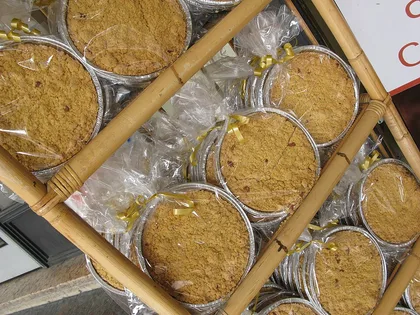 SweetsSbrisolonaSbrisolona is the crumbly almond and cornmeal cake of Mantua, and the only Italian cake you are supposed to…SweetsTorroneHoney and sugar go over a water bath and stay there for hours, sometimes twelve, while someone keeps stirring.
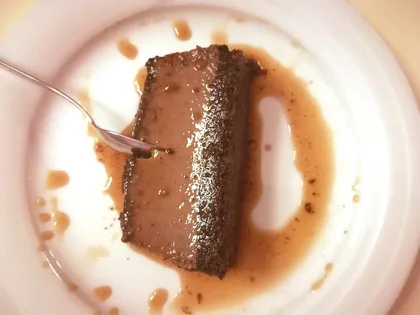 SweetsBonetBonet is the baked custard of Piedmont's Langhe hills: eggs, milk, bitter cocoa, crushed amaretti and rum…
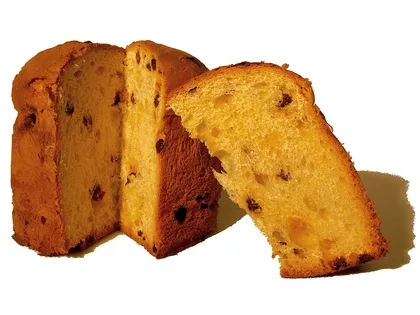 SweetsPanettonePanettone is Milan's Christmas bread: a tall, domed sourdough cake with butter, egg yolk, sultanas and…
 SweetsGelatoGelato is not ice cream translated. It carries less fat (4-8% against 10-18%), holds far less air (20-35%…SweetsColomba (Italian Easter Cake)Colomba is Italy's Easter cake: the same slow-leavened, butter-rich dough as panettone, baked in the shape of…Pasta and breadGnocchiGnocchi are small boiled dumplings, in their modern form made of potato bound with a little flour.Cured meatsPancettaPancetta is Italian cured pork belly: salt, pepper and warm spices, dried for months, never smoked.