What is Bonet?
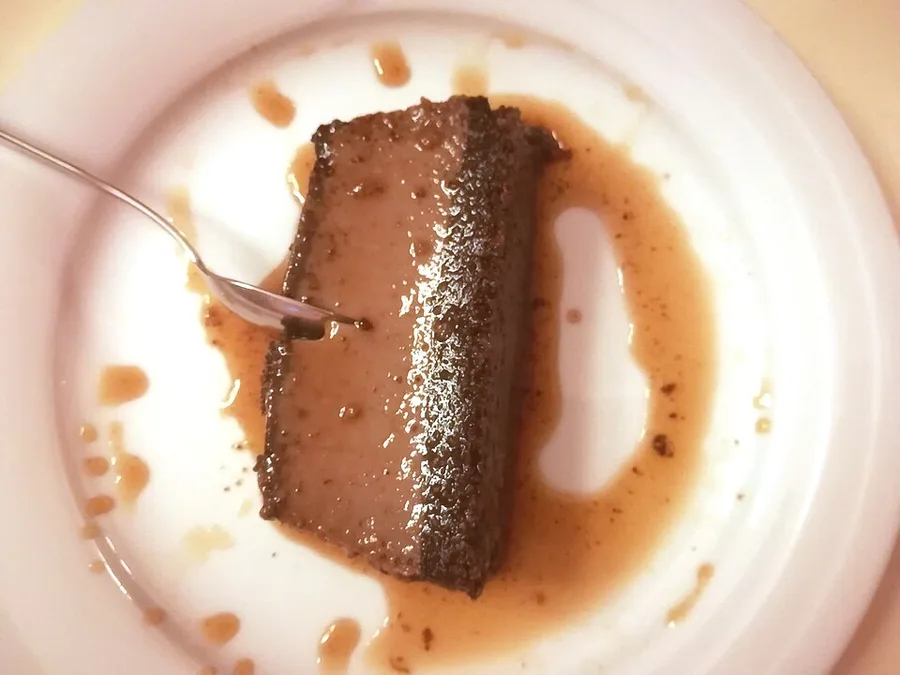
Bonet is a baked custard made from whole eggs, milk, sugar, unsweetened cocoa, dry amaretti biscuits ground to a powder, and a spirit: rum in the Langhe, sometimes Marsala or Fernet elsewhere in Piedmont. The mixture is poured into a mould lined with hard caramel and baked in a water bath at 150 to 160 degrees for about an hour.
The amaretti are structural rather than decorative. Their bitter-almond flour and sugar change the set, giving a custard that is denser, firmer and faintly grainy compared with one made from eggs and milk alone. A properly made bonet holds a clean edge under the spoon.
An older version without cocoa survives in parts of the region, called bonet bianco or bonet alla monferrina. It predates chocolate in Piedmontese home cooking and uses only amaretti, eggs, milk and liquor.
Two explanations of the name circulate, both Piedmontese and both about headwear: bonet means cap in the local dialect, referring either to the flared copper mould or to the fact that the dessert closes a meal the way a hat closes getting dressed.
It is listed among Piedmont's traditional food products.
What does it taste like?
Bitter almond first, then cocoa, then the caramel underneath. That order matters: if chocolate arrives first, the cook was short on amaretti. The rum is present as warmth rather than as an identifiable spirit, and the cocoa is unsweetened, so the whole thing reads as bittersweet rather than sweet.
The texture is the surprise for anyone expecting a wobbling custard. Bonet is dense, close-grained and slightly sandy from the ground biscuits, closer in the mouth to a very fine baked chocolate pudding than to a flan. It should melt slowly rather than dissolve, and it should never bounce: there is no gelatine in the recipe.
The caramel at the base gradually dissolves into the custard over a day or two, which makes the bottom layer darker and sweeter. Many Piedmontese consider that the point at which a bonet is at its best.
How to use it
Make the caramel first: sugar with a splash of water in a small pan over medium heat until it is dark amber, then pour it straight into the mould and tilt to coat the base. It sets in under a minute, so have the mould ready.
Beat whole eggs with sugar without whipping air into them: air becomes bubbles in the oven. Add sieved cocoa, powdered amaretti, warm milk in a thin stream, then the rum. For six people: five eggs, 500 ml milk, 120 g sugar, 30 g cocoa, 100 g amaretti, two tablespoons of rum. Strain the mixture before it goes into the mould.
Bake in a water bath with the water halfway up the mould, at 150 to 160 degrees, for an hour to an hour and a quarter. The water must never boil, or the custard fills with holes and turns spongy. It is done when the centre still moves slightly.
Cool completely, then refrigerate at least four hours and preferably overnight before turning out. It will not unmould before that.
Serve cold, in thick slices, with the caramel from the base spooned over. No cream, no ice cream, nothing warm.
How long it keeps
Covered in the fridge, a bonet holds four or five days, and the first two are when it improves. Keep it in its mould until you serve it: the caramel on the base seals the surface and slows drying. Once turned out, cover it with a dome or with film held clear of the top, because the exposed custard forms a skin within hours.
What changes over time is worth knowing. The caramel at the bottom of the mould dissolves gradually into the custard, so after forty-eight hours the lower part is darker and sweeter, which many people consider the best moment to eat it. Past five days the set tightens and the top dries out. Anything bought from a shop carries the maker's own date.
Freezing is not the route: the egg structure breaks and on thawing releases water, leaving a grainy, separated mass. Serve it cold but not ice cold. Half an hour out of the fridge lifts the aromatics, the rum in particular, which flattens out at fridge temperature.
Spot the real thing
A properly made bonet is an even dark brown, with a smooth unblistered top, and cuts into a compact, faintly grainy set rather than a spongy one. Holes running through the slice mean the water bath was allowed to boil.
Turned out, it should stand up on its own, with caramel running down the sides without being as thin as syrup; watery caramel means it left the fridge too early. On the palate the amaretti arrive first, with their bitter almond note, and the cocoa comes in behind. If all you taste is chocolate, the biscuits were too few or too poor. Texture is what separates it from an industrial pudding: a little resistance to the spoon, then a slow melt, never a bounce. Gelatine is not in the recipe, and a version that wobbles back contains setting agents.
On a menu abroad it gets read as crème caramel or Spanish flan. It is darker and denser than either, and carries cocoa, crushed amaretti and usually rum or Fernet.
How to pronounce Bonet
boo-NET
Two syllables, stress on the second, and the final T is pronounced: it is Piedmontese, not French, so never 'bo-NAY'. The O is closer to the 'oo' in 'book' than to the 'o' in 'bone'. In dialect it is often written bunet, which shows the vowel more honestly. Common errors: 'BON-ay', 'BOH-net' with the stress at the front, and treating it as a French word.
Bonet compared
vsCrème caramel
They share the caramel-lined mould and the water bath, and that is where the resemblance ends. Crème caramel is a smooth, pale custard of eggs, milk and sugar. Bonet adds unsweetened cocoa, ground amaretti and rum, which make it dark, dense, faintly grainy and much less sweet.
| This | Crème caramel | |
|---|---|---|
| Base | Whole eggs, milk, sugar | Whole eggs, milk, sugar |
| Added | Cocoa, amaretti, rum | Vanilla |
| Colour | Dark brown | Pale gold |
| Texture | Dense, close, slightly grainy | Smooth, wobbling, silky |
| Sweetness | Bittersweet (cocoa is unsweetened) | Sweet |
| Origin | Langhe and Monferrato, Piedmont | France |
| Improves with resting | Yes, for two days | Best within a day |
vsPanna cotta
Piedmont's other famous spoon dessert, and a useful contrast because the setting mechanism is completely different. Panna cotta is cream set with gelatine and never baked; bonet is eggs set by heat in a water bath. One is white and wobbly, the other dark and firm.
| This | Panna cotta | |
|---|---|---|
| Set by | Eggs, baked | Gelatine, chilled |
| Dairy | Milk | Cream |
| Cooked | In the oven, one hour | Briefly on the hob, then chilled |
| Colour | Dark brown | White |
| Mouthfeel | Dense, dissolving | Springy, coating |
| Suitable for vegetarians | Yes | Only with a non-animal setting agent |
vsChocolate flan or budino al cioccolato
The closest thing on most dessert menus, and still not the same. A chocolate flan uses melted chocolate or chocolate and cream for richness; bonet uses unsweetened cocoa powder and biscuits, which makes it drier, more bitter and considerably less rich.
| This | Chocolate flan or budino al cioccolato | |
|---|---|---|
| Chocolate form | Unsweetened cocoa powder | Melted chocolate |
| Richness | Moderate (milk, no cream) | High (cream and cocoa butter) |
| Almond note | Central, from amaretti | Absent |
| Alcohol | Rum, Marsala or Fernet | Usually none |
| Finish | Bitter and long | Sweet and round |
Bonet substitutes
- Amaretti di Mombaruzzo, or any hard dry amaretti
Not a substitute for the dessert but the ingredient you cannot skip. Use the hard, crunchy kind, not the soft chewy ones, which carry too much moisture and will loosen the set. Grind them to a powder in a food processor.
100 g amaretti per 500 ml milk - Ratafia biscuits or hard macaroons
The nearest British and American equivalents of amaretti, both built on bitter almond. Slightly sweeter, so drop the sugar in the custard by about 20 grams.
1:1 by weight - Marsala or Fernet instead of rum
Both are traditional regional variations rather than compromises. Marsala rounds the dessert out and suits the Asti version; Fernet pushes it toward a bitter, herbal finish that pairs remarkably well with the cocoa.
2 tablespoons, same as the rum - No alcohol at all
The recipe holds up without it, which is how it is made for children in Piedmont. Replace the two spoons of rum with strong cold espresso to keep some of the bitterness.
2 tablespoons espresso - Toasted hazelnuts for part of the amaretti
An Alta Langa variation from the hazelnut country around Cortemilia. Replace up to a third of the amaretti with finely ground toasted Piedmont hazelnuts for a rounder, nuttier custard.
Up to one third of the amaretti weight - Crème caramel, if you must
The nearest thing you will find on a restaurant menu outside Italy. Order it knowing it will be lighter, sweeter and smoother, with none of the bitter-almond core.
Direct
Where to buy it
Bonet is essentially a restaurant and home dessert; it is not a packaged product and it does not export. Outside Italy you will meet it on the menu of serious Piedmontese restaurants, at roughly 9 to 14 dollars or pounds a portion, often reworked with cream or gelato that the original does not want.
The practical route abroad is to make it, and the only ingredient worth sourcing carefully is the amaretti. Amaretti from Mombaruzzo in Asti province, made with apricot kernels alongside sweet almonds, are stocked by Italian delicatessens and online specialists at roughly 25 to 35 euros a kilo, and you need a hundred grams. Choose the hard, crisp kind, not the soft chewy ones.
Everything else is a supermarket shop: eggs, whole milk, caster sugar, unsweetened cocoa, dark rum.
In Piedmont, pastry shops sell it by weight at 16 to 24 euros a kilo, or as a filled mould serving six for 14 to 20 euros. In a Langhe trattoria a portion runs 5 to 8 euros, rising to 9 or 10 in the Barolo villages.
Where to eat it in Italy
The Langhe: Alba, Barolo, Barbaresco, Neive, La Morra, Serralunga d'Alba. In the trattorie there bonet is almost always on the menu, frequently as the only dessert, and that is a reason to order it rather than a limitation.
Mombaruzzo, in Asti province, is the amaretti town, and its historic workshops sell directly. Buying the biscuits there and making the dessert at home is a sensible plan for anyone passing through.
Around Asti and in the Monferrato you are more likely to meet the Marsala version, and in a few osterie the older cocoa-free bonet survives. It is worth asking for: a genuinely different and increasingly rare dessert.
Turin has it in Piedmontese restaurants and delicatessens, but it is a hill dessert rather than a city one and the difference shows.
During the Alba white truffle fair, from October into November, the whole area's restaurants run at full capacity and bonet is the standard end to almost every lunch. It is also the period in which you will not get a table without booking.
Frequently asked questions
What is bonet?
A baked custard from the Langhe hills of Piedmont, made with eggs, milk, sugar, unsweetened cocoa, ground amaretti biscuits and rum, set over a layer of caramel and cooked in a water bath. It is denser and less sweet than crème caramel and tastes primarily of bitter almond and cocoa.
What is the difference between bonet and crème caramel?
The caramel and the water bath are the same. Bonet adds unsweetened cocoa, powdered amaretti and rum, which give a dark, dense, slightly grainy custard with a bitter-almond flavour. Crème caramel is a smooth, pale, sweeter custard of eggs, milk, sugar and vanilla.
How do you pronounce bonet?
boo-NET, with the stress on the second syllable and the final T clearly pronounced. It is a Piedmontese word meaning cap, not a French one, so it is never 'bo-NAY'.
Why did my bonet come out full of holes?
The water bath boiled, or the oven was too hot. Bake at 150 to 160 degrees with the water halfway up the mould and never let it reach a boil. Over-beating the eggs at the start also traps air that becomes bubbles during baking.
Can bonet be made without alcohol or without cocoa?
Both. Without alcohol, replace the rum with strong cold espresso; the recipe holds. Without cocoa you get bonet bianco, the older Monferrato version made only with amaretti, eggs, milk and sugar, in which the bitter almond comes forward.
Related foods
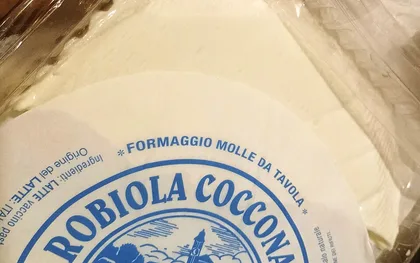 CheeseRobiolaRobiola is a family of soft young cheeses from north-west Italy rather than a single cheese.
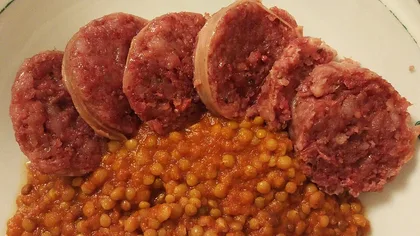 Cured meatsCotechinoCotechino is a large fresh pork sausage from Emilia-Romagna, made with pork meat, fat and rind, and always…
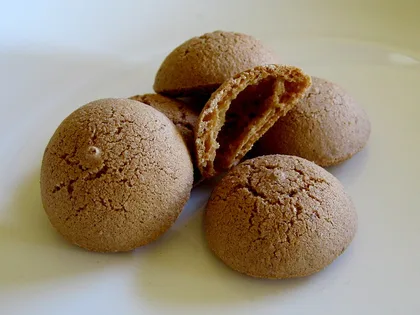 SweetsAmarettiAmaretti are flourless almond cookies whose bitter edge comes from apricot kernels, not almonds.
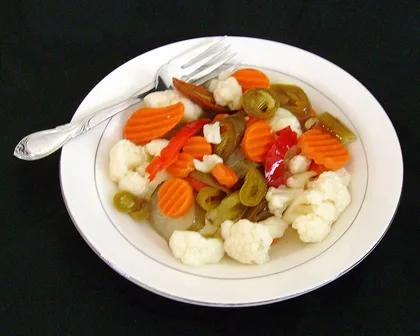 Oil and preservesGiardinieraGiardiniera means two very different jars. In Italy it is a mild mix of vegetables pickled in wine vinegar…
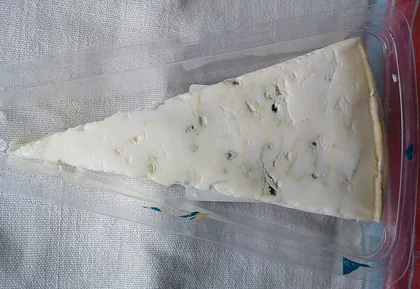 CheeseGorgonzolaThe green veining is the product, not a flaw anyone tolerates: it grows from a mould added to the milk and…
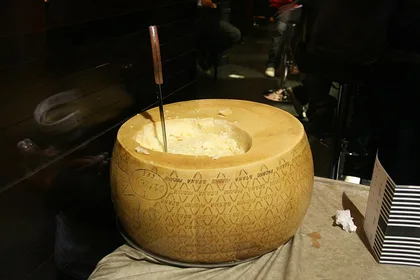 CheeseGrana PadanoNine months is the floor the specification sets before a wheel may carry the name.
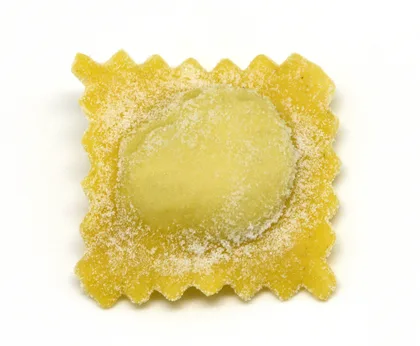 Pasta and breadAgnolottiAgnolotti are Piedmont's stuffed pasta: thin egg dough around a filling of roasted meat, not ricotta.
 WineBaroloBarolo is one hundred per cent Nebbiolo from eleven villages in the Langhe hills of Piedmont, aged at least…