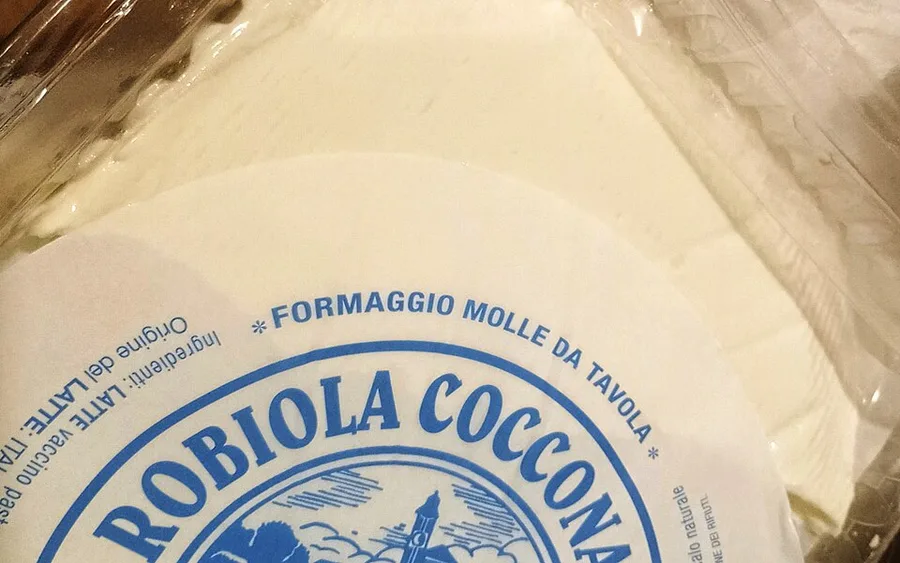
What is Robiola?
The word robiola covers two quite different things. At one end sits Robiola di Roccaverano DOP, a lactic-set cheese from nineteen villages in the Alta Langa, made from raw milk that must be at least fifty per cent goat, with cow and sheep milk making up the rest. At the other end sit industrial robiole, almost always pasteurised cow's milk, sold in small 100-gram blocks and eaten as a mild spread.
The traditional shape is a low cylinder, about eleven centimetres across and three high, weighing between 250 and 400 grams. The paste is white and soft with no holes; the rind, where there is one, is thin and wrinkled, and on aged wheels it develops grey moulds and an ammoniacal edge.
Two explanations of the name have coexisted for centuries: one from Latin rubeola, for the reddish tone an aged rind takes on, the other from Robbio, a town in Lombardy's Lomellina. Neither has been settled.
Roccaverano earned DOP status in 1996, and a Slow Food Presidium protects the strictest version: raw whole goat's milk, one hundred per cent.
What does it taste like?
Fresh, it tastes of clean acidity and cool milk, with the goat note present but restrained, nothing like the sharp barnyard flavour of an aged chèvre. The texture is fondant rather than springy: it collapses on the tongue instead of resisting.
After ten to twenty days of ageing the character changes. The layer just under the rind goes almost liquid, the flavour concentrates into something nuttier and saltier, and the goat comes forward. Past a month the wheels turn genuinely pungent, with grey mould, an ammoniacal top note and a peppery finish that surprises anyone who met robiola as a mild supermarket block.
The cow's-milk robiole of Lombardy taste sweeter, creamier and simpler, closer to a thicker crescenza than to anything from the Langhe.
How to use it
Serve it at room temperature, always. Take it out of the fridge thirty minutes ahead; cold robiola tastes of nothing because the fat is still set.
On a board it needs almost nothing: rye or plain wheat bread, a spoon of chestnut honey, and toasted Piedmont hazelnuts. Cugnà, the local grape-must mostarda of the Langhe, is the regional pairing, and fig or red-onion jam does the same job.
In cooking, its useful property is that it melts smoothly without stringing or splitting. A spoonful stirred into a risotto off the heat gives a better finish than butter and cream and less fat; folded into a ravioli filling with chard or braised leeks it adds creaminess without water.
With pasta it suits autumn vegetables: pumpkin, leeks, late radicchio, cavolo nero. Add it off the heat and let the residual warmth do the work.
Heavily aged wheels change role entirely: crumble or grate them as you would a pungent cheese, or keep them submerged in olive oil with peppercorns and thyme.
One underrated local combination: fresh robiola, salted Ligurian anchovies and plain bread. The anchovies came over the old salt roads, and the pairing is older than it looks.
How long it keeps
Fresh robiola has a short life: five or six days in the fridge, kept in its own paper rather than cling film, which stops it breathing and pushes it sour. It wants the least cold shelf, 6 to 8 C, and half an hour out before serving, because when the fat is chilled solid the aromas do not register at all. A sealed tub runs to the date printed on it, which belongs to the dairy.
Aged wheels last three or four weeks and go on changing the whole time: the rind dries and tightens, the layer beneath it turns translucent and fondant, the paste softens from the outside in and the ammonia note strengthens as it goes. Turn them every two or three days and keep them in a box that does not seal airtight. They do not freeze, because the lactic structure breaks and thawing leaves separated whey and a grainy mass. The traditional route for aged wheels is a glass jar under extra virgin olive oil with peppercorns, bay and thyme, fully submerged, where they hold for months and concentrate further.
Spot the real thing
In a fresh Roccaverano the paste is a stark white, because goats do not convert beta-carotene, and the surface is faintly wrinkled and moist rather than wet. The little wheel has to hold its own shape: one slumping on the counter has been kept badly. On the palate the fresh version has clean acidity and a restrained goat note that grows as it ages, while a flat, purely milky taste points to pasteurised milk or the minimum goat percentage in the blend. On aged wheels a grey and blue-grey bloom is normal and wanted, and a faint ammonia note is part of the type.
For the marks, Robiola di Roccaverano DOP carries a label with the logo and the dairy number, and the Slow Food Presidium adds its own on wheels made from one hundred percent goat milk. Any robiola that does not declare the species is cow milk. Abroad the word travels loosely: robiola-style and Italian-style robiola are legitimate names with no connection to Piedmont, and most foreign delis stock the mild industrial squares of cow and sheep milk, which cost a fraction of a DOP goat wheel.
How to pronounce Robiola
roh-BYOH-lah
Three syllables, stress on the second. The 'bio' collapses into one sound, 'BYOH', not 'bee-oh'. Roccaverano is rok-kah-veh-RAH-noh, with the double C held slightly longer and the stress on the fourth syllable. Common errors: 'ROB-ee-ola' and 'ro-bee-OH-la'.
Robiola compared
vsStracchino (crescenza)
The closest comparison and the one most often confused abroad. Stracchino is always cow's milk, always fresh, square, rindless and eaten within days. Robiola is cylindrical, may be goat, cow or sheep milk, and can be aged until it develops a rind and real pungency.
| This | Stracchino (crescenza) | |
|---|---|---|
| Milk | Goat, cow, sheep or a blend | Cow only |
| Shape | Low cylinder | Square or rectangular slab |
| Rind | Thin and wrinkled on aged wheels | None |
| Ageing | Four days to over a month | Days, always eaten fresh |
| Flavour range | Lactic to pungent and ammoniacal | Consistently sweet and mild |
| Protected name | Robiola di Roccaverano DOP | None |
vsSquacquerone
Romagna's very soft fresh cow's-milk cheese, spoonable rather than sliceable, and famous as the filling of a piadina. It shares robiola's youth and none of its capacity to age.
| This | Squacquerone | |
|---|---|---|
| Region | Piedmont and Lombardy | Emilia-Romagna |
| Texture | Holds a shape, fondant | Almost pourable |
| Acidity | Clean and moderate | Marked, distinctly sour |
| Milk | Often goat | Cow only |
| Classic use | Cheeseboard, honey and hazelnuts | Inside a warm piadina with rocket |
| Can it be aged | Yes, up to real pungency | No |
vsFrench chèvre (crottin, bûche)
Both are goat cheeses set slowly by lactic acidification, which makes them structurally cousins. The Italian version is milder, moister and rounder because the recipe allows cow's milk into the blend and because the wheels are eaten younger.
| This | French chèvre (crottin, bûche) | |
|---|---|---|
| Milk | At least 50 per cent goat, often blended | 100 per cent goat |
| Setting | Lactic, 12 to 24 hours | Lactic, 18 to 24 hours |
| Goat character | Restrained when fresh | Forward, even when young |
| Moisture | Higher, fondant | Drier, chalkier at the centre |
| Rind | Bare, natural moulds when aged | Often ash-coated or bloomy |
Robiola substitutes
- Stracchino or crescenza
The right answer where the recipe uses robiola as a soft, mild, melting cheese: in a risotto, a ravioli filling or a savoury tart. Milder and sweeter, so add a little salt or a squeeze of lemon.
1:1 - Fresh young chèvre
The right answer where the goat character matters, as on a cheeseboard with honey and hazelnuts. Choose the youngest, moistest log you can find and let it come fully to room temperature.
1:1 - Squacquerone
Softer and sharper. Excellent spread on bread or folded into hot pasta; useless where the cheese needs to hold a shape.
1:1, expect a looser result - Ricotta blended with cream cheese
The pantry workaround. Two parts fresh whole-milk ricotta beaten with one part full-fat cream cheese, plus a pinch of salt, mimics the texture well enough for cooked dishes. It will taste sweeter and flatter raw.
2 parts ricotta to 1 part cream cheese - Vegetarian robiola
Roccaverano DOP uses animal rennet, so it is not vegetarian. Several Piedmontese and Lombard dairies make non-DOP robiole with microbial rennet and say so on the label, worth checking rather than assuming, since soft Italian cheeses are inconsistent on this point.
1:1 - Brillat-Savarin or a young Saint-Marcellin
If the point is a soft, fondant cheese for the end of a meal, either works. Richer and cow-based, so the acidity that defines a Roccaverano is absent, so pair with something sharp.
1:1
Where to buy it
Roccaverano DOP is hard to find outside Italy, largely because it is a raw-milk cheese with a short life. In the UK, specialist cheesemongers such as those in Borough Market and a handful of Italian importers list it intermittently at roughly 30 to 38 pounds per kilo. In the US, the raw-milk ageing rules make the fresh version essentially unavailable; aged wheels appear occasionally at Italian specialists and Eataly at 28 to 40 dollars a pound.
Cow's-milk robiola travels much better and is stocked by most Italian delicatessens abroad. It is a genuine product with its own Lombard tradition, just not the Alta Langa cheese.
Read the label for the milk species. If it does not say capra or goat, the cheese is cow's milk. The DOP mark carries the dairy's number, and Presidium wheels state the one-hundred-per-cent goat's milk version explicitly.
In Italy, buy it in Alta Langa itself at 18 to 24 euros a kilo direct from the farms, or from cheesemongers in Alba, Asti and Turin at 20 to 32. Spring, when the goats are back on pasture, is when the milk is most aromatic.
Where to eat it in Italy
Roccaverano and its neighbours in the Alta Langa: Olmo Gentile, Serole, Monastero Bormida, Spigno Monferrato. These are very small villages with a handful of farms selling at the door, and the cheese is made early in the morning, so visits happen at dairy hours, not tourist hours.
Roccaverano holds an annual event dedicated to its DOP, and several producers open to visitors around it.
In Alba and Asti, the town cheesemongers carry both the Roccaverano and the local cow's-milk robiole, and any decent osteria will have it on the cheese trolley alongside Castelmagno and the tome.
Turin is the easiest place to find a full range: the stalls of the Porta Palazzo market and the delicatessens around via Lagrange stock it regularly. Milan's specialist cheese shops keep it too, usually in the aged form, which survives transport better.
Over in Lombardy, the Lomellina towns of Robbio, Mortara and Vigevano make their own cow's-milk robiole, a different and far less celebrated cheese with an equally long history, and one of the two candidate origins of the name.
Further reading
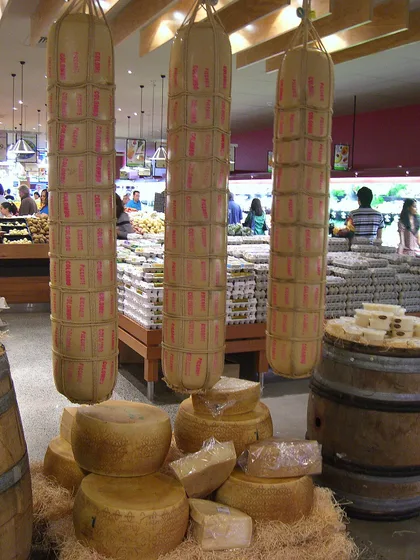 ExplainerWhich Italian cheeses contain no lactoseItaly sets a legal threshold, and long-aged cheeses clear it on their own, with no treatment involved.
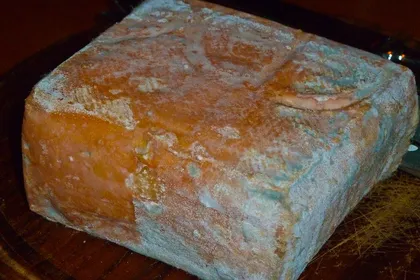 GuideCan you eat cheese rind?On some wheels the rind is the same paste, dried out. On others it is paraffin.
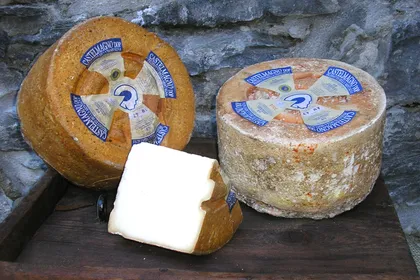 InvestigationItalian raw milk cheeses: the full listWe counted: 19 of 43 declare raw milk, and 16 of those 19 carry a protected designation.
Frequently asked questions
What is robiola cheese?
A family of soft, young cheeses from Piedmont and Lombardy. The protected one is Robiola di Roccaverano DOP, made in the Alta Langa from raw milk that is at least half goat's milk; most robiola sold elsewhere is a mild pasteurised cow's-milk cheese using the same name.
Is robiola the same as stracchino?
No, though fresh cow's-milk versions of the two are similar. Stracchino is always cow's milk, always square, rindless and eaten within days. Robiola is cylindrical, can be goat or blended milk, and can be aged until it develops a rind and a pungent, ammoniacal character.
Is Robiola di Roccaverano a goat cheese?
Mostly. The DOP rules require a minimum of fifty per cent goat's milk, with cow or sheep milk making up the remainder. The Slow Food Presidium version is made from one hundred per cent raw goat's milk. It is the only Italian DOP cheese built around goat's milk.
Is robiola vegetarian?
Roccaverano DOP is not: it is made with animal rennet. Some non-DOP robiole from Piedmont and Lombardy use microbial rennet and label themselves as suitable for vegetarians, but this varies by dairy, so the label is the only reliable guide.
How do you pronounce robiola?
roh-BYOH-lah, three syllables with the stress on the second, and the 'bio' spoken as a single sound rather than 'bee-oh'. Roccaverano is rok-kah-veh-RAH-noh.
Related foods
 SweetsBonetBonet is the baked custard of Piedmont's Langhe hills: eggs, milk, bitter cocoa, crushed amaretti and rum…
 Cured meatsCotechinoCotechino is a large fresh pork sausage from Emilia-Romagna, made with pork meat, fat and rind, and always…
 CheeseGorgonzolaThe green veining is the product, not a flaw anyone tolerates: it grows from a mould added to the milk and…
 CheeseGrana PadanoNine months is the floor the specification sets before a wheel may carry the name.
 CheeseProvoloneProvolone is a stretched-curd cow's milk cheese from northern Italy, rope-tied and hung to age in shapes from…
 CheeseTaleggioTaleggio DOP is a square, washed-rind cow's milk cheese from the Bergamo Alps, aged at least 35 days.
 CheeseBittoBitto DOP can only be made between 1 June and 30 September, on high summer pasture, in a dismantlable stone…
 CheeseQuartirolo LombardoQuartirolo Lombardo is named after quartirola, the fourth grass cut of the year in September: it was made…