What is Sbrisolona?
Sbrisolona is a cake made of crumbs. The dough is never worked smooth: butter is rubbed into the dry ingredients with fingertips until it forms lumps of wildly different sizes, and the mixture is then tipped into a tin without being pressed down. In the oven the lumps fuse just enough to hold, producing a disc two or three centimetres tall with almost no internal cohesion.
The name comes from Mantuan dialect: brisa means crumb, and sbrisolona is 'the big crumbly one'. It is an instruction rather than a description. This cake is not sliced. It is broken by hand, or struck in the centre with a closed fist.
The historic formula is known as the three-cup cake: one part wheat flour, one part cornmeal, one part sugar. Around that skeleton sit the variables (almonds, butter or lard, egg yolks, lemon zest and vanilla) which are what separate a home version from a pastry-shop one.
What does it taste like?
Sand, in the best possible sense. It disintegrates the moment you bite it and dissolves rather than chews, leaving behind the grit of cornmeal, the oil of toasted almond, butter, and a lemon-and-vanilla background. There is nothing soft or moist anywhere in it, which is the entire design.
It is sweet but not aggressively so, and considerably less sweet than most Northern European almond biscuits. The cornmeal is what makes it distinctive and what surprises first-time eaters: it gives a mineral, faintly polenta-like flavour that keeps the almond from tipping into marzipan.
The day after baking it is better. The almonds release their oil, the structure settles, and the flavour deepens. This is one of the rare cakes that genuinely improves with a day or two on the counter, which is why it travels well and why the tinned gift versions are not a compromise.
How to use it
Serve it whole, in the middle of the table, and break it. In Mantua the gesture is a closed fist struck into the centre, and it is genuinely part of the ritual: bringing it out pre-sliced is regarded as a mistake. Then everyone takes pieces with their hands.
The traditional accompaniments are warm zabaione, which you dip the pieces into, and a small glass of grappa or dessert wine. A more recent but widespread third option is lightly sweetened mascarpone. Given how dry the cake is by construction, something wet alongside it is not optional so much as expected.
If you are baking it, two rules cover almost every failure. Do not knead: rub the cold butter in with your fingertips and stop the moment you have irregular lumps, because a dough that comes together into a ball bakes into a hard biscuit. And do not press it into the tin, since every bit of compression costs you crumbliness.
Let it cool completely in the tin before you touch it; warm, it collapses. And leave it a day if you can. The crumbs left on the plate are not waste: use them as a base under a set cream, over ice cream, or stirred through yoghurt.
How long it keeps
Ten to fifteen days in a tin or a rigid box at room temperature, and it is one of the few baked things that is better on day two than on day one: in the first twenty-four hours the almonds release oil into the crumb and the whole structure settles. The refrigerator is the wrong place, and so is plastic film pressed against it, for the same reason: both put damp air in contact with a cake whose entire character is dryness. What softens is the maize, which draws water readily and goes from sandy to leathery.
Ten minutes in a 150 degree oven drives that water back out, and it must cool completely before serving, because it firms as it cools and a warm one will not shatter properly. Whole or in pieces, sealed in a bag, it freezes for three months and comes back at room temperature in an hour. Raw dough is the one thing that cannot wait: as the butter softens it binds the crumbs together and the lumps disappear, so it is baked at once. Boxed ones carry their own date.
Spot the real thing
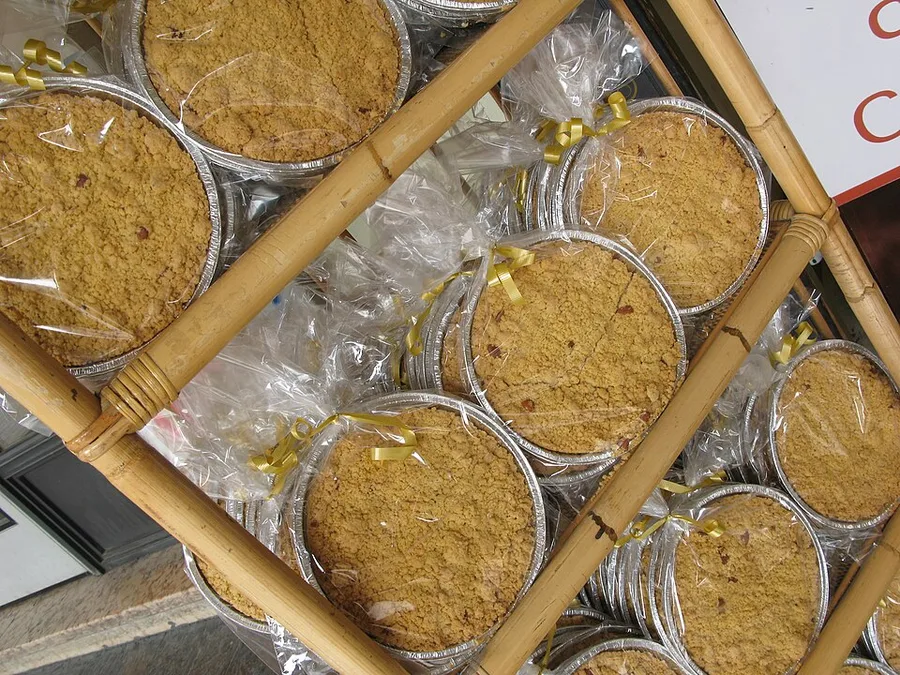
The surface is the tell. A proper sbrisolona looks like rubble: craters, lumps of visibly different sizes, whole almonds breaking the crust. A smooth, evenly domed disc was pressed into its tin, which is the standard industrial shortcut and produces something hard rather than friable. The colour should be a warm amber gold, neither pale nor browned, and the maize flour should be visible as yellow grain in the dough rather than merely implied. On the bite it collapses at once and melts, leaving the sandiness of cornmeal and the oil of almond behind; anything that holds together and needs chewing was made with butter that got warm or dough that got worked.
On a boxed one, read the almond percentage. Fifteen to twenty per cent, listed ahead of any flavourings, is the mark; under ten and you have a maize cake with a few nuts. If maize flour is missing from the list altogether, the thing in the box is a crumbled tart under a borrowed name. It is not a British crumble or a German Streuselkuchen, and it is never cut: you break it by hand.
How to pronounce Sbrisolona
sbree-zoh-LOH-nah
Four syllables, stress on LOH. The opening 'sbr' is a single cluster with a voiced 'z'-like s: zbree, not 'ess-bree', and English speakers should resist inserting a vowel before the b. The 's' between vowels is also voiced: sbree-ZOH, not 'sbree-SOH'. In Mantua you will hear the dialect form sbrisulusa, which is close enough that using the Italian version will be understood everywhere.
Sbrisolona compared
vsFregolotta
The Venetian cousin, from the Treviso area, and the cake it is most often confused with. Fregolotta uses no cornmeal, is thinner, and leans harder on almonds and cream. Both shatter; only one tastes of maize.
| This | Fregolotta | |
|---|---|---|
| Cornmeal | One third of the dry mix | None |
| Thickness | 2-3cm | 1-1.5cm |
| Fat | Butter, sometimes with lard | Butter, often with a little cream |
| Texture | Sandy and gritty | Finer, more brittle, closer to a biscuit |
| Origin | Mantua, Lombardy | Treviso, Veneto |
| Served with | Zabaione, grappa, passito | Coffee, dessert wine |
vsCrumble topping
Structurally almost identical and conceptually opposite. A British crumble is a topping over hot fruit, meant to be eaten with a spoon and something wet. A sbrisolona is the whole dessert, dry all the way through, eaten with the hands.
| This | Crumble topping | |
|---|---|---|
| Role | The entire cake | A topping over fruit |
| Flour | Wheat, cornmeal and ground almond | Wheat, sometimes oats |
| Depth | 2-3cm, self-supporting | 1-2cm, supported by the fruit beneath |
| Moisture | None, by design | Absorbs juice from the fruit |
| Eaten | Broken by hand, at room temperature | With a spoon, hot |
vsShortbread
Both are dry, buttery and crumbly, and there the similarity ends. Shortbread is pressed and scored so it holds a shape; sbrisolona is deliberately left loose so it does not. Shortbread has three ingredients and no nuts; sbrisolona has five and is a fifth almonds.
| This | Shortbread | |
|---|---|---|
| Dough | Loose lumps, never compacted | Pressed firmly into a mould |
| Nuts | 15-20 per cent almonds | None traditionally |
| Grain | Wheat plus cornmeal | Wheat, sometimes with rice flour |
| Serving | Broken into irregular pieces | Cut into fingers or petticoat tails |
| Keeps | 10-15 days, improving | Two weeks, unchanging |
vsSbriciolata
A near-identical word for a different cake, and a common Italian-language trap. A sbriciolata is a filled crumble tart: ricotta, jam or chocolate spread under a crumb layer. A sbrisolona has no filling at all.
| This | Sbriciolata | |
|---|---|---|
| Filling | None | Ricotta, jam, or chocolate spread |
| Structure | Crumb from base to top | Crumb base, filling, crumb lid |
| Moisture | Completely dry | Moist in the middle |
| Keeps | Ten days or more | Two or three days, refrigerated |
Sbrisolona substitutes
- Homemade, which is the point
Almost nobody sells this outside Lombardy, and it is one of the easiest Italian cakes to make. Rub 150g cold butter into 150g plain flour, 150g fine cornmeal, 150g sugar and 150g chopped almonds with lemon zest, bind loosely with one yolk, tip into a 28cm tin without pressing, and bake at 175C for 45 minutes.
Serves six to eight - Cornmeal substitutions
Use fine or medium polenta, sometimes sold as fioretto. Coarse bramata stays gritty in an unpleasant way; instant polenta collapses into powder. American fine yellow cornmeal is the right thing; masa harina is not, because it is nixtamalised and tastes of tortilla.
1:1 by weight with fine polenta - Almond substitutions
Hazelnuts are historically correct for the peasant version and arguably better with the cornmeal. Use them skinned and roughly chopped rather than ground, and reduce the sugar slightly since hazelnut reads sweeter.
1:1 by weight - Torta di nocciole or almond torta
If you want to buy something similar rather than bake, Piedmontese hazelnut cakes and Italian almond tortas occupy adjacent ground. Both are moister and hold together, so they miss the shattering texture entirely.
Not equivalent, a different pleasure - Gluten-free version
Works better than most gluten-free conversions, because a third of the flour is already cornmeal and there is no gluten structure to lose. Replace the wheat flour with rice flour plus a spoonful of potato starch and proceed unchanged.
130g rice flour plus 20g potato starch replaces 150g wheat flour - Dairy-free version
Lard is the historic fat and works perfectly, though it is not vegan. For a vegan version, a firm block coconut oil straight from the fridge rubs in much like butter; skip the yolk and bind with two tablespoons of cold water.
1:1 by weight with cold solid fat
Where to buy it
Outside Lombardy it is uncommon, which is why baking it yourself is the realistic answer. In the US, Italian importers and online specialists sell tinned versions at roughly 16 to 26 dollars for a 500g cake; Eataly stocks it seasonally. In the UK, Italian delicatessens carry it at around 12 to 22 pounds per kilo, and gift tins ship well because the cake is stable and improves in transit.
In Mantua itself, pastry shops sell artisan versions at 18 to 26 euro per kilo, with whole cakes weighing 400 to 600 grams and costing 10 to 16 euro.
Judge a packaged one by its almond content, which is the single biggest difference between good and mediocre: artisan versions run to twenty per cent, industrial ones often sit below ten. Check that cornmeal appears in the ingredients at all, because without it you have bought an almond crumble cake, not a sbrisolona. And look at the surface: it should be cratered and irregular with whole almonds showing. A smooth, even top means the mixture was pressed into the tin and the cake will be hard rather than friable.
Where to eat it in Italy
Mantua, where virtually every bakery and pastry shop in the centre has one in the window all year round. It is worth buying two or three from different producers on the same day: the differences in almond percentage and cornmeal grind are far more noticeable than you would expect.
In the trattorie of the old centre and around piazza delle Erbe it arrives whole at the end of a meal, on a plate, with zabaione served separately. That is the correct service, and it is the version of this cake worth travelling for.
Sabbioneta and the villages of the lower Mantovano make rougher versions, often using lard in place of some of the butter, more crumbly and less sweet. Anyone who knows only the urban version will find them a revelation.
Mantua sits an hour from Verona and Parma, both of which are easier to reach and both of which have Mantuan pastry on sale, a practical option if you are not routing through the city itself.
Frequently asked questions
Why is sbrisolona not sliced?
Because it has no internal structure. The dough is a mass of loose crumbs that barely fuse in the oven, and a knife simply reduces it to rubble. It is broken with the hands, or struck in the centre with a closed fist, which in Mantua is part of the ritual.
What kind of cornmeal should I use?
Fine or medium ground: fioretto in Italian, or standard fine yellow cornmeal elsewhere. Coarse polenta stays unpleasantly gritty and instant polenta turns to powder. Do not use masa harina, which is nixtamalised and tastes of tortillas.
Why did my sbrisolona come out hard?
Almost always one of two things: the mixture was worked until it formed a dough, or it was pressed down in the tin. Use cold butter, rub it in with your fingertips only until irregular lumps form, and tip the mixture into the tin without compacting it.
How long does sbrisolona keep?
Ten to fifteen days in a tin at room temperature, and it improves for the first day or two as the almonds release their oil. Never refrigerate it and never wrap it in cling film, because humidity destroys exactly the quality it exists for. It freezes for three months.
How do you pronounce sbrisolona?
sbree-zoh-LOH-nah, with the stress on LOH. The opening 'sbr' is one cluster with a voiced s, and the s between the vowels is voiced too, so sbree-ZOH, not 'sbree-SOH'.
Related foods
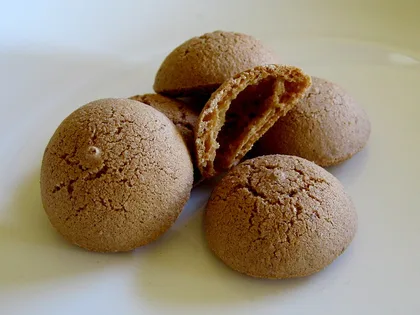 SweetsAmarettiAmaretti are flourless almond cookies whose bitter edge comes from apricot kernels, not almonds.
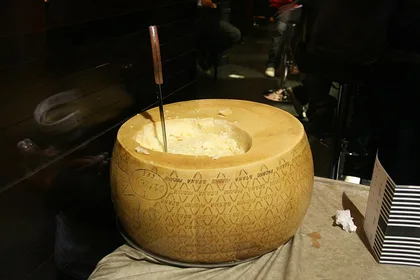 CheeseGrana PadanoNine months is the floor the specification sets before a wheel may carry the name.SweetsTorroneHoney and sugar go over a water bath and stay there for hours, sometimes twelve, while someone keeps stirring.
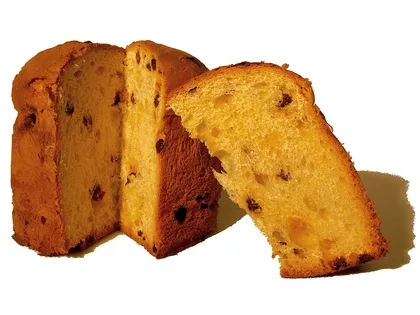 SweetsPanettonePanettone is Milan's Christmas bread: a tall, domed sourdough cake with butter, egg yolk, sultanas and…
 SweetsGelatoGelato is not ice cream translated. It carries less fat (4-8% against 10-18%), holds far less air (20-35%…SweetsColomba (Italian Easter Cake)Colomba is Italy's Easter cake: the same slow-leavened, butter-rich dough as panettone, baked in the shape of…Pasta and breadGnocchiGnocchi are small boiled dumplings, in their modern form made of potato bound with a little flour.Cured meatsPancettaPancetta is Italian cured pork belly: salt, pepper and warm spices, dried for months, never smoked.