What is Grissini?
A grissino is bread dough rolled into a thin stick and baked until nearly all its water is gone. The ingredients are ordinary (flour, water, yeast, salt, fat), but the shape pushes the crust-to-crumb ratio close to one, which is why they keep for weeks and why they shatter when you bite them.
The name comes from the Piedmontese ghersin, a diminutive of ghersa, the long narrow loaf once baked in Turin. Grissini were not invented as a snack; they are that loaf, stretched until only the shell is left.
Two families exist, and confusing them is the standard mistake. Rubatà are rolled by hand on the bench under the palm, which makes them short, thick, knobbly and crumbly. Stirati, what most of the world means by 'Turin breadstick', are pulled from both ends in a single motion, so they stay smooth, thin and fragile, with an airy interior. The vacuum-packed sticks in restaurant baskets worldwide are a third thing entirely: an industrial imitation with a longer shelf life and none of the texture.
What does it taste like?
Clean and wheaty, with almost no sweetness. The flavour is closer to a well-baked crust than to bread: toasted, faintly nutty, salted lightly rather than aggressively. If the maker used lard, there is a rounder, richer finish; olive oil gives a drier, greener edge.
The experience is mostly texture. A rubatà crumbles as soon as your teeth close, shedding fragments; a stirato snaps into two clean halves and dissolves. Neither leaves grease on your fingers, and that dryness is the point: it is what makes them work with cured meat and cheese.
Industrial breadsticks taste sweeter and blander, because malt and sugar are added for colour, and they bend before they break. Once you have had a good rubatà, the difference is not subtle.
How to use it
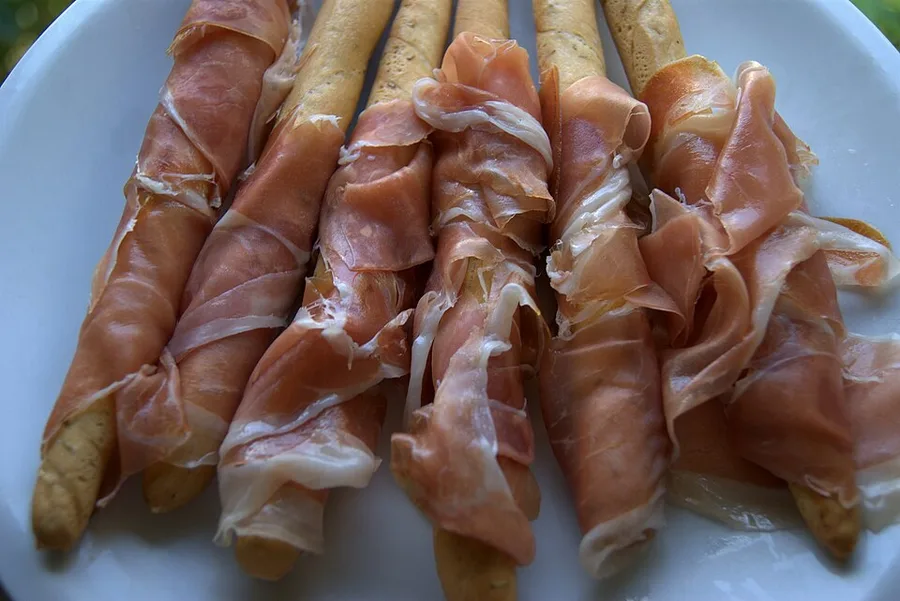
The classic Piedmontese move is to wrap a rubatà in a slice of prosciutto crudo or lardo and serve it with the first glass of wine. It works because the breadstick is bone-dry and the cured fat has somewhere to go. Do it at the last moment: after twenty minutes under prosciutto, the stick goes soft.
At the table they belong in a tall glass, standing up, not lying in a basket. Turin restaurants have served them that way for a century and it is not just decoration: it keeps them off a damp surface.
Beyond the aperitivo, crush them for a coating that stays crisper than breadcrumbs on baked fish or veal, use them to scoop the bottom of a bagna cauda pot, or snap them into a soup where you would otherwise use croutons. Scattered over vitello tonnato or a tartare they add crunch without adding moisture.
One rule that matters more than it sounds: bring them out cold and dry, and put the tin away as soon as the aperitivo is over. Humidity is the only thing that can ruin them.
How long it keeps
In an airtight container away from light, hand-made grissini stay brittle for three or four weeks, drying a little further as they go. Industrial packs reach six months or so, helped by the modified atmosphere sealed into the bag, and carry a printed date from the maker. Time is not really the variable here: damp is. A paper bag left open on a kitchen counter is enough to soften them in two days, and once they bend instead of snapping, the crumb has taken on water.
Keep them out of the fridge, where the humidity is high and they also absorb the smell of everything around them. A glass jar with a clip lid works best, stored away from the hob and the kettle. Sticks that have gone soft crisp again with five to eight minutes in a 150°C (300°F) oven; let them cool completely before putting them back, or the residual steam softens them a second time. Freezing serves no purpose, and the thaw cycle leaves them limp.
Spot the real thing
A hand-made grissino is never quite straight and never identical to the one beside it. Rubatà, the rolled type, is knobbly, its cross section changing along the length, the surface matte and uneven. The hand-pulled stirato has slightly thicker ends, where the fingers gripped, and an oval rather than round section.
It should snap clean, with a dry crack, and shatter into crumbs. One that bends before it breaks has taken on moisture or was underbaked. One that leaves a greasy film on the fingers was made with cheap fat.
On the label, read the order of the ingredients and the type of fat: extra virgin olive oil or lard point to serious production, while palm oil, unnamed vegetable oil, malt or added sugar point to an industrial stick built for colour and shelf life. Sticks of identical length in individual wrappers have never been touched by a hand. And note the word trap: American breadsticks, the soft warm kind from chain restaurants, share the English name and nothing else.
How to pronounce Grissini
gree-SEE-nee
Three syllables, stress on the middle one. The double 's' is a hard, hissed sound, not a 'z'. One breadstick is a grissino (gree-SEE-noh); the plural already ends in -i, so 'grissinis' is doubly wrong. Never 'griss-EYE-nee'.
Grissini compared
vsIndustrial breadsticks
The sticks in the plastic sleeve on the restaurant table and a Turin grissino share a name and nothing else. Industrial breadsticks are extruded by machine from a stiffer dough with added sugar and vegetable fat, engineered for shelf life and uniformity; a real grissino is shaped by hand or by pulling and baked until it dries.
| This | Industrial breadsticks | |
|---|---|---|
| Shaping | Rolled or pulled by hand | Extruded through a die |
| Shape | Irregular, tapered, never identical | Perfectly uniform cylinders |
| Fat | Lard or extra-virgin olive oil | Sunflower, palm or generic seed oil |
| Added sugar | None | Sugar or malt, for colour |
| Texture | Shatters, crumbles | Bends, then breaks |
| Shelf life | Three to four weeks in a tin | Six months, sealed |
| Price | €12-20/kg | €4-8/kg |
vsRubatà vs stirato
The two Piedmontese styles are made from similar dough and diverge entirely at the shaping bench. Rubatà comes from the hill towns east of Turin and is rolled; stirato is the city's own and is stretched. Piedmontese eaters have strong preferences and they are not interchangeable at the table.
| This | Rubatà vs stirato | |
|---|---|---|
| Method | Rolled under the palm | Pulled from both ends |
| Look | Knobbly, ridged, uneven | Smooth, tapering, long |
| Length | 20-40 cm | 40-80 cm |
| Thickness | Thick, chunky | Thin, delicate |
| Interior | Dense and crumbly | Airy, full of bubbles |
| Home region | Chieri, Andezeno, Monferrato | City of Turin |
| Best with | Cheese, bagna cauda, salami | Prosciutto, aperitivo, bread basket |
vsTaralli
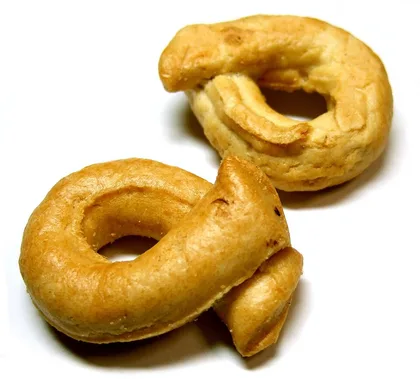
Southern Italy's answer to the same problem (dry, keepable bread) solved very differently. Taralli from Puglia are boiled before baking and heavily flavoured with olive oil, fennel seed, black pepper or wine; grissini are baked straight and left plain. Taralli are a snack in their own right, grissini are a vehicle.
| This | Taralli | |
|---|---|---|
| Region | Piedmont | Puglia, Campania, Basilicata |
| Shape | Stick | Small ring |
| Process | Baked only | Often boiled, then baked |
| Flavourings | Plain | Fennel, pepper, chilli, white wine |
| Fat content | Low, 6-10% | High, 15-25% olive oil |
| Texture | Shattering, dry | Hard, dense, oily |
Grissini substitutes
- Any plain, unsweetened breadstick
The obvious fallback. Check the label for sugar or malt and choose a brand with olive oil; refresh them for five minutes at 150 °C before serving to get some snap back.
1:1 by piece - Pane carasau, broken into shards
The Sardinian flatbread is just as dry and just as neutral, and it works better than breadsticks under cheese and cured meat. It will not wrap in prosciutto, though: it snaps.
One large sheet per six grissini - Melba toast or crostini
Similar dryness, more surface for spreading. Better than grissini for pâté or soft cheese, worse for anything that needs a handle.
1:1 by piece - Lavash or matzo crackers
Neutral, dry and widely available outside Italy. Break into long strips to imitate the shape; the texture is flatter but the function is the same.
One sheet per four to five grissini - Homemade, with pizza dough
The most reliable route if you cannot buy the real thing. Roll ready-made pizza dough thin, cut into strips, brush with olive oil, salt, and bake at 190 °C for 20-25 minutes until fully dry, not just golden.
500 g dough makes roughly 40 sticks - Gluten-free: rice and chickpea flour sticks
Several Italian producers make credible gluten-free grissini from rice flour with chickpea or corn. They are more fragile and slightly sandy, so serve them without wrapping.
1:1 by piece
Where to buy it
In the US, Italian delis and importers carry Piedmontese grissini in tins and paper bags. Look for the words rubatà or stirati on the packet, and for lard or extra-virgin olive oil in the ingredients. Eataly, Gustiamo and most regional Italian grocers stock them; supermarket 'Italian-style breadsticks' are almost always the industrial extruded kind. Expect roughly 8 to 16 dollars a pound for the imported artisan version.
In the UK, Italian delicatessens and online importers carry them at around 10 to 18 pounds per kilo. Ocado and larger Waitrose branches stock at least one decent Piedmontese brand.
The test in the shop is visual: if every stick in the packet is identical, it came out of a machine. Real grissini vary in thickness along their length and no two are the same. Buy them in a tin or a rigid box rather than a soft bag, because they break in transit and broken grissini, while perfectly good, are annoying to serve.
Where to eat it in Italy
Turin is the whole answer. Nearly every bakery in the historic centre bakes its own stirati daily and they differ noticeably from one another; Porta Palazzo market, the largest open-air market in Europe, lets you compare half a dozen in an hour.
For rubatà, drive twenty minutes east to Chieri and Andezeno, in the hills above the city, where a handful of bakeries still roll them by hand every morning. Machine-made rubatà imitate the knobbles, and the difference is immediately obvious once you have had both.
In a traditional Turin piola, the local word for osteria, grissini arrive standing in a glass alongside the wine, often half a metre long, before anyone has ordered. Order a plate of Piedmontese salumi and a glass of Barbera and you have the city's oldest habit on the table.
Frequently asked questions
What is the difference between grissini and breadsticks?
Grissini are the original Piedmontese version: hand-rolled or hand-pulled, made with lard or olive oil, no sugar, and baked until dry rather than merely golden. Industrial breadsticks are extruded by machine from a sweetened dough for uniformity and shelf life. Grissini shatter; breadsticks bend.
How do you pronounce grissini?
gree-SEE-nee, with the stress on the middle syllable and a hissed double 's'. A single one is a grissino. Since the -i ending is already plural, 'grissinis' is a double plural.
Are grissini healthier than bread?
Not per gram. Because almost all the water is baked out, 100 g of grissini carry around 430 calories against about 270 for ordinary bread. Per serving they are lighter, since one stick weighs roughly ten grams, and the added fat is modest at 6-10%.
Why were grissini invented?
The traditional account dates them to Turin around 1679, when the court physician Teobaldo Pecchio asked the baker Antonio Brunero to make a bread without crumb for the sickly young duke Vittorio Amedeo II of Savoy, who could not digest it. The story is court legend, but grissini genuinely date from that period and spread with the Savoy court.
Can you make grissini at home?
Yes, and easily. Use a basic bread dough with 8% olive oil, roll it thin, cut into strips and bake at 190 °C for 20-25 minutes. The one thing beginners get wrong is stopping at golden: grissini need to be baked until fully dry, or they go soft within hours.
Related foods
 Pasta and breadTaralliTaralli are small, crunchy savoury rings from Puglia in southern Italy, made from just flour, dry white wine…Pasta and breadFocacciaTwo centimetres tall, dimpled with the fingertips, flooded with a brine of water, salt and olive oil before…
 Pasta and breadAgnolottiAgnolotti are Piedmont's stuffed pasta: thin egg dough around a filling of roasted meat, not ricotta.
 Pasta and breadTajarinTajarin are the Piedmontese answer to tagliolini: hand-cut egg noodles barely a millimetre and a half wide…
 Oil and preservesGiardinieraGiardiniera means two very different jars. In Italy it is a mild mix of vegetables pickled in wine vinegar…
 CheeseGorgonzolaThe green veining is the product, not a flaw anyone tolerates: it grows from a mould added to the milk and…
 CheeseGrana PadanoNine months is the floor the specification sets before a wheel may carry the name.
 WineBaroloBarolo is one hundred per cent Nebbiolo from eleven villages in the Langhe hills of Piedmont, aged at least…