What is Taralli?
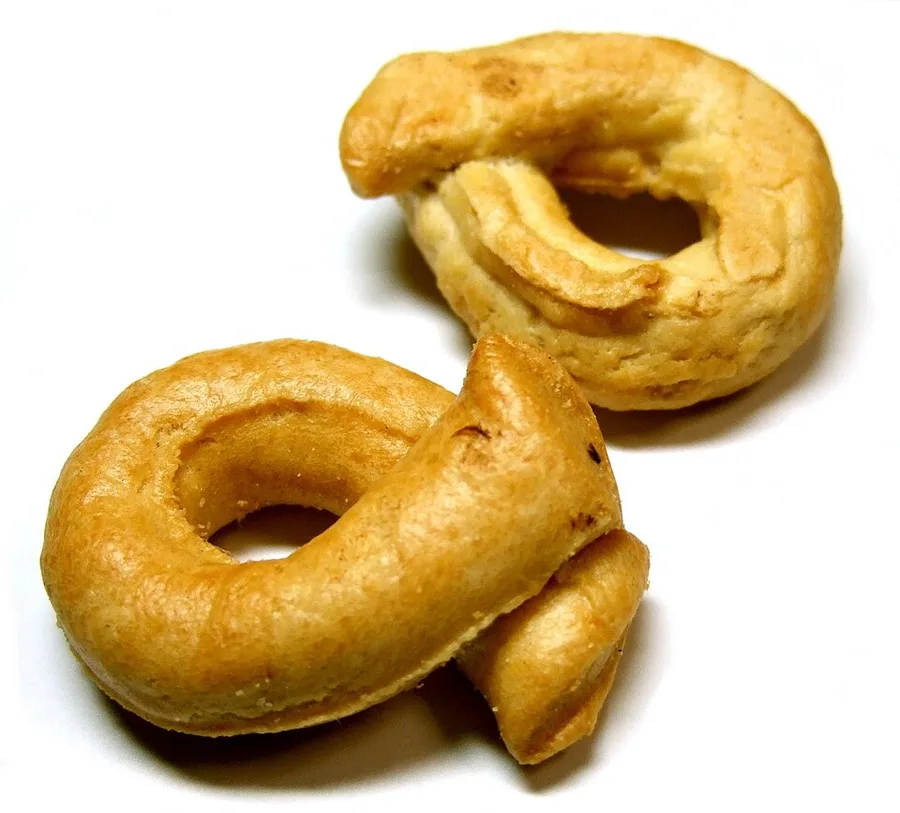
A tarallo is a ring of dry, brittle dough somewhere between four and seven centimetres across, weighing ten to twenty grams. The dough has four ingredients: soft wheat flour or finely milled durum semolina, dry white wine, extra virgin olive oil and salt. Some bakeries add a couple of grams of yeast per kilo of flour, but it is a technical aid rather than an ingredient: taralli are not meant to rise.
The classic ratio is roughly four parts flour to one part wine to one part oil: 500 g of flour, 125 ml of wine, 125 ml of oil, 10 g of salt. The wine does two jobs, adding acidity and aroma while its alcohol burns off in the oven and helps the crumb go short and snappy. The oil coats the gluten and stops the whole thing turning into bread.
What is not in there matters as much. No eggs, no milk, no butter, no sugar, which is why a tarallo keeps for weeks in a tin without preservatives and why the classic Pugliese version happens to be vegan without ever having tried to be.
The defining step is the boil. The rings go into plain boiling water and are lifted out as soon as they float, then dried on a cloth and baked at 180–200 °C for twenty to thirty minutes. That brief boil gelatinises the surface starch and gives taralli their smooth, sealed crust, the same trick, for the same reason, that a German pretzel uses.
Flavourings are added to the dough rather than sprinkled on top: fennel seed above all, then cracked black pepper, chilli, onion, oregano. There is also a sweet cousin, glazed with white sugar icing and eaten around Easter, which shares the name and the shape and almost nothing else.
What does it taste like?
Toasty, savoury and unmistakably olive-oil rich, with the clean mineral taste of good wheat underneath. The salt sits in the dough rather than on the surface, so the seasoning arrives evenly instead of hitting the tongue first the way a salted pretzel does.
The texture is the whole point. A proper tarallo snaps rather than crumbles, with a fine, tight crumb and no big air pockets, and it stays crisp in the mouth for a surprisingly long time before it gives way. It is drier and denser than a cracker and shorter than a breadstick.
The fennel seed version, by far the most common in Puglia, tastes faintly of anise and liquorice, sweet-smelling but not sweet. The black pepper version is sharper and drier and wants a drink alongside. The chilli one is usually mild by Calabrian standards.
What you will not find is any of the buttery, dairy roundness of a Western European biscuit, or the malty note of a pretzel. Taralli taste of olive oil, wheat and the ghost of white wine, which is exactly why they work with almost anything you put on a board.
How to use it
Put them in a bowl. That is the honest answer and the way ninety per cent of taralli in Italy are eaten: on the table with an aperitivo, next to a glass of white wine or a beer, before anyone has decided whether there is going to be dinner. In Puglia the standard board around them is burrata or stracciatella, capocollo, big green Bella di Cerignola olives; further south a smear of spicy nduja on a fennel tarallo is one of the best things you can do with either.
Beyond the bowl, they are a useful pantry ingredient. Blitzed coarsely they make an excellent gratin crumb for roasted vegetables, baked mussels or stuffed tomatoes: they already contain their fat, so you do not need to add oil and the topping crisps instead of going soggy.
Broken into large pieces they replace croutons in a chickpea, fava or lentil soup, softening slowly without dissolving. As a canapé base a whole tarallo topped with a spoonful of stracciatella and a thread of olive oil will sit on a tray for fifteen minutes without collapsing, which a crostino will not.
In the Murgia they are also dunked in milk or milky coffee at breakfast, which is why unflavoured, aroma-free taralli exist at all.
One small piece of counter-intuitive advice: do not serve them straight from the oven if you bake your own. Taralli are at their best twelve to twenty-four hours later, once the residual moisture has gone and the structure has set hard.
How long it keeps
Humidity is the enemy here, not time. In an airtight tin or glass jar in a dark cupboard, a properly baked tarallo stays crisp for three or four weeks. Industrial packs sealed under modified atmosphere declare six to twelve months, and that printed date holds while the bag stays closed. The fridge is the one place to avoid: its damp air softens the crust within about two days and the taralli take on the smell of whatever is beside them. An open plastic bag, a shelf next to the hob or a sunny windowsill all do the same thing more slowly.
Softened ones go back into a 150 °C oven for five to eight minutes and then cool completely on a rack. The cooling is the step people skip and the one that counts, because the structure only sets rigid on the way down. The slower change is the olive oil oxidising, which reads as a waxy, paint-like smell and a bitter finish in the throat; it takes months, and faster in the light. Loose artisanal taralli are worth buying in month-sized amounts rather than stockpiling.
Spot the real thing
The label is the first and least forgiving test. An honest tarallo lists flour, white wine, extra virgin olive oil and salt, with yeast at most. Palm oil, sunflower oil, unnamed vegetable fats, lard in something sold as Pugliese, flavourings, flavour enhancers or sugar all mean a different product. Olive oil without the words extra virgin is already a step down, and extra virgin listed at a low percentage with other oils behind it is the standard industrial shortcut.
Handmade taralli are irregular: rings of slightly different diameters, a visible join where each was pinched shut. Machine-extruded ones are identical to one another with an invisible seam and a rounder section. The colour should be a warm even gold; pale means a short bake and a damp centre that softens within days. The last test is sound. A dry tarallo snaps with a crack and the break shows a fine even crumb, while one that bends first, or leaves your fingers greasy, was underbaked or made with cheap fat. On foreign shelves they sit beside pretzels, which are lye-dipped and contain no oil.
How to pronounce Taralli
tah-RAHL-lee
Three syllables, stress on the second: tah-RAHL-lee. The double L is held, so the sound is drawn out rather than clipped: think of the pause in 'tall lad' rather than the single L in 'tally'. The final letter is an 'i' and it is pronounced, as a clear 'ee'. The singular is tarallo, 'tah-RAHL-loh'; the diminutive is tarallucci, 'tah-rahl-LOO-chee', with a soft 'cci' as in 'cheese'. The two mistakes English speakers make are 'tuh-RAL-eez', tacking an English plural 's' onto a word that is already plural, and 'TARE-uh-lee', which moves the stress to the first syllable. There is no such word as tarallis.
Taralli compared
vsNeapolitan taralli 'nzogna e pepe
Same name, different school. Puglia's tarallo is a small, boiled, olive-oil ring built for crunch and shelf life. Naples' tarallo 'nzogna e pepe is a big, twisted, lard-rich ring loaded with black pepper and whole almonds, never boiled, sold warm from stalls along the seafront. Both are excellent; treating them as versions of one product will confuse every recipe you read.
| This | Neapolitan taralli 'nzogna e pepe | |
|---|---|---|
| Fat | Extra virgin olive oil | Lard (sugna, in dialect 'nzogna) |
| Liquid | Dry white wine | Water, no wine |
| Boiled first | Yes, until the rings float | No, baked only |
| Add-ins | Fennel seed, black pepper, chilli | Whole toasted almonds, heavy black pepper |
| Size | 4–7 cm ring, 10–20 g | 10–12 cm twisted ring, 80–100 g |
| Texture | Dry, snapping crisp | Dense, crumbly, richly greasy |
| Eaten | At room temperature, keeps for weeks | Warm, ideally the day it is baked |
| Vegan | Yes, as traditionally made | No, lard |
vsPretzel (German and American)
The one real point of contact is the pre-bake bath, and even that works differently. Both doughs are boiled before going into the oven, but a pretzel is dipped in an alkaline solution (food-grade lye, or baking soda at home) that accelerates browning and produces that dark, glossy, faintly metallic crust. A tarallo goes into plain water and comes out pale gold. From there almost everything diverges.
| This | Pretzel (German and American) | |
|---|---|---|
| Pre-bake bath | Plain boiling water, out when they float | Alkaline bath: lye or baking soda solution |
| Crust | Pale gold, matte, sealed | Deep mahogany, glossy |
| Leavening | Little or none: wine and oil do the work | Yeasted dough, proved before shaping |
| Fat | Extra virgin olive oil | Butter, lard, or none at all |
| Liquid | Dry white wine | Water or milk |
| Salt | In the dough | Coarse crystals scattered on top |
| Shape | Closed ring, cord ends pressed together | Loop with crossed arms |
| Keeping | Weeks, crisp throughout | Soft pretzels: hours. Hard pretzels: weeks |
vsFriselle
Puglia's other famous dry ring, and a completely different object. Friselle are twice-baked bread: a leavened durum loaf, sliced horizontally and returned to the oven until rock hard, and they have to be dipped in water for a few seconds before you can eat them. Taralli are eaten exactly as they come. One is a meal, the other is a snack.
| This | Friselle | |
|---|---|---|
| Dough | Flour, wine, olive oil, salt | Durum semolina, water, yeast, salt |
| Leavened | Barely, or not at all | Fully, with hours of proving |
| Method | Boiled, then baked once | Baked, sliced through, baked again |
| Size | 4–7 cm ring, 10–20 g | 8–12 cm disc, 40–70 g |
| Before eating | Nothing, eat as is | Dip in water for a few seconds to soften |
| Typical use | Aperitivo snack, cheese boards | Summer meal with tomato, oil, oregano |
Taralli substitutes
- Grissini torinesi
The closest match by role rather than by taste. Turin's breadsticks are leavened wheat, lighter and airier, with none of the wine tang or fennel. Snap them into 5 cm lengths so they behave like taralli on a board, and add a pinch of fennel seed to whatever you serve alongside.
1:1 by weight - Unsalted pretzel sticks
Right crunch, right density, wrong crust flavour. Buy the unsalted kind: taralli carry their salt inside the dough, so surface-salted pretzels will overwhelm burrata or a young pecorino. The malty note is the giveaway, but in a bowl at a party nobody objects.
1:1 by weight - Fennel seed crackers
Fennel is the signature tarallo flavouring, so a plain fennel-seed cracker gets you the aroma even though the texture is flatter and shorter. Look for one made with olive oil rather than butter or palm oil, and avoid anything with added sugar.
1:1, though crackers break more easily under a topping - Pane carasau, broken into pieces
Sardinia's paper-thin flatbread does a similar job on a board. Break it into rough shards, brush lightly with olive oil, scatter salt and a few fennel seeds and bake at 200 °C for three minutes. Nothing like the shape, very close in function.
- Homemade, using the real recipe
Genuinely the best answer if you cannot buy them, and no special equipment is needed. Knead 500 g of flour (type 00 or fine durum semolina) with 125 ml of dry white wine, 125 ml of extra virgin olive oil and 10 g of salt for ten minutes, adding a teaspoon of fennel seeds if you want them. Rest the dough covered for thirty minutes, roll pieces into cords 1 cm thick, cut into 8 cm lengths and press the ends together into rings. Drop them into plain boiling water, lift them out as they float, dry them on a cloth for thirty minutes, then bake at 180–200 °C for 25–30 minutes until evenly golden. As written this dough is vegan: Pugliese taralli use olive oil, never lard, which is what separates them from the Neapolitan 'nzogna e pepe version.
500 g of flour makes roughly 60 taralli - Gluten-free version with a bread mix
Use a gluten-free bread flour mix in place of the wheat, keeping the wine, oil and salt at the same weights, and add 20–30 ml of extra water because these mixes absorb more. The dough will not be elastic, so shape the rings by pressing rather than rolling, and cut the boil to twenty seconds or skip it entirely, because gluten-free rings fall apart in water. Bake five minutes longer and let them cool completely on a rack before judging the texture.
Same 4:1:1 proportions, plus a little extra water
Where to buy it
In the United States, Italian delis and online grocers such as Eataly, Gustiamo and Supermarket Italy carry Pugliese taralli, and the larger supermarket chains increasingly stock them in the cracker aisle. Expect roughly $6–11 for an 8–12 oz bag, which works out at about $10–18 per pound; the cheaper end is almost always made with sunflower or non-extra-virgin oil.
In the UK, Italian delicatessens and specialist online shops carry them alongside friselle, and the price sits around £12–20 per kilo, or £3–6 for a 250–300 g pack. Some UK supermarkets sell own-label taralli at half that, and the ingredient list explains the difference.
Read the label, because it settles the question quickly. A real tarallo lists flour, white wine, extra virgin olive oil and salt, plus perhaps yeast and a flavouring. Palm oil, sunflower oil, unspecified vegetable fats, lard in a product sold as Pugliese, sugar, flavour enhancers or artificial aromas all mean you are buying something else. Olive oil without the word extra virgin is already a step down.
By eye, hand-shaped taralli are slightly irregular, with visibly different diameters and a small seam where the two ends of the cord were pressed together. Machine-extruded ones are identical to each other and have no seam. Colour should be an even warm gold: pale means underbaked and they will soften within days, dark brown means bitter.
Buy quantities you will eat within a month rather than stocking up. Taralli do not go stale so much as the oil in them eventually goes rancid, which you recognise as a waxy smell and a bitter finish at the back of the throat.
Where to eat it in Italy
Bari is the obvious starting point. In the old town, between Strada Arco Basso (the lane where women make orecchiette by hand in front of their doorways) and the fish market, bakeries turn out taralli all day and sell them warm, loose, by weight in a paper bag. Eat them the way the city does: walking along the seafront, with nothing else.
Altamura, up on the Murgia plateau inland, is where you understand the product. The same finely milled durum semolina that goes into Pane di Altamura DOP goes into the taralli, out of the same wood-fired ovens and often the same hands, within the same morning. The historic bakeries in the centre sell bread, focaccia and taralli off one counter.
The Salento (Lecce, Ostuni, Martina Franca) treats taralli as the default with every aperitivo, and the variations multiply: pepper, chilli, onion, chopped black olive. In Lecce they share a counter with the rustico leccese, the town's other essential mid-afternoon habit.
Matera, over the regional border in Basilicata, applies its sourdough bread tradition to taralli, which come out larger, darker and coarser than the Bari version, with more semolina and a longer bake.
And for the other school entirely, go to Naples: along the seafront at Mergellina and the Riviera di Chiaia, taralli 'nzogna e pepe are sold warm from carts, one at a time, usually with a beer. Trying both within the same trip is the fastest way to understand how little the two products share beyond a shape and a name.
Frequently asked questions
What are taralli made of?
Four things: wheat flour (type 00 or finely milled durum semolina), dry white wine, extra virgin olive oil and salt, in a ratio of roughly 4:1:1 for flour, wine and oil. A small amount of yeast is sometimes added by bakeries. There are no eggs, no milk, no butter and no sugar in the savoury Pugliese version.
How do you pronounce taralli?
tah-RAHL-lee, with the stress on the second syllable and the double L held rather than clipped. The final 'i' is a clear 'ee' sound. The singular is tarallo, tah-RAHL-loh, and since taralli is already the plural, there is no such word as tarallis.
Why are taralli boiled before baking?
The brief boil gelatinises the starch on the surface and forms a thin skin that bakes into the smooth, sealed crust taralli are known for. Without it you get an ordinary savoury biscuit, duller-looking and more crumbly. The rings go into plain unsalted boiling water and are lifted out the moment they float, after forty seconds to a minute and a half, then dried on a cloth before baking.
Are taralli vegan?
Classic Pugliese taralli are, since they contain only flour, wine, olive oil and salt. Neapolitan taralli 'nzogna e pepe are not, because they are made with lard, and the sweet glazed Easter taralli contain eggs. Some industrial versions add lard or butter even when sold as Pugliese, so the ingredient list is worth a glance.
How long do taralli keep, and how do you keep them crisp?
In an airtight tin or jar, in a dark cupboard, they stay crisp for three to four weeks; sealed commercial packs are dated at six to twelve months. Never refrigerate them: the humidity softens them within a couple of days. If they do go soft, five to eight minutes at 150 °C revives them completely, provided you let them cool fully on a rack afterwards.
Related foods
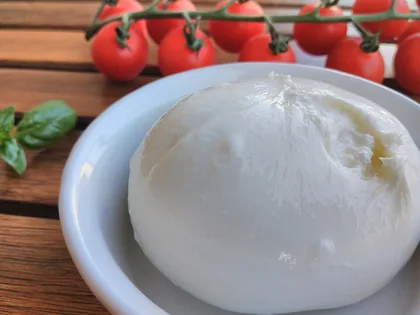 CheeseBurrataIt began as a way of using offcuts: leftover shreds of pasta filata, drowned in cream and sealed inside a…
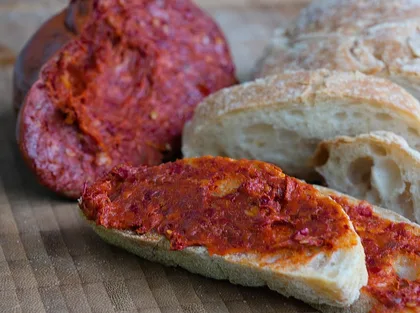 Cured meats'Nduja'Nduja is a soft, spreadable Calabrian pork salume that is up to 40% chilli.
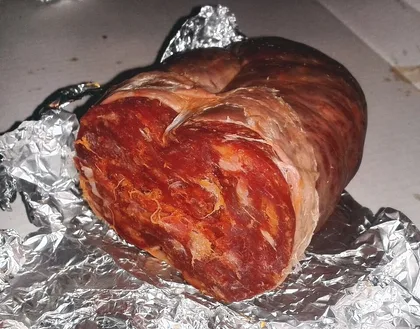 Cured meatsSoppressataSoppressata is a coarse-ground dry salami from southern Italy, pressed flat between boards while it dries…
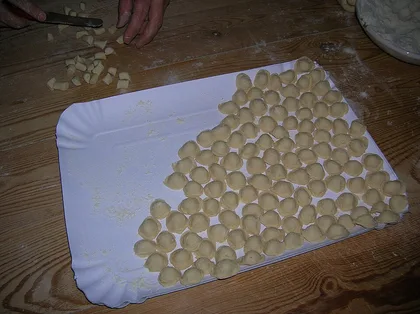 Pasta and breadOrecchietteOrecchiette are Puglia's handmade pasta: semolina and water, no egg, dragged with a knife and flipped over a…
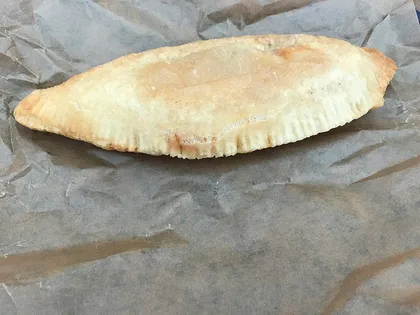 Pasta and breadPanzerottiThe oven never comes into it. A hand-sized half-moon of pizza dough, tomato and mozzarella sealed inside…
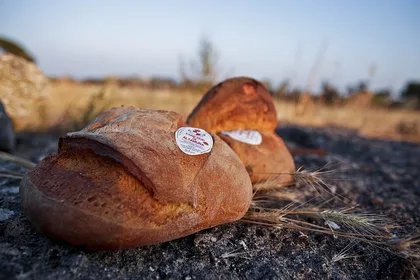 Pasta and breadPane di AltamuraPane di Altamura is a durum-wheat sourdough from the Murgia plateau in Puglia, and in 2003 it became the…Pasta and breadPuccia SalentinaPuccia is the round wood-fired bread of Salento, in the heel of Italy: a flat, soft loaf about the size of…
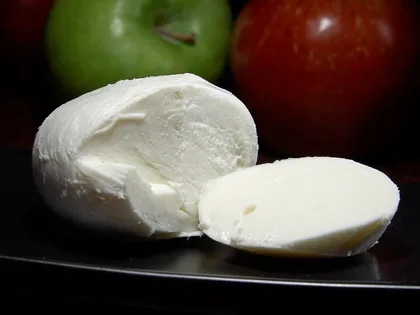 CheeseMozzarellaThe name is a verb before it is a cheese: mozzare means to lop off, which is what the cheesemaker does by…