What is Puccia Salentina?
A puccia is a low, round loaf fifteen to twenty centimetres across and two or three deep, with a thin pale crust and a soft, faintly moist crumb. It weighs 150 to 250 grams and is sized for one person.
What separates it from any other bread is not the recipe (flour, water, yeast, salt, and that is the whole list) but the purpose. A puccia is cut horizontally and filled. The crumb compresses without crumbling, the crust holds, and the sandwich that results does not disintegrate in your hand. No other bread in Puglia does exactly that job.
Two versions coexist. The plain white puccia is the everyday bread of Salento bakeries and the basis of the region's street food, sold in dedicated shops called puccerie throughout Lecce and along both coasts. The olive version, called puccia uliata, has whole black olives folded through the dough and is eaten on 7 December, the eve of the Immaculate Conception, when rural tradition prescribed a fast and this bread was the meal it allowed.
What does it taste like?
Plain, in the best sense. There is no oil, no sugar and no sourness worth naming: the flavour is wheat, salt and the faint smokiness that a wood oven leaves on the base. It is a bread that gets out of the way.
The texture carries it. Fresh, the crumb is soft and slightly damp, tender enough to press flat under a filling and springy enough to come back. The crust is thin and quiet: it does not crackle, and it is not supposed to.
Filled, which is how most people meet it, the puccia works as an absorbent shell: the oil from grilled vegetables, the juice from tomatoes, the fat from cured pork all soak inward and the bread tastes of whatever went inside.
The olive version is a different proposition altogether: properly savoury, briny and slightly bitter, with pockets of soft black olive throughout. That one needs nothing added, and adding anything is considered a mistake in Salento.
How to use it
Split it horizontally, warm it for a few seconds if it has cooled, and fill it. Salento fillings are Mediterranean and unfussy: tuna with tomato, capers and onion; mozzarella with grilled aubergine and courgette; capocollo with stracciatella; meatballs in tomato sauce. The unwritten rule is that the filling should be wet, because the crumb is dry and does the absorbing.
The olive version is eaten on its own, warm, at most with a thread of new olive oil. Filling a bread that already tastes of something is regarded locally as missing the point.
Eat it within the hour. This is not a packed-lunch bread: half an hour after a juicy filling goes in, the crumb has taken on the moisture and the base is soft. If you need to carry it, keep the wet elements separate and assemble on arrival.
Stale pucce toast well. Slice, grill and use as a base for bruschetta with cherry tomatoes and oregano, or dampen the slices and build a Salento-style panzanella with tomato, onion and olive oil.
One local trick worth stealing: hollow out a day-old puccia, pack it with leftover greens and cheese, and bake it for ten minutes. It becomes a hot stuffed loaf, and in Salento it is what happens to leftover turnip tops.
How long it keeps
The plain white puccia is a same day bread. Soft crumb and a thin crust leave it no defence against air: by twelve hours it has dried at the edges, by twenty four the crumb has gone firm and crumbly all through. Keep it in a paper bag or wrapped in a tea towel, never in plastic, where it sweats and the crust turns leathery. The olive version holds a day or two longer, because the moisture and oil from the olives stay in the crumb, the same reason enriched breads outlast plain ones.
The fridge is the thing to avoid. At four degrees the starch retrogrades within hours and the crumb turns rubbery, faster than it would on the counter. Freezing works better here than with most breads and is what the puccerie do: bag them as soon as they are cool, then eight minutes at 180 °C from frozen, or four if thawed, and the result lands close to the original. One that has dried out gets sliced and toasted as a base for bruschetta, or dampened for a Salento panzanella with tomato, onion and oregano.
Spot the real thing
A well made puccia is pale, almost blond, with a few dark blisters on top and a light dusting of flour underneath. Evenly golden, like a supermarket roll, means it was overbaked or came from an electric oven. Press it with a finger and it should give and come back up, because the crumb is soft and slightly moist; stiff or rubbery means it has hours behind it. Cut it and the crumb is white with small regular holes and no caverns, since large bubbles are a fault here: the filling runs straight through them onto the plate.
The crust is thin, a millimetre or so, and it should not crackle. A puccia is not a crisp bread, and anyone selling it as one is selling something else. In the olive version the olives should be scattered irregularly but generously, clearly visible in the cut face, whole or split in half at most; finely chopped olives, or a greyish uniform crumb, mean they went into the mixer too early. It is not a pocket bread like pita, even though it gets opened and stuffed.
How to pronounce Puccia Salentina
POOT-chah
Two syllables, stress on the first. The 'u' is a short 'oo' as in 'put'. The double 'cc' before an 'i' makes a held 'tch' sound, so the middle of the word lands like the 'tch' in 'butcher': POOT-chah, not 'pukka' and not 'poo-see-ah'. The 'i' after the 'cc' is silent: it exists only to soften the 'c'. Plural: pucce, POOT-cheh. The olive version is puccia uliata, POOT-chah oo-lee-AH-tah.
Puccia Salentina compared
vsAn ordinary bread roll (panino)
Both are single-portion breads meant to be filled, but they are built for different climates and different fillings. A standard Italian panino has a firmer, drier crumb and a crisper crust; it holds a dry filling well and a wet one badly. A puccia is softer, flatter and more absorbent, engineered around Mediterranean fillings that leak oil and tomato juice. The trade-off is shelf life: the panino lasts a day, the puccia is finished by evening.
| This | An ordinary bread roll (panino) | |
|---|---|---|
| Shape | Flat disc, 15-20cm across | Domed roll, 8-12cm |
| Crumb | Soft, damp, fine and even | Firmer, drier, more open |
| Crust | Thin, pale, silent | Crisper, more coloured |
| Best filling | Wet and oily: tomato, grilled veg | Dry: cured meats, cheese |
| Oven | Wood-fired, 280-300C, 8-10 min | Deck oven, 220C, 15-20 min |
| Eat within | The same day | A day or so |
vsPita
The comparison people reach for, and it breaks down quickly. Greek and Levantine pita is baked hot and fast so that steam splits it into two layers, leaving a pocket; the bread is thin and mostly wall. A puccia is a proper loaf that happens to be flat: it has real crumb, no pocket, and is opened with a knife rather than by tearing. Fill a pita and the bread stays at the edges of your mouth; fill a puccia and you are eating bread as much as filling.
| This | Pita | |
|---|---|---|
| Structure | Solid crumb throughout | Hollow pocket between two layers |
| Thickness | 2-3cm | 0.5-1cm |
| Opened by | Cutting horizontally | Tearing the natural pocket |
| Weight | 150-250g | 60-90g |
| Bread-to-filling | Roughly equal | Filling dominates |
| Reheats | Poorly once filled | Well, and often required |
vsFocaccia barese
Two Pugliese breads from either end of the same region, and the difference is fat. Focaccia from Bari is made with a potato-enriched dough drenched in olive oil, pressed into an oiled tin and topped with tomatoes and olives before baking, so it comes out rich, wet and golden. The puccia from Salento is lean, baked directly on the oven floor and left plain, because it is a vehicle rather than a dish.
| This | Focaccia barese | |
|---|---|---|
| Home city | Lecce and the Salento | Bari |
| Fat | None, or a trace of oil | Generous olive oil, inside and out |
| Baked | On the oven floor | In an oiled round tin |
| Topping | Nothing | Tomatoes, olives, oregano, salt |
| Served | Split and filled | In wedges, as it is |
Puccia Salentina substitutes
- Thick Greek-style pita (pocketless)
Not the pocket kind: look for the soft, thick flatbread used for souvlaki wraps. Closest in crumb and moisture, though thinner. Warm it briefly before splitting so it does not tear.
2 pitas per puccia - Turkish bazlama
A round, flat, soft griddle bread sold in Turkish shops across the UK and Germany. The thickness and the tender crumb are very close; the flavour is slightly milkier.
1:1 - A plain round focaccia, unoiled
Widely available and structurally right: flat, soft, splittable. Buy the plainest one you can find, since a heavily oiled or topped focaccia will overwhelm the filling.
1:1 by diameter - Ciabatta roll
Available everywhere and it holds a filling well, but the crumb is far more open and the crust crisper, so oil and tomato juice run straight through the holes onto the plate.
1 large roll per puccia - Home-made
Genuinely easy: a 60-65% hydration dough of type 0 flour, water, salt and a little yeast, risen twice, divided into 200 gram pieces, flattened by hand and baked on a preheated stone at 280C for eight minutes. This is one of the few Italian breads a home oven can reproduce faithfully.
200g of dough per puccia
Where to buy it
In Salento, any bakery. A plain 200 gram puccia costs 1 to 2 euros, which is roughly 5 to 8 euros per kilo; the olive version runs 1.50 to 2.50 each. A filled puccia in a pucceria is restaurant food and costs 5 to 9 euros, rising to 10 in the coastal resorts in August. That is still one of the cheapest full meals in the region.
Elsewhere in Italy, Pugliese bakeries in the northern cities sell it at 7 to 10 euros per kilo. Abroad it barely exists: a soft, same-day bread has no export market, and what turns up frozen in Italian shops is a compromise.
In the US and the UK your realistic options are a Turkish or Greek bakery, where a comparable flatbread costs 1 to 3 dollars or 1 to 2 pounds, or twenty minutes of work at home, which produces a better result than anything you can buy outside Italy.
If you do find an imported frozen puccia, bake it from frozen at 180C for eight minutes rather than defrosting it first. It comes back surprisingly well.
Where to eat it in Italy
Lecce is the obvious base. The baroque old town is full of puccerie that stay open late, and the streets around piazza Sant'Oronzo and the run down towards Porta Napoli are where to start. Prices are low and the queues move fast.
On the Adriatic side, Otranto and Torre dell'Orso; on the Ionian, Gallipoli and Porto Cesareo. In all of them the puccia is the standard beach lunch and bakeries start turning them out early.
Inland is more interesting. In the villages of the Grecia Salentina (Calimera, Martano, Sternatia, where a Greek dialect called griko is still spoken) and in Nardo, Galatina and Maglie, bakers make the puccia the way it was made before the puccerie existed: unfilled, unbranded, sold by weight.
If you can choose your date, come on 7 December. On the eve of the Immaculate Conception every bakery in Salento bakes olive pucce in enormous quantity and people queue from the morning. It is the one day of the year when this bread is the occasion rather than the container.
Frequently asked questions
What is a puccia?
A round, flat wood-fired bread from Salento, in the heel of Italy, 15 to 20 centimetres across and made to be split open and filled. The traditional dough is only flour, water, yeast and salt. Each one weighs 150 to 250 grams and serves one person.
Is a puccia the same as a pita?
No. Pita is thin and hollow, split into two layers by steam during a very hot bake, and torn open along the pocket. A puccia is a proper small loaf with solid crumb all the way through, cut horizontally with a knife. It is three or four times heavier and there is far more bread in the finished sandwich.
Why are olive pucce eaten on 7 December?
Because it is the eve of the Immaculate Conception, a fast day in Salento's rural calendar. The olive puccia was the permitted meal: bread with no animal fat, savoury enough to eat on its own. The custom survives, and bakeries across the region sell out that day.
What goes inside a puccia?
In Salento, tuna with tomato, capers and onion; mozzarella with grilled vegetables; capocollo with stracciatella; meatballs in sauce. Wet fillings work best, since the crumb is dry and absorbs them. The olive version is eaten empty.
How long does a puccia keep?
The plain one is a same-day bread: dry within twelve hours, stale within twenty-four. The olive version lasts a day or two because the olives keep the crumb moist. It freezes very well, better than most breads, and reheats from frozen in eight minutes at 180C.
Related foods
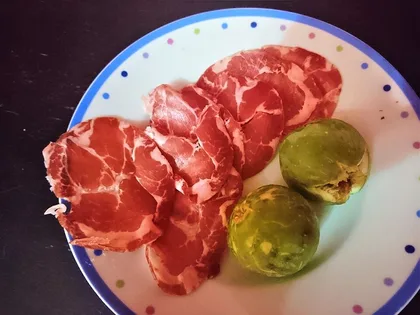 Cured meatsCapocolloCapocollo is the pork neck muscle, salted whole and aged in casing.
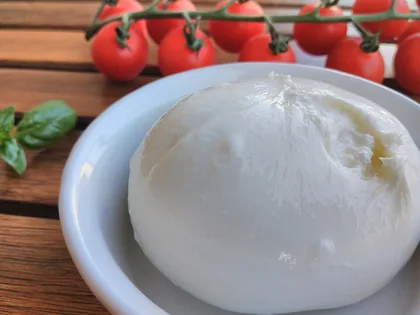 CheeseBurrataIt began as a way of using offcuts: leftover shreds of pasta filata, drowned in cream and sealed inside a…
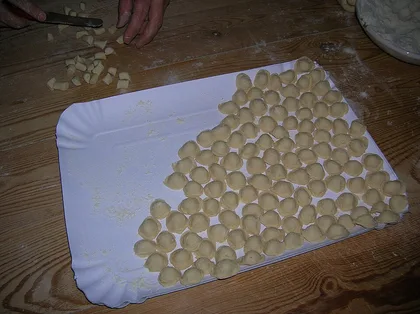 Pasta and breadOrecchietteOrecchiette are Puglia's handmade pasta: semolina and water, no egg, dragged with a knife and flipped over a…
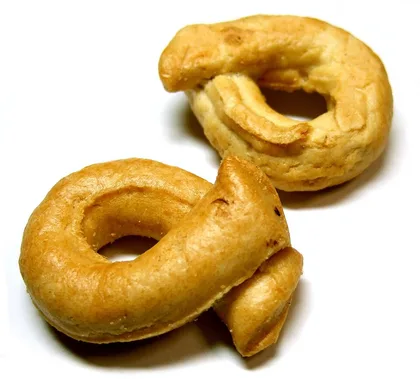 Pasta and breadTaralliTaralli are small, crunchy savoury rings from Puglia in southern Italy, made from just flour, dry white wine…
 Pasta and breadPanzerottiThe oven never comes into it. A hand-sized half-moon of pizza dough, tomato and mozzarella sealed inside…
 Pasta and breadPane di AltamuraPane di Altamura is a durum-wheat sourdough from the Murgia plateau in Puglia, and in 2003 it became the…
 CheeseMozzarellaThe name is a verb before it is a cheese: mozzare means to lop off, which is what the cheesemaker does by…
 Oil and preservesExtra Virgin Olive OilTwo exams have to be passed, and one of them is carried out by people.