Piedmont Truffle Hunting
Alba is where the world's most expensive truffle is sold, and the hunt you can book is a daytime demonstration: the real one happens at night and nobody takes strangers. The part that matters for a visitor is buying, and there is exactly one place to do it safely.
What you'll actually do
The hunt: sixty to ninety minutes in the hills around Alba, the Roero or the Monferrato with a trifolau and his dog, followed by a tasting or a lunch. The dog is the whole apparatus: usually a Lagotto or a local crossbreed, trained from puppyhood on cheese and then on truffle, and worth more to its owner than the car it arrives in. Watch the handler as much as the dog: the reading of the dog's body, the decision to dig or move on, is the craft.
Understand what you are buying. Traditional hunting happens at night, partly because the dogs work better in the cool and partly because the productive spots are secrets held within families, and no trifolau takes a stranger to them. Guest hunts are daytime, on ground the hunter is happy to reveal, and frequently seeded so that the dog finds something. It is a demonstration, and a good one is still worth doing.
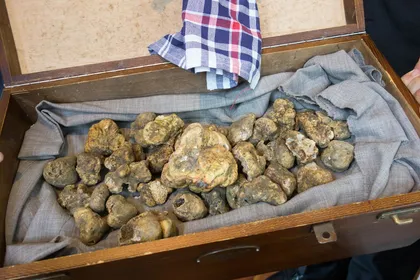
The season is set by regional law, running roughly from 21 September to 31 January for the Alba white truffle. The Alba truffle fair runs from the second weekend of October into early December, and the part of it that matters is the Mercato Mondiale del Tartufo, where a quality panel inspects every truffle before it can be sold on the tables. For a visitor with no way to judge a truffle by smell, that inspection is the only real protection available.
Where it goes wrong: roadside sellers along the provincial roads, and restaurants offering suspiciously cheap shavings. The fraud to know about is Tuber indicum, the Chinese truffle, which looks similar, has almost no aroma, and is doused with synthetic 2,4-dithiapentane, the same molecule that is all there is in truffle oil. If a shaved truffle smells overwhelming from a metre away and tastes of nothing on the tongue, that is what happened.
What it costs
Group hunt with tasting: $70 to $120 (€65 to €110) per person for two to three hours. Hunt with a full truffle lunch and Langhe wines: $120 to $190 (€110 to €175). Private hunts: $200 to $350 (€185 to €325) for two to four people.
Buying at the Alba fair: €200 to €450 per 100g for white truffle depending on the year, with the market entrance costing a few euros and tasting tickets sold separately. Prices peak in the first weeks of the fair and soften in December.
In restaurants, shaving is charged by weight at €6 to €10 per gram. A proper portion over tajarin is six to eight grams, so €45 to €70 on top of a €16 to €22 plate of pasta. This is not a markup, it is the raw material cost, but ask the per-gram price before you nod, because the truffle and the scale come to the table.
Best time to go
Late October to early December, without much argument. The season opens around 21 September and closes 31 January, but the truffles are best and most abundant from mid-October, which is also when the fair, the restaurants and the whole apparatus of Alba are running at full capacity.
The corollary is that this is the hardest and most expensive time to be in the Langhe: hotel rates roughly double, restaurants book out three weeks ahead, and weekend parking in Alba, La Morra and Barolo is a genuine problem. Midweek is dramatically easier than Saturday.
The crop depends on August and September rain. A dry late summer means fewer, smaller, pricier truffles, and everyone in Alba will tell you the same thing about the year before you ask.
January hunts still happen, cost less, and coincide with bagna cauda season, which is its own reason to be in Piedmont.
How to book
GetYourGuide and Viator list Alba hunts, and many hunters and the agriturismi they work with also take direct bookings by email, usually at a lower price and with a smaller group.
Questions worth asking: how many people per hunt (four to eight is good, fifteen is a coach), whether lunch is included, and whether you can buy truffle from the hunter afterwards, which is usually the cheapest legitimate source you will encounter.
For October and November, book the hunt two to three weeks ahead and the accommodation two months ahead. Restaurants in fair season need booking at the same time as the hotel; the good ones in the Barolo villages fill first.
If you plan to buy, plan the fair into a Saturday or Sunday, since the truffle market runs at weekends through the season.
Some booking links on this page are affiliate links: if you book through them we earn a commission, at no extra cost to you. It never changes what we recommend.
Where to stay nearby
Alba itself is the practical base: walkable, well supplied with restaurants, on the rail line from Turin via Asti or Bra, and the only place in the area where you can eat and drink without driving. It is also the most expensive and the first to sell out in October.
The Barolo villages (La Morra, Barolo, Monforte d'Alba, Serralunga, Verduno, Novello) are ten to twenty minutes away by car on winding ridge roads, and put you inside the vineyards. Neive and Treiso do the same on the Barbaresco side, with slightly lower prices. Bra and Cherasco are cheaper again and less atmospheric.
If you are visiting in fair season and want to drink seriously, either stay somewhere you can walk to dinner or budget for a driver: the drink-drive limit is 0.5 g/l and the roads between the villages are narrow and policed.
What to eat while you're there
Tajarin (thin egg noodles with twenty or more yolks per kilo) with butter and shaved truffle is the dish. After that: a baked or coddled egg with truffle, fonduta, and carne cruda, hand-chopped raw veal with lemon, which takes truffle better than almost anything.
Outside the truffle: agnolotti del plin, tiny hand-pinched ravioli sometimes served on a napkin with no sauce at all; brasato slow-cooked in Nebbiolo; bollito misto with green sauce; bagna cauda from November, a hot bath of garlic, anchovy and oil for raw vegetables, which is superb and socially inadvisable before a working day. Bonet for dessert, and hazelnut cake made with the Tonda Gentile from the high Langhe.
Drink Barolo and Barbaresco if you are eating meat, Barbera d'Alba with almost everything else, and Dolcetto when you want to spend €12 and be happy. Skip anything on a menu involving truffle oil.
Read before you go
Frequently asked questions
When is white truffle season in Piedmont?
Regional law sets it at roughly 21 September to 31 January. In practice the truffles are at their best from mid-October to early December, which is when the Alba fair runs and when the restaurants build their menus around it. January is cheaper, quieter and still legitimate, with smaller truffles.
Where can I buy a truffle safely in Alba?
At the Mercato Mondiale del Tartufo inside the Alba fair, where a quality commission inspects every truffle before it reaches a table. That inspection is the only meaningful protection for a buyer who cannot judge a truffle by smell. Buying directly from the hunter after a hunt is the other reliable route. Avoid roadside stalls entirely: Tuber indicum, the near-odourless Chinese truffle sold with synthetic aroma added, is the standard fraud.
Is truffle hunting in Piedmont suitable for children?
Yes. The walk is short and easy, the dog is the star, and most hunters welcome children and charge little or nothing for young ones. Note that the season falls in late autumn, so the hills are wet and cold; boots and a waterproof matter more than they would in Tuscany in June.
Piedmont or Tuscany for white truffle?
Piedmont, if the truffle itself is the reason for the trip. Alba's white truffle is the benchmark, the market has a quality inspection that Tuscany's smaller fairs do not, and the local cooking (tajarin, raw veal, eggs) is built to carry it. Tuscany's San Miniato white truffle is genuinely good, much cheaper to visit, and easier to combine with a broader trip.