What DOP means
DOP (Denominazione di Origine Protetta) is the Italian form of the EU's PDO, Protected Designation of Origin. It means every stage of production (raw material, processing and preparation) takes place inside a defined area, under a published specification checked by an independent control body.
The scheme is EU law, not Italian marketing. It dates from 1992 and is now governed by Regulation (EU) 2024/1143, which has applied since 13 May 2024 and replaced Regulation (EU) No 1151/2012, bringing geographical indications for food, wine and spirits into a single text. Registered names are listed in the EU's public eAmbrosia database, and the same rules apply in every member state, which is why an Italian DOP and a French AOP or a Spanish DOP are the same legal instrument under different language labels.
Two tests have to be passed at the same time. The geographical test: every stage of production, processing and preparation must happen within the delimited area, raw materials included. The causal test: the quality or characteristics of the product must be essentially or exclusively due to that geographical environment, understood as the sum of natural factors (soil, climate, water, native flora and microflora) and human factors, meaning established techniques and know-how. It is not enough for a food to be good and to be made in a place; the producers have to demonstrate that it is what it is because it is made there.
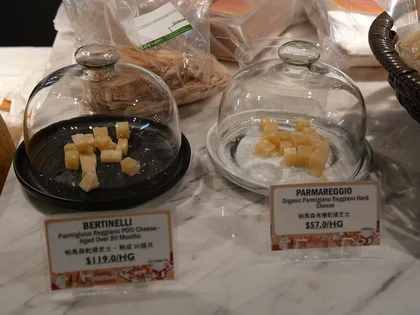
The examples make it concrete. Parmigiano Reggiano DOP can only be made from raw cow's milk produced in Parma, Reggio Emilia, Modena, the part of Bologna west of the Reno and the part of Mantua east of the Po, with no additives and a minimum of twelve months' ageing. Mozzarella di Bufala Campana DOP requires buffalo milk from farms inside the specified provinces. Pecorino Romano DOP, despite the name, is made in Lazio, Sardinia and the province of Grosseto, and most of it now comes from Sardinian dairies. Aceto Balsamico Tradizionale di Modena DOP is nothing but cooked grape must aged in a battery of barrels for at least twelve years.
Protection is broader than most shoppers realise. A registered name is defended against direct or indirect commercial use, imitation and evocation, even where the true origin is shown or the name is qualified by words such as style, type, method, flavour or as made in. In 2008 the Court of Justice of the European Union held, in Case C-132/05 Commission v Germany, that the word Parmesan evokes Parmigiano Reggiano within the EU. Outside the EU the picture changes: in the United States parmesan is treated as a generic term, which is why American supermarket parmesan is generally not the Italian cheese at all.
What DOP does not tell you is whether you will like the product. It certifies origin, raw material and method against a minimum standard written by the producers themselves; within a single denomination the range between a workmanlike wheel and an outstanding one is enormous. Read the mark as a guarantee of provenance and process, then choose the producer.
Guides that cover this
Frequently asked questions
What is the difference between DOP and IGP?
DOP requires every stage, including the raw materials, to take place inside the delimited area. IGP requires at least one stage, so ingredients can legally come from elsewhere. The legal protection is identical; what changes is the nature of the link to the place.
Does the DOP logo have to appear on the label?
Yes for food products registered in the EU: the red and yellow EU symbol must appear alongside the registered name in full. For wines carrying a designation of origin the symbol is optional, which is why you rarely see it on a bottle.
Does DOP mean the product is better?
It means the product is authentic, not that it is excellent. The specification sets a floor, not a ceiling, and quality varies widely between producers within the same denomination. Use DOP to rule out imitations, then choose by maker.
Why is American parmesan not Parmigiano Reggiano?
Because parmesan is treated as a generic cheese name in the United States, while in the EU the Court of Justice has held it to be an evocation of the protected name. Parmigiano Reggiano DOP is raw-milk, additive-free and aged at least twelve months in a defined area; US parmesan need meet none of that.
Sources
Where to check what you just read.
- 1
The text in force since 13 May 2024, which merged geographical indications for food, wine and spirits into one regulation.
- 2
The wording the specifications are built on: every production step inside the defined area, and quality essentially or exclusively due to that geographical environment.
- 3
The official comparison of PDO, PGI and TSG, and the route to eAmbrosia, the EU register of registered names.
- 4
The judgment of 26 February 2008 holding that the word Parmesan evokes the protected name Parmigiano Reggiano and has not become generic in the EU.