Parma Ham and Parmesan Tour
The Parma tour is a dairy at dawn, a ham cellar in the hills and, if the itinerary is honest, a culatello cellar in the fog country by the Po. Book an 11am dairy visit and the cheese was made six hours earlier: you will be shown a clean, empty room.
What you'll actually do
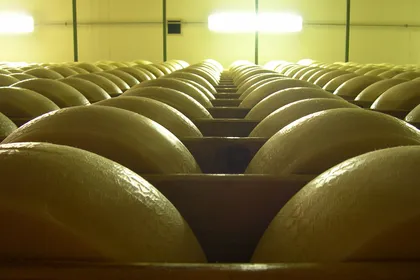
Start with the dairy, because the timing is the whole point. Evening milk rests overnight in shallow vats and is skimmed; the morning milk arrives and the two are combined in copper cauldrons at around five or six in the morning with whey starter and calf rennet. The curd sets, is broken with a spino into grains the size of rice, is cooked to about 55C, and settles into a single mass at the bottom of the cauldron. Then two people lift roughly a hundred kilos of it out in a cloth, on a wooden paddle, and cut it in two. That extraction is the twenty minutes worth travelling for and it happens between about seven and nine. Afterwards the wheels go into moulds, then into brine for around three weeks, then onto racks. Minimum ageing is twelve months, most of what you will taste is twenty-four or thirty-six, and at twelve months an inspector from the Consorzio walks the ageing room tapping every forty-kilo wheel with a small hammer and listening for flaws inside.
The ham is a separate world and usually a separate stop. Prosciutto di Parma is made in the hills south of the city around Langhirano, where the rules require salting, resting, washing, greasing the exposed muscle with sugna, and ageing in rooms whose windows are opened to the valley wind. The legal minimum is over a year; the hams you taste on a visit are typically eighteen to twenty-four months. Tasting is thin slices at room temperature with the fat left on, which is the point: cold ham from a fridge tastes like a different animal. Langhirano has a public ham museum and Soragna has a Parmigiano museum, both useful fallbacks if you cannot get a producer slot.
The third stop, which most packaged tours leave out, is culatello di Zibello DOP: the heart muscle of the ham, cased in bladder, tied by hand, and aged in damp ground-floor cellars in eight communes along the Po (Zibello, Polesine Parmense, Busseto, Soragna, Roccabianca, San Secondo, Sissa and Colorno). The river fog is the tool, which is why it cannot be made in the hills. Production is small, the cellars are forty minutes further out, and it is the best thing in the province. If a tour includes it, that tells you something about the tour.
Practical, and worth insisting on. Get the dairy start time in writing before you pay. Dairies are working food plants: hairnets and coats are supplied and compulsory, strong perfume is discouraged, open shoes are refused, some have a minimum age for children, and if you turn up visibly ill you can be turned away. None of this is theatre: a contaminated batch is thousands of euros of cheese.
What it costs
A full-day group tour from Parma or Bologna covering a dairy, a ham cellar and usually an acetaia runs $130 to $190 (roughly €120 to €175) per person including transport, and on a per-hour basis it is among the best-value food experiences in Italy. Half-day dairy-only tours are $60 to $110 (€55 to €100).
With your own car, booking direct is much cheaper: dairies typically charge €15 to €30 per person for a guided visit with tasting, ham cellars €10 to €25, and several waive the fee against a purchase. A private driver-guide for the day is $350 to $550 (€320 to €510) per group.
Buying at source is the other reason to come. Parmigiano at twenty-four months is roughly €20 to €28 a kilo at the dairy shop against €35 to €50 in a foreign supermarket; a whole boneless Prosciutto di Parma is €180 to €300; culatello runs €80 to €120 a kilo, which looks absurd until you have seen how much ham is thrown away to make one.
Best time to go
Cheese is made 365 days a year, so the season is set by your alarm clock rather than the calendar. For weather and for the landscape, September to November and March to May. The Bassa's fog starts in late autumn, which is when the culatello cellars look and smell like what they are.
Culatello is made in the cold months, roughly October to February, so a winter visit shows the cellars working rather than resting. August is the weakest month for the ham and culatello producers, many of whom cut visits back, though the dairies keep making cheese throughout.
Day of the week matters. Most producers receive visitors on weekdays only; Sunday visits are rare and, where they exist, are usually shop-and-taste with no production to see. Saturday is possible at the larger dairies.
How to book
GetYourGuide and Viator both carry the packaged day trips from Bologna and Parma, which is the simplest route if you have no car. For direct visits, the Consorzio del Parmigiano Reggiano and the Consorzio del Prosciutto di Parma each publish lists of member producers open to the public, and emailing a dairy directly is completely normal: replies come within a day or two and the visit costs a third of the packaged price.
Ask three questions before you pay for anything. What time do we arrive at the dairy? If the answer is after 9.30am, the production is finished. Is the ham stop a working cellar or a shop with a slicer. And how many people are on the visit, because an ageing room tour with thirty people is a queue.
Book one to two weeks ahead in spring and autumn, longer if you want a specific small producer. Note that these are farms and family businesses: they confirm by email, not by an instant booking engine, and a no-show costs someone their morning.
Some booking links on this page are affiliate links: if you book through them we earn a commission, at no extra cost to you. It never changes what we recommend.
Where to stay nearby
Parma itself is the sensible base: compact, walkable, quietly wealthy, with an excellent Saturday market and a restaurant scene far better than a city of 200,000 has any right to. Everything in the province is within an hour.
Langhirano puts you next to the ham but is a small working town with industrial edges. The Bassa Parmense (Polesine Parmense, Busseto, Soragna, Roccabianca) has converted farmhouses and small country inns and is the right base if culatello and the Po landscape are why you came; it is flat, foggy and very quiet.
Bologna works as a base and adds about an hour and a half of travel each way, which is survivable for a 9am start and painful for a 7am one. Milan day trips are three hours return and rarely worth it for a dairy that finishes before lunch.
What to eat while you're there
Parmigiano Reggiano at twelve, twenty-four and thirty-six months tasted side by side, which is the only way to understand why the price triples: at twelve it is milky and elastic, at twenty-four the tyrosine crystals appear and it starts to crunch, at thirty-six it is dry, sharp and almost sweet.
Prosciutto di Parma with bread and butter, because melon is a summer habit, not a Parma tradition. Culatello with a slice of unsalted bread and nothing else. Torta fritta, squares of fried dough puffed like pillows, served hot with salumi. Anolini in brodo, Parma's small stuffed pasta in a long-cooked capon or beef broth, which is the Christmas dish and available year-round in serious restaurants. Tortelli d'erbetta, chard and ricotta, dressed with butter and Parmigiano. Horse and donkey meat appear on menus here as pesto di cavallo and stracotto: genuinely local, not a dare.
Drink Malvasia dei Colli di Parma, dry and lightly fizzy, or the local Lambrusco, which is drier and less exported than Modena's. Skip pre-grated cheese from souvenir shops near the Duomo, and treat any wheel sold as parmesan without the pin-dot rind writing as something else entirely.
Read before you go
Frequently asked questions
Why do Parmigiano Reggiano dairy visits start so early?
Because cheese is made once a day, in the morning, from the previous evening's skimmed milk plus that morning's whole milk. The cauldrons are filled around five or six, the curd is cut and cooked over the next hour or two, and the mass is lifted out between roughly seven and nine. Arrive at eleven and you see a spotless room being washed down, plus the ageing warehouse, which is impressive, but it is not the process.
Is Parmigiano Reggiano the same thing as Grana Padano?
No, and the differences are specific. Parmigiano Reggiano comes only from a defined area across Parma, Reggio Emilia, Modena, and parts of Bologna and Mantova; the cows' feed excludes silage; nothing is added beyond milk, salt and rennet; and the minimum ageing is twelve months. Grana Padano covers a much larger area, permits silage feed and the preservative lysozyme, and can be sold from nine months. Both are good cheeses. They are not interchangeable and the price gap is not marketing.
Can I take cheese and ham home with me?
Hard aged cheese travels well and is generally the easier of the two to bring into most countries, especially vacuum-packed. Cured pork is the problem: several countries, the United States among them, restrict or prohibit imports of Italian cured meats carried in luggage, and the rules change with animal-health status. Check your own country's current customs and agriculture rules before you buy a whole ham, and ask the producer to vacuum-pack and date-label whatever you do take.
Is a dairy visit suitable for children?
Partly. The extraction of the curd is genuinely interesting to watch and takes twenty minutes; the ageing room is a warehouse and smells strongly of cheese. Against that: the start time is around seven or eight in the morning, hairnets and coats are compulsory, and some dairies set a minimum age for hygiene reasons. Ask when you book rather than turning up with a four-year-old at dawn.