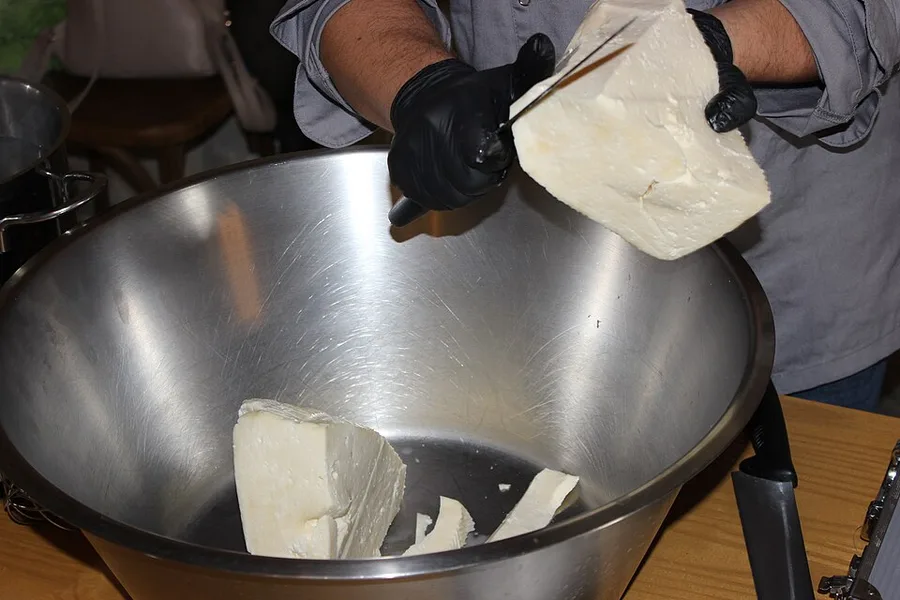
What is Provola dei Nebrodi?
Provola dei Nebrodi is a stretched-curd cheese made from raw whole cow's milk inside and around the Nebrodi Park, in the province of Messina. The traditional shape is a pear with a small neck, formed by the cord that pinches the hot paste, weighing from half a kilo to two kilos; larger four- and five-kilo wheels are made for long ageing.
It belongs to the same family as mozzarella and caciocavallo but sits at the hard end of it. The curd is not spun immediately: it rests under warm whey for three to six hours, acidifying on its own until it will stretch. Only then is it flooded with water at eighty to ninety degrees and worked by hand into a single glossy mass.
What separates it from every industrial provola is the milk. The cows are Cinisara, Modicana and Bruna, grazing semi-wild in beech woods and upland pasture between five hundred and eighteen hundred metres. The milk is neither pasteurised nor thermised, and the rennet is kid or lamb paste. The cheese therefore tastes different in May than in October, which is the whole point.
The word 'provola' is not protected in any way: anyone may use it on any label. The Slow Food Presidium covering raw-milk production in this area is, in practice, the only filter between the real cheese and its supermarket namesake.
What does it taste like?
Milk first, and a surprising amount of it. Young provola is sweet, buttery and faintly grassy, with the clean lactic tang of a curd that acidified naturally rather than with added cultures. The texture is springy and layered: pull a piece apart and it opens into fine sheets.
Where the cheese is smoked, the smoke reads as embers and dry hay rather than bacon, and it sits under the milk instead of over it, and fades as you chew. Industrially smoked cheese does the opposite.
With age the sweetness turns nutty and toasted, and the kid rennet shows itself: a slow warmth that at eight or ten months becomes a real peppery bite. Salt stays moderate throughout, far below pecorino. Melted, it stays glossy and stringy without releasing a pool of fat, which is why Sicilian baked pasta is built on it.
How to use it
Young provola is a table cheese: thick slices, coarse bread, olive oil, black pepper. Take it out of the fridge half an hour first, because cold it tastes of nothing.
Its real vocation is heat. Cut slices about a centimetre and a half thick and cook them on a dry, very hot griddle for two minutes a side: the outside crusts, the inside goes molten, and it holds together long enough to reach the plate. This is provola alla piastra, an antipasto in every trattoria in the province of Messina.
In Sicilian baked pasta it does the work Americans expect from mozzarella but better: layered with maccheroni, ragù, fried aubergine and sliced hard-boiled egg, or inside a timballo of anelletti. It melts glossy and does not flood the dish with fat.
Aged six months or more, grate it. It is sweeter and far less salty than pecorino, so it suits bean soups and bitter greens where a Roman pecorino would bulldoze everything. As with all stretched-curd cheeses, add it off the heat, because boiled it splits and turns rubbery.
How long it keeps
It goes in the least cold part of the fridge, wrapped in greaseproof paper or a lightly dampened cotton cloth. Cling film against the rind is the thing to avoid, because the surface sweats beneath it and turns slick within about three days. A fresh provola is generally used inside two weeks; an aged one holds two or three months and keeps drying throughout, firming up as the salt and flavour concentrate. When the surface dries too far, wiping it with a damp cloth every couple of days brings it back.
Whole forms can also hang in a cellar between 10 and 14 °C, which is how the dairies age them and what the cheese was built for. A dry white or grey bloom on the rind comes away with a cloth soaked in vinegar, while deep green, black or pink growth is a question for the producer or the shop rather than for guesswork. Freeze only what is headed into a hot dish, sliced and for no more than three months: freezing breaks the stretched-curd structure and a thawed form will not slice cleanly again.
Spot the real thing
The pear shape with its lopsided little head is made by hand and is never quite regular, so no two real provole match each other. The rind is thin, smooth and elastic, straw coloured on a fresh one and amber to hazel on smoked and aged pieces, and it gives slightly under the fingers. A surface as hard as plastic, evenly glossy and a brown that looks painted on, was smoked with flavouring rather than over wood.
Break a piece by hand instead of cutting it. Real pasta filata opens into leaves, while industrial versions part like rubber. The paste is white to faintly straw and compact, with sparse irregular eyes; dense, evenly spaced holes belong to something else. On the nose the milk comes first, butter and grass behind it, and any smoke sits underneath rather than on top. Always ask for the name of the dairy, because the Presidium producers number a few dozen and sell mostly close to home. Abroad its neighbours are scamorza, which is smaller, and caciocavallo, which is a good deal larger.
How to pronounce Provola dei Nebrodi
PROH-voh-lah day NEH-broh-dee
'Provola' takes the stress on the first syllable: PROH-voh-lah, not proh-VOH-lah. 'Dei' is one syllable, like the English word 'day'. 'Nebrodi' is also stressed on the first syllable: NEH-broh-dee, with a clear rolled 'r'. The name of the mountains comes from the Greek nebros, a fawn.
Provola dei Nebrodi compared
vsIndustrial smoked provola
They share a name and nothing else. Supermarket provola affumicata is made from pasteurised pooled milk, spun by machine, and coloured either in a smoke chamber running wood chips for minutes or, more often, by dipping in liquid smoke. Provola dei Nebrodi is raw milk from named mountain herds, spun by hand, smoked over burning wheat straw or not smoked at all. The tell is the order of the flavours: real cheese tastes of milk and then of smoke.
| This | Industrial smoked provola | |
|---|---|---|
| Milk | Raw, single-area, mountain herds | Pasteurised, pooled, often from lowland dairies |
| Rennet | Kid or lamb paste | Microbial or liquid calf rennet |
| Acidification | Natural, 3-6 hours under whey | Starter cultures, under an hour |
| Shaping | By hand, tied with cord | Extruded and moulded |
| Smoke | Wheat straw, a few hours, surface only | Smoke chamber or liquid smoke |
| Price | EUR 16-28 per kg | EUR 7-10 per kg |
vsCaciocavallo
Same technique, different job. Caciocavallo is made in larger formats, salted harder and aged for months or years until it becomes a grating cheese; provola is the small format eaten young, often within weeks. On the Nebrodi both come out of the same vat on the same morning: the cheesemaker simply decides which wheels get shaped small and eaten and which get shaped big and hung.
| This | Caciocavallo | |
|---|---|---|
| Typical weight | 0.5-2 kg | 2-10 kg, up to 15 for Ragusano |
| Ageing | 15 days to 6 months | 3 months to 3 years |
| Texture | Springy, sliceable, melts | Hard, flaking, grates |
| Salt | Low, brined for a day | Higher, brined for days |
| Smoked | Often, lightly | Rarely |
| Best use | Grilled, baked pasta, table | Grated, board, long cooking |
vsSmoked scamorza
Scamorza affumicata is the cheese most people abroad reach for when a Sicilian recipe says provola, and for melting it is a reasonable stand-in. But scamorza is a young cheese by definition, spun and brined for hours and sold within days, while provola dei Nebrodi is built on slow natural acidification and can age for months. Scamorza melts softer and blander; provola holds its structure on a grill.
| This | Smoked scamorza | |
|---|---|---|
| Origin | Nebrodi, Sicily | Abruzzo, Molise, Puglia |
| Milk | Raw, mountain herds | Usually pasteurised |
| Ageing | Weeks to months | Days to two weeks |
| On a grill | Crusts outside, stays whole | Softens fast, can collapse |
| Flavour | Sweet milk, straw smoke, late piquancy | Mild, milky, smoke forward |
| Availability abroad | Rare, specialist importers | Widely stocked |
Provola dei Nebrodi substitutes
- Provola delle Madonie
The twin cheese from the mountain range immediately to the west, made with the same technique, the same breeds and the same kid rennet. If a Sicilian counter has it, the swap is invisible.
1:1 - Young Caciocavallo Silano DOP or Ragusano DOP
Both are pasta filata from cow's milk. Take the youngest wheel available, three to four months, and expect a slightly firmer, saltier cheese. Ragusano, being Sicilian and raw-milk, is the closer of the two.
1:1, reduce salt elsewhere in the dish - Smoked scamorza
The easiest substitute in the US and UK and the right choice for melting. It is milder and wetter, so drain it on paper and use a little more; in a baked pasta it will not hold its edges the way provola does.
1.2:1 by weight - Provolone dolce
Same family, made in much larger formats. Buy it in a piece rather than sliced, and pick the mildest one on the counter, because provolone piccante uses more kid rennet and will overwhelm a delicate dish.
1:1 - Low-moisture mozzarella with a smoked element
Not a match, but a working fix for baked dishes: firm mozzarella for the melt plus a small amount of smoked cheese, around one part in five, to supply the aroma. Avoid liquid smoke, which tastes of barbecue rather than straw.
4 parts mozzarella to 1 part smoked cheese - Vegetarian: microbial-rennet smoked scamorza or provola
Provola dei Nebrodi is never vegetarian: kid or lamb rennet paste is part of what gives it its late piquancy. Most industrial Italian scamorze and several UK-made smoked cheeses use microbial rennet and are labelled accordingly; they melt well and carry smoke, but they will not give you the raw-milk depth.
1:1
Where to buy it
This is a genuinely hard cheese to buy outside Sicily, and you should be suspicious of how easy it looks: most 'Sicilian smoked provola' sold online is industrial cheese from mainland dairies. In Italy, buy from the Nebrodi dairies directly, since many ship, or from serious cheese counters in Messina, Catania and Palermo, at EUR 16 to 28 per kilo.
In the US, a handful of importers of Sicilian cheese carry it seasonally alongside Ragusano and Piacentinu Ennese; shops such as Murray's, Formaggio Kitchen and DiPalo's are the places to ask, at roughly USD 18 to 28 per pound. If you cannot find it, buy Ragusano DOP rather than a generic smoked provola. In the UK, Italian delicatessens and online importers list it occasionally at GBP 24 to 38 per kilo.
Ask two questions before buying: the name of the dairy, and whether the milk is raw. A seller who cannot answer either is not selling Nebrodi provola. At the counter, look for an uneven hand-formed pear, a thin rind that yields under a thumb, and a paste that flakes into sheets. A hard, uniformly lacquered brown skin means a smoke chamber, not straw.
Where to eat it in Italy
San Fratello, Cesarò, San Teodoro and Longi are the villages where raw-milk dairies still work and where you can buy at the farm. Floresta, the highest municipality in Sicily at 1,275 metres, runs a small summer festival built around its provola.
The Nebrodi Park itself is the reason to go: beech forest, upland pasture, the Biviere di Cesarò lake, and a landscape that looks nothing like the Sicily on postcards. Trattorie across the province of Messina serve provola alla piastra as a default antipasto, usually with local mushrooms and cured meat from the Nebrodi black pig. Mistretta and Capizzi sit on the western edge, where the Nebrodi meet the Madonie and the twin cheese begins.
Go in late spring. The pasture peaks in May and June, and the wheels made in those weeks are the ones the cheesemakers keep for themselves.
Recipes with it
Further reading
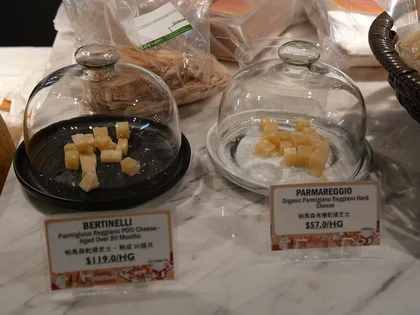 ExplainerParmesan vs Parmigiano Reggiano: the differenceIn Europe «parmesan» evokes a protected designation and cannot be used for anything else.
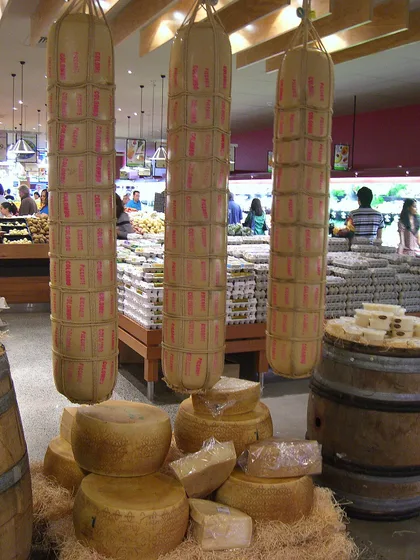 ExplainerWhich Italian cheeses contain no lactoseItaly sets a legal threshold, and long-aged cheeses clear it on their own, with no treatment involved.
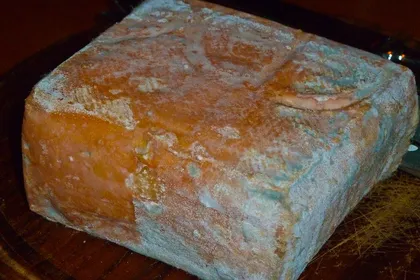 GuideCan you eat cheese rind?On some wheels the rind is the same paste, dried out. On others it is paraffin.
Frequently asked questions
What is the difference between provola and caciocavallo?
The technique is identical; the format and the ageing are not. Provola is the smaller pear-shaped format, eaten young and often lightly smoked. Caciocavallo is made in larger wheels, salted more heavily and aged for months or years until it becomes a grating cheese. On the Nebrodi they come from the same vat.
Is provola dei Nebrodi always smoked?
No. It is made both plain and smoked, and the traditional smoking is very short: a few hours over burning wheat straw, enough to dry and protect the rind. If the smoke dominates the milk, you are tasting an additive rather than straw.
Can I use smoked scamorza instead?
For melting, yes: it is the best widely available substitute. Use about 20% more by weight, drain it first, and accept a milder result. Scamorza is sold within days of being made and has none of the depth that comes from raw milk and slow acidification.
Is it vegetarian?
No. The rennet is kid or lamb paste, an animal product, and its enzymes are what give the aged cheese its piquancy. Microbial-rennet smoked scamorze are the practical vegetarian alternative.
How do you pronounce Provola dei Nebrodi?
PROH-voh-lah day NEH-broh-dee. Both 'provola' and 'Nebrodi' are stressed on the first syllable, and 'dei' is a single syllable that sounds like the English 'day'.
Related foods
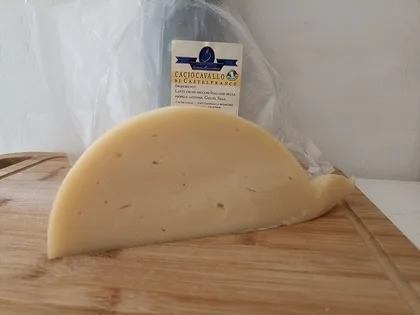 CheeseCaciocavalloCaciocavallo is a stretched-curd cow's milk cheese from southern Italy, aged in a distinctive gourd shape…
 CheeseScamorzaScamorza is cow's-milk pasta filata that has been tied off into a pear shape and hung to dry for one to two…
 CheeseProvoloneProvolone is a stretched-curd cow's milk cheese from northern Italy, rope-tied and hung to age in shapes from…
 CheeseRicottaRicotta is not a cheese. It is a dairy product made from whey, the liquid left over after cheese has been…
 CheeseRicotta SalataRicotta salata is sheep's milk ricotta that has been salted, pressed and aged for at least three months…CheeseRagusanoRagusano is a ten-to-sixteen-kilo rectangular block of raw-milk pasta filata cheese from the Iblei plateau in…
 CheeseGirgentana Goat CheeseThe Girgentana is the corkscrew-horned goat of Agrigento, in south-western Sicily: white, spiral-horned…
 CheesePiacentinu EnnesePiacentinu Ennese is the only Italian cheese whose specification requires saffron: the paste is egg-yolk…