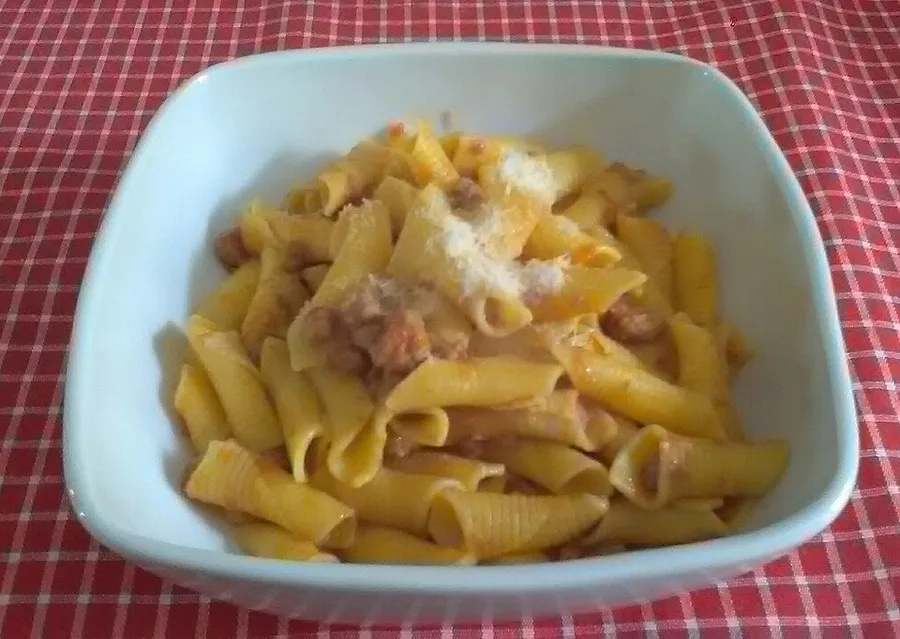
What is Maccheroni?
Maccheroni is a vocabulary problem before it is a pasta. The word appears in Italian by the fourteenth century, when Boccaccio's Decameron imagines a land where a mountain of grated Parmigiano is used to make maccheroni and ravioli, and for centuries it simply meant pasta. Only with nineteenth-century industrialisation did catalogues start assigning names to individual shapes, and maccherone ended up attached to different objects in different regions.
On Italian shelves today it usually means a short semolina tube, smooth or ridged, three to four centimetres long and seven to ten millimetres wide, cut square. In Naples the word keeps its older, wider meaning and covers dried semolina pasta in general, especially the long hollow formats: ziti and candele, snapped by hand before they go into the pot. In Abruzzo, maccheroni alla chitarra are long, solid, square-section egg strands, the exact opposite of a short tube. In Molise, Basilicata, Calabria and Sicily, maccheroni al ferretto are hollow tubes twisted by hand around an iron rod. In Sardinia the same gesture around a reed stem produces maccarrones de busa.
Underneath the confusion there is one consistent logic, and it is about sauce. Each regional maccherone is engineered for its local condiment. The Neapolitan hollow tube exists because Sunday ragù is a long-cooked whole-cut meat sauce that leaves a dense gravy, and the tube takes it in. The chitarra strand has sharp square edges and a porous egg dough because Abruzzese ragù contains pallottine, meatballs the size of a hazelnut that wedge between the strands. The ferretto tube is hollow because the mutton and goat sauces of the Apennines are thin and intensely savoury. And the American elbow is small and curved because macaroni cheese is a cheese béchamel that needs trapping both inside the tube and in the bend.
The name changes from valley to valley. The principle does not: the shape is designed around the sauce.
What does it taste like?
The short semolina tube tastes the way good dried pasta tastes, nutty and faintly sweet with a chalky centre when properly al dente, and eats in a compact, satisfying way, with sauce arriving from inside the tube as well as outside.
Maccheroni alla chitarra is a different sensation entirely. The egg dough is porous and slightly rough, and the square section means four flat faces and four hard edges against your tongue, so it feels denser and grabbier than round spaghetti. It is chewier than it looks and absorbs more sauce than any extruded strand.
The hand-rolled ferretto version is the most rustic of the three: uneven wall thickness means parts go soft while the seam stays firm, and the twist gives you sauce in bursts. If you have only eaten industrial pasta, this is the one that will taste unfamiliar.
How to use it
The semolina tube cooks in 9 to 13 minutes, fresh chitarra in 2 to 4, fresh ferretto in 5 to 8. Plenty of salted water in every case.
Drain two minutes short of the box time and finish in the pan with a ladle of pasta water. On any hollow shape this is the step where sauce actually enters the tube; skip it and half the sauce stays in the bowl.
Match the sauce to the version. The short tube wants ragù napoletano, whole cuts of beef and pork simmered three or four hours in tomato, with the sauce dressing the pasta and the meat served afterwards as a second course, or genovese, the Neapolitan slow-cooked onion and beef sauce, or ricotta loosened with pasta water.
The chitarra wants Abruzzese ragù with pallottine, tiny beef and pork meatballs that lodge between the square strands, or a lamb and pepper sauce.
The ferretto version wants thin, powerful mutton, goat or pork sauces that run into the channel.
What fails everywhere is a thin sauce with no body: it runs through the tube, out the other end, and sits at the bottom of the bowl.
How long it keeps
Sealed in a cupboard away from light, heat and damp, dry maccheroni run to the date on the pack, commonly two or three years out; that date is the maker's reference, and what you notice over time is the smell of wheat thinning. Once the bag is open, tip it into an airtight jar, mostly because open packs in a warm kitchen are where pantry moths arrive in summer. Dry egg pasta takes up moisture faster than plain semolina and needs the tighter seal: strands that once snapped clean start to bend instead once they have picked up humidity.
Fresh chitarra keeps about two days in the fridge, coiled into nests on a tray dusted with semolina and covered with a cloth. To freeze it, spread the nests apart until firm, then bag them: two months, cooked straight from frozen. Fresh ferretto behaves the same and also air-dries at home, two days on a cloth somewhere dry and airy, after which it keeps for months as dry pasta. Cooked and dressed, one day in the fridge, brought back in a pan with a spoonful of water.
Spot the real thing
Start with the word, because in English macaroni means one thing, the small curved elbow of macaroni cheese, while in Italy maccheroni covers several. There is the plain dry tube; there is maccheroni alla chitarra, not a tube at all but a square-section egg strand from Abruzzo; and maccheroni al ferretto, rolled by hand around an iron rod in the south. Read the picture and the region on the pack before the name. Elbows sit at the bottom of the price list in foreign supermarkets, and the other two rarely appear outside an Italian deli.
On dry tubes the usual marks apply: a matt, faintly floury surface rather than a shiny one, mouths cut clean and circular, a wall of at least a millimetre, white semolina dust in the bottom of the bag, protein above 13 percent and a cooking time of 9 to 13 minutes. On packaged chitarra, check the section is genuinely square, since extruded copies have rounded corners and lose the point of the shape. On ferretto the proof is irregularity: uneven lengths, the hollow visible at the ends, the seam where the dough closed on itself.
How to pronounce Maccheroni
mah-keh-ROH-nee
Four syllables, stress on the third. The double c before an 'h' is a hard k held slightly long: 'mahk-keh', never the English 'mack-a-roan-ee' with its swallowed middle. One piece is a maccherone. Note the spelling: Italian uses two c's and an h, English 'macaroni' dropped both.
Maccheroni compared
vsAmerican elbow macaroni
Same word, different object, and the divergence is old. In eighteenth-century England a 'macaroni' was a fashionable young man back from the Grand Tour: that is the joke in Yankee Doodle, where a feather in a cap is called macaroni. The word later attached itself to the small curved tube, and mac and cheese fixed it there permanently. The elbow is genuinely well designed for its job: the bend plus the bore trap cheese sauce twice over, and the small size means a high sauce-to-pasta ratio. It is simply not a shape Italian kitchens use much, where the equivalent is called gomiti or chifferi and is mostly for soups.
| This | American elbow macaroni | |
|---|---|---|
| Shape | Straight short tube, 3-4cm | Curved elbow, 1.5-2.5cm |
| Italian name for it | Maccheroni | Gomiti or chifferi |
| Typical use | Ragù napoletano, genovese, ricotta | Mac and cheese, pasta salad, soup |
| Sauce logic | Dense gravy enters the bore | Cheese sauce trapped in bore and bend |
| Cook time | 9-13 minutes | 6-8 minutes |
vsMaccheroni alla chitarra
The most confusing entry in the whole family, because it is not a tube at all. The chitarra is a wooden frame strung with steel wires; a sheet of egg dough two to three millimetres thick is laid over it and pressed through with a rolling pin, producing long strands with a square cross-section and sharp corners. The corners are the point. Round extruded pasta lets a chunky sauce slide, but square edges and porous egg dough hold it, and the Abruzzese ragù served with it contains hazelnut-sized meatballs that lodge between the strands. If a menu in Abruzzo says maccheroni, this is what arrives.
| This | Maccheroni alla chitarra | |
|---|---|---|
| Form | Hollow short tube | Long solid strand, square section |
| Dough | Semolina and water | Egg pasta, often part semolina |
| Made by | Die extrusion | Pressed through steel wires by hand |
| Cook time | 9-13 minutes | 2-4 minutes fresh |
| Classic sauce | Neapolitan ragù, onion genovese | Ragù with pallottine, lamb and pepper |
| Region | Campania | Abruzzo |
vsMaccheroni al ferretto (maccarruni)
The hand-rolled cousin, found under a dozen local names across Molise, Basilicata, Calabria, Sicily and Sardinia. A rope of semolina dough is pressed around a square iron rod with the palm and slid off, leaving a hollow twisted tube with a thin, uneven wall. The unevenness is functional: thin sections go tender while the seam stays firm, so a single piece has two textures. It exists to carry thin, powerful meat broths (mutton, goat, pork) that run into the channel. A kilo takes over an hour to roll, which is why it has never been industrialised successfully.
| This | Maccheroni al ferretto (maccarruni) | |
|---|---|---|
| Made by | Machine, seconds per kilo | By hand, 60-90 minutes per kilo |
| Wall | Uniform, 1-1.5mm | Uneven and thin |
| Length | 3-4cm | 6-10cm |
| Best sauce | Thick ragù and dense gravies | Thin, savoury mutton and goat sauces |
| Price | $2-14 per lb | $9-20 per lb |
Maccheroni substitutes
- Ziti tagliati or mezze maniche
Straight-cut short tubes of the same calibre, and effectively the same object under a different catalogue name. No adjustment needed.
1:1 - Rigatoni
Wider and ridged, so it holds more sauce on the outside as well as inside. A clear upgrade for anything creamy or chunky; add a minute or two to the cook time for the thicker wall.
1:1 - Penne lisce
Smooth quills, close in calibre but cut on a diagonal, which means the tubes tend to drain when tossed. Reduce the sauce slightly so it clings better.
1:1 - Spaghetti alla chitarra
Only as a substitute for the Abruzzese version, not for the tube. Square-section strands sold dried by several Abruzzo producers. Cook 7-9 minutes dried, and reserve it for meatball or lamb ragù.
1:1 - Gluten-free elbows or short tubes
The most reliably good gluten-free category, since short thick shapes hold together where strands fall apart. Jovial, Rummo Senza Glutine and Barilla's corn-and-rice blend all work. Stop a minute early and finish off the heat, because the walls collapse quickly once past.
1:1
Where to buy it
In the US, De Cecco and Barilla short tubes are in every supermarket at $1.50 to $3 a pound; Rummo, Garofalo and Mancini at $4 to $6; bronze-cut Gragnano IGP and southern artisan producers (Faella, Setaro, Gentile, Afeltra, Rustichella d'Abruzzo) at $7 to $14 through Eataly, Gustiamo and Market Hall Foods. Dried maccheroni alla chitarra is stocked by Abruzzo-focused importers at $7 to $16 a pound; hand-rolled ferretto pasta is rarer still, $9 to $20.
In the UK, supermarkets carry short tubes at £4 to £9 per kilo, and Natoora, Vorrei and Vallebona ship artisan Gragnano and Abruzzese egg pasta at £8 to £24 per kilo. Italian prices are €1.10 to €2.20 a kilo for supermarket brands, €6 to €14 for artisan, and €8 to €18 for hand-rolled.
One warning about labels: American and British shelves sometimes print 'macaroni' on elbows and 'maccheroni' on straight tubes from the same importer. Look at the picture, not the word.
Where to eat it in Italy
Naples, where Sunday maccheroni al ragù is still a family ritual before it is a restaurant dish. The trattorie of the Sanità, the Quartieri Spagnoli and the Vomero serve it with hand-snapped ziti. Gragnano, half an hour away, is where the pasta itself comes from: the historic factories along Via Roma run tours and sell direct, and the town holds a pasta festival in September.
Abruzzo for the chitarra. The most faithful versions are in the Teramo area, where the pallottine are tiny and the ragù mixes beef, pork and sometimes lamb. Summer village festivals between Teramo and Atri are the best place to eat it.
In inland Molise, Basilicata and Calabria, maccheroni al ferretto appear on patron saint festival menus with mutton or goat ragù. In Sicily, in the Madonie and Nebrodi mountains, hand-rolled maccarruni come with pork sauce and grated ricotta salata.
Frequently asked questions
What exactly are maccheroni?
It depends where you are standing. On Italian shelves it is a short semolina tube; in Naples the word covers dried pasta in general, especially long hollow shapes; in Abruzzo it means square-section egg strands cut on a wire frame; in the southern Apennines it means hand-rolled hollow tubes. All of these uses are legitimate.
Is Italian maccheroni the same as American macaroni?
No. American macaroni is the small curved elbow used for mac and cheese, a shape Italians call gomiti or chifferi and mostly put in soup. Same word, different object, and the English spelling dropped a c and an h along the way.
What is maccheroni alla chitarra?
Egg pasta from Abruzzo pressed through the steel wires of a wooden frame, giving long strands with a square cross-section. The sharp corners and porous dough hold chunky meat sauces, which is why the classic partner is a ragù studded with hazelnut-sized meatballs called pallottine.
How do you pronounce maccheroni?
mah-keh-ROH-nee, stress on the third syllable, with the double c held as a hard k. One piece is a maccherone.
Related foods
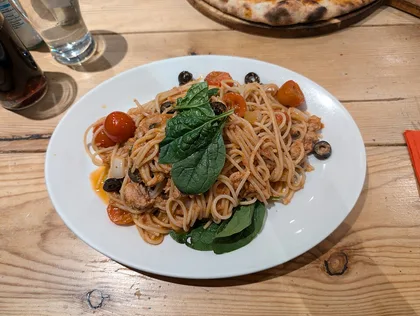 Pasta and breadSpaghettiA solid round strand of durum semolina and water, 1.7 to 2.0mm across. It looks like the most neutral pasta…
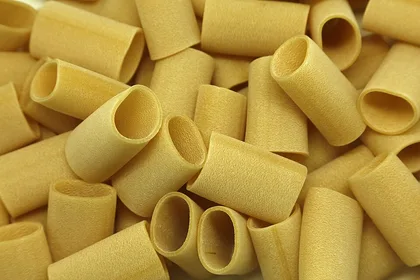 Pasta and breadPaccheriPaccheri are large smooth tubes of durum wheat pasta from Campania: 4-5 cm long, 3-4 cm across, with a thick…
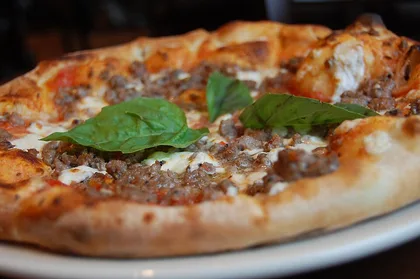 Cured meatsSalsicciaCoarsely ground pork, salt, pepper, wine and usually garlic, packed into natural hog casing and sold raw.
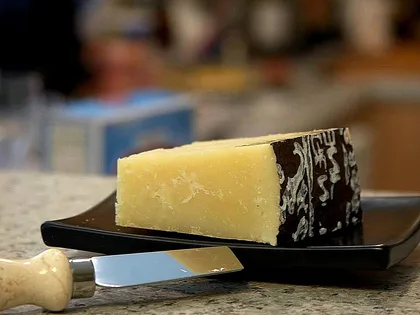 CheesePecorino RomanoPecorino Romano DOP is a hard, dry-salted sheep's milk cheese aged at least five months, made in Sardinia…
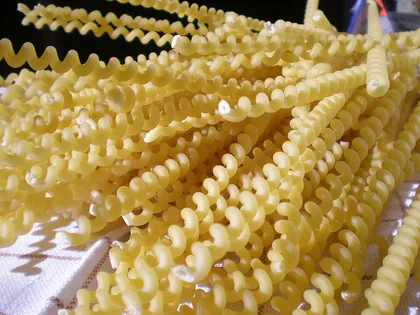 Pasta and breadFusilliTwo different pastas share this name. The industrial spiral is solid and holds sauce on its outside surface…
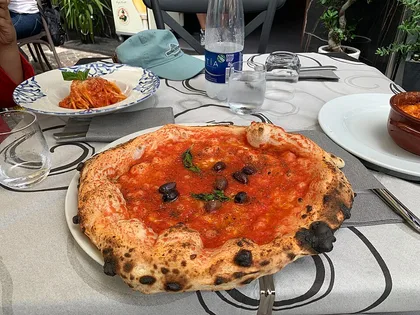 Pasta and breadNeapolitan PizzaNeapolitan pizza has been an EU-registered Traditional Speciality Guaranteed since 2010: four ingredients in…
 Pasta and breadPizza di Scarola (Neapolitan Escarole Pie)Pizza di scarola is Naples's Christmas Eve pie: bread dough wrapped around escarole stewed with Gaeta olives…
 Cured meatsGuancialeGuanciale is cured pork jowl: unsmoked, rubbed with salt and pepper, aged for one to three months.