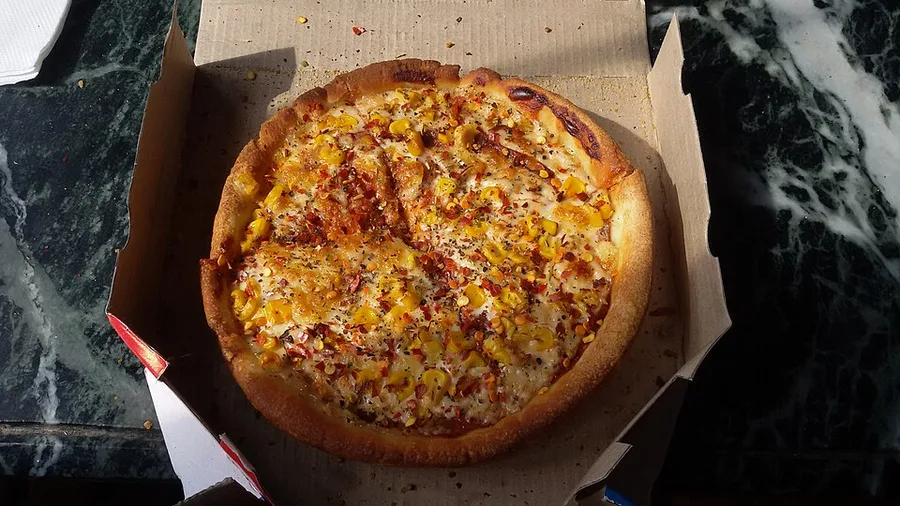
What is Pizza di Scarola (Neapolitan Escarole Pie)?
Pizza di scarola is a covered savoury pie, twenty-five to thirty centimetres across, made from two rounds of bread dough enclosing a filling of stewed escarole. It is not a pizza in the sense the word usually carries abroad: in Naples pizza describes any flattened, oven-baked thing, and this is one of the older uses of the term.
The filling is the dish. Escarole wilted in olive oil with garlic, black Gaeta olives, capers rinsed of their salt, pine nuts, raisins, and salted anchovies melted into the oil. The sweet-and-savoury combination is an old Mediterranean signature, and the raisins and pine nuts trace back to the same medieval Arab influence that shows up across southern Italian cooking.
It belongs to 24 December. The Neapolitan Christmas Eve table is meatless by religious custom, and the pie sits alongside fried eel, salt cod and the pickled cauliflower salad called insalata di rinforzo. Bakeries and rotisseries across the city sell it all winter regardless.
What does it taste like?
Salty first, sweet a beat later. The anchovies, capers and olives hit immediately and make it read as an intensely savoury pie; then the raisins arrive and pull the whole thing sideways. It is a genuinely unusual balance for anyone raised on Northern European savoury pastry, and it is the reason the dish is memorable rather than merely nice.
Underneath both is the escarole itself, which loses most of its bitterness in the pan and turns soft, silky and faintly green-tasting. The pine nuts add a resinous crunch that stops the filling being uniformly soft.
The crust is bread, not pastry: thin, chewy, slightly oily on the base where it has fried against the tin. It contributes texture and a little salt and stays out of the way.
Served warm rather than hot, which is how Neapolitans eat it, the flavours separate properly. Straight from the oven the salt dominates everything.
How to use it
Serve it warm or at room temperature, never straight from the oven. Half an hour of resting lets the salt settle and the sweetness of the raisins come forward; hot from the tin it tastes of anchovy and nothing else. Cut it into wedges like a tart: a 28cm tin gives eight starter portions or four main courses.
On Christmas Eve it goes on the table with fried eel, salt cod and the pickled cauliflower salad, as one savoury element among several. The rest of the year, treat it as the excellent portable lunch that it is: it survives a bag, it needs no reheating, and it is genuinely better on day two.
Two failures to avoid, both of them about water. First, wring the cooked escarole out with your hands before it goes into the dough; residual liquid steams the base from the inside and leaves it raw. Second, let the filling go completely cold, because warm filling does the same damage.
Do not remove the raisins because they seem out of place. Without the sweet counterweight the filling is relentlessly salty, and the dish stops making sense.
The same method works with other winter greens outside the Christmas context, and in Naples a summer version is made with courgettes.
How long it keeps
This is a pie built to be made ahead. Baked, cooled uncovered and then kept under a cloth at room temperature, it holds a day, and the Neapolitan habit of making it the evening before is about letting the filling settle and the crust take up some of the oil. What changes as it sits is moisture heading outwards from the greens: the base softens first, a bread dough casing firms and stales while a pastry one goes limp. Wrapping it while still warm traps steam and soaks the underside within minutes.
In the fridge, wrapped once cold, it keeps three or four days, the crust going soft and the filling stiffening as the olive oil sets. Ten to fifteen minutes at 180°C dries the base out again and loosens the oil. Whole or in wedges it freezes one to two months well wrapped, and reheats from frozen at a gentler 160 to 170°C so the centre catches up with the crust; expect a softer base afterwards, since the greens release more water once thawed. Go by the day it was baked.
Spot the real thing
It is a closed round pie, 24 to 28 centimetres across, sealed on top and usually pricked, baked to a deep gold. The casing is either a bread dough or a short pastry made with oil or lard, and it should be thin enough that the pie is mostly filling. Cut it and the inside is dark green and densely packed: escarole stewed right down with Gaeta olives, capers, anchovies, pine nuts, raisins, garlic and chilli. That sweet and salty pull between the raisins and the anchovies is the Neapolitan signature and the quickest way to tell a real one.
What it gets confused with abroad: spanakopita, which is filo and feta; Ligurian torta pasqualina, which is chard, ricotta and whole eggs in many pastry layers; and calzone, which is folded into a half moon and usually filled with cheese and salumi. Within Naples itself, pizza rustica or pizza chiena is the Easter pie full of cheese and cured meats, a different thing on a different feast. Bakeries and rosticcerie sell it around Christmas at 8 to 14 euro a pie; outside Italy it is essentially a home kitchen dish.
How to pronounce Pizza di Scarola (Neapolitan Escarole Pie)
PEET-tsah dee skah-ROH-lah
The double 'z' in pizza is a held 'ts', so the word lands as PEET-tsah rather than the English 'pee-tsa', and the pause before the 'ts' is what makes it sound Italian. In scarola the 'sc' before an 'a' is a hard 'sk', unlike the 'sh' it makes before 'e' and 'i'. Stress on ROH, and the 'r' is tapped: skah-ROH-lah. The vegetable is escarole in English, ESS-kuh-role.
Pizza di Scarola (Neapolitan Escarole Pie) compared
vsTorta pasqualina
Two Italian vegetable pies from opposite coasts and opposite calendars. The Ligurian torta pasqualina is an Easter dish built from many sheets of paper-thin dough, traditionally thirty-three, one for each year of Christ's life, layered over chard or artichokes with ricotta and whole eggs baked into hollows in the filling. The Neapolitan pizza di scarola uses two rounds of ordinary bread dough, no dairy and no eggs, and takes its complexity from the sweet-salt filling instead of from the pastry.
| This | Torta pasqualina | |
|---|---|---|
| Occasion | Christmas Eve | Easter |
| Dough | Two rounds of bread dough | Many layers of paper-thin pastry |
| Filling | Escarole, olives, capers, raisins, pine nuts, anchovy | Chard or artichoke, ricotta, whole eggs |
| Dairy | None | Central: ricotta and cheese |
| Flavour profile | Sweet and salty at once | Rich, creamy, herbal |
| Region | Campania | Liguria |
vsCalzone
Both are Neapolitan and both enclose a filling in dough, but the shape and the intent differ. A calzone is a pizza folded over on itself, sealed in a half-moon, and either baked in the pizza oven or deep-fried; it is single-portion, made to order, and usually filled with ricotta, salami and cheese. Pizza di scarola is a whole pie baked in a tin, cut into wedges, made in advance and eaten warm or cool: a dish for a table rather than a plate.
| This | Calzone | |
|---|---|---|
| Shape | Round covered pie in a tin | Folded half-moon |
| Portion | Serves 4-8, cut into wedges | One person |
| Typical filling | Escarole, anchovy, olives, raisins | Ricotta, provola, salami, pepper |
| Cooked | Domestic oven, 180-200C, 40 min | Pizza oven in 90 seconds, or deep-fried |
| Eaten | Warm or at room temperature | Immediately, hot |
vsSpanakopita
The closest thing to it in the eastern Mediterranean, and useful as a reference point for anyone who has never met a Neapolitan vegetable pie. Spanakopita layers filo with spinach, feta and dill; pizza di scarola wraps bread dough around escarole with no cheese at all. Greek pie is herbal and tangy from the feta; the Neapolitan one is briny and sweet. Both, notably, exist because a green vegetable in season needed to feed a lot of people.
| This | Spanakopita | |
|---|---|---|
| Pastry | Bread dough, 3-4mm | Filo, many buttered sheets |
| Green | Escarole | Spinach, often with wild greens |
| Cheese | None | Feta, sometimes ricotta |
| Sweet element | Raisins | None |
| Salt element | Anchovy, capers, olives | Feta |
Pizza di Scarola (Neapolitan Escarole Pie) substitutes
- Escarole, which is easier to find than you think
In the US it is sold as escarole in almost every supermarket, often near the chicory and radicchio. In the UK it is rarer: look for it as Batavian endive or scarole at Italian and Turkish greengrocers.
1kg raw escarole yields about 300g cooked filling - Curly endive or frisée
The same species, different leaf. More bitter and more assertive, so blanch it for a minute before wilting to take the edge off. Otherwise it behaves identically.
1:1 by raw weight - Swiss chard
Widely available and structurally right: it wilts down to a similar silky texture and releases similar amounts of water. It lacks the faint bitterness, so add a handful of rocket or a little radicchio for balance.
1:1 by raw weight, plus a bitter green - Savoy cabbage with a bitter leaf
The winter fallback where nothing in the chicory family exists. Shred it finely, cook it longer than you would escarole, and blend in some chicory, dandelion or watercress for the bitter note.
700g cabbage plus 300g bitter greens per kilo of escarole - Spinach, the weakest option
It works only if you squeeze it ferociously. Spinach holds far more water than escarole and turns to slush, which is the single most common way this pie ends up with a raw base.
1.3:1 by raw weight, squeezed hard
Where to buy it
In Naples, from a neighbourhood bakery or rotisserie rather than a restaurant: this is takeaway and home food. A whole 28cm pie costs 8 to 14 euros, a slice 2.50 to 4, or 10 to 14 euros per kilo. Prices rise a couple of euros in December, and city-centre bakeries close their Christmas Eve order books days in advance.
Elsewhere in Italy, Neapolitan delicatessens in the northern cities sell it at 14 to 18 euros per kilo through the winter. Outside Italy it is not a commercial product at all: it is a dish you make, not one you buy.
Making it is cheap and the shopping list is short. Escarole runs 1.50 to 3 euros a kilo in season in Italy, about 3 to 5 dollars a head in the US and 2 to 4 pounds in the UK. Raw bread dough can be bought by weight from most Italian bakeries for 2 to 3 euros a kilo, which saves the longest step; abroad, ask a local pizzeria, or use a plain bread dough recipe.
The expensive items are pine nuts, which comfortably exceed 40 euros a kilo, and salt-packed anchovies. Neither can be skipped, but both are used in small quantities: a whole pie costs 6 to 8 euros in ingredients.
Where to eat it in Italy
Naples in December. From the start of the month the trays appear in bakery windows across the city, and the best hunting grounds are the working neighbourhoods rather than the tourist streets: the Quartieri Spagnoli, the Sanità, Forcella, and the shops around the Vomero markets, where it is sold by weight from the counter.
In Christmas week, via San Gregorio Armeno, the street of the nativity-scene craftsmen and so crowded it is barely walkable, is ringed by bakeries turning out pizza di scarola continuously. Combining the two is the best possible use of a December morning in the city.
The historic friggitorie of the old centre, the fried-food counters that also sell zeppole and fried pizza, make individual fried versions called pizzelle di scarola, eaten straight from the oil.
Beyond Naples the pie is made across Campania. In the Cilento, south of Salerno, a version with fresh anchovies instead of salted ones is worth the detour, and in southern Lazio around Gaeta and Formia they make it with the local olives that the Neapolitan recipe calls for by name.
Frequently asked questions
Why is pizza di scarola eaten on Christmas Eve?
Because the Neapolitan meal of 24 December is meatless by religious custom. The pie provides something substantial without meat, and the anchovies that season it are permitted. It is served alongside fried eel, salt cod and insalata di rinforzo, the pickled cauliflower salad that stays on the table until Epiphany.
What is scarola?
Escarole, Cichorium endivia var. latifolia, a broad-leaved endive grown around Naples from October to March. Its bitterness is mild and softens further with cooking. It is common in American supermarkets and much rarer in the UK, where it may be labelled Batavian endive.
Why are there raisins and pine nuts in a savoury pie?
For the sweet-and-salty balance, a medieval Mediterranean habit that survived in Naples long after it disappeared elsewhere in Europe. The raisins counterweight the anchovies, capers and olives. Leave them out and the filling becomes one-note and punishingly salty.
Bread dough or shortcrust?
The traditional Neapolitan recipe uses bread dough, and many families simply buy it raw by weight from their baker. Versions with shortcrust or a plain oil-and-flour pastry exist and are more fragile and more quiche-like, but they are not the historic dish.
Why is the bottom of my pie soggy?
Water, in one of two ways. Either the cooked escarole was not wrung out hard enough, or the filling went into the dough while still warm. Both leave liquid that steams the base from inside. Cool the filling completely and squeeze it with your hands before assembling.
Related foods
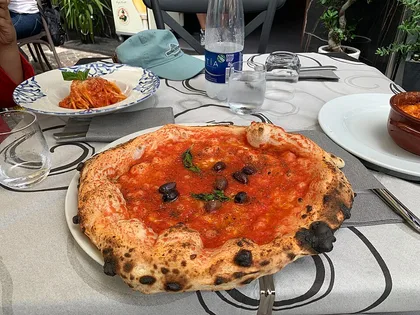 Pasta and breadNeapolitan PizzaNeapolitan pizza has been an EU-registered Traditional Speciality Guaranteed since 2010: four ingredients in…
 Fish and seafoodColatura di Alici (Italian Anchovy Sauce)Colatura di alici is the amber liquid that drains from anchovies packed in salt in chestnut barrels at…
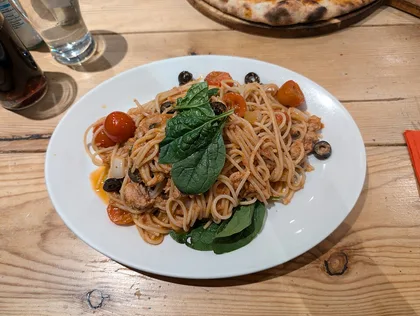 Pasta and breadSpaghettiA solid round strand of durum semolina and water, 1.7 to 2.0mm across. It looks like the most neutral pasta…
 Pasta and breadFusilliTwo different pastas share this name. The industrial spiral is solid and holds sauce on its outside surface…
 Pasta and breadPaccheriPaccheri are large smooth tubes of durum wheat pasta from Campania: 4-5 cm long, 3-4 cm across, with a thick…
 Pasta and breadMaccheroniThe most misunderstood name in Italian pasta. In Naples it means dried semolina pasta in general, in Abruzzo…
 CheeseMozzarellaThe name is a verb before it is a cheese: mozzare means to lop off, which is what the cheesemaker does by…