What is Girgentana Goat Cheese?
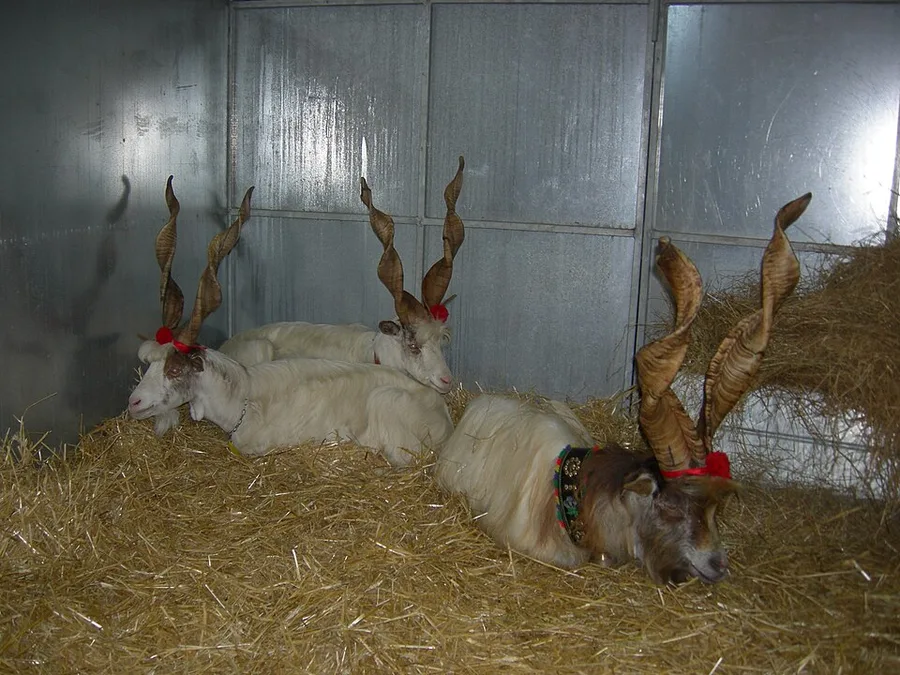
Girgentana names both a breed and the cheeses made from it. The animal is unmistakable: a white coat with amber markings on the head and neck, a long beard in both sexes, and horns that grow vertically while twisting around themselves like a corkscrew, reaching sixty or seventy centimetres in adult males. No other Italian goat looks like this.
It is a dairy breed rather than a meat one, but a modest producer: around two litres a day, against three or four times that from a commercial Saanen. What it gives instead is quality. Girgentana milk has a fatty acid profile that makes it far less 'goaty' on the palate than milk from high-yield breeds, and it was historically fed to infants and convalescents for its digestibility.
The cheeses are fresh ones. Tuma is the unsalted curd, eaten within a day or two. Primosale is lightly salted and eaten within a week, sometimes studded with black peppercorns. Ricotta is made from the whey. A small number of wheels are aged one to three months, and that is the whole range.
There is no DOP and there will not be one: the volumes cannot support it. A Slow Food Presidium protects the breed and its products, and in practice it is the only structure holding the remaining farmers together.
What does it taste like?
Sweet, milky and clean, and startling to anyone who arrives expecting goat cheese to taste like goat. The pungent, slightly barnyard note that defines most chèvre is nearly absent here; what you get instead is warm milk, fresh almond and a faint citrus lift.
Tuma, unsalted and hours old, is the most extreme version: squeaky, elastic, almost sweet, with the texture of very firm fresh mozzarella and almost no flavour beyond milk. It is a cheese you either love immediately or find pointless.
Primosale, lightly salted and a few days old, is the one that makes the case. The salt sharpens the milk without covering it, the paste firms up enough to slice and grill, and the almond note comes forward. With peppercorns it gains heat without losing sweetness.
The ricotta is exceptionally fine-grained and delicate, closer to a fresh whipped curd than to the grainy sheep's ricotta used in Sicilian pastry. Aged wheels, where you find them, develop a mild nuttiness and a thin natural rind, but never the sharpness of an aged French or Spanish goat cheese.
How to use it
Tuma is eaten the day it is made: sliced, with new olive oil, black pepper and warm bread. Nothing else, and nothing later: it does not keep.
Primosale is the workhorse. Slice it with tomatoes, spring broad beans, or crushed green olives. Grill it: two minutes a side on a dry hot pan gives a browned crust and a firm centre, and it will not collapse the way a lactic-set chèvre does. Put it in the Sicilian orange and fennel salad, where its mildness lets the citrus lead instead of fighting it.
Girgentana ricotta belongs in dishes where ricotta is the point rather than a filler: eaten with a spoon under honey and lemon zest, folded through pasta with broccoli, or baked into a herb tart. For cannoli, Sicilians use sheep's ricotta, which is fatter and holds up better under sugar.
The few aged wheels crumble or grate over cooked vegetables. Like all rennet-set goat cheeses it does not melt smoothly: heat dries it out and splits it, so keep it off direct flame and add it at the end.
How long it keeps
Tuma is not a keeping cheese at all: it is bought and eaten within twenty four to forty eight hours, held in the fridge in a closed container under a finger of its own whey. Primosale runs eight to ten days, wrapped in greaseproof paper inside a container that is not airtight, and the water gathering at the bottom is poured off each day. Cling film against the surface speeds up oxidation of the exposed fat. Ricotta goes within two days, covered, and never beside anything aromatic, because it takes up every smell in the fridge.
Semi-aged forms hold a good month in a lightly damp cloth, drying and firming as they go; when the surface dries too far, a cloth wrung out in salted water brings it back. Nothing along this chain rewards freezing except ricotta headed into a cooked dish, which lasts three months and comes out with the fine grain gone entirely. Half an hour out of the fridge before serving changes the taste of every one of them.
Spot the real thing
The first check is not on the cheese but on the farm. The people keeping Girgentana goats number in the dozens and are known by name, so a counter offering girgentana goat cheese and unable to say which holding it came from is almost certainly selling goat cheese and nothing more. The animal itself is unmistakable, with long corkscrew horns spiralling straight up, and producers put it on their labels for exactly that reason.
On the cheese: tuma and primosale are strikingly white, a milk white rather than a grey one, with a compact paste that is moist without being wet, and the rind on a primosale is barely there. The most useful clue is an absence. That sharp goaty note most people abroad associate with goat cheese is nearly missing here, and what arrives instead is sweet and lactic with a finish of fresh almond, which unsettles anyone expecting a French chèvre. The ricotta is very fine grained and sweet. Price rules out the rest: a goat giving two litres a day cannot make cheap cheese.
How to pronounce Girgentana Goat Cheese
KAH-prah jeer-jen-TAH-nah
'Capra' is stressed on the first syllable: KAH-prah. In 'Girgentana' both 'g's before an 'e' or 'i' are soft, like the 'g' in 'gentle': jeer-jen-TAH-nah, with the stress on the third syllable, never a hard 'gur'. The name comes from Girgenti, what Agrigento was called until 1927.
Girgentana Goat Cheese compared
vsOrdinary Italian goat cheese (caprino)
Most Italian goat cheese is made from Saanen, Camosciata or Maltese milk, breeds selected for yield, often pooled across farms and frequently blended with cow's milk in the cheaper tiers. It is good, consistent and cheap. Girgentana milk comes from a breed nobody keeps for economic reasons, in tiny quantities, and its defining quality is what it lacks: the pungency. The two are not competing products so much as different arguments about what goat's milk is for.
| This | Ordinary Italian goat cheese (caprino) | |
|---|---|---|
| Breed | Girgentana, a few hundred head | Saanen, Camosciata, Maltese and crosses |
| Yield per goat | About 2 litres a day | 4-8 litres a day |
| Goaty pungency | Very low | Moderate to pronounced |
| Milk blending | Never: single flock | Common, sometimes with cow's milk |
| Forms | Tuma, primosale, ricotta, a little aged | Fresh logs, robiola, aged rounds, spreads |
| Price | EUR 18-30 per kg | EUR 8-16 per kg |
| Where to buy | Province of Agrigento, essentially | Everywhere |
vsFrench chèvre
Two completely different technologies wearing the same label abroad. French chèvre is usually lactic-set: a tiny amount of rennet, a slow acidification over twenty-four hours or more, then draining, moulding and often a Geotrichum or ash rind that develops over weeks. Sicilian girgentana cheese is rennet-set in under an hour, drained in a rush basket, and eaten within days with no rind development at all. Chèvre is about the rind and the acidity; girgentana is about the milk and nothing else.
| This | French chèvre | |
|---|---|---|
| Coagulation | Rennet-set, under an hour | Lactic-set, 18-24 hours |
| Rennet | Kid rennet paste | Minimal, often microbial |
| Rind | None or barely formed | Geotrichum bloom, ash, sometimes mould |
| Texture | Firm, springy, sliceable | Soft, dense, spreadable to chalky |
| Acidity | Low: tastes sweet | High: tastes tangy |
| Age when eaten | 1-10 days | 2 weeks to 3 months |
| Grilling | Holds its shape well | Softens and spreads |
Girgentana Goat Cheese substitutes
- Sicilian primosale or tuma from other breeds
The same cheeses made from ordinary goat or mixed goat and sheep milk, widely sold across Sicily. Texture and use are identical; the milk is less delicate and usually a little more pungent.
1:1 - Fresh sheep's milk primosale
Richer and fattier, with more body, and the closest thing to girgentana primosale outside Sicily's goat farms. Excellent grilled. Where a recipe leans on the milk's sweetness, this works better than a tangy goat cheese.
1:1 - Chèvre frais, the youngest available
Widely available and structurally different: lactic-set, tangier, softer. Buy the freshest, least-ripened log you can find, and taste before adding acid to the dish, since the cheese already brings plenty.
1:1, and cut any lemon in the recipe - Fresh goat ricotta or a very fresh robiola di capra
For the ricotta side of the range. Goat ricotta is close in grain and delicacy; robiola di capra is creamier and works where the cheese is spread rather than sliced.
1:1 - Mild fresh cow's milk cheese (fior di latte or fresh queso fresco)
If the point of the dish is a sweet, mild, sliceable cheese that grills, these do the job. You lose the goat's milk character entirely, which for tuma is arguably not much of a loss.
1:1 - Vegetarian: microbial-rennet fresh goat cheese
Traditional girgentana cheeses use kid rennet paste and are not vegetarian. Most supermarket chèvre frais and many fresh goat cheeses in the US and UK are made with microbial rennet or a lactic set and state it on the label: those are the practical alternative.
1:1
Where to buy it
Honestly: in the province of Agrigento, or not at all. Tuma lasts two days, primosale about ten, ricotta forty-eight hours. None of them survive export logistics, and a shop outside Sicily selling 'Girgentana goat cheese' is almost certainly selling goat cheese from another breed.
In Sicily, buy directly from the Presidium farms around Agrigento, Naro, Favara, Racalmuto, Camastra and Palma di Montechiaro, or inland in the Sicani mountains around Santo Stefano Quisquina and Bivona. Several take visitors by appointment. Expect EUR 18 to 26 per kilo for primosale at the farm, up to EUR 30 in good shops in Agrigento or Palermo, EUR 12 to 16 for ricotta.
Ask for the farm by name. There are very few producers, and any counter genuinely selling girgentana can tell you whose it is. A seller who cannot is selling generic goat cheese.
One useful price check: below EUR 15 per kilo it is not girgentana. A goat giving two litres a day cannot produce cheap cheese.
Where to eat it in Italy
The Valley of the Temples at Agrigento is the obvious first stop, and not only for the archaeology. Inside the park, the Giardino della Kolymbethra (an ancient Greek water basin turned citrus garden, now looked after by the FAI) keeps a small flock of Girgentana goats grazing among almond and orange trees. It is the easiest place in the world to see the animal.
The Presidium farms are scattered through the hinterland: Naro, Favara, Racalmuto, Camastra, Palma di Montechiaro, and further inland in the Sicani mountains around Santo Stefano Quisquina and Bivona. Many sell at the gate; some do tastings by arrangement.
In Sciacca and along the coast, the better delicatessens carry primosale, but ask specifically: what is on display is usually mixed-milk cheese.
Go between March and June. The goats have kidded, the milk is flowing, and the interior of the Agrigento province is green for the only stretch of the year.
Recipes with it
Further reading
 GuideHow long food keeps once openedThe date on the label describes the sealed package. After that, four things govern everything: water, salt…
 InvestigationItalian raw milk cheeses: the full listWe counted: 19 of 43 declare raw milk, and 16 of those 19 carry a protected designation.
 ExplainerParmesan vs Parmigiano Reggiano: the differenceIn Europe «parmesan» evokes a protected designation and cannot be used for anything else.
Frequently asked questions
Why does the Girgentana have corkscrew horns?
It is the defining trait of the breed, present in both sexes and reaching sixty to seventy centimetres in adult males. The resemblance to the Asian markhor has led many to suggest an eastern origin, possibly arriving in Sicily during Arab rule, but that remains a morphological hypothesis rather than a proven lineage.
Why is the breed nearly extinct?
Because it yields about two litres of milk a day. Sicily had tens of thousands of Girgentana goats in the mid-twentieth century; farms then switched to far more productive Saanen and Camosciata breeds, the countryside emptied and family herding ended. A few hundred head remain and the breed is classed as at risk of extinction.
Does Girgentana milk taste goaty?
Much less than people expect. Its fatty acid profile gives a sweet, milky, faintly almond-like flavour without the pungency associated with goat cheese, which is why it was traditionally given to infants and the sick.
Is it vegetarian?
Traditionally no: the rennet is kid rennet paste, an animal product. A few dairies use microbial rennet on request but it is not the norm. The producers are small enough that you can simply ask, and they will know.
Can I buy it outside Sicily?
Effectively no. Tuma lasts two days, primosale ten, ricotta forty-eight hours: none of them travel. Cheese sold abroad under the Girgentana name is almost always from other goat breeds.
Related foods
 CheeseRicottaRicotta is not a cheese. It is a dairy product made from whey, the liquid left over after cheese has been…
 CheeseProvola dei NebrodiProvola dei Nebrodi is a raw cow's milk pasta filata cheese from the mountains of north-eastern Sicily…
 CheeseRobiolaRobiola is a family of soft young cheeses from north-west Italy rather than a single cheese.
 Vegetables and fruitBronte PistachioBronte pistachios grow on the lava fields of Etna, are picked by hand in odd-numbered years only, and have a…
 CheeseRicotta SalataRicotta salata is sheep's milk ricotta that has been salted, pressed and aged for at least three months…CheeseRagusanoRagusano is a ten-to-sixteen-kilo rectangular block of raw-milk pasta filata cheese from the Iblei plateau in…
 CheesePiacentinu EnnesePiacentinu Ennese is the only Italian cheese whose specification requires saffron: the paste is egg-yolk…
 CheeseVastedda del BeliceVastedda della Valle del Belìce is the only stretched-curd sheep's milk cheese in the world.