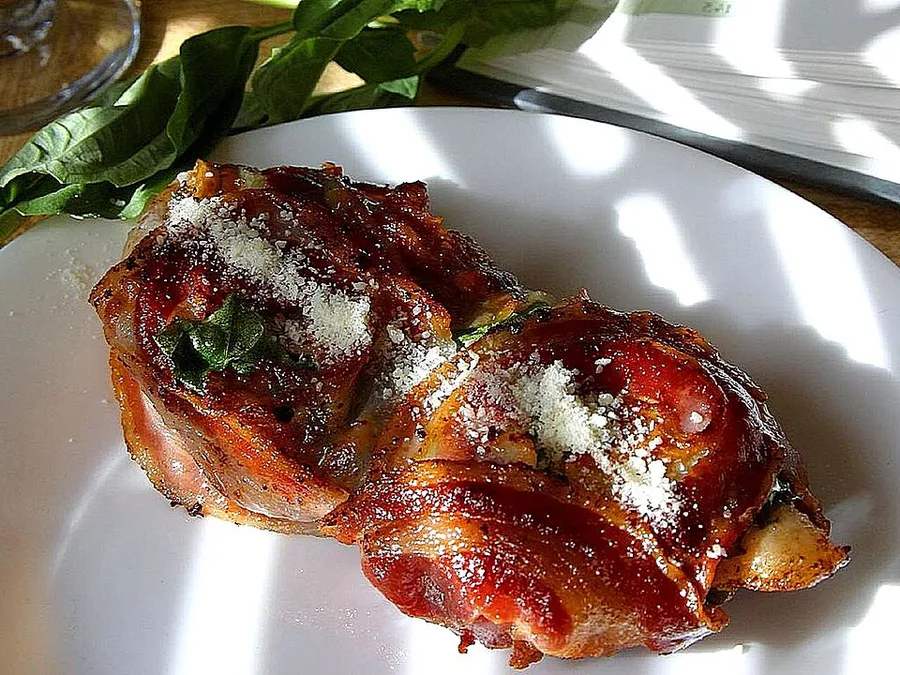
What is Pancetta Piacentina?
Pancetta Piacentina PDO is made from the pig's belly, trimmed square, skinned, dry-salted, then rolled tightly into a cylinder, stuffed into natural casing and bound by hand with string along its full length.
The rolling is the product. In a flat belly the layers of lean and fat run horizontally; rolled, they become concentric, and a slice shows a regular spiral found in no other Italian cured meat. It is not decoration: the spiral guarantees that every mouthful carries the same ratio of fat to lean.
The seasoning follows the Piacenza school, the same one used for coppa: salt, whole and ground black pepper, cloves, nutmeg and a little sugar. No garlic, no chilli, no smoke.
Minimum ageing under the rules is four months, and a finished piece weighs four to eight kilos, one of the largest whole cured meats in Italy that is eaten raw.
It is one of Piacenza's three PDO salumi, alongside coppa and salame. No other Italian province holds three.
The crucial point for anyone shopping abroad: this is not the pancetta that goes into carbonara. That is a different, cheaper, younger product.
What does it taste like?
Sweet and clean, with the nutmeg and clove arriving as warmth rather than as identifiable spice, and the pork underneath tasting fresher and less concentrated than in a leg or neck cure.
The fat does the work. Aged four months or more, belly fat turns translucent and firm and melts at mouth temperature into something closer to butter than to bacon fat. There is no smoke, no sweetness from sugar cure, and none of the salty punch of American cured pork.
The texture depends entirely on how thin it is cut. Under a millimetre it dissolves; at two millimetres it turns chewy and greasy, which is why bad pancetta is usually a slicing problem rather than a product problem.
Against guanciale it is milder and less gamey; against prosciutto it is fattier and far less salty; against streaky bacon it shares only the cut.
How to use it
Slice it under a millimetre, thinner than you think, and serve the slices whole and flat at room temperature. Do not cut them into pieces: the spiral is half the pleasure, and a folded slice loses it.
In Piacenza it is eaten with batarò, a lard-enriched flatbread cooked on a hot stone in the Nure and Trebbia valleys, or with chisulén, the local fried dough diamonds. Warm bread under a cold slice is the entire technique.
On a board it belongs beside coppa and salame piacentino. Keep the accompaniments plain: unsalted bread, aged Grana Padano (Piacenza is inside its production zone) and restrained pickles. Skip jams, since the cure is already faintly sweet.
For cooking, use a cheaper flat pancetta. That said, the ends of a rolled piece are excellent diced and rendered slowly as the base for pisarei e fasö, the city's bean and gnocchi dish, or for a broth of anolini.
One easy local serving: a raw slice wrapped around a breadstick or a shard of hard cheese, nothing else.
How long it keeps
The whole roll hangs in a cellar or cool room between 12 and 16 C, where it goes on drying and losing weight. It needs no fridge, and hard cold sets the fat solid. Once you have started cutting, press greaseproof paper against the cut face and work through the piece over three or four weeks: the exposed surface dries and yellows as the fat meets the air, and half a centimetre comes off before you slice again. A vacuum-packed piece keeps in the fridge to the date on the label and wants half an hour out of the bag before slicing, since the closed smell it arrives with disperses in air.
Slices cut to order last a couple of days and should lie flat between sheets of paper rather than heaped, because they are thin enough to weld together. White bloom on the roll is normal and comes off with a cloth dipped in vinegar or white wine; anything else is a question for the shop and the label. It does not freeze raw, since belly fat oxidises in the freezer faster than any other pork fat.
Spot the real thing
Read the spiral first. It should be tight and regular, lean and fat alternating in orderly bands with no gaps, since a loose roll or a hollow in the middle means the rolling was done badly. The proportions matter as much: thick seams of fat stay heavy however long the piece hangs, while a very lean one dries out hard. The fat should be white and translucent, never yellow or chalky, and the lean bright red with no grey shading towards the centre of the roll. A slice feels soft but not tacky and leaves no oily film on the fingers at room temperature, and the smell is pepper and nutmeg over a sweet base.
On the label, look for the European DOP mark and the Consorzio dei Salumi DOP Piacentini. The words pancetta arrotolata on their own guarantee nothing, because they describe a shape. Abroad the confusion is with three things: streaky bacon, which is smoked, sugar-cured and sold raw to fry; pancetta tesa, the flat unrolled slab; and the tubs of diced pancetta in supermarkets, usually made from flat belly and priced far below a DOP roll.
How to pronounce Pancetta Piacentina
pan-CHET-tah pyah-chen-TEE-nah
The 'ce' in pancetta is soft, as in 'chess', and the double 't' is held slightly longer than English wants: pan-CHET-tah, never pan-SET-ta. Piacentina carries the stress on the second-to-last syllable, and its 'ci' is soft too. The city, Piacenza, is pyah-CHEN-tsah.
Pancetta Piacentina compared
vsPancetta tesa (flat pancetta)
Same cut of pig, two different foods. Tesa stays flat, usually keeps the rind, is cured for a few weeks to a couple of months and is built to be cubed and rendered, the workhorse of Italian cooking. Arrotolata is rolled, cased, skinned and aged for months so that the fat becomes firm and translucent enough to eat raw. The Piacentina PDO is the aristocratic end of the rolled category. If a recipe says to fry pancetta, it means tesa; if a menu offers pancetta on a board, it means arrotolata.
| This | Pancetta tesa (flat pancetta) | |
|---|---|---|
| Shape | Rolled into a cylinder, cased | Flat slab or rectangle |
| Rind | Removed before rolling | Usually left on |
| Ageing | 4 months minimum, often 6-7 | 3 weeks to 2 months |
| Eaten | Raw, sliced paper-thin | Cooked, cubed or in strips |
| Seasoning | Salt, pepper, cloves, nutmeg | Salt, pepper, sometimes garlic, bay |
| Slice | Wide concentric spiral | Straight parallel layers |
| Price | 16-24 EUR per kg whole | 8-14 EUR per kg |
vsGuanciale
The comparison Roman cooking turns on. Guanciale is jowl and cheek, a small triangular cut with dense fat that melts slowly and crisps hard at the edges, cured with salt and a heavy pepper crust and nothing else. Pancetta is belly: leaner, softer, milder, and it wilts in the pan where guanciale crisps. For carbonara, amatriciana and gricia the traditional cut is guanciale, and pancetta is the fallback rather than the equal. For eating raw, the roles reverse: a rolled aged pancetta is the better slicing meat.
| This | Guanciale | |
|---|---|---|
| Cut | Belly | Jowl and cheek |
| Fat behaviour | Softer, renders fast, wilts | Dense, renders slowly, crisps |
| Flavour | Mild, sweet, spiced | Deep, gamey, peppery |
| Yield per pig | One large belly | Two jowls of about 1 kg |
| Best raw | Yes, when rolled and aged | Only when very well aged |
| Best in Roman pasta | Acceptable substitute | The traditional choice |
vsStreaky bacon
The same cut of the same animal, treated by an entirely different logic. Bacon is brine-cured or wet-cured, sweetened with sugar or maple, and smoked; pancetta is dry-salted, spiced and air-dried with no smoke and no sugar cure. Bacon is designed to be cooked and is unsafe to eat raw; aged rolled pancetta is designed to be eaten raw. Substituting bacon into an Italian recipe is not neutral: it adds smoke and sweetness that the dish was never built around.
| This | Streaky bacon | |
|---|---|---|
| Cure | Dry salt and spice, air-dried | Brine or wet cure, often sugared |
| Smoke | None | Central, usually |
| Eaten raw | Yes | No |
| Sweetness | Barely: a trace of sugar in the cure | Noticeable, from sugar or maple |
| In the pan | Renders clean, little water | Releases water, then spits |
| Slice thickness | Under 1 mm for raw service | 2-4 mm rashers |
Pancetta Piacentina substitutes
- Another rolled pancetta (arrotolata)
Any well-aged Italian pancetta arrotolata gives the same spiral and the same raw-slicing behaviour, with a slightly different spice profile. Pancetta di Calabria PDO is the southern alternative, seasoned with chilli and kept flat with the rind on.
1:1 - Lardo di Colonnata or lardo d'Arnad
Almost pure fat, so it is fattier than pancetta by a wide margin, but it plays the same role on a board, sliced translucent and laid over warm bread. Use about half as much by weight.
0.5:1 - Pancetta tesa, for cooking only
If the goal is a soffritto, a carbonara or a bean soup, flat pancetta is not a downgrade: it is the correct product, and half the price. Reserve the rolled Piacentina for raw service.
1:1 in cooked dishes - Speck Alto Adige PGI
Boned, lightly smoked ham from the far north. It slices thin, keeps its shape and works on a board, but it brings smoke and much less fat. Good where a smoky note is wanted, wrong as a like-for-like swap.
1:1 - Halal or no-pork: beef bacon or cured beef brisket
Dry-cured beef bacon slices thin and carries enough fat to read similarly on a board. Pastrami-style cured brisket is a looser substitute, spicier and leaner, but works in a sandwich.
1:1 - Smoked duck breast
Widely available, pork-free, and it slices to the same translucency with a comparable fat cap. The flavour is gamier and the smoke changes the balance, so serve it with something sweet, figs or pears, rather than plain bread.
1:1
Where to buy it
In the US, Italian importers and specialist grocers stock Pancetta Piacentina PDO, though most shelf space goes to domestic flat pancetta sold for cooking. Expect roughly 18 to 32 dollars per pound for a vacuum-packed piece. Ask specifically for arrotolata, or you will be handed a cooking product.
In the UK, Italian delicatessens and online grocers carry it at about 26 to 42 pounds per kilo, with sliced packs proportionally dearer.
Check the label for the blue-and-yellow PDO mark and a reference to the Consorzio dei Salumi DOP Piacentini. "Pancetta arrotolata" on its own describes a shape and guarantees nothing about origin or ageing.
Look at the cut face. The spiral should be tight and even with no air gaps, the fat white and translucent rather than yellow or chalky, and the lean uniformly red right to the centre of the roll. Grey at the core means the salt never got there.
Buy a one- or two-kilo vacuum-packed section rather than the whole piece, which runs to four to eight kilos, and rather than sliced trays, which lose their aroma within two days.
Where to eat it in Italy
Piacenza itself, in the osterie of the old centre, where the board of the three PDO meats arrives with hot batarò or fried dough as standard.
The Nure and Trebbia valleys (Bettola, Ponte dell'Olio, Rivergaro, Bobbio) serve it alongside the local kitchen: pisarei e fasö, anolini in broth, and picula ad caval, a horsemeat mince that says a great deal about how differently this province eats from the rest of Emilia.
Toward the Po, Monticelli d'Ongina and Castelvetro Piacentino belong to another Piacenza altogether, flat and foggy, where the older producers still work the large pieces and sell at the door.
Carpaneto Piacentino, in the hills between the Nure and the Arda, is one of the province's butchery centres and holds a summer festival devoted to local cured meats, the easiest place to taste pancette of different ages side by side.
Piacenza sits an hour from Milan by train and is routinely skipped by visitors heading to Parma or Bologna, which is precisely why the food is still priced for locals.
Recipes with it
Further reading
Frequently asked questions
Is pancetta the same as bacon?
No. Both come from pork belly, but bacon is wet-cured or brined, usually sweetened and smoked, and must be cooked. Pancetta is dry-salted, spiced and air-dried without smoke, and the rolled aged versions are eaten raw.
What is the difference between rolled and flat pancetta?
Flat pancetta (tesa) keeps its rind, cures for a few weeks and is meant for cooking. Rolled pancetta (arrotolata) is skinned, rolled into a cylinder, cased and aged for months so it can be sliced paper-thin and eaten raw. Pancetta Piacentina PDO is rolled.
Can I use Pancetta Piacentina for carbonara?
You can, but it is a waste and not the right product. Carbonara traditionally calls for guanciale, with plain flat pancetta as the fallback. Rendering a four-month cured, nutmeg-scented salume in a pan destroys what you paid for.
Why is pancetta piacentina rolled?
Rolling turns the belly's horizontal layers of fat and lean into concentric rings, so every slice carries the same ratio. The tight cylinder also seals the interior from air, which is what allows four months or more of ageing without the fat turning rancid.
How thin should pancetta be sliced?
For raw service, under a millimetre, thin enough to see light through. Cut thicker than about two millimetres it turns chewy and greasy, which is the single most common way good pancetta gets ruined at the counter.
Sources
Where to check what you just read.
- 1
L'atto europeo che iscrive «Pancetta Piacentina» fra le DOP: la protezione riguarda il nome completo, non la pancetta generica.
- 2
Il PDF del disciplinare vigente, dove si controllano provenienza dei suini, salagione a secco, spezie ammesse, arrotolamento e stagionatura minima.
- 3Consortium · interested partyConsorzio di Tutela Salumi DOP Piacentini
L'ente riconosciuto dal Ministero nel 2007 per le tre DOP piacentine: qui si trovano i produttori autorizzati e il ruolo del microclima fra Po e Appennino nella stagionatura.
Related foods
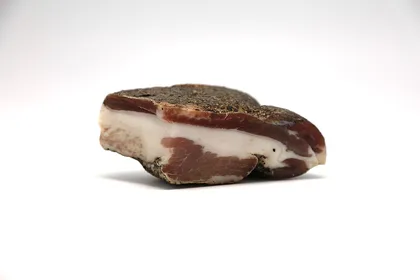 Cured meatsGuancialeGuanciale is cured pork jowl: unsmoked, rubbed with salt and pepper, aged for one to three months.
 Cured meatsCoppa PiacentinaCoppa Piacentina is dry-cured pork neck from the province of Piacenza, seasoned with cloves, cinnamon and…
 Cured meatsMortadellaThe white cubes are not just any fat: they are jowl, the firmest part of the pig, and they stay whole…
 Cured meatsProsciutto di ParmaProsciutto di Parma DOP is Italian ham made from three things only: pork, sea salt and at least 400 days.
 Cured meatsCotechinoCotechino is a large fresh pork sausage from Emilia-Romagna, made with pork meat, fat and rind, and always…
 Cured meatsZamponeZampone Modena IGP is spiced pork and rind forcemeat stuffed into a boned pig's trotter: same filling as…
 Cured meatsCulatello di ZibelloCulatello di Zibello is the heart muscle of a pork leg, boned out, sewn into a pig's bladder, tied by hand…