What is Fiore Sardo?
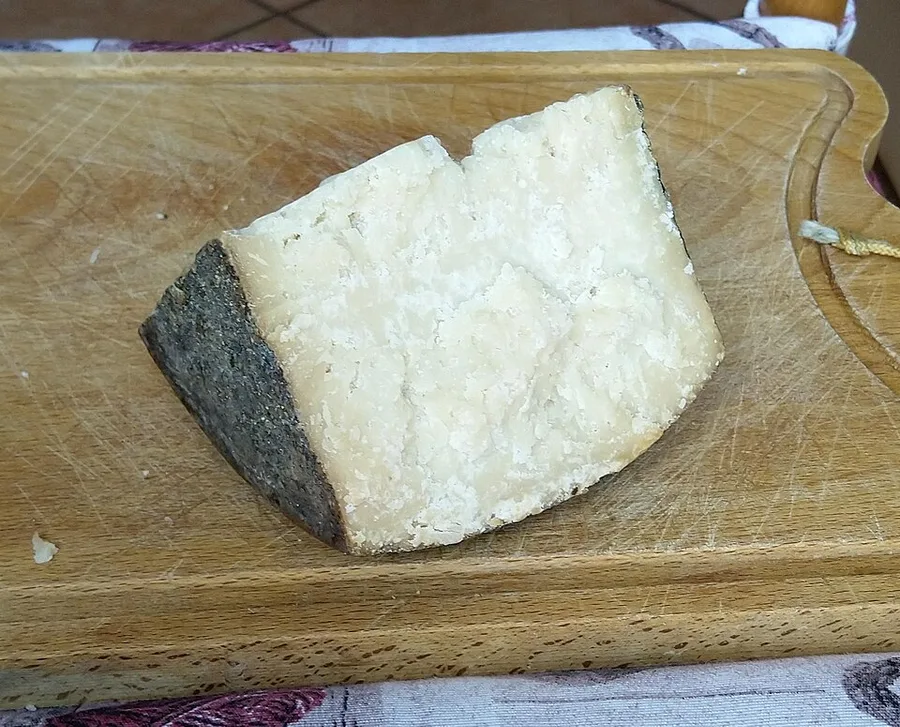
Fiore Sardo is a hard, uncooked-curd cheese made throughout Sardinia from raw whole milk of Sarda ewes, coagulated with lamb rennet paste. Its shape gives it away instantly: two truncated cones joined at the base, with a bulging side, weighing 1.5 to 4 kilos.
Three things set it apart from every other Italian pecorino. The milk is always raw, never pasteurised or thermised, so the pasture's own microflora goes into the ageing room. The rennet is lamb paste, made from the dried abomasum of milk-fed lambs, which carries lipase enzymes that break down milk fat and generate a long, building piquancy. And the first weeks of ripening happen on a cane rack above a hearth, where the wheels dry in the smoke of Mediterranean woods: mastic, strawberry tree, wild olive.
The smoke is not a flavouring. It is the by-product of how shepherds dried cheese inside the pinnetta, the conical branch-and-stone hut of the Sardinian highlands. In a well-made wheel it sits behind the milk, not over it.
Minimum ageing is a little over three months. Wheels intended for grating go past six, and the best shepherd-made ones reach a year or more. Italy recognised it as a traditional cheese in 1955; the EU granted DOP status in 1996.
What does it taste like?
Sheep first, then embers. The attack is savoury and slightly gamey (lanolin, wool, dry grass) followed by a warm smokiness that reads more like a wood fire in a stone room than like smoked bacon. Underneath there is real sweetness from the raw milk, and a nutty, almost roasted-hazelnut mid-palate.
The piquancy from the lamb rennet arrives late and stays. At six months it is a warmth; at twelve it is a genuine peppery bite that hangs on for a minute after you swallow.
Salt is present but restrained, nothing like Pecorino Romano's blunt saline hit. The texture is hard, dry and flaking, breaking into irregular shards rather than slices, with occasional crunchy crystals in older wheels. It is a cheese that tastes of a place and a fire, and it does not taste like anything made in a stainless-steel vat.
How to use it
Young wheels, six to eight months, belong on a board: break them into irregular shards with a knife point rather than slicing, and serve with carasau flatbread, olive oil and bitter corbezzolo honey.
Older wheels grate beautifully. Use them on malloreddus with sausage ragù, on fregola, inside culurgiones filling, over bean and chickpea soups. Because the salt is far lower than Pecorino Romano's, you can be generous, and you will need to season the dish separately.
For pesto genovese, the traditional formula is two parts Parmigiano Reggiano to one part Fiore Sardo, both grated into the mortar with the basil, garlic, pine nuts and coarse salt. That combination is what gives real Ligurian pesto its savoury base without turning it salty.
Like every raw-milk pecorino, it hates direct heat: added to a hot pan it strings and then seizes. Take the pan off the flame first, always. And bring it to room temperature before serving: half an hour on the counter doubles the aroma.
How long it keeps
This is a low moisture cheese that has already spent months drying, and it goes on doing so. A whole wheel keeps for months in a cool humid cellar at 8 to 14°C, turned now and then. A cut wedge goes in the fridge at 4 to 8°C, wrapped in waxed cheese paper or baking paper with a loose outer layer of foil; cling film pressed onto the rind seals it and makes the surface sweat. Wrapped that way a wedge holds three or four weeks, and the direction of travel is always drier: the cut face sets into a firm skin, the paste hardens inward from the edge and grates more finely as the weeks pass.
With age the white crunchy specks of tyrosine appear through the paste, and in a warm kitchen fat beads out onto the cut surface, both of them ordinary consequences of long maturing. Freezing leaves it crumbly on thawing, so it only really suits cheese destined for the grater. Grated and jarred it dries and cakes within days. The wheel brand and the producer date are the reference.
Spot the real thing
The shape is unusual enough to identify it across a counter: a squat drum with strongly bulging sides and flat ends, from the wooden moulds it is pressed in, weighing between one and a half and four kilos. The rind is hard and dark, ochre through to near black, the colour coming from weeks of hearth smoke and from rubbing with oil or sheep fat, and DOP wheels carry the consortium brand on the side. The paste is white to pale straw, dense and close, with few holes, and it fractures rather than slices once mature. Raw sheep milk and lamb rennet paste give it the sharp back note.
Abroad it is routinely shelved beside Pecorino Romano, which is also made in Sardinia but comes in a far bigger cylinder with a pale rind, is much saltier and is never smoked. Pecorino Sardo DOP, dolce or maturo, is a separate designation and unsmoked. Spanish Idiazábal is the closest foreign relative, also smoked sheep milk. Reckon on 18 to 28 euro a kilo in Sardinia, £6 to £9 for 200g, $22 to $32 a pound.
How to pronounce Fiore Sardo
fee-OH-reh SAR-doh
Four syllables plus two. 'Fiore' is fee-OH-reh, three sounds with the stress in the middle and a clearly pronounced final 'e', not 'fee-or'. 'Sardo' takes the stress on the first syllable. The name means 'Sardinian flower', probably after the flower motifs carved into the old wooden moulds.
Fiore Sardo compared
vsPecorino Sardo
Two Sardinian sheep's milk DOPs that share an island and almost nothing else. Fiore Sardo is raw milk, lamb rennet paste, uncooked curd and hearth smoke: a shepherd's cheese built to survive a year. Pecorino Sardo is calf rennet, semi-cooked curd, often pasteurised milk, no smoke: a dairy's table cheese built to be sliced. If a recipe calls for 'Sardinian pecorino' and means depth and smoke, it means this one.
| This | Pecorino Sardo | |
|---|---|---|
| Milk | Raw only | Raw, thermised or pasteurised |
| Rennet | Lamb or kid rennet paste, lipase-rich | Calf rennet, liquid |
| Curd | Uncooked | Semi-cooked to 43-45C (Maturo) |
| Smoke | Yes, 2-3 weeks over a hearth | None |
| Shape | Two truncated cones joined at the base | Straight cylinder |
| Minimum ageing | Just over 3 months, often 6-12 | 20 days (Dolce) or 2 months (Maturo) |
| Flavour | Gamey, smoky, building piquancy | Milky and sweet, or nutty and mild |
| Price | $22-34 per lb | $14-24 per lb |
vsPecorino Romano
Both use lamb rennet paste, so both have a piquant edge, and there the resemblance ends. Pecorino Romano is a semi-cooked, dry-salted industrial-scale cheese in 20-35 kilo wheels at about 5% salt, designed as seasoning. Fiore Sardo is an uncooked, smoked, shepherd-scale cheese at a fraction of the salt, designed to be eaten. The most common error abroad is swapping one for the other in pesto.
| This | Pecorino Romano | |
|---|---|---|
| Curd | Uncooked | Cooked to 45-48C |
| Salting | Dry or brine, days to two weeks | Coarse dry salt by hand, 80-100 days |
| Salt content | Roughly 2-3% | Roughly 5% |
| Smoke | Yes, from hearth ripening | None |
| Wheel | 1.5-4 kg, double cone | 20-35 kg, cylinder |
| Milk | Raw, always | Raw or thermised |
| Role | Table cheese that also grates | Grating cheese that can be eaten |
vsPecorino Romano in pesto genovese
The classic Genoese pesto is made with two cheeses: Parmigiano Reggiano and Sardinian pecorino, and the Sardinian pecorino Genoa historically bought through its port was Fiore Sardo. Substituting Pecorino Romano is the shortcut behind most harsh, over-salted home pesto. The proportions matter as much as the choice: roughly two parts Parmigiano to one part Fiore Sardo.
| This | Pecorino Romano in pesto genovese | |
|---|---|---|
| Salt contributed | Moderate, lets basil lead | High, dominates the sauce |
| Flavour added | Smoke, depth, gentle piquancy | Sharp saline bite |
| Texture in the mortar | Crumbles into the paste | Grates fine, can go pasty |
| Typical ratio with Parmigiano | 2 parts Parmigiano to 1 part Fiore Sardo | Needs 3:1 or more to stay balanced |
| Extra salt needed | A pinch | None, reduce salt elsewhere |
Fiore Sardo substitutes
- Pecorino Sardo Maturo
The nearest relative geographically and the easiest to find. It lacks the smoke and the lipase bite, so the result is gentler and rounder. Excellent in pesto if Fiore Sardo is unavailable.
1:1 - Idiazabal
The best substitute nobody suggests. This Basque raw sheep's milk cheese is traditionally lightly smoked, aged hard and made with lamb rennet, structurally the closest thing to Fiore Sardo outside Sardinia, and easier to buy in the US and UK.
1:1 - Pecorino Romano, only with adjustment
It shares the lamb rennet piquancy but carries roughly double the salt and none of the smoke. If you use it in pesto or on pasta, cut the quantity and remove salt everywhere else.
0.6:1, and cut the salt in the recipe - Aged Manchego plus a touch of smoked salt
A workaround rather than a match: curado or viejo Manchego gives the sheep's milk base, and a few grains of smoked salt approximate the hearth note. Do not use liquid smoke, which reads as barbecue rather than woodfire.
1:1, plus a pinch of smoked salt - Vegetarian: Berkswell or Spenwood
Fiore Sardo can never be vegetarian: the DOP requires lamb or kid rennet paste, and that enzyme is the source of its character. These two Berkshire sheep's milk cheeses use microbial rennet, age hard and grate well. Berkswell is nuttier and the better stand-in.
1:1 - Vegan, for pesto only: toasted pine nuts and white miso
Nothing reproduces raw-milk sheep cheese, but for a vegan pesto an extra 20 g of toasted pine nuts plus half a teaspoon of white miso restores the savoury weight the cheese was providing.
Where to buy it
In the US, Fiore Sardo is a specialist item rather than a supermarket one. Murray's Cheese, Formaggio Kitchen, Eataly, iGourmet and well-stocked Italian delis carry it, typically at $22 to $34 per pound. Several importers bring in Presidio-level shepherd-made wheels in autumn.
In the UK expect £28 to £45 per kilo from Italian delicatessens, La Fromagerie and online importers; it appears in cheese shops more often than in supermarkets. Genoese pesto enthusiasts are the main reason UK demand exists at all.
Check the shape before anything else: two truncated cones joined at the base. A cylinder is not Fiore Sardo. Look for the DOP wording, the Consorzio mark and, on whole wheels, the numbered casein plate. Where the counter can tell you the production date, take it: the difference between a six-month and a twelve-month wheel is enormous, and neither is wrong.
Where to eat it in Italy
Gavoi, in the Barbagia highlands below the Gennargentu, is the acknowledged capital: dairies and shepherds there still work raw milk and ripen wheels over the fire. Ovodda, Fonni, Lodine and Ollolai complete the circle.
From September to December, the Autunno in Barbagia circuit opens the courtyards of these villages in rotation. You walk into private houses, see wheels on their racks and taste them beside the fire that smoked them, the single most efficient way to understand what age does to this cheese.
In Nuoro and the surrounding province, restaurants often list Fiore Sardo at several ages on one board. In Ogliastra, around Seulo, Villagrande and Escalaplano, small shepherd production survives and is sold directly at the farm, usually in whole wheels.
Further reading
 InvestigationItalian raw milk cheeses: the full listWe counted: 19 of 43 declare raw milk, and 16 of those 19 carry a protected designation.
 InvestigationWhich Italian cheeses are vegetarianWe counted what rennet the 43 cheeses in our atlas declare: 35 out of 43 say animal, none say otherwise.
 GuideHow long food keeps once openedThe date on the label describes the sealed package. After that, four things govern everything: water, salt…
Frequently asked questions
What is the difference between Fiore Sardo and Pecorino Sardo?
They are two separate DOPs. Fiore Sardo uses raw milk, lamb rennet paste and an uncooked curd, ripens over a hearth and comes in a double-cone shape. Pecorino Sardo uses calf rennet and a semi-cooked curd, allows pasteurised milk, is never smoked and is much milder.
Which pecorino goes in pesto genovese?
The classic recipe uses two cheeses: Parmigiano Reggiano and Sardinian pecorino, and historically that meant Fiore Sardo, which reached Genoa through the port. Use roughly two parts Parmigiano to one part Fiore Sardo. Pecorino Romano is the common substitution and the reason many home pestos taste harsh and over-salted.
Is Fiore Sardo smoked?
Naturally, yes. Wheels spend two to three weeks on a cane rack above an open hearth, drying in the smoke of mastic, strawberry tree and wild olive wood. No smoke flavouring is added, and in a good wheel the smoke stays behind the milk rather than covering it.
Is it vegetarian?
No. The DOP requires lamb or kid rennet paste, an animal product, and its lipase enzymes are exactly what create the cheese's piquancy. English Berkswell and Spenwood, both microbial-rennet sheep's milk cheeses, are the practical vegetarian alternatives.
How do you pronounce Fiore Sardo?
fee-OH-reh SAR-doh. Three syllables in the first word with the final 'e' clearly sounded, stress on the first syllable of Sardo.
Sources
Where to check what you just read.
- 1
Il regolamento del 1º luglio 1996 che iscrive «Fiore Sardo» fra le DOP dei formaggi, nello stesso atto di Pecorino Sardo e Pecorino Toscano.
- 2
Il disciplinare in PDF: obbligo di latte crudo di pecora sarda, caglio in pasta di agnello o capretto, forma a schiena di mulo e stagionatura minima.
- 3
La scheda della Regione Sardegna: latte crudo, caglio in pasta, leggera affumicatura e stagionatura in cantina, con i riferimenti all'organismo di controllo.
Related foods
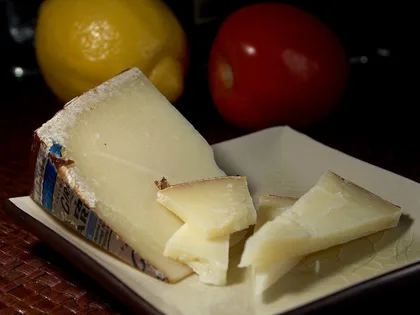 CheesePecorino SardoPecorino Sardo DOP is Sardinia's table cheese: whole sheep's milk, calf rennet, two official types.
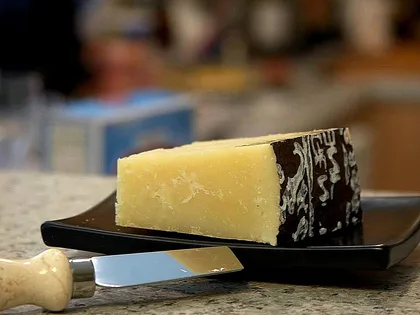 CheesePecorino RomanoPecorino Romano DOP is a hard, dry-salted sheep's milk cheese aged at least five months, made in Sardinia…
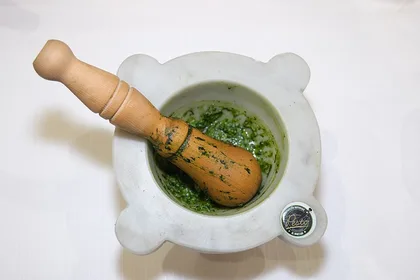 Oil and preservesPesto GenoveseHeat never touches this sauce, and by the rule neither does a blender: basil pounded in a marble mortar with…
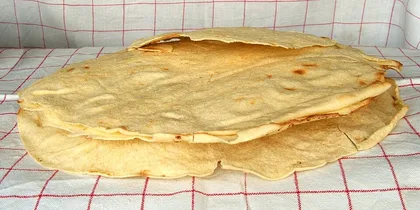 Pasta and breadPane carasauBaked twice because it had to survive months in a shepherd's saddlebag: a paper-thin disc of durum semolina…
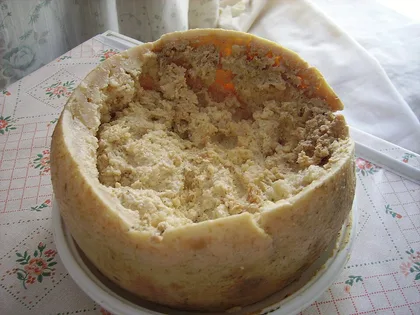 CheeseCasu MarzuCasu marzu is a Sardinian sheep's cheese whose ripening is carried on by the larvae of the cheese fly.
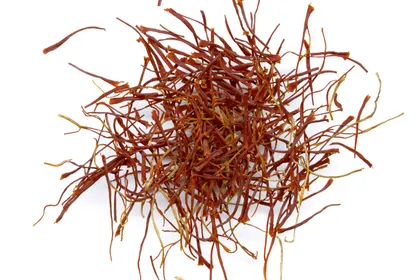 Oil and preservesSaffronOne kilo takes between 150,000 and 200,000 flowers, and every flower gives up three stigmas that have to be…
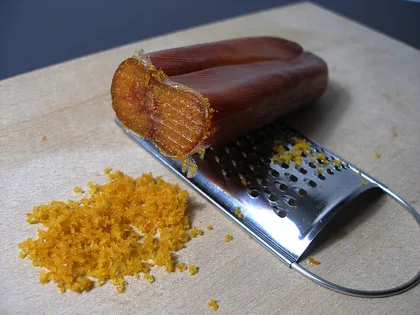 Fish and seafoodBottargaFifteen grams a head is enough, and that is not meanness: bottarga is the salted, pressed, air-dried roe sac…
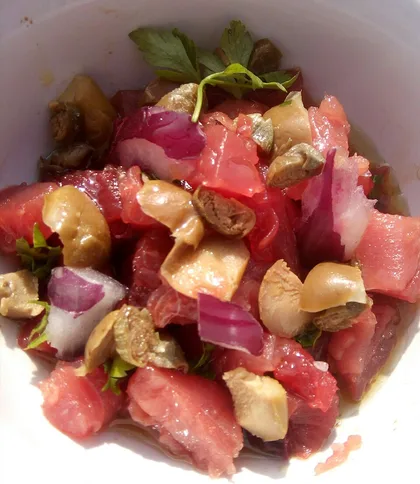 Fish and seafoodBluefin TunaAtlantic bluefin, Thunnus thynnus, is the fish Sicily and Sardinia built their tonnare around, with a…