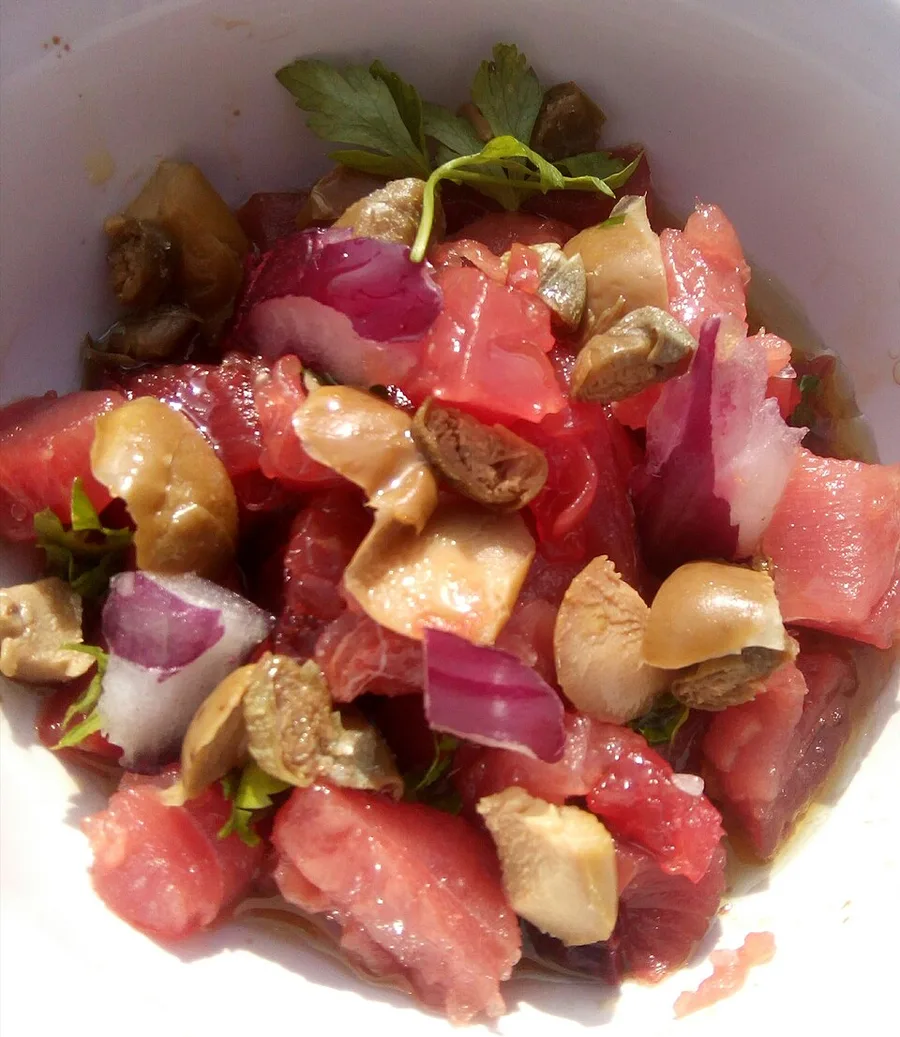
What is Bluefin Tuna?
Bluefin tuna is the largest of the tunas: over three metres and four hundred kilos, capable of seventy kilometres an hour, and warm-blooded in a way almost no other fish is. That physiology is why the flesh is dark red and dense with myoglobin rather than pale like other tuna.
Every spring the adults enter the Mediterranean from the Atlantic to spawn, passing Sicily, Sardinia and Calabria in May and June. Every trap fishery in southern Italy was built on that migration, some of them documented since the thirteenth century.
The flesh changes so completely from one part of the fish to another that each has its own name, price and cooking. Ventresca is the fatty belly, tarantello the flank, buzzonaglia the dark meat near the bone, filetto the lean loin. Then there are the cured parts: bottarga from the roe, lattume from the milt, mosciame from the air-dried loin.
One thing that matters at the supermarket: canned tuna is almost never bluefin. It is skipjack or yellowfin, different species, far more abundant and far cheaper.
What does it taste like?
Closer to beef than to any other fish. The lean loin is clean, faintly metallic in the way rare steak is, firm enough to hold its shape under a knife and with none of the oily aftertaste of mackerel or the blandness of canned tuna.
Ventresca is a different food entirely: heavily marbled with white fat that melts at body temperature, buttery, with a sweetness that lingers. This is the cut sold in Japan as otoro, and the reason a single fish can be worth thousands.
Buzzonaglia, the dark meat along the backbone, tastes strongly of iron and sea and is the part most people would call fishy. Sicilians turn it into meatballs and ragu.
Overcooked, all of it turns dry and chalky within seconds: the failure mode is exactly that of a well-done steak, and just as irreversible.
How to use it
Short cooking or none. A loin steak wants thirty seconds a side in a very hot dry pan, leaving the centre raw. Anything beyond that and it goes dry and chalky, exactly like an overcooked steak.
For raw dishes, slice against the grain with a long knife in one clean pull, about half a centimetre thick. Tartare needs only olive oil, salt, lemon and perhaps a little shallot. In Sicily it is also served marinated in oil and oregano, or as carpaccio with citrus.
Traditional Sicilian cooking, though, cooks tuna hard and long: alla stemperata with celery, olives, capers, vinegar and sugar; alla marinara with tomato and onion; as meatballs from the dark buzzonaglia. Ventresca handles slow braising because the fat protects it.
Grate bottarga di tonno over spaghetti dressed only with oil and garlic, or slice it thin onto buttered bread.
Safety note for raw tuna at home: EU rules require freezing at -20C for at least 24 hours before raw consumption. A domestic freezer needs about 96 hours to achieve the same result.
How long it keeps
Fresh tuna changes faster than almost any other fish. Wrapped in paper, covered, on the coldest shelf at 0 to 2 C, the working window is twenty-four hours and at the outside forty-eight. What happens across it is visible: the myoglobin at the surface oxidises and the cherry red walks inward to brown, the flesh slackens and loses its shine, and a cloudy liquid gathers in the dish. Beyond that, the date on the label and the fishmonger are the people to ask.
For anything served raw, EU rules put the freezing step on the seller, at minus 20 C for at least twenty-four hours right through the piece, so ask the counter whether it has been frozen; at home a three-star freezer at minus 18 C is usually given ninety-six hours instead. Thawed slowly in the fridge, a properly frozen piece loses very little liquid. A sealed jar of tuna in oil runs to its date, two or three years out; once open it goes in the fridge with the fish kept under the oil, and any piece standing above the oil line dries and darkens within a day.
Spot the real thing
At the counter the colour is dark cherry red, not pink and not fuchsia. A very bright, perfectly even red is often the mark of carbon monoxide treatment, permitted in some countries and banned in the European Union, which locks the colour in place for days regardless of what the fish is doing underneath. The steak should look glossy and firm with no reddish liquid pooling in the tray, and the grain should be visible: muscle bundles separated by thin white lines of fat, at their most dramatic in the belly cut, the ventresca.
Every legally caught bluefin travels with a Bluefin Catch Document, the BCD, which follows the fish from the boat to the counter; a serious fishmonger knows what that is and can tell you where the fish came from. The usual substitution is yellowfin sold under the bluefin name: paler, far less marbled and roughly a third cheaper, and in American shops both it and bigeye go by ahi. On tins and jars, read the species: Thunnus thynnus is bluefin, Thunnus albacares yellowfin, Katsuwonus pelamis skipjack.
How to pronounce Bluefin Tuna
TOHN-noh ROH-soh
Both double consonants are held slightly longer than in English: TOHN-noh, not 'toh-no'. The 'r' is tapped, and rosso ends with a clear 'oh'. In Sicily you will also hear tunnu. If you order 'tonno' alone you will usually be brought whatever tuna the kitchen has; say tonno rosso if you specifically want bluefin.
Bluefin Tuna compared
vsYellowfin and skipjack tuna
Three different species sold under one English word. Bluefin is the large, cold-water, high-fat fish that commands the price; yellowfin (ahi, Thunnus albacares) is leaner, paler and abundant; skipjack (Katsuwonus pelamis) is small, strong-flavoured and the backbone of the canning industry. Almost every tin on a supermarket shelf is one of the last two.
| This | Yellowfin and skipjack tuna | |
|---|---|---|
| Species | Thunnus thynnus | T. albacares / Katsuwonus pelamis |
| Size | Up to 3 m, 400+ kg | Up to 2 m / under 1 m |
| Colour raw | Deep cherry red | Pink to pale red / dark brown |
| Fat | High, visibly marbled | Low / very low |
| Price | 35-80 EUR per kg by cut | 18-28 EUR / under 15 EUR canned |
| Best use | Raw, seared, ventresca | Seared, grilled / canning |
| Stock status | Recovered under ICCAT quota | Mostly healthy, some stocks pressured |
vsTrap fishing (tonnara) and the mattanza vs industrial purse seining
The tonnara was a fixed maze of anchored nets set across the migration route, ending in the camera della morte, where the mattanza, the final hauling of the nets directed by the rais, took place. It caught only fish that swam in, in a fixed season, in known numbers. Industrial purse seining catches whole schools at sea and tows them alive to fattening cages off Malta, Spain and Croatia, where they are fed for months before being killed and flown mostly to Japan. Favignana held its last commercial mattanza in 2007; Carloforte in Sardinia runs the only Italian trap still working.
| This | Trap fishing (tonnara) and the mattanza vs industrial purse seining | |
|---|---|---|
| Method | Fixed nets on the migration route | Encircling nets at sea |
| Season | May-June only | Set by quota calendar |
| Selectivity | Adults that enter the trap | Whole schools, including young fish |
| After capture | Killed and processed the same day | Towed alive to fattening cages |
| Scale | Tens to hundreds of fish | Thousands of tonnes |
| Status in Italy | One trap left, at Carloforte | The dominant commercial method |
vsVentresca, tarantello and bottarga di tonno
The cuts are not interchangeable and neither are their prices. Ventresca is the belly, the fattiest and most expensive part, sold fresh for raw preparations or preserved in oil. Tarantello is the flank between belly and loin, the sensible everyday choice, fat enough to sear without drying. Bottarga di tonno is the pressed, salted, air-dried ovary sac: darker, firmer and more bitter than the more common grey mullet version.
| This | Ventresca, tarantello and bottarga di tonno | |
|---|---|---|
| Part of fish | Belly (ventresca) / flank (tarantello) | Ovary sac, salted and dried |
| Fat | Very high / medium-high | Concentrated, dense |
| Sold as | Fresh cut or preserved in oil | Whole waxed lobe or grated |
| Flavour | Buttery, sweet / clean and rich | Salty, iodine, faintly bitter |
| Typical use | Raw, seared, slow-braised | Grated over pasta, sliced on bread |
| Price | 45-80 / 30-50 EUR per kg | 120-200 EUR per kg |
Bluefin Tuna substitutes
- Yellowfin tuna (ahi)
The obvious swap for seared or raw dishes and widely available at sashimi grade. Leaner, so it dries out faster: cut thicker, sear harder and shorter, and add a little olive oil to a tartare.
1:1 by weight - Albacore (tonno bianco, alalunga)
Pale, mild and the traditional fish for the best Italian and Spanish oil-packed tuna. Not a raw fish, but excellent seared or in vitello tonnato. Very different colour on the plate.
1:1 - Swordfish (pesce spada)
The Sicilian alternative in every cooked bluefin recipe: alla stemperata, alla ghiotta, in involtini. Firmer and drier, so cook it a shade less and be generous with oil.
1:1 in cooked dishes only - Amberjack (ricciola) or kingfish
For raw preparations, this is the closest texture available in Mediterranean waters and a far more sustainable choice. Cleaner and sweeter, without the iron note.
1:1 raw - Bottarga di muggine for bottarga di tonno
Grey mullet bottarga is easier to find, paler, softer and less bitter. Use slightly more of it to reach the same intensity, and grate rather than slice.
1.3:1 by weight - Vegetarian: watermelon or beetroot 'tuna'
Compressed watermelon or roasted beetroot marinated in soy, sesame oil and rice vinegar reproduces the colour and the yielding bite of raw tuna, not the flavour. It works in poke-style bowls; it does not work seared.
Where to buy it
In the US, sashimi-grade bluefin is a special-order item from fishmongers and online suppliers such as Catalina Offshore Products and Browne Trading; much of it is Pacific bluefin or ranched Atlantic. Expect roughly 25 to 60 dollars per pound for loin and 40 to 90 for belly. Italian preserved tuna, bottarga di tonno and mosciame come through Gustiamo, Eataly and Sardinian importers.
In the UK, specialist fishmongers and The Fish Society list bluefin loin at roughly 60 to 120 pounds per kilo when available; jarred Sicilian and Sardinian tuna in olive oil is far easier to find, at 60 to 110 pounds per kilo drained.
Ask two questions. First, the species: "tuna" on a label covers three or four completely different fish, and yellowfin is routinely sold as the real thing. Second, the catch documentation: every legal bluefin carries a Bluefin Catch Document that follows it from vessel to counter, and a serious supplier knows exactly what you are asking about.
On colour: an unnaturally bright, even red often means carbon monoxide treatment, legal in some countries and banned in the EU, which fixes the colour of fish that is no longer fresh. Real bluefin is dark cherry red and dulls with age.
Where to eat it in Italy
Favignana, in the Egadi islands off Trapani, is where the industry lived. The former Florio plant is now a museum with the original equipment, and although the trap no longer operates, the island's restaurants and conserve makers work good fish.
Carloforte, on the Sardinian island of San Pietro, has the only working Italian trap and a cuisine of its own, since the Tabarkino community came from Liguria via Tabarka in Tunisia and still speaks a Genoese dialect. The Girotonno festival at the end of May is four days built entirely around the fish.
The Trapani coast (San Vito Lo Capo, Bonagia, Scopello) keeps the buildings of the disused tonnare and a living tradition of tuna cooking, and Marzamemi in south-east Sicily has turned its old tonnara into a small square of seafront restaurants.
Go between May and July, when the fish passes and the quota is landed. Outside that window you are eating frozen or ranched tuna: fine, but worth knowing.
Recipes with it
Frequently asked questions
Does the mattanza still happen at Favignana?
No. The last commercial mattanza at Favignana was held in 2007 and the trap has not reopened; the Florio plant is a museum. The only Italian tonnara still operating is at Carloforte in Sardinia, under assigned quota and with a limited number of fish taken each season.
Is bluefin tuna endangered?
It was, seriously. Eastern Atlantic and Mediterranean stocks collapsed through the 1990s and 2000s under overfishing and illegal catch. The ICCAT recovery plan from 2007, with sharply cut quotas, minimum sizes, individual catch documents and closed seasons, worked, and in 2021 the IUCN moved the species globally from Endangered to Least Concern. Illegal fishing and the fattening-cage trade remain real problems, but quota-caught Atlantic bluefin is no longer an irresponsible purchase.
What is the difference between bluefin and yellowfin tuna?
Different species. Bluefin (Thunnus thynnus) is much larger, far fattier, deep cherry red with visible marbling, and costs two to three times more. Yellowfin (Thunnus albacares) is paler, leaner and drier, and it is what most fish counters and most sushi restaurants actually serve.
Which cut of bluefin should I buy?
Ventresca, the belly, for raw or briefly seared dishes: it is the fattiest and the most expensive. Tarantello, the flank, is the best value and the most forgiving. The lean loin suits slicing and carpaccio. Buzzonaglia, the dark meat near the bone, is strong and cheap and belongs in ragu or meatballs.
Can I eat bluefin tuna raw at home?
Yes, if it has been frozen properly. EU rules require -20C for at least 24 hours before raw consumption, which a domestic freezer takes about 96 hours to achieve. Buy from a fishmonger who will tell you whether the fish has already been treated, and never refreeze.
Related foods
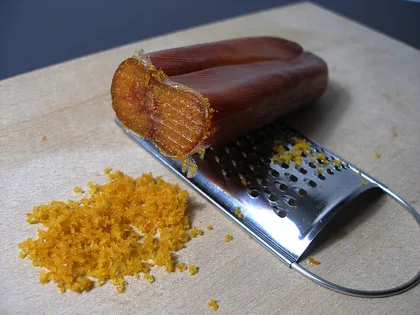 Fish and seafoodBottargaFifteen grams a head is enough, and that is not meanness: bottarga is the salted, pressed, air-dried roe sac…
 Fish and seafoodColatura di Alici (Italian Anchovy Sauce)Colatura di alici is the amber liquid that drains from anchovies packed in salt in chestnut barrels at…
 Fish and seafoodBaccalàBaccalà is North Atlantic cod preserved in salt. It is not the same thing as stoccafisso, which is the…Fish and seafoodSardinesSardines are not small anchovies. They are a different species with a different snout, a different mouth and…
 Fish and seafoodMazara Red PrawnsMazara red prawns are trawled between 400 and 700 metres down in the Strait of Sicily, where the water stays…
 SweetsCannoliIt has to be filled when you order it, and anywhere that fills them in advance has already lost: the fried…
 Pasta and breadAranciniArancini are deep-fried Sicilian rice balls: saffron rice moulded around a filling of meat ragù and peas, or…
 SweetsGelatoGelato is not ice cream translated. It carries less fat (4-8% against 10-18%), holds far less air (20-35%…