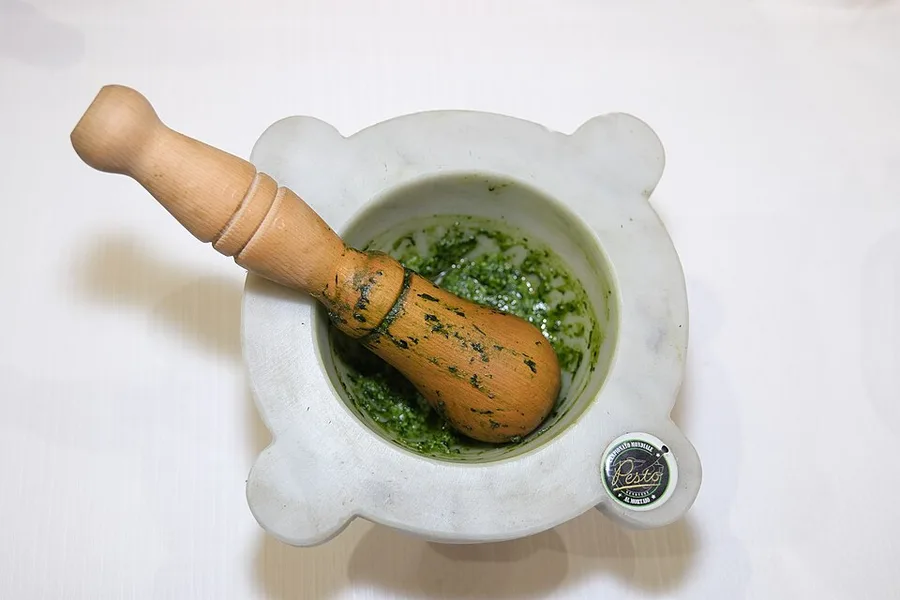
What is Pesto Genovese?
Pesto is not a recipe, it is a technique. The word comes from pestare, to pound, and shares a Latin root with the English word pestle: what the name describes is a sauce made by crushing ingredients in a mortar, which is why Italy has a dozen legitimate pestos. Pesto Genovese is the one from Genoa, and it is built from seven things: Genoese basil, Ligurian extra virgin olive oil, pine nuts, garlic, aged Parmigiano Reggiano, Pecorino Sardo and coarse sea salt.
The protected-designation question is worth getting right, because almost every English-language source gets it wrong. Pesto Genovese itself carries no DOP and no IGP. What the European Union protects, since 2005, is Basilico Genovese DOP, the basil itself. The rules cover where it can be grown (Liguria, below 800 m) and what the leaf must be like, including a clause banning any hint of mint in the aroma.
Sitting on top of that is the Consorzio del Pesto Genovese, a producers' body that owns and polices the phrase Pesto Genovese al Basilico Genovese DOP. That is a collective trademark with its own standard, not a public designation. The practical consequence for a shopper: any jar can legally call itself pesto genovese, and only the Consorzio wording tells you the basil was certified.
What does it taste like?
Green in the most literal sense: grassy, peppery, with the faint aniseed lift that fresh basil has and none of the dried-herb flavour of jarred sauce. Under it there is garlic warmth, the resinous sweetness of pine nuts, a salty edge from two cheeses pulling in different directions, and the slightly bitter, almost artichoke note of a good Ligurian olive oil.
The texture matters as much as the flavour. Mortar-made pesto is a loose, slightly rough cream, not a purée: you can see leaf fibre and flecks of pine nut, and it coats pasta rather than sitting on it. Blade-made pesto is smoother and duller, because the leaves have been torn and warmed rather than crushed.
The defect to know is mint. Basil that has grown too large or too close to flowering develops a menthol note that the DOP rules explicitly exclude, and once you have tasted it in a bad pesto you cannot unnotice it. If a supermarket jar tastes vaguely of toothpaste, that is why.
How to use it
The rule that governs everything: pesto is never heated. Not in a pan, not in the oven, not stirred into a simmering sauce. It goes raw into a warm serving bowl, gets loosened with a ladle of the pasta cooking water until it turns into a cream, and only then meets the pasta, off the heat and tossed at the table.
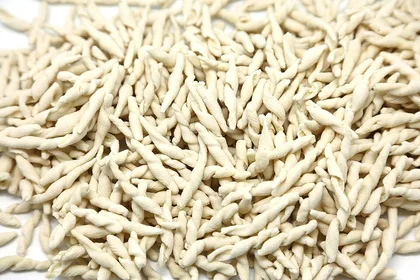
The canonical dish is trofie or trenette with potato and green beans, all cooked in the same pot: diced potato first, beans a few minutes later, pasta last, so everything finishes together. That starchy water is the best thing to loosen the pesto with. Beyond that: mandilli de sæa, the paper-thin pasta squares whose Genoese name means silk handkerchiefs; gnocchi; and lasagne al pesto, layered raw with thin fresh sheets.
The other classic use is minestrone alla genovese, a spoonful stirred in at the end with the heat already off, which turns a vegetable soup into something else entirely.
Quantities run to about 30 g per person, a heaped tablespoon. Some Genoese households soften the sauce for lasagne with a knob of butter or a spoon of prescinseua, the local sour curd. What to avoid: heating it, adding cream, draining the pasta too thoroughly, and buying a food processor's worth at once. Pesto is at its best within minutes of being made.
How long it keeps
An unopened shelf stable jar keeps to the date printed on it, a year, in a dark cupboard; a chilled tub carries a much shorter one, two to three weeks. Once any jar is open it goes in the fridge and the working window is short, roughly five to seven days. Level the surface with the back of a spoon and pour a thin film of olive oil over it before closing: the oil seals the basil off from air, and every spoonful needs a fresh film after it.
What air does to basil is visible within hours: the surface oxidises and darkens to brown, and the darkening works downward over days. Chilled olive oil also clouds and solidifies, which is temperature, not the sauce, and it clears at room temperature. Pesto freezes well and this is the standard Genoese solution: freeze it in ice cube trays without the cheese, bag the cubes, and stir the grated cheese in after thawing, since cheese is what suffers most from freezing. Six months in the freezer. Beyond any of this, the date on the pack and the maker are the reference.
Spot the real thing
Colour is the first read, and it separates two production routes rather than good from bad. Fresh, unpasteurised pesto sold from a chilled cabinet is a bright, slightly greyed grass green and smells of raw basil. Shelf stable jars have been heat treated to survive the shelf, which drives the colour towards khaki or olive and the aroma towards cooked basil. Texture matters too: hand or stone worked pesto stays coarse and slightly grainy, with visible flecks of cheese and nut, while an industrial one is a smooth homogeneous paste.
The label is where most jars abroad give themselves away. The Genoese formula is basil, extra virgin olive oil, Parmigiano Reggiano, pecorino, pine nuts, garlic and salt, and nothing after that. Sunflower or rapeseed oil in place of olive, cashews or sunflower seeds in place of pine nuts, generic hard cheese, potato flakes, added water and preservatives are all common substitutions and all change the sauce. Look for Basilico Genovese DOP named on the front. Price follows honestly: pine nuts are expensive, so a 180 gram jar at $4 has bought something else.
How to pronounce Pesto Genovese
PEH-stoh jeh-noh-VEH-zeh
Five syllables in total. PEH-stoh takes the stress on the first syllable, with a short open 'e', not 'PAY-stoh'. Genovese is jeh-noh-VEH-zeh, stressed on the third syllable: the initial 'g' is soft, like the 'j' in 'jet', and the middle 's' is voiced like a 'z', so it is VEH-zeh and never VEH-seh. The final 'e' is always pronounced. The two common English mistakes are 'jen-oh-VEEZ', which reads it as if it were French, and 'jen-oh-VAY-see'. Worth knowing: pesto comes from pestare, to pound in a mortar, from the same Latin root that gave English 'pestle'. The name describes a method, not an ingredient, which is why pesto alla trapanese, made with almonds and tomato, is also correctly called pesto.
Pesto Genovese compared
vsJarred supermarket pesto
Not a lesser version of the same thing but a different product built to survive a supply chain. The gap is in every line of the label: the basil, the fat, the nuts, the thickeners, and the heat treatment that makes an 18-month shelf life possible. Mortar pesto is a fresh sauce with a few days of life; the jar is a preserve.
| This | Jarred supermarket pesto | |
|---|---|---|
| Basil | Basilico Genovese DOP, small leaves picked before flowering | Generic basil, often large-leaved and minty |
| Method | Marble mortar, wooden pestle, rotary crushing, no heat | Steel blades that tear, warm and oxidise the leaves |
| Fat | Riviera Ligure extra virgin olive oil | Mostly sunflower oil, with a little olive oil |
| Nuts | Mediterranean pine nuts | Cashews, or cashews blended with pine nuts |
| Thickeners | None: the pine nuts and cheese bind it | Potato flakes, starch or fibre |
| Additives | None | Lactic acid as acidity corrector, sometimes added aroma |
| Heat | Never cooked, at any stage | Pasteurised in the jar before it reaches you |
| Shelf life | Three to four days, refrigerated | Twelve to eighteen months, ambient |
vsPesto alla trapanese (Sicilian pesto)
Genoa's sauce reinterpreted in western Sicily, reportedly by Ligurian ships putting in at Trapani. The method is identical (mortar, garlic, salt, raw) but almost every ingredient changed to what Sicily actually grows: almonds instead of pine nuts, ripe tomato instead of nothing, and a great deal more garlic.
| This | Pesto alla trapanese (Sicilian pesto) | |
|---|---|---|
| Nuts | Pine nuts | Blanched almonds |
| Tomato | None | Fresh peeled tomato, a structural ingredient |
| Garlic | One or two cloves, ideally Vessalico | Red garlic of Nubia, and noticeably more of it |
| Cheese | Parmigiano Reggiano and Pecorino Sardo | Pecorino Siciliano, or none at all |
| Colour | Bright herbaceous green | Pink-orange |
| Pasta | Trofie, trenette, mandilli | Busiate |
vsRed pesto (pesto rosso)
A category invented by northern European supermarkets rather than an Italian regional recipe, loosely inspired by southern tomato-and-almond sauces. Useful, cheap and perfectly good on its own terms, but it behaves like a concentrate, not like pesto genovese, and it is the reason many British and American cooks think pesto is something you stir into a hot pan.
| This | Red pesto (pesto rosso) | |
|---|---|---|
| Base | Fresh basil leaves, 30–40% of the jar | Sun-dried tomato, sometimes roasted pepper |
| Basil | The whole point | A minor ingredient, occasionally absent |
| Origin | Genoa, documented from 1863 | A commercial category, no regional recipe behind it |
| Flavour | Herbaceous, garlicky, milky from the cheese | Sweet, concentrated, heavy on umami |
| Heat | Never: pasta water only, off the heat | Works cooked, in sauces, soups and traybakes |
| Best use | Trofie, trenette, gnocchi, minestrone | Bread, roasted vegetables, cream sauces |
Pesto Genovese substitutes
- Vegetarian hard cheese (microbial rennet)
Classic pesto genovese is not vegetarian, and almost no recipe says so. Parmigiano Reggiano DOP must be made with calf rennet, and Pecorino Sardo and Fiore Sardo use animal rennet too. Italian-style hard cheeses made with microbial rennet are stocked by most UK supermarkets and by US natural-food chains, and they behave the same in the mortar: they are simply milder, so taste before adding salt.
1:1 by weight for both cheeses - Pecorino Romano for Pecorino Sardo
The easiest swap outside Italy, and the one that most often unbalances the sauce. Pecorino Romano is sharper and considerably saltier, so it takes over. Use less of it and cut the coarse salt in the mortar accordingly.
Two thirds by weight, and halve the added salt - No cheese at all
A real Ligurian practice, not a compromise: cheeseless pesto is what goes into the freezer, what many households stir into minestrone, and what dresses pasta with potatoes, where the potato starch supplies the creaminess. It is also the honest answer for a dairy-free table. Expect a sharper, more herbaceous sauce.
Replace the cheese with half its weight in olive oil - Nutritional yeast, for a vegan version
The closest thing to the savoury depth the cheese provides, and the standard workaround. It brings no fat and no salt, so both need adjusting, and it makes the sauce noticeably drier, so add a spoon of pasta water earlier than you would otherwise.
Half the weight of the cheese it replaces, plus a pinch of salt - Walnuts for pine nuts
Cheap, available everywhere, and the substitution Ligurians themselves make when pine nuts are impossible: walnuts are already the base of the region's other great raw sauce. They are more tannic and slightly bitter, so blanch and rub off the skins first. The texture ends up grainier and the sauce less silky.
1:1 by weight, or slightly less - Almonds or cashews for pine nuts
Blanched almonds give a sweeter, pastier sauce; cashews give a softer, creamier one and are precisely what most industrial jars use in place of pine nuts. Both work, and neither carries the resinous note that makes pesto taste like pesto. Toast neither: raw is closer.
1:1 by weight
Where to buy it
Choose the chilled cabinet over the shelf. Refrigerated pesto with a few weeks of life has usually not been pasteurised, and it is far closer to the real thing than an ambient jar with eighteen months on the date. In the US, Eataly, Italian delis and online specialists carry imported chilled and premium jarred pesto; in the UK, Italian delicatessens and shops such as Sous Chef stock both the sauce and Basilico Genovese DOP-labelled products.
Read the label in this order: the basil percentage (30–40% in serious products), the oil (extra virgin olive oil should come before any sunflower oil, if sunflower appears at all), the nuts (cashews mean no pine nuts), and the additives (potato flakes and lactic acid signal an industrial formula). The phrase Pesto Genovese al Basilico Genovese DOP, the Consorzio's collective mark, is the single most reliable thing printed on a jar.
Prices, roughly: a 6–7 oz jar of imported Italian pesto runs $9–15 in the US and a domestic supermarket brand $4–6, while chilled tubs sit around $7–11. In the UK a 190 g supermarket jar is £2–3.50 and an imported or DOP-basil jar £4.50–8. Making it yourself is cheaper than the premium jar and better than all of them, and the expensive part is the pine nuts, at £50–80 a kilo.
Where to eat it in Italy
Genoa, and specifically the old town. The trattorie of the caruggi, the narrow lanes behind the port, still serve trofie al pesto made in-house, and the Mercato Orientale is where to see what Genoese cooks actually buy. West of the centre, Prà is the district that gave its name to the best basil in Italy; the surviving greenhouses climb the hillside above the container terminal that took the flat land in the 1990s.
Every two years Palazzo Ducale hosts the Campionato Mondiale di Pesto Genovese al Mortaio, the world mortar-pesto championship: a hundred selected competitors, each with a marble mortar and a wooden pestle, judged on colour, texture and aroma. It has run since 2007 and is open to the public, and worth timing a trip around.
Along the coast, Sori and Recco in the Golfo Paradiso are the places for trofie and for focaccia col formaggio, and Camogli for everything else. Inland at Vessalico, above Imperia, the garlic fair on 2 July is the one day to buy the braided resta. In the Cinque Terre pesto is on every menu and the quality is far more variable than in Genoa.
Further reading
Frequently asked questions
Is pesto genovese vegetarian?
Not in its classic form. Parmigiano Reggiano DOP is required to use calf rennet, and Pecorino Sardo and Fiore Sardo are made with animal rennet as well, so the traditional sauce contains animal-derived ingredients. Swapping in Italian-style hard cheeses made with microbial rennet solves it, as does the cheeseless version Ligurians already make.
Why does homemade pesto turn brown?
Enzymes in the bruised leaves react with oxygen and the polyphenols darken. Steel blades make it worse because they tear the basil and warm it; a marble mortar barely does. Work cold, add the oil early, and store it pressed flat under a finger of olive oil.
Can you freeze pesto?
Yes, and it is the best way to keep it. Freeze the base without the cheese, in ice-cube trays, and grate the Parmigiano and Pecorino in after thawing: that way it holds its colour for about six months. Frozen with the cheese already in, it survives but turns grainier and the garlic gets louder.
Should you heat pesto?
No. Heat browns the basil and cooks the cheese into stringy lumps, which is exactly what happens when people warm a jar in a saucepan. Loosen it with hot pasta water in the serving bowl instead: the water does the work without ever cooking the sauce.
What pasta should I use for pesto?
Trofie and trenette are the two Ligurian classics, boiled with diced potato and green beans in the same water. Mandilli de sæa, gnocchi and lasagne al pesto all work. Smooth short shapes like penne shed the sauce, because pesto wants rough surfaces or thin sheets to cling to.
Sources
Where to check what you just read.
- 1
La prova che a essere protetto è il basilico, non il pesto: nell'allegato del 4 ottobre 2005 compare «Basilico Genovese (DOP)», e nessuna salsa.
- 2
Il disciplinare del Basilico Genovese DOP in PDF: comuni ammessi, altitudine massima delle coltivazioni, stadio di raccolta delle foglie.
- 3Consortium · interested partyConsorzio del Basilico Genovese DOP — le norme
Le regole di etichettatura per pesto e prodotti trasformati: quando una salsa può dichiarare in etichetta il basilico DOP e con quali diciture.
Related foods
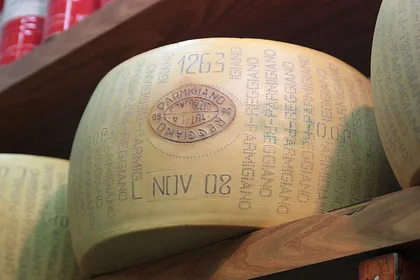 CheeseParmigiano ReggianoThree ingredients and no additives of any kind are permitted: raw cow's milk, salt and calf rennet, from five…
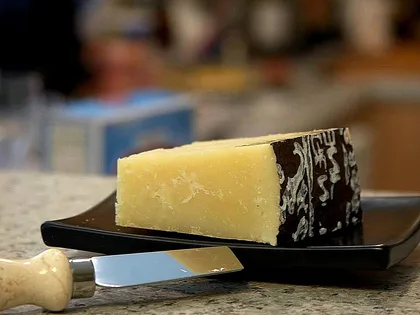 CheesePecorino RomanoPecorino Romano DOP is a hard, dry-salted sheep's milk cheese aged at least five months, made in Sardinia…Pasta and breadGnocchiGnocchi are small boiled dumplings, in their modern form made of potato bound with a little flour.Pasta and breadFocacciaTwo centimetres tall, dimpled with the fingertips, flooded with a brine of water, salt and olive oil before…Fish and seafoodSardinesSardines are not small anchovies. They are a different species with a different snout, a different mouth and…
 Pasta and breadTrofieTrofie are the pasta that pesto was made for: short, tapered twists of flour and water, rolled one by one…
 Pasta and breadFarinataFarinata is a paper-thin chickpea flour pancake baked in a copper pan in a blistering wood oven.Fish and seafoodCantabrian AnchoviesCantabrian anchovies are caught in the Bay of Biscay in spring, cured under salt for six to eighteen months…