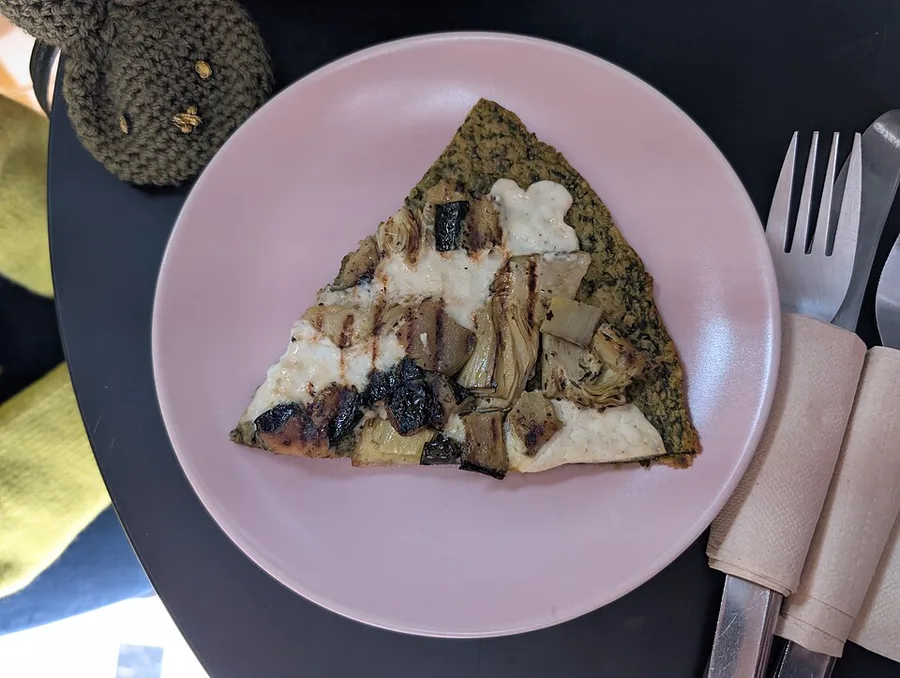
What is Farinata?
Farinata is a savoury flatbread made from chickpea flour, water, olive oil and salt, poured into a wide copper pan and baked at 300°C or more until the surface blisters brown and the inside stays soft and custardy. It is three to five millimetres thick (thinner than a crêpe is thick, thicker than a crisp) and it contains no wheat, no yeast, no egg and no dairy.
In Genoese dialect it is fainâ, and in Genoa it is bought by the slice from sciamadde, the old wood-fired shops of the medieval centre, and eaten standing up with a grind of black pepper. It is not a delicacy there; it is lunch.
Because it is naturally gluten-free and vegan, farinata has quietly become one of the Italian dishes with the most traction abroad. Nobody in Liguria planned it that way.
What does it taste like?
Nutty, earthy and savoury, with the unmistakable roundness of cooked chickpea and a real presence of olive oil. The texture is the point: a thin crisp bottom, a soft almost custardy middle, and a blistered top where the batter has caught and gone bitter-brown in the heat.
There is a faint, deliberate bitterness that comes with chickpea flour: pleasant when it is a whisper, unpleasant when it is not, which is a matter of technique rather than recipe. Black pepper is the traditional and only seasoning, and it works because the heat cuts straight through the oil.
If you have eaten socca in Nice or panisse in Marseille, you already know the flavour. If you have eaten besan chilla in India, you know the flour but not the format.
How to use it
Eat it hot, within minutes of the oven, with black pepper and nothing else. That is the whole instruction in Genoa, and the reason farinata rarely travels well: it loses its crisp edge inside an hour.
If you are making it, the ratio is one part chickpea flour to three parts water by weight, whisked smooth and left to rest four to ten hours. Skim off the pale foam that rises during the rest: it carries the saponins from the chickpeas and is the single biggest cause of a bitter farinata. Add salt and part of the oil, pour a thin layer into a hot, generously oiled wide pan, and bake at the highest temperature your oven reaches, ideally with the heat from below.
The classic Ligurian variations are few: sliced onion, rosemary, thin artichoke, whitebait, and, on the western Riviera, a spoonful of stracchino added near the end. Genoese purists tolerate onion and rosemary and nothing beyond.
A slice of farinata inside a split piece of focaccia is a real Genoese habit, not a joke.
How long it keeps
Farinata is mostly water when it comes out of the oven and it never stops giving that water up, so the crisp surface has a working life measured in tens of minutes. Left on a rack in a single layer it stays crisp for roughly half an hour to an hour, then steam from the soft interior reaches the crust and softens it; stacked or wrapped while hot, the condensation soaks it in minutes. After a few hours at room temperature the surface turns leathery and the inside sets denser as the chickpea starch firms.
In the fridge, loosely covered, it holds two days and goes firm and rubbery when cold, which is the starch retrograding rather than anything else. A hot dry oven or a dry pan at 200 to 230°C for a few minutes reverses most of that and brings the edges back; a microwave steams it and leaves it limp. Pieces freeze for about a month and reheat straight from frozen in the oven, coming back grainier because the ice crystals break up the set interior.
Spot the real thing
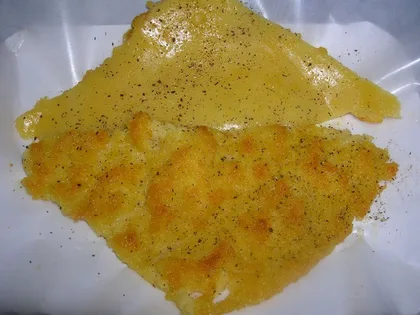
The right thing is thin, three to eight millimetres, deep gold with dark blistered patches across the top, crisp where it met the pan and almost custardy in the middle. It is cut with a spatula out of a wide round copper pan and sold by the wedge, still warm. The ingredient list is four items long: chickpea flour, water, olive oil, salt. No wheat, no eggs, no raising agent; the lift comes from resting the batter four to ten hours before it goes into a very hot oven.
The close relatives cause most of the confusion. Socca in Nice is the same batter, usually thinner and more charred. Tuscan cecina or torta di ceci is the same idea, often a shade thicker. Panelle in Palermo are chickpea batter too, but set firm and deep fried in slices. Indian besan chilla looks similar and is spiced. Anything sold as farinata that contains wheat flour is a different recipe. In Genoa a wedge runs 2 to 3.50 euro; outside Liguria it rarely appears in shops at all and shows up as a 5 to 8 euro restaurant starter.
How to pronounce Farinata
fah-ree-NAH-tah
Four syllables, stress on the third. Every A is open, as in 'father', never 'fa-RIN-a-ta' with a short British I. The Genoese name fainâ is roughly 'fye-NAH', with the final vowel drawn out and no consonant after it.
Farinata compared
vsSocca (Nice)
The same dish on two sides of a border that moved. Nice was Ligurian territory until 1860, and socca is farinata under a French name: same flour, same copper pan, same wood oven. The differences are small, real and fiercely defended by both cities.
| This | Socca (Nice) | |
|---|---|---|
| Ingredients | Chickpea flour, water, olive oil, salt | Identical |
| Thickness | 3-5 mm, kept very even | Slightly thicker and more irregular |
| Pan | Tinned copper testo, 60-100 cm | Copper or steel plaque, similar size |
| Oven | Wood-fired, 300-350°C | Wood-fired, often hotter and briefer |
| Seasoning | Black pepper only | Black pepper, sometimes cumin nearby in Provence |
| Served | Cut in wedges, eaten standing | Torn or scraped up, eaten from paper |
| Where | Genoa and the Ligurian coast | Nice, Menton, the Côte d'Azur |
vsCecina / torta di ceci (Tuscany)
Same batter, different city, different serving ritual. In Livorno and Pisa the chickpea flatbread is called cecina, and its defining move is being stuffed inside a wheat flatbread, a carbohydrate sandwich known locally as cinque e cinque.
| This | Cecina / torta di ceci (Tuscany) | |
|---|---|---|
| Name | Farinata, fainâ | Cecina (Livorno, Pisa), torta di ceci (Carrara) |
| Thickness | 3-5 mm | 5-10 mm, noticeably more substantial |
| Eaten | Plain, by the slice | Often inside a schiacciata with aubergine |
| Seasoning | Black pepper | Black pepper, sometimes aubergine or onion |
| Texture | Crisper, drier edges | Softer, creamier centre |
vsPanelle (Palermo)
Chickpea flour again, cooked in the opposite way. Panelle are a thick chickpea paste cooked on the stove, spread, cooled, cut into rectangles and deep-fried. Farinata is baked and thin; panelle are fried and dense. They are cousins, not variants.
| This | Panelle (Palermo) | |
|---|---|---|
| Cooking | Baked in a copper pan | Boiled to a paste, then deep-fried |
| Batter | Liquid, roughly 1:3 flour to water | Thick, roughly 1:2.5, cooked and set |
| Texture | Crisp top, creamy middle | Crisp shell, dense chickpea inside |
| Served | By the slice with pepper | In a sesame roll (pane e panelle) |
| Region | Liguria | Sicily, specifically Palermo |
Farinata substitutes
- Gram flour / besan
For making farinata at home, gram flour is the same thing under a different name and is cheaper in Indian and Middle Eastern shops. Besan is sometimes ground from split brown chickpeas and is finer, which makes a slightly denser farinata: add 5% more water.
1:1 for chickpea flour - Socca
If you cannot find farinata, socca is not a substitute so much as the same dish. Any Niçois market stall or Provençal bakery version will do exactly the job.
1:1 - Cecina or torta di ceci
The Tuscan version, thicker and often sold in bakeries rather than pizzerias. Use it anywhere you would use farinata; it holds fillings better.
1:1 - Yellow pea flour or red lentil flour
Both behave similarly and are worth knowing if chickpea is off the menu for you. Pea flour is sweeter and less bitter, lentil flour cooks faster and browns harder: drop the oven by 20°C.
1:1, watch the timing - Panisse (Provence)
Where the recipe wants the chickpea flavour in a firmer format (as a side, or cut into chips) panisse is the answer. Same flour, cooked to a paste and fried, closer to panelle than to farinata.
Not interchangeable in baking, only on the plate
Where to buy it
Farinata is a made-to-order food, not a packaged one, so buying it means finding somewhere that bakes it. Outside Italy, look for Ligurian-run pizzerias and Italian bakeries; in New York, San Francisco, London and Melbourne several serve it by the slice, usually under 'farinata' or 'cecina' on the menu.
What you can buy anywhere is the flour. Chickpea flour, gram flour and besan are the same product: Bob's Red Mill and Anthony's in the US, Natco and East End in the UK, roughly 4 to 8 dollars per pound or £3 to £6 per kilo. Italian brands such as Molino Grassi sell farina di ceci milled specifically for farinata.
The piece of kit that matters is the pan. A tinned copper testo, 40 to 60 cm across, is what Ligurian bakers use and what Italian kitchenware sites ship; expect €60 to €150. A heavy carbon-steel pizza pan preheated until it smokes is the realistic home substitute. Frozen supermarket farinata exists and is not worth the freezer space.
Where to eat it in Italy
Genoa, obviously and specifically. The sciamadde of the old town (the wood-fired shops around via Ravecca, vico dei Biscotti and piazza Sarzano) have been selling farinata by the slice for well over a century, alongside fried anchovies and vegetable tortes. They are narrow, marble-countered, cash-friendly and open at lunchtime.
Along the coast: Recco, Camogli and Rapallo to the east; Savona, Albenga and Sanremo to the west, where the Ligurian farinata meets the Niçois socca and the argument about which came first is still live.
Over the Tuscan border, Livorno and Pisa serve cecina inside a wheat flatbread as cinque e cinque, a sandwich of two starches that makes complete sense once you have eaten one. And in Sassari, Sardinia, the fainé brought by Genoese settlers is still served in the old-town restaurants, with sausage or onion on top.
Frequently asked questions
Is farinata gluten-free?
Yes, by nature: it is chickpea flour, water, olive oil and salt. The caveat is cross-contamination: pizzerias usually bake it in the same wood oven as bread, so coeliacs should ask before ordering.
Is farinata vegan?
Yes. There is no dairy, no egg and no honey in the traditional recipe. The only versions that are not vegan are the modern topped ones (stracchino cheese, sausage) which are clearly labelled.
Why did my farinata turn out bitter?
Because you did not skim the foam. Chickpea flour releases saponins that float to the surface while the batter rests; lift them off with a spoon before baking and the bitterness disappears.
Can I make farinata in a normal home oven?
Yes, though it will not match a wood oven. Use the highest setting, preheat a wide oiled pan until it is smoking, pour the batter no more than 4 mm deep, and bake with heat from below for 12 to 18 minutes.
How do you pronounce farinata?
fah-ree-NAH-tah, with the stress on the third syllable and every A open, as in 'father'.
Related foods
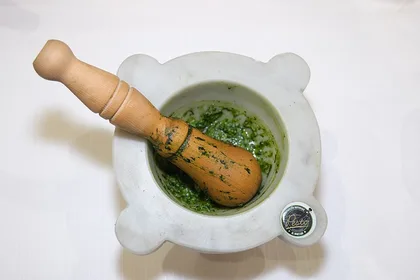 Oil and preservesPesto GenoveseHeat never touches this sauce, and by the rule neither does a blender: basil pounded in a marble mortar with…
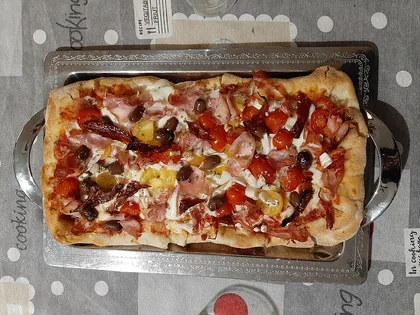 Pasta and breadPinsa RomanaIt is not pizza, and the difference starts with the flour: wheat, rice and soy blended together, hydration…
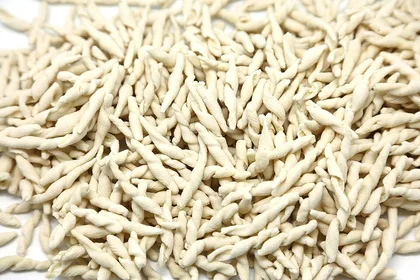 Pasta and breadTrofieTrofie are the pasta that pesto was made for: short, tapered twists of flour and water, rolled one by one…
 Pasta and breadTorta di Ceci (Cecina)Chickpea flour, water, olive oil and salt, baked in a wide copper pan in a fierce wood oven.Fish and seafoodSardinesSardines are not small anchovies. They are a different species with a different snout, a different mouth and…Fish and seafoodCantabrian AnchoviesCantabrian anchovies are caught in the Bay of Biscay in spring, cured under salt for six to eighteen months…SweetsPandolce GenoveseGenoa's Christmas cake: sultanas, pine nuts, candied citron and fennel seeds.