What is Casu Marzu?
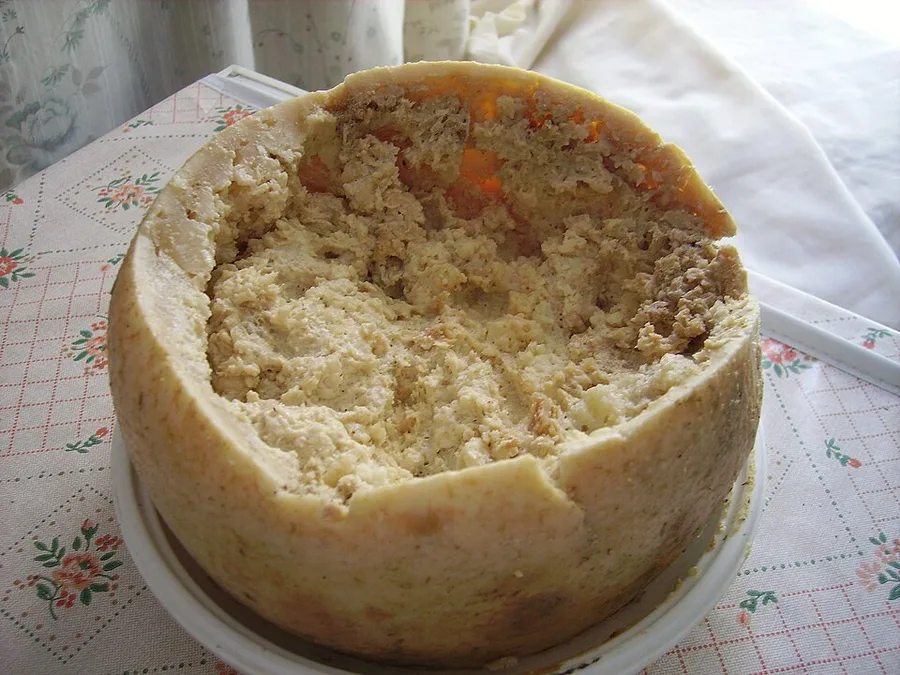
Casu marzu (casu martzu in Sardinian, and also called casu modde, casu becciu or simply formaggio marcio) is a wheel of Sardinian sheep's cheese in which fermentation is continued by the larvae of Piophila casei, the cheese fly. The digestive enzymes of the larvae break down fats and proteins far past the point where ordinary ageing stops. The paste loses structure, turns soft and spreadable, and releases a liquid known locally as lagrima.
The larvae are translucent white, up to eight millimetres long, and alive in the cheese. Disturbed, they flex and jump, sometimes fifteen centimetres, which accounts for most of the folklore attached to the product.
Technically this is arthropod-assisted ripening, the same principle behind German Milbenkäse, matured by mites, and aged French Mimolette, whose rind is worked by mites as well. It is an old technique of pushing preservation past its limit rather than an accident.
The key point is that casu marzu is a description of a state, not a specification. There is no codified recipe, no controls, no standard, and no two wheels are alike.
What does it taste like?
The reference points are the strongest cheeses you already know, pushed further. It is intensely pungent and ammoniacal, saltier and sharper than a well-aged pecorino, with the burn at the back of the throat that very ripe blue cheeses give. The texture is soft and spreading rather than firm, and there is a persistent bitterness in the finish that a normal cheese does not have.
Sardinians who eat it describe a flavour continuous with mature Fiore Sardo, only much further along the same line: not a separate flavour, an extreme of one.
If you want to understand where the taste lives without any of the complications, a two-year Fiore Sardo DOP or a very ripe Gorgonzola piccante will put you in the same register, legally and safely.
How to use it
In traditional practice the cheese is spread on pane carasau, often lightly moistened, and eaten in small quantities at the end of a meal with a robust red wine. It is never cooked, never grated and never used as an ingredient.
Those who eat it follow habits passed down locally: sealing a portion in a paper bag for a few minutes so the larvae, deprived of air, move away or become still; chilling the wheel to slow them; or separating the larvae mechanically before eating the paste.
None of these is a validated safety measure. Medical literature documents cases of intestinal pseudomyiasis: larvae surviving temporarily in the digestive tract, with gastrointestinal symptoms associated with eating foods that contain them. This is rare but real, and it is part of why the product is not admitted to sale.
This page describes a practice that exists; it is not a recommendation to try it. Sardinia's dairy tradition offers dozens of cheeses that can be bought, carried home and eaten with none of this attached, and the section above lists the ones that get closest to the same flavour.
How long it keeps
There is no storage advice to give for a product that cannot be bought, shipped or brought through customs. In Sardinia it is made and eaten inside a local window rather than kept: the wheel is worked on where it sits, in a cool dark room, and the paste changes continuously rather than holding a state. Nothing about it carries a pack, a date or a producer contact, which is exactly the information that would make storage guidance possible. What follows concerns the Sardinian cheeses that do come with all three.
A wedge of Fiore Sardo or aged Pecorino Sardo keeps a month in the fridge, wrapped in waxed cheese paper or parchment inside a loose box, never cling film against the paste, which traps moisture and makes the surface slick. Over that month the paste dries at the cut face, hardens, throws tyrosine crystals and concentrates in flavour; the rind may darken and the oils in a smoked Fiore Sardo slowly turn flatter. Vacuum sealed wedges hold longer and carry a date. For anything you are unsure about, the shop that sold it is the place to ask.
Spot the real thing
Outside Sardinia there is nothing to recognise, because there is nothing on legal sale. No shop stocks it, no importer handles it, and any website offering to ship casu marzu is selling something else. What travellers describe finding is a wheel of sheep milk pecorino with the top cut away like a lid, the paste beneath collapsed into a soft, pale, translucent cream rather than a solid, and a liquid called lagrima weeping through it. That description is the whole of it.
What you can recognise, and buy, is the family it comes from. Fiore Sardo DOP carries a dark, smoke burnished rind, a hard amber paste and a producer stamp; Pecorino Sardo DOP maturo is paler, firmer and sharply salty; Pecorino Romano, despite the name, is largely made in Sardinia and comes stamped with a sheep head mark. For the sharp, almost volatile end of the spectrum, ask a Sardinian counter for a long aged pecorino or one rubbed with oil and vinegar. Prices run roughly $20 to $35 a pound, and the label will say Sardegna.
How to pronounce Casu Marzu
kah-zoo MAR-tsoo
Two words, stress on MAR. In casu the S sits between vowels and is voiced, so it is 'kah-zoo', not 'kah-soo'. In marzu the Z is a 'ts' sound: 'MAR-tsoo', never 'MAR-zoo' with an English Z. The Sardinian spelling casu martzu shows this directly. Common errors: 'kassoo marzoo' and stressing the first word.
Casu Marzu compared
vsFiore Sardo DOP
The starting point rather than a rival. Casu marzu is usually made from a wheel of Fiore Sardo or a similar hard Sardinian pecorino, two or three months old, whose ripening is then taken over by the fly larvae. One is a protected, regulated, widely exported cheese; the other is what happens when that cheese is pushed past every regulation.
| This | Fiore Sardo DOP | |
|---|---|---|
| Milk | Sardinian sheep's milk | Sardinian sheep's milk |
| Ripening agent | Piophila casei larvae | Bacteria and moulds, plus wood smoke |
| Texture | Soft, spreading, weeping | Hard, granular, sliceable |
| Legal status | Cannot be sold | DOP, exported worldwide |
| Price | No legal market | 18 to 30 euros per kilo |
| Ageing | Two to three months of larval activity | Three months to two years |
vsMilbenkäse
The German parallel, from Würchwitz in Saxony-Anhalt. Here the ripening is done by cheese mites rather than fly larvae, and crucially the mites work from the outside in and are not eaten as part of the cheese. Milbenkäse is sold legally in Germany; casu marzu is not sold anywhere.
| This | Milbenkäse | |
|---|---|---|
| Organism | Piophila casei fly larvae | Tyrophagus casei mites |
| Where it works | Inside the paste, in galleries | On and just under the rind |
| Organism consumed | Present in the paste when eaten | Brushed off, though some remain |
| Base cheese | Sheep's-milk pecorino | Quark, cow's milk |
| Legal sale | Prohibited | Permitted in Germany |
| Region | Barbagia and inland Sardinia | Würchwitz, Saxony-Anhalt |
vsMimolette (extra-vieille)
France's aged Mimolette owes its cratered rind to cheese mites deliberately encouraged to work the surface. It illustrates that arthropod-assisted ageing is a recognised European technique, and also how differently regulators treat it when the organism stays on the rind and the cheese can be inspected.
| This | Mimolette (extra-vieille) | |
|---|---|---|
| Organism | Fly larvae in the paste | Mites on the rind |
| Eaten with the organism | Yes, in traditional practice | No: the rind is discarded |
| Legal in the EU | Not for sale | Freely sold |
| US import | Not permitted | Blocked by the FDA in 2013 over mite counts |
| Texture | Soft and spreading | Hard, dense, granular |
Casu Marzu substitutes
- Fiore Sardo DOP, aged 18 months or more
The single best answer. It is the same milk, the same island and the same cheesemaking, taken to the far end of legal ageing: sharp, smoky, salty, with real length. Widely exported and easy to find.
Direct: serve in the same way, on carasau bread - Gorgonzola piccante
For the soft, spreading, ammoniacal register rather than the sheep character. A well-aged piccante gives the throat-catching pungency and the spoonable texture in a cheese sold in every supermarket.
Direct - Milbenkäse
The closest thing to the concept that can legally be bought, from Würchwitz in Germany. Ripened by mites, sold in small quantities, and interesting precisely because it shows how the same idea can exist inside the rules.
Direct - Formaggio di fossa DOP
Sheep's cheese buried in tufa pits in Emilia-Romagna and the Marche for around three months. Anaerobic ripening produces an unusually sharp, slightly bitter cheese with a texture partway between hard and crumbly.
Direct - Pecorino Sardo Maturo DOP
The everyday Sardinian option, milder than Fiore Sardo and far easier to find abroad. A useful starting point if you want to work up the intensity scale rather than jump straight to the top.
Direct - Mimolette extra-vieille
Nutty, dry and crystalline rather than pungent, but genuinely mite-ripened, which makes it the substitute that best explains the technique. Note it has faced US import restrictions.
Direct
Where to buy it
Nowhere, and that is the complete answer. There is no legal market for casu marzu in Italy, the EU, the UK or the US. It cannot be sold in shops, listed on menus, shipped, exported or carried across a border as a food product.
Under EU food hygiene rules (Regulations 852/2004 and 853/2004) food offered for sale must be free of parasites, and Italian food hygiene law provides administrative and criminal penalties for selling non-compliant products. Reported enforcement cases have involved fines running into tens of thousands of euros.
Any website, market stall or intermediary offering casu marzu for sale is operating outside the law, and the product on offer has no traceability of any kind: no known base cheese, no known conditions, no inspection.
What you can buy, from the same island and the same shepherds, is excellent and unrestricted: Fiore Sardo DOP at roughly 25 to 40 dollars or 20 to 32 pounds per kilo abroad, mature Pecorino Sardo DOP a little less, and pane carasau to eat them on. Italian delicatessens and online specialists in both the US and the UK carry all three.
Where to eat it in Italy
It does not appear on any menu, because no restaurant can serve it legally. The occasions on which it is eaten are private ones (family lunches, village feasts, exchanges between shepherds) concentrated in the Barbagia, the province of Nuoro and the Ogliastra.
What is worth travelling for is the dairy culture the cheese comes out of, and that is entirely accessible. Fiore Sardo DOP, smoked over a wood fire and aged for months in the inland villages, is the cheese casu marzu starts from and a remarkable thing in its own right. Gavoi, in Nuoro province, holds an annual event dedicated to it.
The area around Ozieri, Bitti, Dorgali and Orgosolo is dense with dairies working Sardinian sheep's milk by traditional methods, and many receive visitors.
In Cagliari and Sassari, the town cheesemongers carry the full range of island pecorini from fresh to two years old. Tasting them side by side explains more about Sardinian shepherding than any single extreme product does.
Asking a Sardinian shepherd directly about casu marzu is a fast way to get a vague answer, for reasons that should by now be obvious.
Further reading
 InvestigationItalian raw milk cheeses: the full listWe counted: 19 of 43 declare raw milk, and 16 of those 19 carry a protected designation.
 GuideCan you eat cheese rind?On some wheels the rind is the same paste, dried out. On others it is paraffin.
 ExplainerParmesan vs Parmigiano Reggiano: the differenceIn Europe «parmesan» evokes a protected designation and cannot be used for anything else.
Frequently asked questions
Is casu marzu illegal?
Selling it is prohibited. It does not comply with EU food hygiene regulations, which do not permit parasites in food placed on the market, and Italian law penalises the sale of non-compliant food. At the same time it is listed among Sardinia's Prodotti Agroalimentari Tradizionali, a cultural register that records long-established regional practices without authorising commercial sale. Making it privately for one's own consumption sits in a grey area; selling it does not.
Why does casu marzu have live maggots in it?
Because the larvae are the ripening agent. A wheel of pecorino is opened and left where the cheese fly, Piophila casei, can lay eggs. The larvae tunnel through the paste and their digestive enzymes break down fats and proteins far beyond normal ageing, which is what makes the cheese soft, spreadable and extremely pungent.
Is it dangerous to eat?
Medical literature documents cases of intestinal pseudomyiasis: larvae surviving temporarily in the digestive tract, causing gastrointestinal symptoms linked to eating foods containing them. Such cases are rare but real, and they are part of the reason the product cannot be sold. The precautions passed down locally, such as sealing a portion in paper or chilling it, are traditional habits rather than validated safety measures.
Can I buy casu marzu online or bring it home?
No. There is no legal channel of sale in Italy, the EU, the UK or the US, and it cannot be exported or carried across a border as food. Any commercial offer, including online, is outside the law and comes with no traceability whatsoever.
What should I try instead?
Fiore Sardo DOP aged eighteen months or more is the same milk from the same island taken to the limit of legal ageing, and it is the closest legitimate experience. Gorgonzola piccante gives the soft, ammoniacal register; Milbenkäse from Würchwitz in Germany is the one arthropod-ripened cheese that can be bought openly.
Related foods
 CheeseRobiolaRobiola is a family of soft young cheeses from north-west Italy rather than a single cheese.
 CheesePecorino RomanoPecorino Romano DOP is a hard, dry-salted sheep's milk cheese aged at least five months, made in Sardinia…
 CheesePecorino SardoPecorino Sardo DOP is Sardinia's table cheese: whole sheep's milk, calf rennet, two official types.
 CheeseFiore SardoFiore Sardo DOP is the shepherd's pecorino of Sardinia: raw sheep's milk, lamb rennet paste, an uncooked…
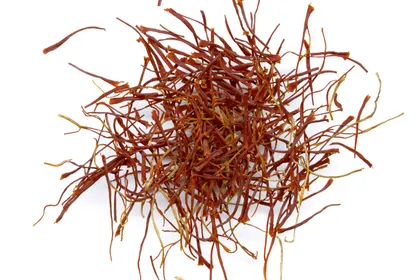 Oil and preservesSaffronOne kilo takes between 150,000 and 200,000 flowers, and every flower gives up three stigmas that have to be…
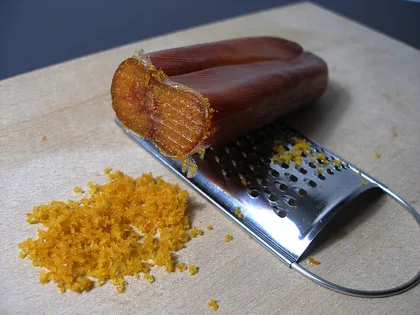 Fish and seafoodBottargaFifteen grams a head is enough, and that is not meanness: bottarga is the salted, pressed, air-dried roe sac…
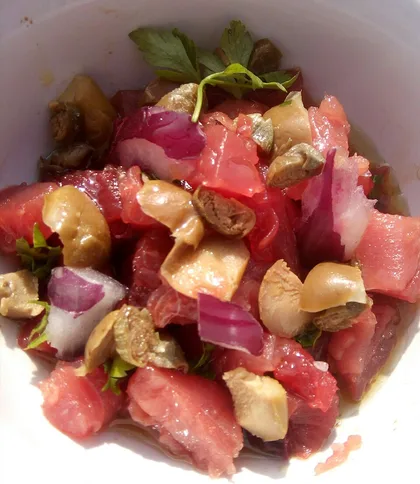 Fish and seafoodBluefin TunaAtlantic bluefin, Thunnus thynnus, is the fish Sicily and Sardinia built their tonnare around, with a…
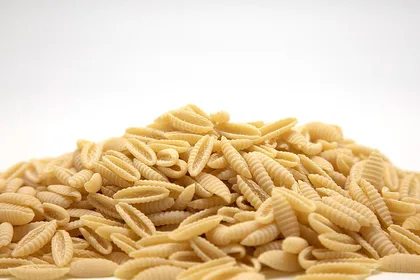 Pasta and breadMalloreddusThe ridges are not decoration: they hold sauce on a shape that would otherwise be smooth and slippery.