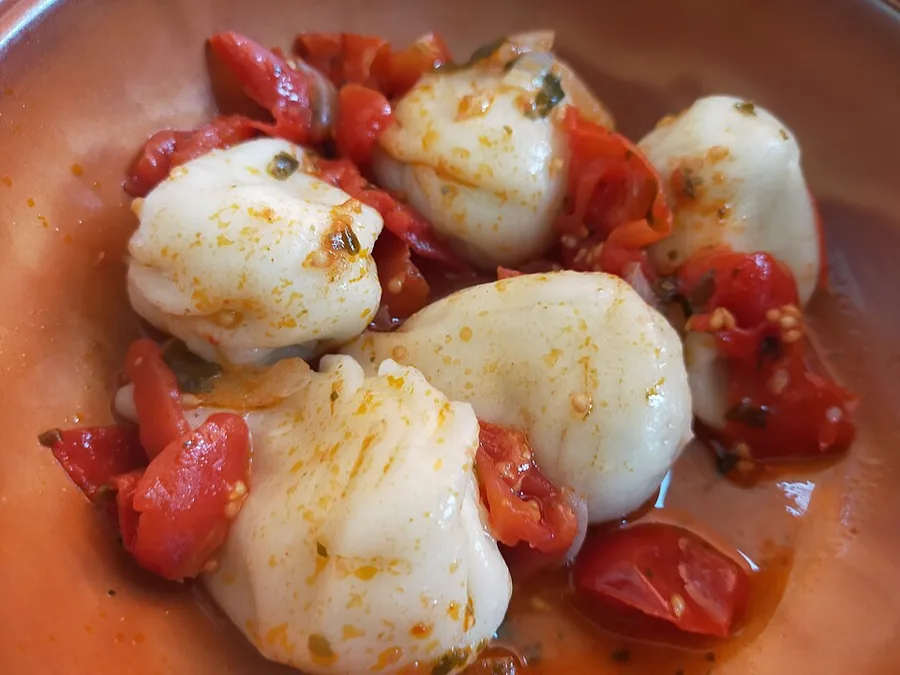
What is Culurgiones?
Culurgiones are made from an eggless dough of durum semolina and water, wrapped around a filling of boiled potato mashed with Sardinian pecorino, mint, garlic softened in olive oil, and salt. Some village versions use lard instead of oil, or a sharper aged cheese alongside the fresh one.
The defining feature is the closure. They are not crimped with a fork or cut with a wheel: the two edges are pinched alternately, left and right, up towards the tip, producing a raised seam that looks exactly like an ear of wheat. It is called the spighetta, and it takes practice: done properly the pasta stands up on its own base.
Since 2015 there has been a protected designation, Culurgionis d'Ogliastra IGP, which fixes the filling, the wrapper and the closure and restricts production to the Ogliastra region. Outside it, versions are made across Sardinia under a shifting set of spellings: culurgionis, culingionis, culurjones, kulurjones.
What does it taste like?
Mild, savoury and unexpectedly fresh. The potato gives body and sweetness rather than flavour; the pecorino brings salt and a sheepy tang; and then the mint arrives and lifts the whole thing, which is what makes culurgiones taste unlike any other Italian filled pasta.
The texture matters as much. The filling is deliberately mashed rather than blended, so it stays slightly grainy, and the semolina wrapper is chewier and more substantial than an egg-pasta ravioli. Each piece is a proper mouthful: three or four make a starter, eight or nine a meal.
With the traditional simple tomato sauce, the effect is comfort food with a herbal edge: closer in spirit to a very good pierogi than to a ricotta ravioli.
How to use it
Boil them in plenty of well-salted water at a gentle simmer, not a rolling boil: hard boiling forces the pleated seam open. Five or six minutes, until they float and hold at the surface for a moment. Lift them out with a slotted spoon rather than tipping them into a colander, which crushes them.
Dress them with a plain tomato sauce and a generous grating of pecorino sardo, and stop there. That is not purism, it is proportion: the filling already carries cheese, garlic and mint, and cream, mushrooms or pesto simply bury it. The only other traditional dressing is melted butter with grated cheese, or a thread of good olive oil.
Portion them at eight or nine per person as a main, three or four as a starter. They are large and filling.
Leftovers reheat well in a hot oven with a little sauce and cheese on top, like a small pasta bake. Never the microwave: the semolina wrapper turns rubbery.
How long it keeps
Fresh culurgiones hold two days in the fridge. Space them out on a tray dusted with semolina and cover them with a cloth: piled together they stick, and the seam tears when you pull them apart. Vacuum-packed pasteurised packs, which is how they usually travel abroad, carry a printed date and typically run three or four weeks refrigerated; once the seal is broken they behave like fresh pasta.
Freezing raw is the better method. Lay them on a tray without touching, freeze for two hours, then move them into bags. They hold about three months, past which the sheet dries at the edges and the seam cracks. Drop them straight into boiling water from frozen, adding two minutes. Do not thaw first, or the filling wets the sheet from inside and they open in the pot.
Cooked and dressed, they hold a day in the fridge and reheat in the oven. A microwave turns the semolina sheet rubbery and no amount of resting fixes it.
Spot the real thing
Look at the back. If there is a hand-sewn wheat-ear seam running along it, with alternating stitches that are slightly uneven, they are culurgiones. If the edge is crimped by a wheel or stamped flat by a mould, they are potato ravioli under a borrowed name.
The sheet should be thin without being see-through, made from semolina, a pale straw yellow. Deep yellow means egg in the dough, which puts it outside the Ogliastra tradition. Cut one in half: the filling should be compact and grainy rather than smooth, because the potato is crushed and never blitzed. Mint should come off it as soon as it opens, and the pecorino should read salty rather than sharp. Packs carrying the IGP show the Culurgionis d'Ogliastra mark with a batch number.
Abroad they land in the refrigerated pasta case beside pierogi and potato ravioli, which are the two things they get taken for. Neither carries the seam, and neither carries mint. Expect an imported IGP pack to cost roughly double a supermarket filled pasta.
How to pronounce Culurgiones
koo-loor-JOH-nehs
Four syllables, stress on the third. The 'gi' is a soft English 'j' as in 'jaw', not a hard g. Both 'u' sounds are 'oo'. The final syllable is pronounced, because Sardinian keeps the plural ending, so it is 'nehs', not a silent 'nes' or an Italian-style 'nee'. Common errors: 'kul-oor-GYO-nez' with a hard g, and swallowing the ending into 'koo-loor-JOHNS'. You will also see culurgionis, which adds a syllable: koo-loor-JOH-nees.
Culurgiones compared
vsRavioli
Culurgiones are a kind of filled pasta, but calling them Sardinian ravioli undersells the differences. Ravioli use an egg-and-flour dough, are usually cut with a wheel or a stamp, and are filled with ricotta, meat or vegetables. Culurgiones use eggless semolina dough, are closed by hand in the wheat-ear pleat, and are filled with potato and pecorino. They also take a much simpler sauce.
| This | Ravioli | |
|---|---|---|
| Dough | Durum semolina and water, no egg | Soft flour and egg |
| Closure | Hand-pleated spighetta seam | Pressed, cut with a wheel or stamp |
| Typical filling | Potato, pecorino, mint, garlic | Ricotta and spinach, meat, squash |
| Size | Large: 8-9 cm disc, stands upright | Smaller, flat, 4-6 cm |
| Bite | Chewy, firm wrapper | Tender, delicate |
| Sauce | Plain tomato and pecorino only | Butter and sage, ragù, cream, broth |
| Vegan-friendly | Dough yes, filling no (cheese) | Dough usually no (egg) |
vsPierogi
The most useful comparison for anyone who has never eaten culurgiones. Polish pierogi ruskie are also potato-and-cheese dumplings, also hand-sealed, also substantial. The differences are the cheese (sheep's pecorino versus fresh twaróg curd), the mint, the eggless semolina wrapper, and the cooking: pierogi are usually boiled then pan-fried in butter with onions, while culurgiones are only boiled and sauced.
| This | Pierogi | |
|---|---|---|
| Wrapper | Semolina and water | Wheat flour, often with egg or sour cream |
| Filling | Potato, pecorino, mint, garlic | Potato, twaróg curd, fried onion |
| Herb | Mint, the signature note | None, or dill on the side |
| Seal | Pleated wheat-ear seam | Crimped or pressed edge |
| Cooking | Boiled, then sauced | Boiled, then often fried in butter |
| Served with | Tomato sauce and grated pecorino | Sour cream, bacon, fried onions |
vsTortelli di patate
The mainland Italian cousin, from the Mugello and Casentino valleys in Tuscany and from parts of Emilia. Both are potato-filled pasta from mountain areas that had potatoes and not much else. The Tuscan version uses egg pasta, seasons the potato with garlic, parsley and sometimes nutmeg, and is served under a meat ragù: richer, heavier, and without the mint and sheep's cheese that define the Sardinian one.
| This | Tortelli di patate | |
|---|---|---|
| Region | Ogliastra, Sardinia | Mugello and Casentino, Tuscany |
| Dough | Semolina and water | Flour and egg |
| Filling seasoning | Pecorino, mint, garlic | Parmigiano, parsley, garlic, nutmeg |
| Shape | Pleated pouch, upright | Flat square or rectangle |
| Classic sauce | Simple tomato, grated pecorino | Meat ragù, or butter and sage |
| Weight of the dish | Medium: herbal and fresh | Heavier and richer |
Culurgiones substitutes
- Fresh potato ravioli, upgraded
Buy plain potato-filled ravioli, then fix the seasoning at the plate: grate sharp pecorino over them and add finely chopped fresh mint to the tomato sauce. You lose the wrapper texture and the pleat, but you get most of the flavour signature.
1:1 by weight, plus 30g pecorino and 6-8 mint leaves per 500g - Pierogi ruskie
Structurally the closest widely available thing in the US and UK, especially frozen from a Polish shop. Boil rather than fry them, dress with a simple tomato sauce and pecorino, and add mint. Softer wrapper, milder cheese, same idea.
1:1 - Tortelli di patate
Italian and easier to find in delis. Richer and eggier, without the mint. Best served the Tuscan way with a meat ragù rather than pretending to be Sardinian.
1:1 - Potato gnocchi with pecorino and mint
Not filled pasta at all, but it delivers the same flavour triangle of potato, sheep's cheese and mint in fifteen minutes. Toss hot gnocchi with tomato sauce, a lot of grated pecorino sardo and torn mint.
500g gnocchi replaces 500g culurgiones - Homemade with a cheat wrapper
The filling is easy and the wrapper is the hard part. Round dumpling or gyoza wrappers, doubled up for strength, will hold the filling if you cannot roll semolina dough. Boil for three minutes only, since they are much thinner.
About 250g filling fills 24 wrappers - Vegetarian and halal note
The dough is flour and water, so it is vegan, but the filling is not: Pecorino Sardo DOP is made with animal rennet, and some village recipes use lard in the dough or the filling. For a vegetarian version, ask for versions made with microbial-rennet cheese, or substitute a vegetarian hard sheep's cheese and use olive oil throughout.
Where to buy it
In Sardinia, from any bakery, pasta shop or village alimentari in Ogliastra, freshly made that morning, at €12 to €18 per kilo. Vacuum-packed and frozen IGP versions travel well and cost €14 to €22 per kilo.
Outside Italy they are genuinely hard to find. In the US, specialist importers such as Gustiamo and Sardinian-focused online shops carry frozen or vacuum-packed culurgiones at roughly $18 to $28 per pound; a few Italian delis in New York, Boston and San Francisco stock them seasonally. In the UK, Sardinian and Italian importers ship them at around £18 to £28 per kilo, and Natoora has carried them on and off.
When buying packaged, look for the Culurgionis d'Ogliastra IGP mark and a lot number, and check the ingredient list for potato and pecorino rather than ricotta: the ricotta-filled versions sold under the same name are a different, milder thing.
Where to eat it in Italy
Inland Ogliastra rather than the coast: Villagrande Strisaili, Ulassai, Lanusei, Talana, Urzulei. Village shops and small pasta makers sell what was rolled that morning, and several villages hold summer festivals built around the dish.
Tortoli and Arbatax on the coast serve them in seafood restaurants, but this is mountain food: it improves with altitude, and the versions in the interior are noticeably better.
Elsewhere in Sardinia every area has its own variant, and the historic delis of Cagliari and Nuoro keep them fresh daily. Off the island, Sardinian restaurants in Rome, Milan and Turin have made culurgiones a fixture, and they are often the best version you will find on the mainland.
Further reading
Frequently asked questions
What is inside culurgiones?
Boiled potato mashed with Sardinian pecorino, fresh mint, garlic softened in olive oil, and salt. The wrapper is durum semolina and water, with no egg. Some village versions use lard, or add a sharper aged cheese.
How do you pronounce culurgiones?
koo-loor-JOH-nehs, stress on the third syllable, with a soft 'j' sound in the middle and the final 's' pronounced. The variant spelling culurgionis adds a syllable: koo-loor-JOH-nees.
What is the pleat on top called?
The spighetta, the little ear of wheat. It is made by pinching the two edges alternately from base to tip, and it is the mark that separates a real culurgione from a potato ravioli. It is also the reason each one is made by hand.
What sauce do you serve with culurgiones?
Plain tomato sauce with grated pecorino, or melted butter and cheese. Nothing else. The filling is already seasoned with cheese, garlic and mint, and heavier sauces cover it.
Are culurgiones vegetarian?
Usually not, despite containing no meat. The wrapper is flour and water, but Pecorino Sardo is made with animal rennet, and some recipes use lard. Vegetarian versions exist, so ask, or make them at home with a microbial-rennet cheese.
Sources
Where to check what you just read.
- 1
Il regolamento del 22 settembre 2016 che iscrive «Culurgionis d'Ogliastra» come IGP nella classe delle paste alimentari: la grafia protetta è quella sarda.
- 2
Cosa deve esserci davvero dentro: ripieno di patate, formaggi e grassi, peso del singolo pezzo fra 20 e 33 grammi e almeno dieci chiusure a spiga sulla sfoglia.
Related foods
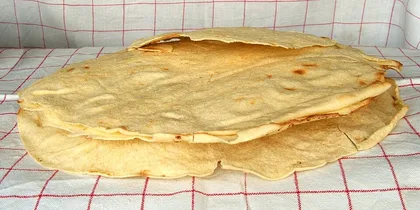 Pasta and breadPane carasauBaked twice because it had to survive months in a shepherd's saddlebag: a paper-thin disc of durum semolina…
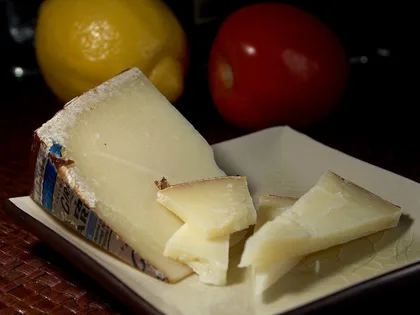 CheesePecorino SardoPecorino Sardo DOP is Sardinia's table cheese: whole sheep's milk, calf rennet, two official types.
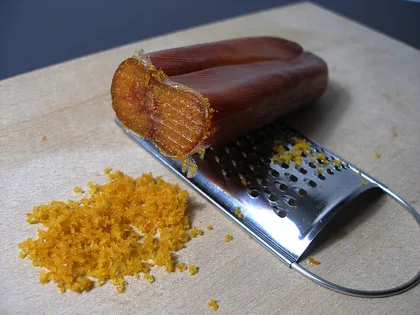 Fish and seafoodBottargaFifteen grams a head is enough, and that is not meanness: bottarga is the salted, pressed, air-dried roe sac…
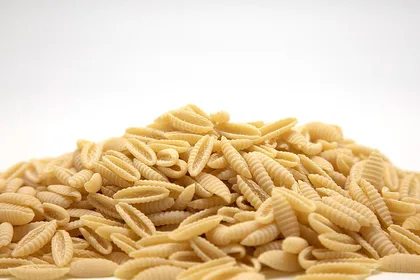 Pasta and breadMalloreddusThe ridges are not decoration: they hold sauce on a shape that would otherwise be smooth and slippery.
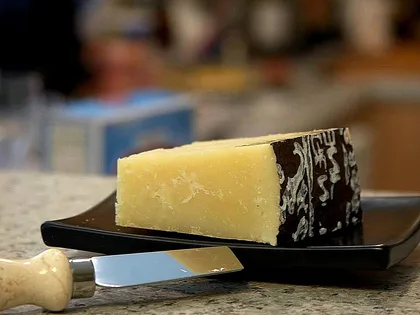 CheesePecorino RomanoPecorino Romano DOP is a hard, dry-salted sheep's milk cheese aged at least five months, made in Sardinia…
 Oil and preservesSaffronOne kilo takes between 150,000 and 200,000 flowers, and every flower gives up three stigmas that have to be…
 CheeseCasu MarzuCasu marzu is a Sardinian sheep's cheese whose ripening is carried on by the larvae of the cheese fly.
 Fish and seafoodBluefin TunaAtlantic bluefin, Thunnus thynnus, is the fish Sicily and Sardinia built their tonnare around, with a…