What is Prosciutto di San Daniele?
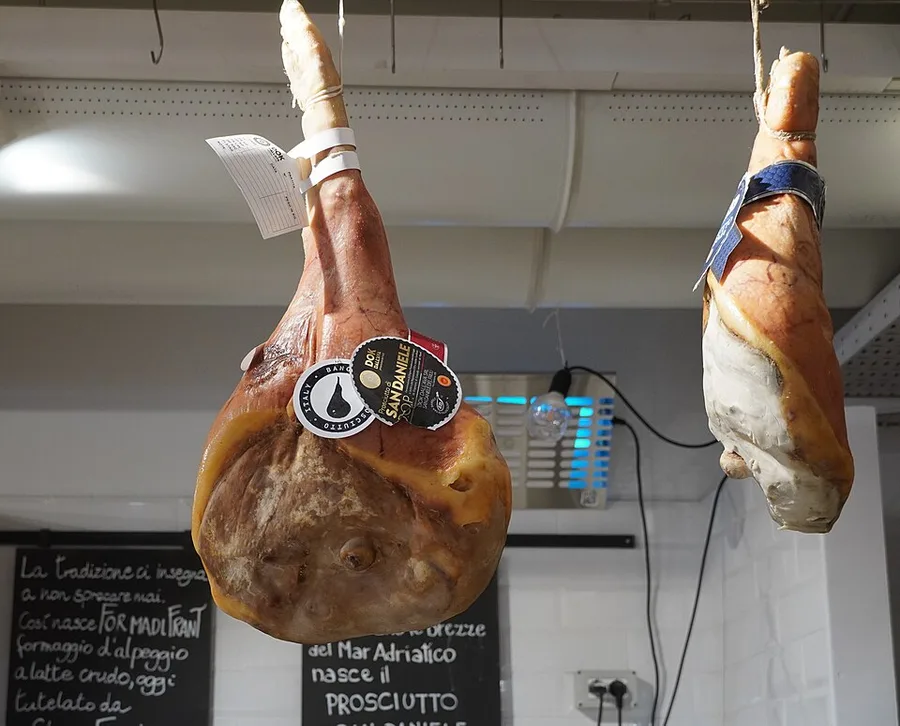
Prosciutto di San Daniele is a dry-cured ham produced exclusively within the town limits of San Daniele del Friuli, in the province of Udine. Not the region, not the province: the municipality, about thirty-five square kilometres, with roughly thirty producers.
The ingredient list is two lines long: legs from heavy Italian pigs, and sea salt. No preservatives, no nitrites, no smoke, no spices. Everything else is time and air.
The shape is the first thing you notice. It is called a chitarra, guitar-shaped, because pressing widens the leg at the base and narrows it at the top, and the trotter is left on. No other major Italian ham keeps the foot.
The rules require a minimum of thirteen months of ageing from salting, against twelve for Parma, and a finished weight of at least eight kilos. The fire-branded mark, a stylised ham outline with the letters SD, is applied only after an independent inspector has passed the piece.
What does it taste like?
Sweet, delicate and buttery, with far less salt than most people expect from cured ham. The first taste is milk and hazelnut rather than salt; the salt arrives late and never dominates.
The fat is the point. It is soft enough to melt on the tongue at body temperature, which is why a slice should be brought to room temperature before eating, and why a slice eaten cold from the fridge tastes like a different, duller product.
Against Parma, San Daniele reads as rounder and moister, with a slightly more marked sweetness and a shorter, cleaner finish. Against Spanish serrano it is softer, less salty and much less chewy.
A well-aged piece has small white specks in the lean. These are tyrosine crystals, an amino acid that forms during long curing. They are a sign of quality and they give a faint crunch.
How to use it
Eat it raw, and eat it soon after it is cut. Slices lose their aroma within hours, which is why Italian shops slice to order and why vacuum packs are a compromise.
Take it out of the fridge twenty minutes before serving. Cold fat does not melt on the tongue, and the whole character of the ham depends on that.
In Friuli it is eaten with plain white bread, with Montasio cheese, and with figs in summer. Melon is the national cliche and works better with saltier hams; with something as sweet as San Daniele, figs, pears or a squeeze of nothing at all suit it better.
Cooking it is a waste of money, but if it goes near heat, let the heat come to it: draped over a pizza after the oven, laid on hot pumpkin soup, wrapped around grissini. The offcuts near the bone, which a good shop will often hand over cheaply, are excellent diced into a risotto, a frittata or a pasta sauce.
A note on slicing: the correct slice is thin enough to be almost translucent but still able to hold together when lifted. If it tears, it is too thin.
How long it keeps
A whole bone-in leg does not belong in the fridge. It hangs, or sits on a stand, in a cool ventilated room between 12 and 18 °C, which is what it has been doing for the previous thirteen months. Once you start cutting, cover the open face with its own trimmed fat, a cloth or the slice of fat kept back for the purpose, and work through the leg over a month or two. The cut face dries and darkens whenever it is left bare, and that dried layer gets pared away before the next session.
Boneless vacuum packs live in the fridge and hold to the date printed on them. Opened, wrap them in greaseproof paper or a cloth and reckon on about two weeks, across which the exposed surface stiffens and the colour deepens. Slices cut at a counter are the fragile form and lose their aroma within hours, so buy small amounts. Freezing slices is the thing to skip: the fat crystallises and the slice flakes apart and weeps as it thaws.
Spot the real thing
The trotter left on the end is the quickest tell, and it is not decoration: it helps liquid drain during curing and the rules require it, so a whole leg sold as San Daniele without one is not San Daniele. On the skin sits a fire brand with the stylised ham outline, the letters SD and a producer code, and packs of slices carry the Consorzio logo next to the European DOP symbol. The leg is pressed flat into the shape people compare to a guitar, which is how it reads differently from a Parma on the same counter.
A slice is pink-red with fine white marbling, and the covering fat is pure white and firm, a couple of centimetres at most; yellow or soft fat says something about how it was kept. The smell is sweet and faintly buttery. Cut properly the slice is thin but not transparent and holds its own shape when lifted. White specks in the meat are tyrosine crystals from long ageing. Anything priced near domestic prosciutto-style ham is domestic prosciutto-style ham.
How to pronounce Prosciutto di San Daniele
proh-SHOO-toh dee san dan-YEH-leh
Prosciutto has a soft 'sh' from the 'sci' and a held double 't': proh-SHOO-toh, not 'pro-zoo-toh' or 'per-shoot'. Daniele is three syllables with the stress on the second, dan-YEH-leh, and the final 'e' is pronounced. Italians say crudo for the raw cured ham and cotto for the cooked one; prosciutto alone means either.
Prosciutto di San Daniele compared
vsProsciutto di Parma
The two great Italian raw hams start from identical raw material, heavy Italian pigs from the same eleven regions, and diverge entirely in the curing house. San Daniele sits on a morainic hill above the Tagliamento, where sea air from the Adriatic meets cold dry air off the Carnic Alps; Parma cures in the hill breezes of the Apennine foothills south-west of the city, historically scented by the chestnut woods. San Daniele is pressed flat and keeps its trotter; Parma is neither pressed nor footed. Thirteen months minimum against twelve. The result is a sweeter, moister, more delicate ham on one side and a slightly saltier, firmer, more assertive one on the other.
| This | Prosciutto di Parma | |
|---|---|---|
| Production area | San Daniele del Friuli only, ~35 km2 | Hills of Parma province |
| Air | Sea air from the Adriatic meeting Alpine air | Hill breezes off the Apennines |
| Trotter | Left attached, required | Removed |
| Pressing | Yes, pressed flat under weights | No pressing; rounder shape |
| Minimum ageing | 13 months | 12 months |
| Flavour | Sweeter, softer, buttery | Saltier, firmer, more savoury |
| Annual output | About 2.5 million hams | Roughly four times as many |
| Mark | Branded ham outline with SD | Five-pointed ducal crown |
vsJamon serrano
The Spanish everyday cured ham, and the comparison most English-speaking buyers actually make in a shop. Serrano comes from white pigs, is cured drier and cooler, usually for nine to twelve months, and is normally made with nitrites. It is firmer, chewier and saltier, and costs considerably less. Iberico de bellota is a different conversation altogether: acorn-fed black pigs, deeply nutty fat, and a price above any Italian ham.
| This | Jamon serrano | |
|---|---|---|
| Pig | Heavy Italian white pigs, 9+ months, 160 kg | Standard white breeds, lighter |
| Ingredients | Pork and sea salt only | Usually pork, salt and nitrites |
| Ageing | 13-24 months | 9-12 months typical |
| Texture | Soft, melting, moist | Firmer and drier, chewier |
| Flavour | Sweet, milky, delicate | Saltier, more direct |
| Price | 38-55 EUR per kg sliced | 18-30 EUR per kg sliced |
vsSpeck Alto Adige
The other northern Italian ham English speakers meet, and the one most often confused with prosciutto. Speck is boned, lightly smoked over beech, seasoned with juniper and pepper, and aged around five months. It is a fundamentally different product: smoky, firm and made to be cut thicker.
| This | Speck Alto Adige | |
|---|---|---|
| Bone | Cured on the bone, trotter on | Boned and pressed square |
| Smoke | None | Cold-smoked over beech |
| Seasoning | Sea salt only | Salt, juniper, pepper, bay |
| Ageing | 13 months minimum | About 22 weeks |
| How to slice | Paper-thin | Thin but with body; often diced |
Prosciutto di San Daniele substitutes
- Prosciutto di Parma
The nearest thing in every sense and the easiest to find outside Italy. Slightly saltier and firmer, so if a recipe balances the ham against something sweet (melon, figs, burrata) expect a sharper contrast.
1:1 - Prosciutto Toscano or Prosciutto di Carpegna
Other Italian PDO raw hams. Toscano is saltier and seasoned with pepper and herbs, so use it where the ham is a supporting flavour rather than the point. Carpegna, from the Marche, is closer to San Daniele in sweetness.
1:1, use slightly less Toscano - Jamon serrano
Cheaper and widely available. Drier and saltier: serve it a touch thicker, and skip any additional salt in the dish. Not a match for the melting texture, but perfectly good wrapped around grissini or figs.
1:1 - Speck Alto Adige
Only where smoke is welcome: with rye bread, eggs, or in a cooked dish. It will take over anything delicate, so use about two-thirds of the quantity.
0.7:1 - Halal or no-pork: bresaola or beef prosciutto
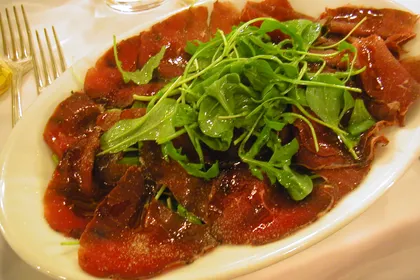
Bresaola della Valtellina is air-cured beef, sliced paper-thin and served the same way; it is much leaner, so dress it with olive oil and lemon. Cured beef or veal 'prosciutti' made with the same salt-and-air method exist and behave similarly.
1:1, plus a spoon of olive oil - Turkey or duck prosciutto
Widely made in the US and in kosher and halal charcuterie. Duck breast cured in salt and air-dried gets closest to the fat-and-lean balance; turkey is very lean and works best in cooked applications.
1:1
Where to buy it
In the US, San Daniele is widely available: Eataly, Di Bruno Bros, Whole Foods and most Italian delis carry it whole, boned or pre-sliced, and the Consortium has been exporting to the American market for decades. Expect roughly 25 to 40 dollars per pound sliced at a counter, and more for pre-packed trays.
In the UK, supermarkets carry sliced San Daniele alongside Parma, and Italian delicatessens and online specialists sell boned pieces. Prices run about 40 to 60 pounds per kilo sliced.
Look for the branded mark on the rind, the stylised ham outline with SD, and the blue-and-yellow EU PDO symbol on packaging. If you are buying a whole ham, the trotter must be there.
Buy sliced to order where you can. Ask for it thin but not shredded, laid flat on paper rather than piled, and buy only what you will eat within a day.
One caution on labels: "San Daniele style" or "prosciutto crudo" without the protected name is a different, cheaper product. The name itself is the guarantee.
Where to eat it in Italy
San Daniele del Friuli has a density of prosciutterie found nowhere else: small rooms where you order a plate of ham cut to order, a glass of Friulano and nothing else. Several producers run guided tours of their curing halls, ending in a tasting.
Aria di Festa, at the end of June, is the Consortium's festival: four days when the curing houses open their doors and the whole town becomes one long tasting counter.
The surrounding hills fill in the rest of the picture: Montasio cheese from the cooperative dairies, the white wines of the Colli Orientali between Buttrio and Cividale, frico and mountain cheese as you climb towards Carnia.
In Udine, twenty-five kilometres away, the osterie of the old centre serve San Daniele as a tajut, the Friulian half-glass of wine with something to eat, taken standing at the bar in the middle of the afternoon.
Further reading
Frequently asked questions
What is the difference between San Daniele and Parma ham?
Same raw material, different curing. San Daniele is made only in the town of San Daniele del Friuli, is pressed flat, keeps the trotter attached and ages at least thirteen months, giving a sweeter, softer, moister ham. Parma is made in the hills of Parma province, is not pressed, has no trotter, ages at least twelve months and tastes saltier and firmer.
Why does San Daniele keep the trotter on?
The production rules require it, and during curing it helps drain moisture from the leg. It is also the quickest way to identify a genuine whole ham: no trotter, no San Daniele.
Does San Daniele contain nitrites or preservatives?
No. The only permitted ingredients are pork leg and sea salt: no nitrites, no nitrates, no sugar, no smoke. Preservation comes from salt, pressing and slow air-drying over at least thirteen months.
What are the white specks in the slice?
Tyrosine crystals, an amino acid that forms during long ageing. They give a slight crunch and are tyrosine crystals, formed over a long maturation, not a fault.
How do you pronounce prosciutto di San Daniele?
proh-SHOO-toh dee san dan-YEH-leh. The 'sci' is a soft 'sh', the double 't' is held, and Daniele takes the stress on its second syllable with the final 'e' clearly sounded.
Sources
Where to check what you just read.
- 1
Il primo grande elenco di DOP e IGP italiane, del giugno 1996: qui il prosciutto compare come «Prosciutto di S. Daniele».
- 2
I vincoli verificabili: peso minimo delle cosce fresche, stagionatura minima di 13 mesi, solo sale marino e obbligo di lavorare tutto nel comune di San Daniele del Friuli.
- 3Consortium · interested partyConsorzio del Prosciutto di San Daniele
Due soli ingredienti dichiarati (coscia di suino e sale marino), assenza di conservanti e nitriti, e i prosciuttifici autorizzati.
Related foods
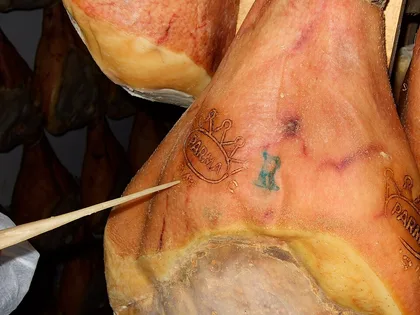 Cured meatsProsciutto di ParmaProsciutto di Parma DOP is Italian ham made from three things only: pork, sea salt and at least 400 days.
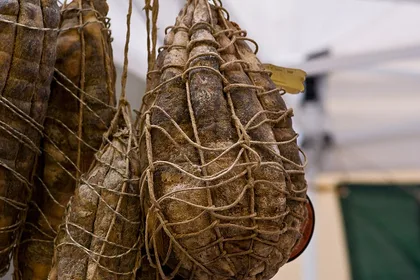 Cured meatsCulatello di ZibelloCulatello di Zibello is the heart muscle of a pork leg, boned out, sewn into a pig's bladder, tied by hand…
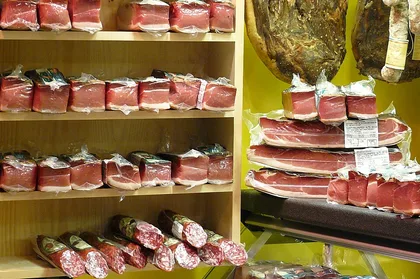 Cured meatsSpeck Alto Adige IGPA little salt, a little smoke, plenty of air: the South Tyrolean saying describes a method rather than a…
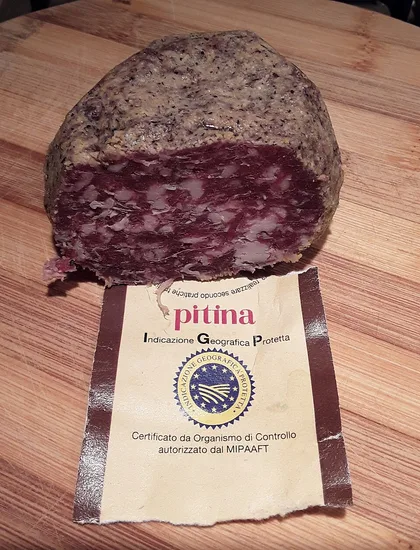 Cured meatsPitinaPitina is a smoked, cured meatball from the Friulian Dolomites: minced game or mutton bound with pork fat…
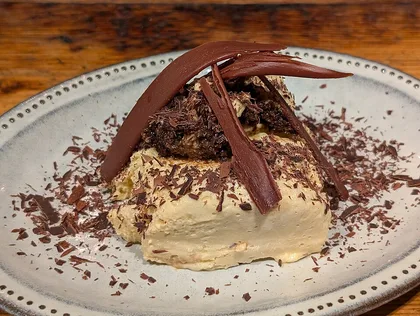 SweetsTiramisuNothing here goes near an oven. Savoiardi dipped in cold espresso, raw egg yolk whipped with mascarpone…
 WineProseccoProsecco is made from Glera grapes by the Martinotti tank method, not the traditional bottle method used for…
 CheeseMontasioMontasio DOP is Friuli's cheese: cow's milk, semi-cooked curd, wheels of 6 to 8 kilos and an ageing ladder…
 SweetsGubanaA long strip of enriched leavened dough rolled around walnuts, raisins, pine nuts and grappa, then coiled…