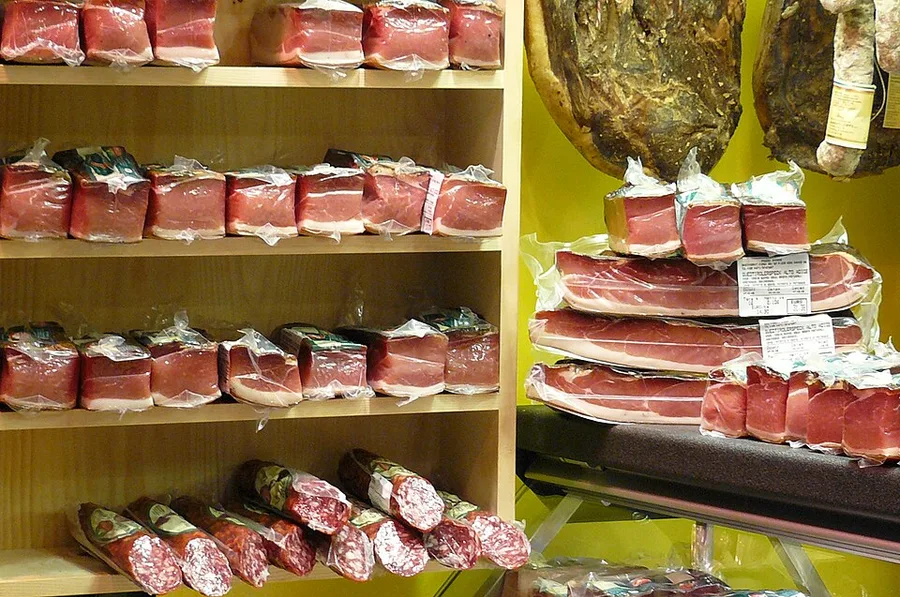
What is Speck Alto Adige IGP?
Speck is a smoked prosciutto, and both halves of that description matter. It is raw, never cooked and cured entirely by salt, smoke and time, and it is smoked, but so gently that the smoke sits behind the meat rather than in front of it.
It starts as a deboned pork leg opened into two flat rectangular slabs called baffe, each with the rind still on one side. Flattening the leg is the key structural decision: it exposes a large surface area, so smoke and air penetrate quickly and evenly. That is the opposite of the whole-leg logic behind Parma or serrano, and it is why speck is ready in five to seven months instead of one to three years.
The IGP was granted in 1996 and the consortium formed in 1992. The specification is unusually precise: salt content capped at five per cent, smoking temperature never above twenty degrees, total maturation of at least twenty-two weeks, and a weight loss of at least thirty per cent. Every certified slab carries a fire brand on the rind with the producer's code and a batch number.
What does it taste like?
Savoury and clean, with the smoke arriving late rather than early. If you know American bacon, reset your expectations: there is no sweetness, no bacon-fat rush, and the smoke is a whisper of beech rather than a wall of hickory. Think prosciutto with a campfire somewhere in the next valley.
Underneath the smoke sits juniper, piney and slightly bitter, plus pepper, garlic and bay from the cure. The meat itself is firm and dense, drier than Parma, with a strip of clean white fat along the outer edge that carries most of the aromatics. Trimming that fat off is the single most common mistake people make.
Sliced thin it is delicate; sliced properly, meaning about two millimetres by hand, it has enough body to chew and releases the fat slowly. Cooked, it turns nutty and its smoke amplifies, which is why a few cubes transform a dumpling or a barley soup.
How to use it
Cut it by hand on a wooden board, at about two millimetres, with the rind resting on the board and the knife angled. Machine-thin slices look elegant but collapse: speck needs a little thickness to chew against and to release its fat.
On a board, serve it the South Tyrolean way: rye bread or Schüttelbrot, the crisp rye flatbread; pickled gherkins; freshly grated horseradish; a piece of alpine cheese; and Kaminwurzen, the lean smoked sausage sticks that always come alongside.
In cooking it brings salt and smoke in one ingredient. Dice it into Speckknödel, the bread dumplings that are the province's signature dish; cut it into strips for a white ragù; lay it over white asparagus with melted butter; stir it into Tyrolean barley soup; use it instead of pancetta in a risotto.
The one rule is restraint with heat. Speck is already dry, and a hot pan turns it bitter within a minute. Two minutes over medium heat is enough: you are warming it, not crisping it.
How long it keeps
A vacuum-sealed piece keeps in the fridge at 4 to 7°C until the producer date, often several months out, because the meat is cured and still slowly losing water. Once the vacuum is broken the cut face is the part that moves: over two or three days it dries, darkens and forms a dry rim, so wrap that face in baking paper or press it against a reserved offcut of rind, and avoid laying cling film directly on the meat, which traps moisture against it. A whole piece traditionally hangs in a cool dry cellar, where it simply keeps hardening and concentrating.
Pre-sliced packs behave differently. Opened, the slices lose moisture within hours, curling and stiffening at the edges, so keep them flat with their interleaving paper in a closed container. With time the fat shifts from white towards ivory or yellow as it oxidises, and the aroma turns sharper and less sweet. Slices freeze for a couple of months wrapped tight, though the fat can go slightly grainy on thawing. The pack date is the reference.
Spot the real thing
On a whole or half piece, look for the mark fire branded into the rind side: the wording Speck Alto Adige IGP inside the consortium stamp, alongside a numbered producer code. The shape matters too, because speck is boned and pressed, so it is a flattened rectangular slab rather than the rounded leg shape of prosciutto crudo. The rind is dark brown from cold smoking, the meat deep rose to brownish red, the fat cap white and about a centimetre thick. Sliced thin it should drape and fold rather than snap.
The usual mix-up abroad is with German and Austrian smoked hams such as Schwarzwälder Schinken, which is more heavily smoked and differently shaped, and with the German word Speck itself, which means cured pork fat or streaky bacon; the Alto Adige product is a lean ham. Deli counters outside Europe sometimes sell a domestic smoked ham under the same name. Prosciutto crudo is the unsmoked cousin. In Alto Adige it runs about 25 to 35 euro a kilo, and abroad roughly £4 to £6 per 100g or $30 to $45 a pound.
How to pronounce Speck Alto Adige IGP
shpek
One syllable. In South Tyrol, where the word is German, 'sp' at the start is said 'shp': 'shpek', rhyming with 'deck'. Italian speakers from elsewhere often say a plain 'spek', which is understood everywhere. The full name is 'shpek AL-toh AH-dee-jeh'.
Speck Alto Adige IGP compared
vsProsciutto crudo (Parma, San Daniele)
Same animal, same principle, one extra step. Prosciutto is salt and air only, aged whole on the bone for a year or more, and it tastes sweet and delicate. Speck adds a spice rub and a light cold smoke, and is cured as flat slabs, so it matures in a third of the time and comes out saltier, firmer and more aromatic. Speck is the ham you cook with; prosciutto is the ham you don't.
| This | Prosciutto crudo (Parma, San Daniele) | |
|---|---|---|
| Smoke | Light cold smoke over beech, under 20 °C | None |
| Cure | Salt, juniper, pepper, garlic, bay, spices | Salt only, by regulation |
| Shape | Flat boned slabs (baffe), 4–5.5 kg | Whole bone-in leg, 7–10 kg |
| Maturation | 22 weeks minimum, often 5–7 months | 12–36 months |
| Flavour | Savoury, spiced, faintly smoky | Sweet, nutty, mellow |
| Cooking | Excellent: dumplings, soups, pasta | Wasted by heat |
| Region | South Tyrol, province of Bolzano | Emilia and Friuli |
vsBacon
The comparison most English speakers reach for, and the most misleading. Bacon is pork belly, usually wet-cured with sugar and nitrates, hot-smoked or unsmoked, and it must be cooked. Speck is a lean leg, dry-cured with spices, cold-smoked so it stays raw, and it is eaten as it is. They share almost nothing except the word 'smoked'.
| This | Bacon | |
|---|---|---|
| Cut | Leg, lean | Belly (US) or back (UK), fatty |
| Cure | Dry salt and spices | Usually wet brine with sugar |
| Smoking | Cold, under 20 °C, over weeks | Hot or warm, over hours |
| Eaten raw | Yes, that is the point | No, must be cooked |
| Sweetness | None | Common, from sugar or maple |
| Fat content | Low, one clean edge strip | High, marbled through |
vsSchwarzwälder Schinken (Black Forest ham)
Germany's protected smoked ham is speck's nearest relative and the two get confused constantly. Black Forest ham is smoked over fir and pine sawdust, which gives a darker, resinous, considerably heavier smoke, and it is often smoked at slightly higher temperatures for longer. Speck uses beech only, keeps the temperature under twenty degrees, and alternates smoke with long air-drying rests. The result is that speck tastes of ham with smoke, and Schwarzwälder tastes of smoke with ham.
| This | Schwarzwälder Schinken (Black Forest ham) | |
|---|---|---|
| Wood | Beech only | Fir and pine, resinous |
| Smoke intensity | Deliberately light | Pronounced and dark |
| Method | Alternating smoke and long air rests | Longer continuous smoking |
| Exterior | Pale rind, brushed of noble mould | Dark, almost black surface |
| Protection | IGP, Italy | PGI, Germany |
| Typical use | Board, dumplings, pasta | Board, rye bread, sandwiches |
Speck Alto Adige IGP substitutes
- Schwarzwälder Schinken (Black Forest ham)
The nearest thing on most European and American shelves. Considerably smokier, so use a little less than the recipe asks and skip any other smoked ingredient in the dish. Excellent on a board and fine in dumplings.
0.8:1 - Prosciutto crudo plus a smoked element
Where speck's job is savouriness rather than smoke, in a pasta sauce or over asparagus, plain prosciutto works, with a pinch of smoked paprika or a few drops of liquid smoke to bridge the gap. On a cheeseboard the swap is invisible.
1:1 - Westphalian ham or Katenschinken
German raw smoked hams from the same family. Katenschinken is beech-smoked like speck, which makes it a very close match, though the cure lacks the juniper and the Alpine spice mix.
1:1 - Thick-cut smoked bacon or pancetta affumicata
Only for cooked dishes, never for a board. Bacon is fattier and often sweetened, so render it first, discard some fat and reduce the salt elsewhere in the recipe. Pancetta affumicata is the better of the two.
0.8:1, after rendering - Pork-free: smoked turkey breast or pastrami
For anyone avoiding pork, cold-smoked turkey breast sliced thin covers the board role, and beef pastrami covers the cooked role: both bring salt and smoke, though neither brings the juniper. Add a few crushed juniper berries to close the distance.
1:1 - Vegetarian: smoked tofu or smoked aubergine
Firm smoked tofu cubed and seared hard does a surprisingly good job in Speckknödel and barley soup, since what those dishes want is salt, smoke and texture. For a board, thinly sliced smoked aubergine dressed with olive oil and juniper.
Where to buy it
Speck is one of the most widely exported Italian cured meats, so it is genuinely easy to find. In the US, Italian grocers, Whole Foods and online specialists carry it at 16 to 26 dollars per pound. In the UK, Ocado, Waitrose and Italian delis list it at 26 to 40 pounds per kilo.
The catch is the word itself. 'Speck' is not protected as a generic term and is used across Germany and Austria for very different products, including plain cured fatback. Look for the full name Speck Alto Adige IGP or Südtiroler Markenspeck, and on a whole slab, for the fire brand on the rind carrying the producer's code.
Buy a piece rather than a tray if you can. A whole baffa weighs four to five and a half kilos, which is a lot, but many delis will cut a quarter. Keep the fat edge on: it holds most of the aroma, and speck trimmed of fat is a worse product at the same price.
Where to eat it in Italy
Autumn is the season. From late September to November, the farms of the Eisacktal and the hills around Brixen open their parlours for Törggelen: new wine, roasted chestnuts, dumplings and boards of speck. It is not an organised festival but a seasonal habit, and people walk from farm to farm.
For places: Brixen and the Eisacktal, Bruneck and the Pustertal, Schlanders and Naturns in the Vinschgau (the driest valley in the province and the one considered best for ageing), Meran and its surrounding farms, and the Sarntal above Bozen, where domestic curing traditions survive outside the IGP entirely.
In Bozen itself, the market stalls on Piazza delle Erbe sell speck year round and the old-town beer halls serve the classic board. The Christmas markets of Bozen, Meran, Brixen and Bruneck, running from late November to Epiphany, are crowded and touristy but the producers are real and you can taste before you buy.
Further reading
Frequently asked questions
What is speck?
A raw, lightly smoked, dry-cured ham from South Tyrol in northern Italy. The pork leg is boned, opened into flat slabs, rubbed with salt, juniper, pepper, garlic and bay, cold-smoked over beech below twenty degrees, and air-dried for at least twenty-two weeks.
Is speck the same as bacon?
No. Bacon is pork belly, usually wet-cured with sugar, hot-smoked and always cooked before eating. Speck is a lean leg, dry-cured with spices, cold-smoked so that it stays raw, and eaten as it is. Substituting one for the other changes a dish completely.
Is speck cooked or raw?
Raw. The smoking happens at under twenty degrees, which flavours and protects the surface without cooking anything. Preservation comes entirely from salt, smoke and the loss of at least thirty per cent of the original weight.
How is speck different from Black Forest ham?
Wood and intensity. Black Forest ham is smoked over fir and pine, which is resinous and heavy; speck uses beech only, keeps the temperature under twenty degrees, and alternates short smoke cycles with long air-drying rests. Speck tastes of ham with a hint of smoke; Black Forest ham tastes of smoke first.
How do you pronounce speck?
'shpek', one syllable, rhyming with 'deck'. The word is German, so the initial 'sp' is said 'shp' in South Tyrol. The full name is 'shpek AL-toh AH-dee-jeh'.
Sources
Where to check what you just read.
- 1
L'allegato registra la denominazione come «Speck dell'Alto Adige» (IGP): il nome protetto è quello, e vale solo per la produzione altoatesina.
- 2
Il PDF del disciplinare vigente, dove si controllano tenore massimo di sale, tempi minimi di stagionatura e regole su salagione e affumicatura.
- 3Consortium · interested partyConsorzio Tutela Speck Alto Adige IGP
L'elenco dei produttori autorizzati in Alto Adige e i parametri che il Consorzio dichiara di far rispettare: 22 settimane di stagionatura e massimo 5% di sale.
Related foods
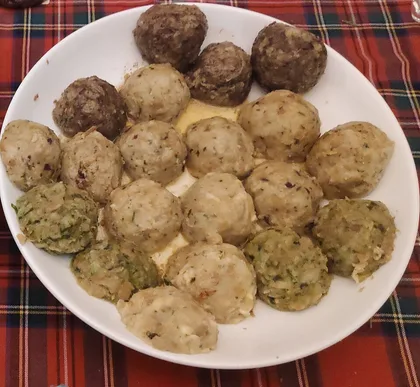 Pasta and breadCanederliIn the mountains nobody ever threw bread away, and canederli are the proof: stale white bread soaked in milk…
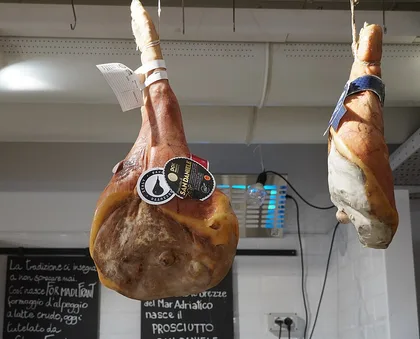 Cured meatsProsciutto di San DanieleProsciutto di San Daniele DOP is made in one town in Friuli from two ingredients: pork leg and sea salt.
 CheeseAsiagoOne name covers two cheeses nobody would mistake for each other at the counter.
 Vegetables and fruitVal di Non AppleVal di Non apples are three varieties (Golden Delicious, Renetta Canada and Red Delicious) grown between 600…
 CheesePuzzone di MoenaPuzzone di Moena means 'the big stinker of Moena', and the name is earned honestly: the rind is washed with…
 Cured meatsMortadellaThe white cubes are not just any fat: they are jowl, the firmest part of the pig, and they stay whole…Cured meatsPancettaPancetta is Italian cured pork belly: salt, pepper and warm spices, dried for months, never smoked.
 Cured meatsGuancialeGuanciale is cured pork jowl: unsmoked, rubbed with salt and pepper, aged for one to three months.