What is Puzzone di Moena?
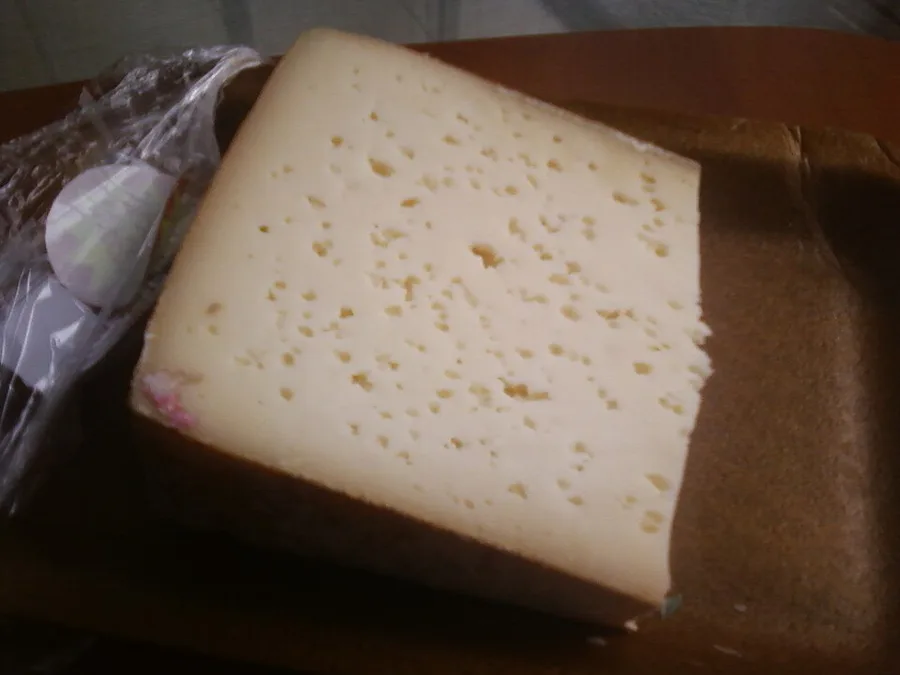
Puzzone di Moena is a semi-cooked raw cow's milk cheese from the val di Fassa, val di Fiemme and Primiero valleys in Trentino, in the Italian Dolomites. Wheels weigh 9 to 13 kilos and measure 34 to 42 centimetres across, with a straight side about 9 to 12 centimetres high.
What separates it from every other Italian mountain cheese is the rind. Instead of being left to dry, it is washed and rubbed with warm, lightly salted water at regular intervals: every two or three days at first, then weekly, for the entire ageing period. The permanent damp surface grows a smear of bacteria that break down proteins and release sulphur compounds. The rind turns ochre and tacky, the paste directly under it softens into a darker, more yielding band, and the cheese acquires the smell that gives it its name.
Minimum ageing is 90 days; most wheels are sold between five and eight months. There is also a malga version, made only in summer from high-pasture milk and aged longer, which carries the name of the individual alpine dairy on the label.
The DOP was granted in 2014, though the technique in these valleys is documented from the nineteenth century, when the cooperative dairies of Fiemme and Fassa organised production. Output is small, a few thousand wheels a year, and essentially all of it is eaten in northern Italy.
What does it taste like?
The gap between the nose and the palate is the whole story. The smell is farmyard, wet cellar, cured meat, something between a ripe Munster and the inside of a cave. The taste is far gentler than that: sweet milk underneath, a clean salinity, a savoury depth from the rind, and a finish that suggests hazelnuts and mountain herbs rather than anything barnyard.
Texture is elastic and dense, closer to a young Alpine wheel than to the runny washed-rind cheeses of France. The band under the rind is softer and much more intense; the centre stays firm, milky and sweet even in an eight-month wheel.
If your reference is Époisses, expect a third of the pungency on the palate and none of the spoonable ooze. If your reference is Taleggio, expect the same family of flavours with far more grip and a longer finish. Malga wheels add a green, herbal top note that comes directly from the summer pasture.
How to use it
In the valleys it goes on polenta and nothing else needs to happen. Cut thick slices, lay them over hot yellow polenta and let the residual heat melt them, or slide the plate under a hot grill for a minute until the surface blisters. The cheese is the sauce.
It is also grated into canederli, the Trentino bread dumplings, alongside speck, melted into a mountain fonduta with milk and egg yolk to pour over boiled potatoes, or stirred into risotto off the heat, in small quantities, because it dominates easily.
On a board, serve it at room temperature with the rind on: that band under the rind is the best part of the wheel. Rhododendron or fir honeydew honey, mostarda and walnuts all balance it rather than hiding it.
Two practical notes. First, it will perfume everything in your fridge, butter and eggs included, so keep it in a sealed box. Second, cold Puzzone gives you less than half of what it has; take it out thirty minutes before serving.
How long it keeps
A wedge runs three or four weeks in the vegetable drawer of the refrigerator, and the container matters more here than with almost any other cheese, because a washed rind scents everything around it: butter and eggs will take it on within a day. A rigid box with a lid, or two layers of waxed paper with a barely damp cloth against the rind, keeps that in and keeps the surface supple. Plastic film pressed on it is the one thing to avoid, since it seals the moisture in and pushes the surface towards ammonia.
The rind is alive and goes on working even at fridge temperature, so a piece bought today is stronger in three weeks than it is tonight; that is the cheese doing what it does rather than a fault. The cut face dries and darkens, and a millimetre scraped off resets it. Freezing is out: the paste crumbles and the rind loses the surface flora it depends on. Take it out half an hour before serving, always, because cold shuts it down completely. The label date and the dairy are the reference.
Spot the real thing
The rind carries the identity. It should be ochre going towards brown, damp and faintly tacky to the touch, never dry or cracked, because that surface is the result of months of washing and a dry rind means the routine was thin or stopped early. Cut across, the paste is compact and elastic, white to pale straw, with sparse irregular eyes, and there is almost always a softer, darker band a centimetre or two under the rind where the surface bacteria worked hardest. That band is the most flavoured part of the wheel. The denomination is branded on the heel, and the rarer alpine wheels also name their malga.
It should smell pungent but clean, of cellar, damp woodland and washed rind; a flat ammonia note means it has travelled further than the style intends, and no smell at all means it is not this cheese. Its relatives abroad are the washed-rind family: Taleggio, Époisses, Munster, Reblochon, Limburger. Puzzone is firmer than any of them, a semi-hard wheel of around ten kilos, and it carries DOP status under the double name Puzzone di Moena and Spretz Tzaorì.
How to pronounce Puzzone di Moena
poo-TSOH-neh dee moh-EH-nah
The double 'zz' is a hard 'ts', as in 'pizza', never a 'z' as in 'zoo'. Stress falls on the second syllable of each word: poo-TSOH-neh dee moh-EH-nah. The Ladin name, Spretz Tzaorì, is roughly 'sprets tsa-oh-REE', with the stress on the final syllable.
Puzzone di Moena compared
vsTaleggio
The Italian washed-rind cheese English speakers already know, and the fair starting point. Both develop their character from a bacterial smear on a damp rind, but they are built differently. Taleggio is a soft, square, uncooked cheese from Lombardy that ripens in about forty days and eats creamy and mild-to-funky. Puzzone is a large, round, semi-cooked alpine wheel that ages for months, keeps an elastic paste, and pushes the aroma much further. Think of Taleggio as the approachable version of the same idea and Puzzone as the mountain version that had four more months to think about it.
| This | Taleggio | |
|---|---|---|
| Origin | Trentino: Fassa, Fiemme, Primiero | Lombardy: Val Taleggio and the Po plain |
| Shape | Round wheel, 9-13 kg | Square block, about 2 kg |
| Paste | Semi-cooked, firm and elastic | Uncooked, soft and creamy |
| Milk | Raw | Usually pasteurised |
| Minimum ageing | 90 days | 35 days |
| Smell | Strong, sulphurous, cellar-like | Moderate, mushroomy |
| Availability abroad | Rare | Widely stocked |
vsÉpoisses de Bourgogne
The washed-rind benchmark for most English speakers, and instructive precisely because the two cheeses take the technique in opposite directions. Époisses is washed in marc de Bourgogne, ripens in five to eight weeks and collapses into something you eat with a spoon; it is famously the cheese banned from French public transport. Puzzone is washed only in salt water, ages for months and keeps a sliceable, elastic body. On smell they are comparable; on texture and use they have nothing in common.
| This | Époisses de Bourgogne | |
|---|---|---|
| Origin | Trentino, Italy | Burgundy, France |
| Rind washed with | Warm salted water | Brine, then marc de Bourgogne |
| Size | 9-13 kg wheel | 250 g or 700 g disc |
| Texture | Firm, elastic, sliceable | Liquid at peak ripeness, eaten with a spoon |
| Ageing | 3-8 months | 5-8 weeks |
| How to eat it | Sliced, melted on polenta, on a board | Spooned onto bread |
vsMunster (Munster-Géromé AOP)
The closest functional cousin, and the comparison locals make themselves. Both are mountain washed-rind cheeses from a valley culture with its own language (Alsatian on one side of the Vosges, Ladin in the Dolomites) and both are traditionally eaten with potatoes and a glass of aromatic white wine. Munster is smaller, softer, quicker and spicier; Puzzone is bigger, firmer and sweeter under the funk. If Munster with Gewürztraminer makes sense to you, Puzzone with Trentino Müller Thurgau will too.
| This | Munster (Munster-Géromé AOP) | |
|---|---|---|
| Origin | Dolomites, Trentino | Vosges, Alsace and Lorraine |
| Size | 9-13 kg wheel | 120 g to 1.5 kg disc |
| Paste | Semi-cooked, elastic | Uncooked, soft and supple |
| Ageing | Minimum 90 days | 21 days minimum, usually 5-8 weeks |
| Classic partner | Polenta, Müller Thurgau, Vino Santo | Boiled potatoes, cumin, Gewürztraminer |
| Milk | Raw cow's milk | Raw or pasteurised cow's milk |
Puzzone di Moena substitutes
- Taleggio DOP
The easiest substitute to find anywhere and the closest in flavour family. Softer, milder and quicker to melt, so a dish made with it will be creamier and less assertive. Buy a properly ripe piece rather than a young supermarket block.
1:1 - Munster or Munster-Géromé AOP
The nearest match on aroma. Much softer, so it will not slice or grill the same way; use it where the cheese is meant to melt into something, and expect a spicier finish.
1:1, slightly less if the wheel is very ripe - Fontina Val d'Aosta DOP
The structural substitute rather than the aromatic one. Same alpine, semi-cooked, raw-milk build and the same behaviour over polenta, but sweet and mild instead of pungent. The right choice if you want the dish to work and the funk is not the point.
1:1 - Ardrahan, Milleens or Durrus (Irish washed rinds)
Widely available in the UK and Ireland and genuinely close in register: farmhouse washed rinds with real pungency and a sweet milky core. Softer than Puzzone, so treat them as board cheeses rather than cooking cheeses.
1:1 - Grayson or Oma (US washed rinds)
Meadow Creek Dairy's Grayson and von Trapp Farmstead's Oma are the American washed-rind cheeses that get closest, and both are far easier to buy in the States than any Trentino wheel. Oma in particular has the same balance of stink and sweetness.
1:1 - Vegetarian: microbial-rennet washed rinds
Puzzone di Moena is never vegetarian: the specification requires calf rennet, as do Taleggio, Munster and Époisses. Several British and American farmhouse creameries make washed-rind cheeses with microbial rennet and label them 'suitable for vegetarians'; that is the only realistic route.
1:1
Where to buy it
Outside Italy this is a specialist purchase. In the US, importers of Alpine and Italian mountain cheeses list it occasionally: Murray's, Formaggio Kitchen, Eataly and serious regional cheesemongers are the realistic places to ask, at roughly 22 to 32 dollars per pound. In the UK, Italian delicatessens and washed-rind specialists carry it sporadically at about 30 to 45 pounds per kilo.
Ask your cheesemonger to source it rather than hunting shelves, and ask for the age. A three-month wheel and an eight-month wheel are different cheeses, and the malga version (summer milk, longer ageing, alp name on the label) is different again and dearer.
When it arrives, judge the rind. It should be ochre to brown, damp and slightly tacky. A dry, cracked rind means the washing stopped early and the aroma never developed. A sharp ammonia smell, as opposed to a strong farmyard one, means it has gone too far.
In Trentino itself, the cooperative dairies of Predazzo-Moena and Cavalese sell every ageing directly at 16 to 24 euros a kilo, which is roughly half the export price.
Where to eat it in Italy
Moena sits at the mouth of the val di Fassa, an hour and a half from Trento and inside the Dolomites proper. The cooperative dairy shared by Predazzo and Moena has a public shop selling the full range; the val di Fiemme dairy in Cavalese is the second address worth the stop.
For a cooked version, Malga Panna above Moena is a fine-dining restaurant that treats the valley's cheeses seriously. For the elemental version, cheese with polenta and a glass of something local, head for the malghe around the San Pellegrino and Costalunga passes, both of which are on classic Dolomite driving routes.
Late summer is the moment. When the herds come down from the high pastures the valleys hold the desmontegada festivals, Moena's Gran Festa da d'Istà among them, and the whole season's malga cheese reaches the market at once.
The area is Ladin-speaking, one of Italy's three officially protected minority languages, and the cheese is one of the more edible ways into that culture: ask for Spretz Tzaorì and watch the conversation change.
Further reading
 ExplainerWhich Italian cheeses contain no lactoseItaly sets a legal threshold, and long-aged cheeses clear it on their own, with no treatment involved.
 ExplainerParmesan vs Parmigiano Reggiano: the differenceIn Europe «parmesan» evokes a protected designation and cannot be used for anything else.
 GuideHow long food keeps once openedThe date on the label describes the sealed package. After that, four things govern everything: water, salt…
Frequently asked questions
Why does Puzzone di Moena smell so strong?
Because the rind is washed and rubbed with warm salted water every two or three days throughout ageing. The constant damp grows a bacterial smear that breaks down proteins and releases sulphur compounds. It is the same principle as Taleggio, Munster and Époisses, applied to a large semi-cooked wheel that then ages for months.
Does it taste as strong as it smells?
No, and that is the surprise. The nose is pungent; the palate keeps a sweet, milky core with a savoury, saline depth and a nutty finish. Even eight-month wheels never reach the aggression the smell promises.
What does Spretz Tzaorì mean?
'Tasty cheese' in the Ladin of the val di Fassa: spretz is cheese, tzaorì is tasty. It is the original name, and it appears alongside the Italian one in the DOP specification.
Can you eat the rind?
Yes, and it is the most intense part of the wheel. If the aroma is too much, cut it off, but the softer, darker band just under the rind is where the character lives.
Is Puzzone di Moena vegetarian?
No. The specification requires calf rennet, as do Taleggio, Munster and Époisses. Washed-rind cheeses from British or American farmhouse creameries explicitly labelled 'microbial rennet' are the practical alternative.
Sources
Where to check what you just read.
- 1
L'atto del 7 novembre 2013 che iscrive «Puzzone di Moena / Spretz Tzaorì» fra i formaggi DOP: il nome ladino fa parte della denominazione tutelata.
- 2
Da qui si scarica il disciplinare: razze bovine ammesse, lavaggi periodici della crosta con acqua tiepida salata, stagionatura minima e valli comprese nella zona.
Related foods
 CheeseTaleggioTaleggio DOP is a square, washed-rind cow's milk cheese from the Bergamo Alps, aged at least 35 days.
 Pasta and breadCanederliIn the mountains nobody ever threw bread away, and canederli are the proof: stale white bread soaked in milk…
 Cured meatsSpeck Alto Adige IGPA little salt, a little smoke, plenty of air: the South Tyrolean saying describes a method rather than a…Pasta and breadPolenta TaragnaPolenta taragna is the dark alpine polenta of Lombardy: cornmeal cut with buckwheat flour, stirred for the…
 CheeseAsiagoOne name covers two cheeses nobody would mistake for each other at the counter.
 Vegetables and fruitVal di Non AppleVal di Non apples are three varieties (Golden Delicious, Renetta Canada and Red Delicious) grown between 600…
 CheeseBurrataIt began as a way of using offcuts: leftover shreds of pasta filata, drowned in cream and sealed inside a…
 CheeseMozzarellaThe name is a verb before it is a cheese: mozzare means to lop off, which is what the cheesemaker does by…