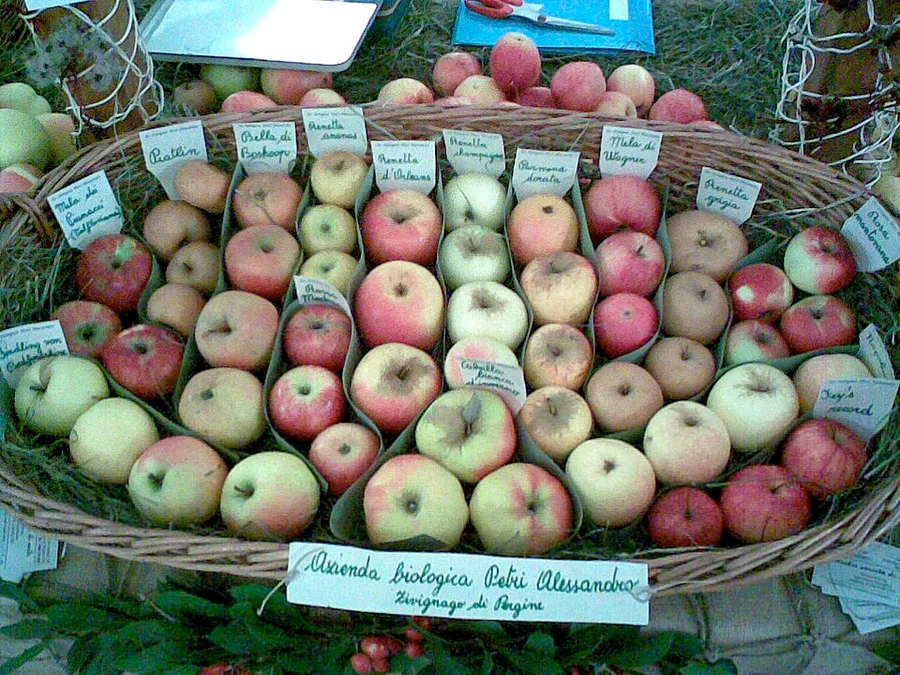
What is Val di Non Apple?
Mela Val di Non has been a protected DOP since 1996, the first Italian apple to get one. Three varieties qualify, and they behave very differently.
Golden Delicious accounts for most of the crop. Golden-yellow skin, usually with pronounced russeting around the stem, crisp flesh, sweet and aromatic with a tart edge that the same variety loses when grown on flat land. That russeting is not a flaw: it is how the skin reacts to sharp day-night temperature swings, and growers read it as a marker of altitude.
Renetta Canada is the opposite in every way: flattened, irregular, rough bronze-green skin russeted across the whole surface. It is tart, aromatic and slightly floury. This is the cooking apple, the one that goes into strudel and fritters, and it has been grown in the valley for over a century.
Red Delicious is the red one: conical, with five pronounced lobes at the base, crisp and sweet with low acidity and thick skin. Children like it, and it collapses when cooked.
Most of the crop is handled by Consorzio Melinda, formed in 1989 out of the valley's cooperatives, which is why in Italy the brand is better known than the designation. The two are not the same: Melinda also sells varieties outside the DOP rules, from Fuji to Pink Lady. The words to look for are Mela Val di Non DOP.
What does it taste like?
The common thread is snap. A mountain-grown apple is dense and hard, and it breaks under the tooth rather than compressing, a direct consequence of cool nights slowing sugar accumulation and keeping cell walls firm.
Golden Delicious from here tastes considerably better than the reputation of the variety elsewhere: honeyed and floral, with real acidity behind the sweetness instead of the flat sugariness of a lowland Golden.
Renetta is sharply tart, almost lemony, with a dry, faintly grainy flesh and a strong aroma that survives baking. Eaten raw it divides people; cooked, it is the reason the variety still exists.
Red Delicious is sweet, mild and low in acid: a crunchy eating apple with little complexity.
How to use it
Match the variety to the job: using the wrong one is the single most common mistake.
Renetta Canada is the baking apple. It holds its shape without collapsing entirely, releases acidity and aroma, and browns more slowly than the others. It is the apple for Trentino strudel, for apple fritters, for baked apples with butter and sugar, and for any tart where you want the slices to stay visible.
Golden Delicious is the everyday one: raw, in salads, in soft cakes, in compotes and juice. Its sweetness lets you cut the sugar in a recipe. Cooked long, it breaks down, which makes it ideal for purée and for the mustard-fruit preserves of northern Italy.
Red Delicious is for eating raw. Cooked it turns mealy and bland.
On the savoury side, these apples belong to alpine cooking: with game and roast pork, in horseradish and apple sauce, grated into sweet dumplings, and above all beside mountain cheese. A slice of raw apple with a piece of Puzzone di Moena and rye bread is standard mountain-hut fare.
One practical point: Renetta skin is thick and should come off for delicate dishes, while Golden skin can stay on in rustic tarts and baked halves, where it holds the slice together.
How long it keeps
An apple keeps breathing after picking, and everything about keeping it comes down to slowing that down. The consortium does it with controlled atmosphere stores at 1 to 2°C and very low oxygen, which is why Val di Non fruit is on shelves nearly all year. At home the crisper drawer at 0 to 4°C in a perforated bag is the closest equivalent, and Golden Delicious will hold four to eight weeks there. In a fruit bowl at room temperature the same apple runs through those changes several times faster, in one or two weeks.
What you see over that time: water escapes through the skin so the fruit loses weight and the surface wrinkles, most visibly on the russeted Renetta; the flesh moves from crisp to mealy as the cell walls soften; and the skin can turn faintly greasy as natural waxes come to the surface. Apples give off a lot of ethylene, so they hasten everything stored beside them and are best kept apart from leaf vegetables. Cut faces brown within minutes, and slices freeze for months only for cooking, since whole apples collapse.
Spot the real thing
Start with the sticker, because without it a Golden Delicious from the Val di Non and one from anywhere else look much the same in a crate. The fruit carries the DOP mark with the wording Mela Val di Non, usually alongside the Melinda consortium branding, and boxes state the growers association. Then look at the fruit itself: the mountain Golden carries a pink blush on the sun side that lowland ones do not, fine russeting round the stem and a dense skin flecked with lenticels. Pressed with a thumb it should not dent.
The DOP also covers Renetta Canada, which looks nothing like it: squat, irregular, with a rough matte green-brown russeted skin and a sharply acidic flesh meant for the oven. Red Delicious is the tall five pointed one. Abroad the confusion is almost entirely with generic Golden Delicious grown in France, Poland or South Tyrol, which sit in the same bins at a lower price. In Italy DOP apples run 1.80 to 2.80 euro a kilo; loose commodity Goldens cost noticeably less and carry no consortium sticker.
How to pronounce Val di Non Apple
MEH-lah del-lah val dee NOHN
Mela is two syllables, stress on the first. Non rhymes with the English 'known' without the w: a clean open o, not 'nun'. Renetta is reh-NET-tah. The valley name means the valley of the Anaunia, and locals say 'Val di Non' as three quick words.
Val di Non Apple compared
vsLowland apples (Po valley, Emilia, Veneto)
Same varieties, two hundred kilometres south and a thousand metres lower, and a genuinely different fruit. Warm nights on the plain mean the apple burns off less of its acidity overnight, colours less, and builds softer flesh. It also ripens earlier, stores worse and costs less.
| This | Lowland apples (Po valley, Emilia, Veneto) | |
|---|---|---|
| Altitude | 600-1,000 m | 0-200 m |
| Day-night swing | Large, sharpens acidity and colour | Small |
| Flesh | Dense, snaps | Softer, compresses |
| Skin | Russeted near the stem | Smooth and uniform |
| Keeping quality | Months in store | Shorter |
| Price | EUR 1.80-3/kg | EUR 1.20-2/kg |
vsSouth Tyrol apples (Mela Alto Adige IGP)
The next valley system north, over the Mendola pass, and Italy's other great apple region, larger and also mountain-grown, and protected as an IGP rather than a DOP. Quality is comparable and the growing logic is the same; the differences are in variety mix and in the level of legal protection.
| This | South Tyrol apples (Mela Alto Adige IGP) | |
|---|---|---|
| Protection | DOP (stricter origin link) | IGP |
| Varieties covered | Three | A dozen, Gala and Fuji included |
| Altitude | 600-1,000 m | 200-1,000 m |
| Scale | About 6,500 hectares | About 18,000 hectares |
| Signature apple | Renetta Canada | Gala and Golden |
vsClub varieties (Pink Lady, Jazz, Envy)
Trademarked apples grown under licence worldwide and bred for uniformity, sweetness and shelf life. They are consistent and often very good, but they are brands rather than places, and the same apple from Chile and from Trentino carries the same label.
| This | Club varieties (Pink Lady, Jazz, Envy) | |
|---|---|---|
| Defined by | Origin and altitude | Trademark and breeding programme |
| Grown where | One valley | Licensed growers worldwide |
| Acidity | High in Renetta, moderate in Golden | Usually low to moderate |
| Price | EUR 1.80-3/kg | EUR 3-4.50/kg |
Val di Non Apple substitutes
- Bramley (for Renetta)
The British cooking apple and the closest functional match: tart, aromatic, oven-proof. It breaks down more than Renetta, so cut the pieces larger.
1:1, cut larger - Reinette grise du Canada
The same apple under its French name, grown across France and Belgium. Identical use, identical unattractive russeted skin.
1:1 - Granny Smith
Universally available and reliably tart. Less aromatic than Renetta and firmer, so it needs a few more minutes of baking, but it will not let a strudel down.
1:1 - Braeburn or Honeycrisp (for Golden)
For raw eating and salads where you want crunch and balanced acidity. Honeycrisp is sweeter and crunchier, Braeburn sharper and closer to a mountain Golden.
1:1
Where to buy it
Outside Italy the DOP is hard to find as such. Trentino apples that are exported usually travel under the commercial brand or simply as Italian apples, and Italy is not a major apple exporter to the US, where domestic varieties dominate. In practice, the realistic route is Italian delicatessens and online Italian grocers in Europe, at roughly 3 to 5 euros a kilo, or 3 to 5 pounds a kilo in the UK. In Italy the same fruit is 1.80 to 3 euros a kilo.
If you want the variety rather than the origin, Renetta Canada is the one worth hunting: France and Belgium sell it as Reinette grise du Canada, and it is the apple that changes a strudel.
What to look for on the label: the EU DOP mark and the words Mela Val di Non DOP. The Melinda brand alone is not the designation: the consortium also markets varieties outside the rules.
And on the fruit itself: weight relative to size, no give under thumb pressure, and, in the case of Golden, russeting around the stem. A perfectly smooth, glossy, uniform Golden almost certainly came from flat land.
Where to eat it in Italy
Cles is the main town, and the valley's cooperative shops there and in Taio, Tuenno, Sanzeno, Coredo and Romeno sell direct, and in autumn they carry varieties that never reach supermarkets.
Segno, a hamlet of Predaia, has the consortium's visitor centre, where the industrial scale of the operation becomes clear and where you can see the system of cold stores dug into a disused dolomite mine inside the mountain.
The sanctuary of San Romedio, perched on a rock spur above the valley, and the lake of Tovel are the two classic outings, both surrounded by orchards.
Two windows are worth planning around. The last week of April and the first of May, when blossom turns the entire valley white, one of the more startling agricultural sights in Italy. Or late September and October, during harvest, when all three varieties are freshly picked and the Renettas are at their best.
Further reading
Frequently asked questions
Which varieties are covered by the Val di Non DOP?
Three: Golden Delicious, Renetta Canada and Red Delicious. Every other variety grown in the valley (Fuji, Gala, Pink Lady, Granny Smith) is outside the designation, even when sold under the consortium's commercial brand.
Why do Val di Non apples have rough skin around the stem?
It is russeting, a reaction of the skin to strong day-night temperature swings at altitude. Lowland Goldens do not develop it. It is not a defect and not a sign of treatment: growers read it as evidence of mountain origin, and a perfectly smooth glossy Golden probably did not come from the valley.
How heavily are Val di Non orchards sprayed?
Heavily, and it is worth stating plainly. This is intensive monoculture across roughly 6,500 hectares, and fungal pressure, apple scab above all, typically means somewhere between ten and twenty treatments a season. The full picture: nearly all production runs under integrated pest management protocols, pheromone mating disruption has sharply cut insecticide use against codling moth, and residues on the fruit are monitored and generally well below legal limits. The genuinely open question is spray drift towards homes, roads and schools in a valley where orchards run right up to the villages. That local debate has produced municipal rules on buffer distances and spraying hours, and a steadily growing organic share.
Which apple is best for strudel?
Renetta Canada, comfortably. It is tart, aromatic and holds its shape in the oven, and its ugly russeted skin has nothing to do with how it bakes. Golden works but gives a sweeter, softer filling; Red Delicious goes mealy.
When are Val di Non apples harvested?
Between mid-September and mid-October: Red Delicious first, then Golden in two or three passes as colour develops, then Renetta from late September. They are available all year because they are held in controlled-atmosphere stores, including the cells cut into the mountain at Predaia.
Sources
Where to check what you just read.
- 1
L'atto del 2003 che registra come DOP «Mela Val di Non»: la forma esatta del nome tutelato, senza l'articolo che si usa parlando.
- 2Consortium · interested partyConsorzio di tutela
Le tre sole varietà ammesse dalla DOP (Golden Delicious, Red Delicious, Renetta Canada) e il perimetro del bacino del Noce fra Val di Non e Val di Sole.
- 3
Il PDF ministeriale del disciplinare, con i parametri di durezza, zuccheri e acidità e le rese massime per ettaro che separano la DOP dalla mela comune.
Related foods
 CheesePuzzone di MoenaPuzzone di Moena means 'the big stinker of Moena', and the name is earned honestly: the rind is washed with…
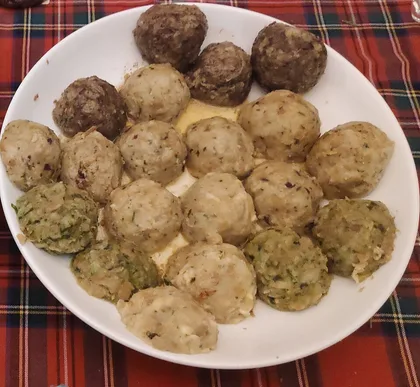 Pasta and breadCanederliIn the mountains nobody ever threw bread away, and canederli are the proof: stale white bread soaked in milk…
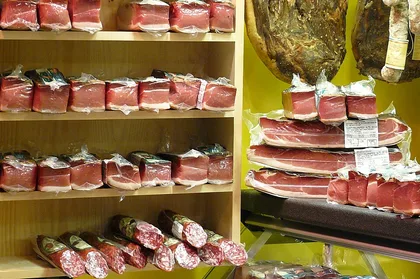 Cured meatsSpeck Alto Adige IGPA little salt, a little smoke, plenty of air: the South Tyrolean saying describes a method rather than a…
 CheeseAsiagoOne name covers two cheeses nobody would mistake for each other at the counter.
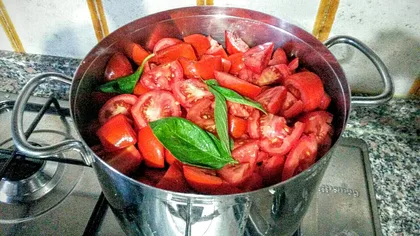 Vegetables and fruitSan Marzano TomatoesSan Marzano is a long, thin-skinned plum tomato grown in the volcanic plain between Naples and Salerno, and…Vegetables and fruitBergamotBergamot is the most geographically concentrated citrus on earth: around 90 per cent of world production…
 Vegetables and fruitCarnaroli RiceCarnaroli is the risotto rice with the highest amylose content: it sheds enough starch to build a creamy…Vegetables and fruitChestnutsFor a thousand years the Apennines made bread from them rather than dessert: Castanea sativa was the tree…