What is Bergamot?
Bergamot is Citrus bergamia, a fruit between an orange and a sour orange in size, round or slightly pear-shaped, with thin smooth skin that turns from deep green to full yellow as the season advances. Genetic work points to a hybrid of sour orange with lemon or citron, but its origin is unsettled and even the name has three competing etymologies.
The flesh is not the point. The peel is. Its essential oil (linalyl acetate, linalool, limonene, plus furocoumarins including bergapten) has a composition with no equivalent among citrus fruits: floral, sharp and bitter at once, instantly recognisable and notoriously hard to reproduce synthetically.
One precision worth having. The PDO registered in 2001 covers Bergamotto di Reggio Calabria - Olio essenziale: what is legally protected is the oil pressed from the peel, not the fresh fruit on a market stall. That tells you everything about the history of this citrus, farmed for three hundred years as an industrial raw material rather than as something to eat.
There are three cultivars. Femminello, the oldest, is round with thin skin. Castagnaro is larger, hardier and rougher-skinned. Fantastico, a selection out of Castagnaro, is now the dominant planting: high-yielding and regular in shape.
What does it taste like?
Scratch the skin and you get the smell of Earl Grey tea, because that is exactly what it is: floral, resinous, orange-adjacent but with a cool bitter edge that no other citrus has.
The juice is a different experience. It is sharply acidic, comparable to lemon, and layered over that is a persistent bitterness stronger than grapefruit. Undiluted, most people find it close to unpleasant. Diluted and sweetened, or used a spoonful at a time, it becomes the most interesting citrus in the kitchen.
The flesh is greenish or pale yellow, seedy, and not eaten in segments. Nobody in Calabria peels a bergamot and eats it.
How to use it
Rule one: do not drink the juice neat. It is bitter and very acidic, and it belongs in the kitchen as a seasoning rather than as a citrus. A few drops over raw fish, a spoonful in a vinaigrette, a tenth of the volume in a lemonade.
The zest is where the value sits. Microplaned over risotto, seafood pasta, pastry cream, panettone or a raw prawn tartare, it does something no lemon can. Add it off the heat: above about 70°C the aromatics leave with the steam.
The Calabrian preserves are marmalade, made from the peel after two or three changes of boiling water to pull out excess bitterness, and candied peel, usually dipped in dark chocolate. Beyond that: liqueurs, flavoured salt, and gelato, which in Reggio is on every serious counter.
In modern pastry, bergamot has become the bitter counterpoint of choice in white chocolate mousses and citrus creams, precisely because it brings more than acidity.
In drinks it is the most useful citrus there is: it replaces lemon in sours and stands up to juniper better than anything else. A strip of bergamot peel in a gin and tonic is the simplest demonstration.
One safety note. Bergamot furocoumarins, bergapten in particular, are phototoxic: essential oil on skin exposed to sunlight can cause burns and pigmentation, which is why cosmetics almost always use bergapten-free oil. Zest and juice in normal culinary quantities are not a concern.
How long it keeps
Whole fruit keeps about a week in a bowl at room temperature and two to four weeks in the fridge drawer at around 5 to 8 C, loose or in a perforated bag rather than sealed plastic, since trapped condensation softens the skin. The thick rind is what protects it, and what happens over time is dehydration: the surface dulls and goes leathery, the oil glands empty, the fruit gets lighter in the hand, and the perfume that made it worth buying is the first thing to go. Take the zest early rather than late.
Because the season is short, most of it is preserved rather than stored. Juice freezes well in ice cube trays for several months and keeps its acidity better than its aroma; zest freezes in a bag, and strips of peel freeze whole. A cut fruit goes back in the fridge with the face covered and dries and browns at the edge over a few days. Jars of marmalade, candied peel and bottles of essential oil all carry a date from the producer, which is the reference for those.
Spot the real thing
A bergamot is about the size of an orange, round to faintly pear-shaped, with a smooth thick rind that is yellow shading to green depending on when it was picked, from November through March. The perfume is the identification: scratch the peel with a thumbnail and it releases a floral, slightly bitter scent that no lemon or lime produces, the exact smell of Earl Grey tea. A heavy fruit for its size has juice in it, and that juice is sharply sour, closer to lime than to orange.
Several things share the name. In North American and British herb shops, bergamot often means bee balm, the garden flower Monarda, sold dried as a tisane and unrelated to citrus. Bitter Seville orange has a rougher, deeper orange skin and no floral top note. Bergamot flavouring in tea and confectionery is an essence, not the fruit. Fresh bergamot rarely reaches shops outside Italy and turns up at specialist greengrocers in winter at a price several times that of lemons, if it appears at all.
How to pronounce Bergamot
ber-gah-MOT-toh
Four syllables, stress on the third, with the double T held slightly: ber-gah-MOT-toh, not 'BER-guh-mot'. The English word bergamot for the oil is fine in English; the Italian fruit keeps the final vowel. Reggio Calabria is RED-joh kah-LAH-bree-ah.
Bergamot compared
vsLemon
The comparison people reach for first, and it holds only for acidity. Bergamot has similar sourness but adds a heavy floral aroma and a bitterness lemon does not have. Swap one for the other in a recipe and you change the character of the dish, not just its intensity.
| This | Lemon | |
|---|---|---|
| Species | Citrus bergamia | Citrus limon |
| Aroma | Floral, balsamic, bitter: the Earl Grey note | Bright, simple, clean |
| Bitterness | Strong, persistent | Slight, mostly in the pith |
| Juice drinkable neat | No | Diluted, yes |
| Main use | Peel oil for perfume and tea | Juice and zest for food |
vsCitron (cedro)
Another Calabrian citrus, grown a couple of hundred kilometres up the Tyrrhenian coast, and another fruit prized for something other than its juice. Citron is almost all pith and is candied; bergamot is prized for the volatile oil in a thin skin. Both are wrongly described as inedible, and both are simply used differently.
| This | Citron (cedro) | |
|---|---|---|
| Prized part | Thin oil-rich peel | Thick white pith |
| Juice | Small amount, very bitter | Almost none |
| Classic product | Essential oil, marmalade, candied peel | Candied peel, cedrata |
| Aroma | Floral and bitter | Clean, sweet, faintly floral |
| Where grown | Ionian coast of Reggio | Riviera dei Cedri, Cosenza |
vsSeville (bitter) orange
One of bergamot's likely parents, and the closest thing to it in behaviour: too bitter to eat, valued for peel and for marmalade, harvested in the same winter window. Seville is easier to find and cheaper, and it is the sensible substitute for bergamot marmalade, but it lacks the floral top note entirely.
| This | Seville (bitter) orange | |
|---|---|---|
| Bitterness | High, with floral lift | High, purely bitter |
| Aroma | Distinctive floral-balsamic | Orange, sharper and drier |
| Season | November to March | December to February |
| Best known for | Perfume, Earl Grey | Marmalade, curaçao |
| Abroad | Rare and brief | Widely sold in season |
Bergamot substitutes
- Meyer lemon zest plus a drop of orange blossom water
The best kitchen approximation of the aroma. The lemon supplies the acid, the flower water supplies the floral top note that ordinary citrus lacks.
Zest of 1 Meyer lemon plus 2-3 drops orange blossom water per bergamot - Seville (bitter) orange
The right choice for marmalade, candied peel and anything where the bitterness does the work. Same season, far easier to buy, no floral note.
1:1 by weight - Kaffir lime leaf or zest
Not remotely Italian, but the closest widely available match for that cool, perfumed, slightly soapy aromatic quality. Excellent in desserts and cocktails, wrong in marmalade.
Zest of 1 kaffir lime, or 2 leaves infused, per bergamot - Bottled bergamot juice
Calabrian producers sell pasteurised juice across Europe and it keeps for months unopened. It carries acidity and bitterness faithfully but loses much of the volatile aroma, so add zest if you have any.
1:1 by volume for juice - Earl Grey tea infusion
A real shortcut for creams, syrups and ice creams: steep good Earl Grey in the warm liquid, since the flavouring is bergamot oil. It brings tannin with it, so keep the infusion short.
2 tsp leaves per 250 ml, infused 4-5 minutes
Where to buy it
Fresh bergamot is a January-and-February purchase or nothing. In the UK it is the easier of the two markets: Natoora, Italian delicatessens and some Waitrose and Ocado listings carry Calabrian fruit for a few weeks in midwinter, at roughly 8 to 15 pounds a kilo. In the US it is scarce: Californian growers produce small quantities sold through specialty produce distributors and farmers' markets in Southern California, and Italian fruit rarely clears import rules. Expect 10 to 20 dollars a pound when it appears.
Out of season, buy the processed forms. Bottled Calabrian juice runs 8 to 16 euros a litre and keeps for months unopened; marmalade is 6 to 10 euros for a 200-gram jar; candied peel and bergamot salt travel well. Essential oil retails at 8 to 20 euros for 10 millilitres, and the price makes sense once you know the yield: about 200 kilos of fruit for one kilo of oil.
What to check: thin, smooth, glossy skin; green in November and yellow by February, both correct; and above all the smell when you scratch it. For oil, look for the Bergamotto di Reggio Calabria PDO reference and the consortium. The word bergamot on a label of sweets, drinks or cosmetics guarantees nothing: synthetic aroma and non-Italian oil are both common.
Where to eat it in Italy
The Ionian coast of the province of Reggio Calabria, between Melito di Porto Salvo, Condofuri, Bova Marina, Palizzi and Brancaleone. The groves are visible from the coast road, and several farms sell at the gate and run visits from December to February.
Bianco and Ferruzzano combine bergamot groves with the vineyards of Greco di Bianco, the local passito wine, which makes for the best single-day itinerary in the area.
Reggio Calabria itself has the Museo del Bergamotto, which keeps the historic extraction equipment: sponges and the nineteenth-century macchina calabrese included, and explains why the fruit was an industrial crop long before it was a culinary one. The city's gelaterie and pastry shops are the place to taste it made properly rather than as an industrial flavouring.
Go in January or February: peak harvest, fruit turning from green to yellow, and groves running down to the sea under the Aspromonte.
Further reading
Frequently asked questions
What does bergamot taste like?
The peel smells floral, citrusy and balsamic with a bitter edge: it is the flavour of Earl Grey tea and of most classic eau de cologne. The juice is sharply acidic and distinctly bitter, more so than grapefruit. It is not a fruit you eat in segments.
Can you drink bergamot juice straight?
You can, but few people enjoy it: it is intensely bitter and very sour. Use it as a seasoning: drops over raw fish, a spoonful in a dressing, a small fraction of a sweetened diluted drink.
Why is bergamot only grown in Calabria?
The coastal strip of Reggio Calabria combines mild winters, constant sea humidity, shelter from cold winds by the Aspromonte massif, and the loose deep soils of the seasonal riverbeds. The tree grows elsewhere (Ivory Coast, Argentina, Turkey) but the oil it yields there has a different and less prized aromatic profile. Around 90 per cent of world production stays in this hundred-kilometre strip.
When is bergamot in season?
November to March, with the peak between December and February. Fruit picked in November is green, fruit picked in February is yellow, and both are ripe. Outside that window you will only find juice, frozen zest and processed products.
Is bergamot the same as the flavouring in Earl Grey tea?
Yes. Earl Grey is black tea scented with bergamot essential oil. But many commercial blends use synthetic aroma or non-Calabrian oil, so the word bergamot on a tea packet says nothing about origin.
Sources
Where to check what you just read.
- 1
Il regolamento del 15 marzo 2001. Va letto con attenzione: la DOP registrata è «Bergamotto di Reggio Calabria - Olio essenziale», non il frutto fresco.
- 2
Le tre varietà ammesse (Femminello, Castagnaro e Fantastico), l'obbligo dell'estrazione a freddo, i comuni della fascia ionica e il limite di 450 piante per ettaro.
Related foods
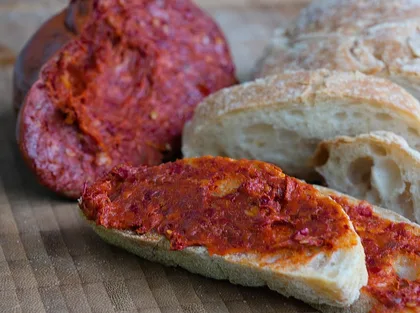 Cured meats'Nduja'Nduja is a soft, spreadable Calabrian pork salume that is up to 40% chilli.
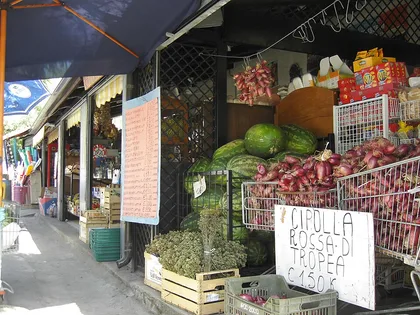 Vegetables and fruitTropea Red OnionTropea red onions are grown on a narrow strip of sand along Calabria's Tyrrhenian coast, and they are sweet…
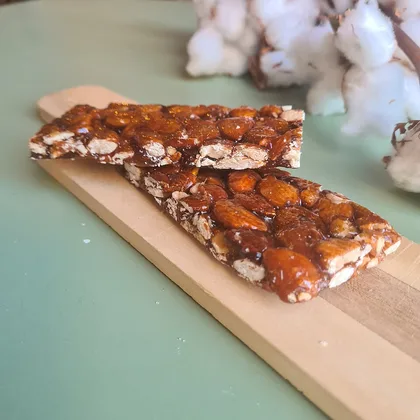 SweetsTorrone di BagnaraThe only Italian nougat with a European denomination: IGP since 2014.Vegetables and fruitCitron of Santa Maria del CedroYou do not eat the flesh of a citron: there is barely any and it is fiercely sour.Vegetables and fruitSila PotatoSila potatoes are grown above 1,000 metres on the granite plateau in the middle of Calabria.
 Cured meatsSoppressataSoppressata is a coarse-ground dry salami from southern Italy, pressed flat between boards while it dries…
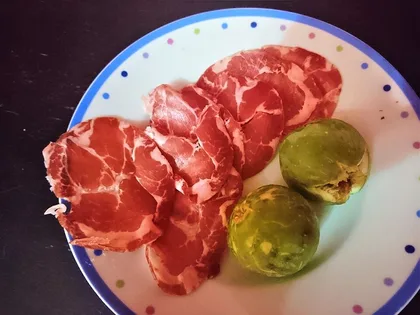 Cured meatsCapocolloCapocollo is the pork neck muscle, salted whole and aged in casing.
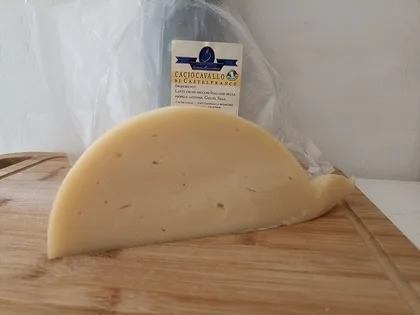 CheeseCaciocavalloCaciocavallo is a stretched-curd cow's milk cheese from southern Italy, aged in a distinctive gourd shape…