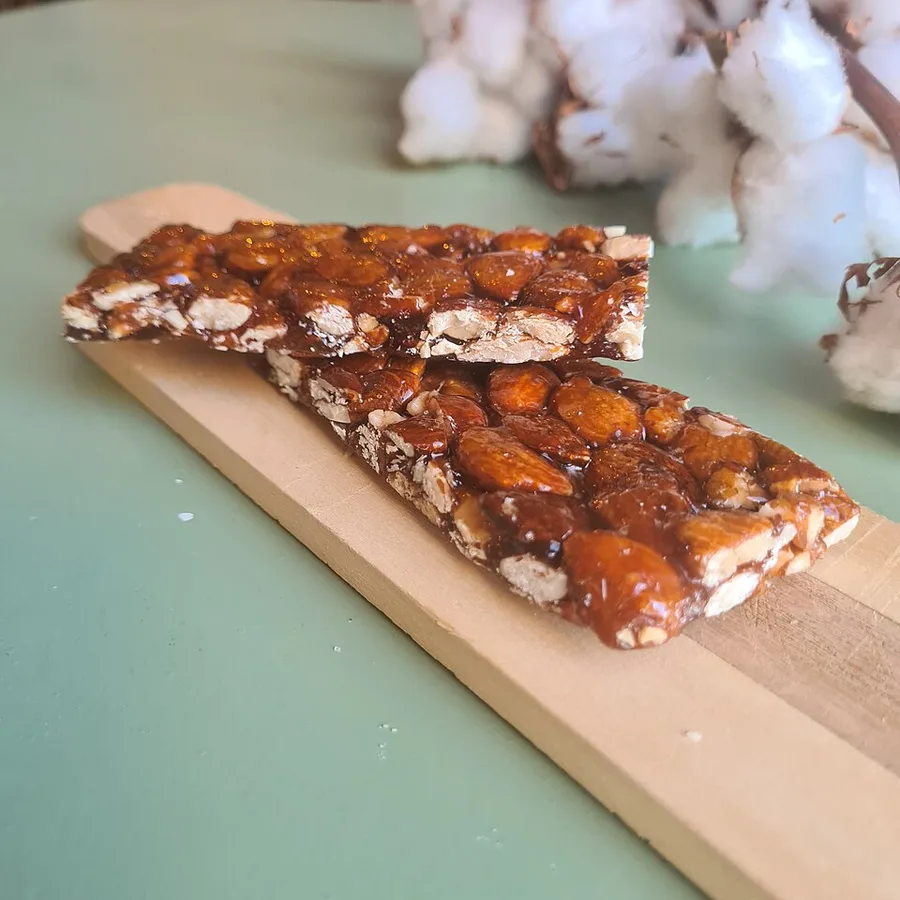
What is Torrone di Bagnara?
Torrone di Bagnara is honey, sugar and whole unpeeled almonds, spiced, cast into bars and cut into slabs. Its IGP status, granted in 2014, makes it the only Italian nougat with EU protection, and neither Cremona nor Benevento, the two names everyone knows, carries a European mark on its torrone.
Two decisions set it apart, and no other Italian nougat district makes both. The first is the unpeeled almond. The skins stay on, bringing a tannic bitterness that pushes back against the honey. Cremona and Benevento always blanch, because they want a clean pale interior; Bagnara leaves the almonds as they are, which is why a cut slab shows dark flecks instead of a white mosaic.
The second is structure. The Bagnara method does not build the mass on whipped egg white, which is the foundation of both the Lombard and the Campanian schools. Here the binder is sugar cooked with honey, and the result is dense, compact and brittle in a clean-snapping way rather than aerated or chewy.
There are two types and it is worth knowing which you are buying. The Martiniana is coated in bitter cocoa and cinnamon, with cloves in the mix: dark, spiced, with a bitter finish. The Torrefatto glassato is toasted in the oven and then coated in a sugar syrup that vitrifies as it cools into a thin, matte, crackling shell.
What does it taste like?
Darker and much less sweet than any nougat most people have met. The honey is the dominant flavour, not sugar, and the almond skins add a dry bitterness underneath it that keeps the whole thing from cloying.
The Martiniana leads with cocoa and cinnamon on the outside, powdery and slightly dusty on the lips, before the honey and clove arrive. The finish is genuinely bitter, closer to dark chocolate than to a confection. The Torrefatto glassato is the sweeter of the two, but the oven toasting takes the almonds to a roasted, nearly coffee-like depth and the glaze shatters instead of dissolving.
Texture is dense and brittle. There is no give and no chew: it breaks cleanly and the almonds crunch. If a piece is spongy, aerated or sticks to your teeth, it belongs to a different tradition.
How to use it
Eat it as it comes, in small pieces, at the end of a meal or with coffee in the afternoon. It is dense and spiced, so twenty or thirty grams per person is a serving.
Serve it at room temperature. Straight from the fridge it turns unpleasantly hard and loses its aroma, a mistake people make in summer, when the instinct is to keep it cool.
Cut it with a smooth-bladed knife warmed under hot water and dried. A serrated knife crumbles a mass this compact, and on the Martiniana it takes the cocoa coating off with it.
In the kitchen, the best use is as granella: roughly chopped over fiordilatte gelato or folded into a semifreddo, where it brings crunch, almond and spice at once. Crumbled over fresh sheep's ricotta with a thread of honey it makes a dessert in five minutes.
The Martiniana also holds up in a savoury context, not traditional in Calabria, but it works. Shave it over aged pecorino, where the bitter cocoa bridges the honey and the salt.
How long it keeps
Room temperature, somewhere cool and dry, in its own wrapper or a closed container. Six to eight months for the Torrefatto glassato, a little less for the Martiniana, whose cocoa coating takes up surrounding smells readily. The date on the wrapper is the producer's own.
Damp is the real variable. Torrone is hygroscopic: in a humid room the surface turns tacky, the glaze loses its glassy set and the cocoa coating cakes into a paste. An airtight container handles nearly all of that. Skip the fridge, where the cold hardens the sugar and honey mass past the point where it eats well, and the condensation that forms as it returns to room temperature marks the surface of both versions.
Above 25°C (77°F) the bars soften and stick to each other, so in summer keep them separated with sheets of baking paper. Freezing is possible with no real gain: room-temperature storage covers the whole useful life. What sets the limit is the almonds, whose oil slowly oxidises and flattens the roasted note.
Spot the real thing
Look at the cut face. The almonds should be whole, plentiful and still wearing their dark skins: a white, uniform mosaic inside means blanched almonds and a different method from the one used in Bagnara.
Weigh a bar in your hand. This torrone is heavy for its size, because no whipped egg white has put air into it. A light bar riddled with small holes belongs to the soft Cremona and Alba school, which is the version most shops abroad stock.
On the Martiniana, check the coating: it should be a powder of cocoa and cinnamon that sticks to your fingers, not a smooth glossy chocolate shell. Chocolate coating is the signature of the Benevento torroncini, not of this product. On the Torrefatto glassato, the surface should be matte, thin and slightly uneven, and it should crack under the teeth. A thick, shiny, perfectly even glaze is an industrial coating.
Last, look for the IGP mark and the words Torrone di Bagnara on the wrapper. The word torrone on its own guarantees nothing.
How to pronounce Torrone di Bagnara
tor-ROH-neh dee ba-NYAH-rah
Stress on the second syllable in both words. The double 'r' in torrone is rolled slightly and held. In Bagnara the 'gn' is a single sound, like the 'ny' in canyon: ba-NYAH-rah, not 'bag-NAR-a'. Martiniana is mar-tee-NYAH-nah, with the same 'ny'.
Torrone di Bagnara compared
vsTorrone di Cremona
The famous one, and structurally the opposite product. Cremona builds its nougat on honey and whipped egg white cooked over a water bath for eight to twelve hours, with blanched almonds and wafer sheets top and bottom, producing a pale, hard, glassy bar. Bagnara skips the egg white entirely, leaves the almond skins on, spices the mix and finishes it with cocoa or a sugar glaze. Cremona has the older reputation and vastly bigger volumes; Bagnara has the European denomination.
| This | Torrone di Cremona | |
|---|---|---|
| Egg white | None | Whipped, the structural base |
| Almonds | Whole, unpeeled | Blanched, peeled |
| Colour inside | Dark, flecked | Pale ivory |
| Texture | Dense, brittle, clean snap | Hard, glassy, shatters |
| Wafer | None | Ostia sheets top and bottom |
| Finish | Cocoa and cinnamon, or sugar glaze | Bare |
| Protection | IGP since 2014 | None at EU level |
vsTorrone di Benevento
The Sannio school, and the other name that dominates the Italian market. Benevento cooks for a shorter time and keeps more sugar relative to honey, giving a softer, more friable bar, and it built its identity on single-portion croccantini enrobed in dark chocolate, a technique perfected at San Marco dei Cavoti in the late nineteenth century. Bagnara's cocoa coating is a dusting, not an enrobing, and the bar underneath is denser and more bitter.
| This | Torrone di Benevento | |
|---|---|---|
| Texture | Dense, brittle | Softer, friable, crumbly |
| Coating | Cocoa powder and cinnamon, or sugar glaze | Dark chocolate enrobing |
| Format | Slabs cut from a bar | Single-portion croccantini |
| Spices | Cinnamon, cloves | Usually none |
| Sweetness | Lower, honey-led | Higher, sugar-led |
vsMartiniana vs Torrefatto glassato
The internal choice, and the one to make before you buy. Both start from the same honey-and-almond mass. The Martiniana is finished by hand in bitter cocoa and cinnamon and carries cloves in the mix, which makes it the darker, drier, more bitter of the two. The Torrefatto glassato goes into the oven first, which roasts the almonds and concentrates the sugars, then takes a sugar-syrup coat that sets into a thin vitrified crust. If you want spice, take the Martiniana; if you want crunch and roast, take the Torrefatto.
| This | Martiniana vs Torrefatto glassato | |
|---|---|---|
| Extra step | Hand-dusted after cutting (Martiniana) | Oven-toasted, then glazed |
| Coating | Bitter cocoa and cinnamon | Vitrified sugar glaze |
| Spices | Cloves in the mix | None or minimal |
| Finish | Bitter, dry | Sweeter, roasted, crackling |
| Price | Lower of the two | Higher: double process |
Torrone di Bagnara substitutes
- Nougat noir de Provence
The closest thing outside Italy and closer than any Italian nougat. French black nougat is caramelised honey and almonds with no egg white, so it shares Bagnara's density and clean snap. It lacks the spices and the skins, so add a pinch of cinnamon if you are using it in a dessert.
1:1 - Turrón de Alicante
The Spanish hard nougat, and a fair stand-in for texture. It uses whipped egg white and blanched Marcona almonds, so it is paler, sweeter and airier, so expect a lighter bar for the same volume and a much less bitter finish.
1:1 by weight, reduce added sugar in any recipe - Torrone di Cremona, hard type
Available everywhere Italian food is sold. Structurally different (egg white, blanched almonds, wafer sheets) so use it where you need the crunch of nougat rather than the spice. In a granella for gelato it works; as a direct swap on a cheese board it does not.
1:1 as granella, not recommended neat - Croccantino di San Marco dei Cavoti
The chocolate-enrobed Sannio croccantino. Sweeter, softer and dominated by the chocolate coating, but the almond-and-honey core is recognisably related. The best substitute if what you liked about the Martiniana was the cocoa rather than the bitterness.
1:1 by count - Pasteli
The Greek honey-and-sesame bar. No almonds and no spice, but the same principle of cooked honey as the only binder, and the same dense brittle break. Useful if you need something honey-led and egg-free rather than nougat specifically.
1:1 by weight
Where to buy it
In Bagnara itself, from the handful of family workshops along the main street, at 25 to 40 euro a kilo. The Torrefatto glassato usually costs more than the Martiniana because the oven-toasting and glazing add a second full process. Single slabs run 4 to 8 euro depending on size.
Elsewhere in Italy, specialist grocers and the producers' own online shops add twenty to thirty per cent. Calabrian nougat that does not follow the IGP specification sits at 10 to 18 euro a kilo, and the gap is mostly almond percentage and how much of the honey has been replaced by plain sugar.
Abroad it is genuinely rare. Italian importers in the US carry it at roughly 18 to 30 dollars a pound; in the UK expect 30 to 50 pounds a kilo, usually only in Christmas gift boxes. Production is small and export has never been a priority for the town's workshops.
Check the wrapper for the IGP mark and the words Torrone di Bagnara. The word torrone on its own guarantees nothing, and plenty of Calabrian nougat has no connection to the specification.
Where to eat it in Italy
Bagnara Calabra is a town of a few thousand people on the Costa Viola, the stretch of Tyrrhenian coast between Scilla and Palmi in the province of Reggio Calabria, built on two levels linked by steep flights of steps. The nougat workshops are almost all on the main street and sell directly; ask to see the laboratory and they will usually show you.
December is the moment, when production peaks for Christmas and both types fill the windows. Easter is the second peak.
The coast justifies the trip on its own. Scilla is eight kilometres away, with the fishermen's quarter of Chianalea built on the water and the Ruffo castle on the headland; Palmi lies the other way, looking across the Strait to Sicily and, on clear days, to the Aeolian islands. Bagnara is historically a swordfish town, and in summer that is the other half of its identity.
Reggio Calabria, where the Riace Bronzes are, is half an hour down the line on one of the most spectacular stretches of coastal railway in Italy.
Further reading
Frequently asked questions
Why is Torrone di Bagnara the only Italian nougat with a European denomination?
Because it is the only one to have obtained one: IGP status granted in 2014, which fixes the production area, the ingredients and the two historic types. Cremona and Benevento have older traditions and far larger volumes, but no EU mark on their torrone.
What is the difference between Martiniana and Torrefatto glassato?
The Martiniana is hand-coated in bitter cocoa and cinnamon and has cloves in the mix, making it darker, drier and more bitter. The Torrefatto glassato is oven-toasted and then dipped in sugar syrup that vitrifies into a thin crackling crust, making it sweeter and more roasted.
Why are the almonds left unpeeled?
Because the skins bring a tannic bitterness that balances the honey, and it is an identifying choice of the Bagnara method. You can see it in a cut slab: dark flecks through the mass rather than the uniform white mosaic of blanched-almond nougat.
Is it hard or soft nougat?
Dense and brittle, but not glassy like hard Cremona torrone. The Bagnara method does not whip egg white into the mass, so there is no air in it: the bar is compact, snaps cleanly, and gets its crunch from whole almonds.
How do you pronounce Bagnara?
ba-NYAH-rah, with the 'gn' as a single sound like the 'ny' in canyon and the stress on the second syllable. The full name is tor-ROH-neh dee ba-NYAH-rah.
Sources
Where to check what you just read.
- 1
Il regolamento del 31 luglio 2014 che registra «Torrone di Bagnara» come IGP: è il primo torrone italiano a ottenere la protezione europea.
- 2
Le due sole versioni ammesse (Martiniana con lo zucchero in grani e Torrefatto glassato con il cacao amaro), con dimensioni, peso del pezzo e ingredienti obbligatori.
Related foods
 Cured meats'Nduja'Nduja is a soft, spreadable Calabrian pork salume that is up to 40% chilli.
 Vegetables and fruitTropea Red OnionTropea red onions are grown on a narrow strip of sand along Calabria's Tyrrhenian coast, and they are sweet…
 Cured meatsSoppressataSoppressata is a coarse-ground dry salami from southern Italy, pressed flat between boards while it dries…
 Cured meatsCapocolloCapocollo is the pork neck muscle, salted whole and aged in casing.
 CheeseCaciocavalloCaciocavallo is a stretched-curd cow's milk cheese from southern Italy, aged in a distinctive gourd shape…Vegetables and fruitBergamotBergamot is the most geographically concentrated citrus on earth: around 90 per cent of world production…
 Fish and seafoodStoccafissoStoccafisso is cod air-dried on wooden racks in the Norwegian Lofoten Islands, with no salt at all, until it…