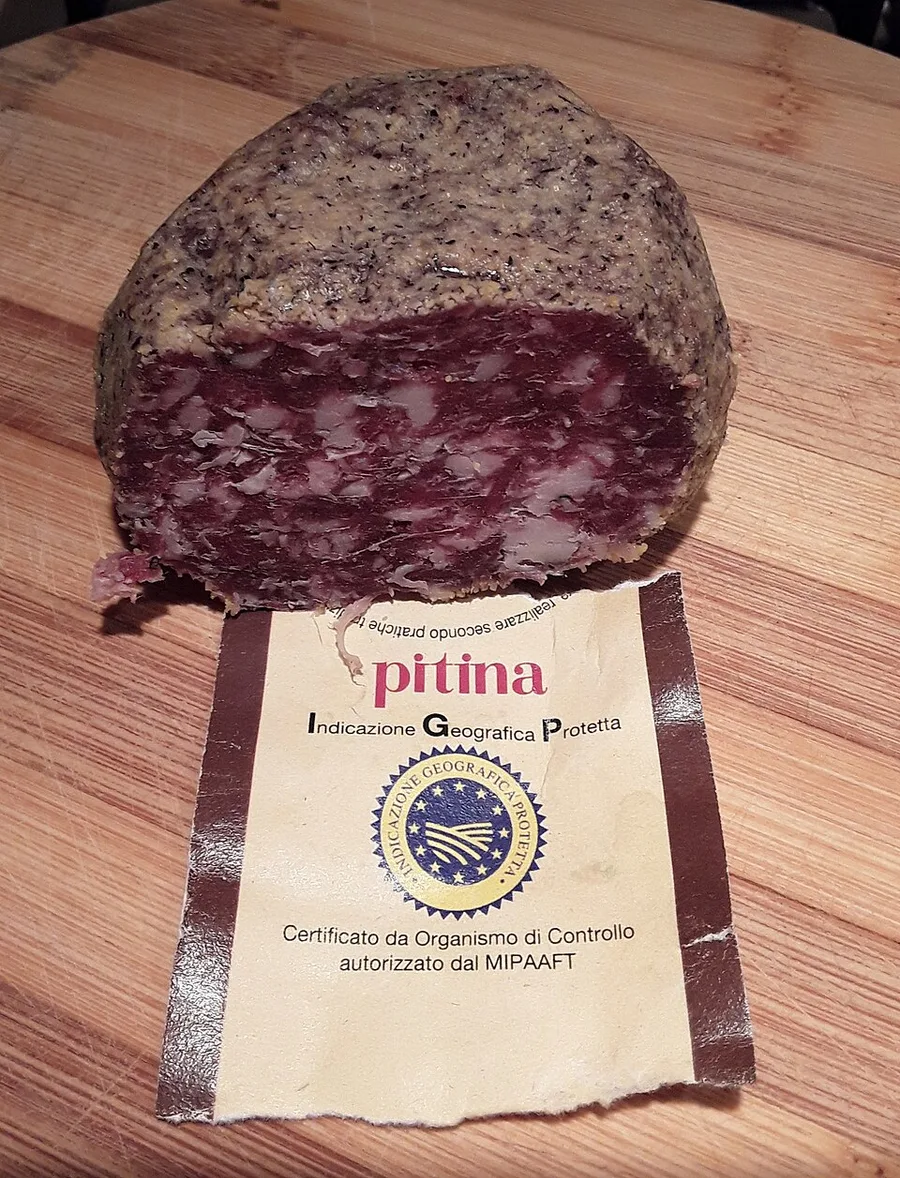
What is Pitina?
Pitina is minced meat, mixed with pork fat and spices, pressed by hand into a flattened ball the size of a fist, rolled in cornmeal and hung in the chimney to smoke. Then it dries for thirty to sixty days. No casing, no mould, no press: none of the things that normally make a salume a salume.
That absence is the whole story. Italian charcuterie is built on the gut casing, which contains the mince, shields it and regulates how it loses moisture. Pitina solves the same problem with two substitutes: a shell of cornmeal that protects the surface, and hearth smoke that keeps it clean. The reason is economic. In the poor valleys of western Friuli there were very few pigs, and no pigs means no casings.
The meat was whatever the mountain provided: roe deer, chamois, red deer, or old sheep and goats at the end of their working lives. The fat had to come from a pig, because game is extremely lean and without fat the mixture will neither bind nor keep. The usual ratio today is four parts lean meat to one part lard or pancetta.
Slow Food created a Presidium to keep alive a production that had nearly disappeared by the 1990s, and in 2018 the name was recognised at European level as an IGP. There are still only around ten producers.
What does it taste like?
Wild, smoky and juniper-heavy, with a texture between a coarse salami and a firm terrine. The mince is medium-ground, so you feel individual grains of meat rather than a smooth paste, and small white specks of pork fat run through it.
Juniper is the signature. It comes through resinous and slightly bitter, the way it does in gin, and it is doing a job: it was the traditional way to soften the gaminess of roe deer and old mutton. Behind it are garlic, black pepper and wild fennel, and behind those the smoke, which is present but restrained.
The cornmeal crust adds a faint toasted note and a visual signature: every slice has a thin yellow rim around a dark red centre. Young pitina, eaten raw, is softer and more aromatic. Older pitina is drier and more concentrated, which is why the valley cooks it rather than slicing it.
How to use it
Young pitina, under about forty days, is sliced thin with a sharp knife and eaten raw, like any cured sausage: a little olive oil and rye bread is all it needs.
Older pitina is drier and wants heat. The traditional Val Tramontina preparation is pitina all'aceto: bring water and vinegar to a simmer in a wide pan, drop in the slices for a minute or two, and serve them boiling hot over freshly poured polenta. The acid cuts the fat, the heat softens the meat, and the polenta echoes the cornmeal crust.
The other classic is broth. Lower a whole pitina into simmering water with vegetables for half an hour, then slice it and serve it in its own broth with polenta alongside. That is Sunday lunch in the valley in winter.
Outside tradition, crumble it into a pasta sauce where it replaces sausage and adds smoke; float slices in a barley and bean soup; or dice it into scrambled eggs, which is the fastest way to understand what it does.
How long it keeps
A whole pitina is a dried and smoked piece and keeps the way those do: hung in a cool, airy, dark place at around 10 to 14 C, loose rather than wrapped in plastic, where it goes on losing water for weeks. The ball shrinks and hardens from the outside in, the cornmeal coat dries and some of it flakes away, the surface darkens further, and the flavour concentrates toward smoke and salt. Younger ones slice thin; older ones are firm enough to be cut into cubes.
Once it is cut the exposed face is bare mince with no casing to protect it, so it dries fastest of anything on the piece. Cover just that face with paper, keep it at 0 to 4 C, and use it within a week or two; the surface will darken and form a rim that is trimmed before the next cut, and the fat shifts from white toward ivory as it oxidises. Vacuum packs carry a date from the producer, which is the reference for those. Freezing coarsens the fat and softens the texture, so it is not the usual route.
Spot the real thing
Nothing else on a counter looks like it. Pitina is a ball, slightly flattened, roughly the size of a fist and weighing between a hundred and three hundred grams, and it has no casing at all: the outside is a coat of yellow cornmeal pressed onto the surface, darkened where the smoke has worked on it. Pick it up and it smells of woodsmoke and juniper before anything else. Cut across, the mince is coarse and dark, red-brown rather than pink, flecked with white pork fat, with pepper, garlic and wild fennel through it. The IGP mark and the Friulian origin should be on the tag, along with the meat used, sheep, goat or game.
The local names shift by valley, so peta and petuccia are the same idea at different sizes. There is nothing abroad that stands in for it. Smoked sausages are in casings and industrially cured; game salami is a cylinder; a raw meatball is a raw meatball. Production is very small, most of it stays in the Pordenone valleys, and where it appears elsewhere it is priced accordingly and sold whole rather than sliced.
How to pronounce Pitina
pee-TEE-nah
Three syllables, stress on the middle one. Both 'i' sounds are the 'ee' of 'seen', never the 'i' of 'pit'. The plural is 'pitine', pee-TEE-neh. The larger version is peta, 'PEH-tah', and the small one petuccia, 'peh-TOO-chah'.
Pitina compared
vsSalame
Both are cured minced meat, and that is where the resemblance stops. A salame is stuffed into a casing, which controls drying and gives it its cylindrical shape; pitina is hand-formed and coated in cornmeal because casings were unavailable. Salame is pork; pitina is game or mutton with pork fat added. Salame is never smoked in most of Italy; pitina always is. The practical difference is that pitina can be cooked, and often is, while a salame almost never is.
| This | Salame | |
|---|---|---|
| Casing | None: a cornmeal crust instead | Natural or synthetic gut casing |
| Meat | Roe deer, chamois, red deer, sheep, goat | Pork, almost always |
| Fat | Pork lard added, about 20% | Pork fat from the same animal, 25–30% |
| Smoke | Always, lightly, over the hearth | Rare outside the far north |
| Shape | Flattened ball, 100–500 g | Cylinder, 300 g to several kilos |
| Ageing | 30–90 days | 1–12 months |
| Cooked | Frequently: in vinegar, in broth | Almost never |
vsSmoked sausage (kielbasa, andouille, Räucherwurst)
Closer in flavour than salame, but a different category of food. Smoked sausages are usually hot-smoked, sometimes partly cooked, and are meant to be heated through before eating. Pitina is cold-smoked over a domestic hearth and then air-dried until it loses a third of its weight, which makes it a preserved product you can eat raw when young. It is also far leaner, since the base is game rather than pork shoulder.
| This | Smoked sausage (kielbasa, andouille, Räucherwurst) | |
|---|---|---|
| Smoking | Cold, a few days over the hearth | Hot or warm, hours |
| Drying | 30–90 days, loses about a third of its weight | Minimal or none |
| Eaten raw | Yes, when young | No |
| Base meat | Lean game or mutton | Fatty pork, sometimes beef |
| Form | Ball, no casing | Link, in casing |
| Seasoning | Juniper, garlic, wild fennel, pepper | Paprika, marjoram, garlic, caraway by tradition |
vsMeatballs (polpette)
Pitina looks like a meatball and is sometimes described as one, which causes real confusion. A polpetta is fresh mince bound with bread and egg, cooked the day it is made and eaten hot. Pitina contains no bread and no egg, is preserved by salt, smoke and drying rather than by cooking, and keeps for months. Calling it a cured meatball is accurate; expecting it to behave like one is not.
| This | Meatballs (polpette) | |
|---|---|---|
| Binder | None: fat and salt bind the mince | Bread, milk, egg |
| Preservation | Salt, smoke, 30–90 days of drying | None, eaten fresh |
| Shelf life | Months | Two days |
| Eaten | Raw sliced, or reheated in vinegar or broth | Cooked and served hot |
| Exterior | Cornmeal crust, smoked | Browned in the pan or in sauce |
Pitina substitutes
- Venison or wild boar salami
The closest widely available option: same lean game base, same need for added pork fat, similar juniper-and-garlic seasoning. It lacks the smoke and the cornmeal crust, so for cooked dishes add a pinch of smoked salt.
1:1 - Landjäger
The Swiss and southern German smoked, pressed, air-dried snack sausage. Leaner and smokier than salami and closer to pitina in how it is preserved. Easy to find in German delis in the US and UK. Slice it thin rather than eating it in sticks.
1:1 - Smoked mutton or lamb
For the ovine version of pitina, Icelandic hangikjöt or any cold-smoked cured mutton gets the register right: gamey, smoky, salty. It is a whole muscle rather than a mince, so use it on a board rather than in the vinegar-and-polenta preparation.
1:1 - Make your own
The most satisfying route, and genuinely feasible. Mince 800 g venison with 200 g pork back fat, season with salt, crushed juniper, garlic, wild fennel and black pepper, form into flattened balls, roll in fine polenta flour, cold-smoke for a few hours and hang in a cool, airy place for a month.
4 parts lean meat to 1 part pork fat - Pork-free version
Traditional pitina uses pork fat, but the binding fat is the only pork in it. Producers who work exclusively with sheep sometimes use mutton fat instead, and the result holds together perfectly well, if slightly stronger and slightly waxier. Worth asking for if pork is a constraint.
1:1 - Vegetarian: smoked mushroom and lentil patty
Not a substitute so much as a parallel. Blend cooked brown lentils with hard-seared, smoked king oyster mushrooms, juniper, garlic and fennel seed, form into flattened balls, roll in polenta flour and bake slowly. It takes the vinegar-and-polenta treatment surprisingly well.
Where to buy it
In Italy, buy it from producers in Tramonti di Sopra, Tramonti di Sotto, Meduno and the Val Colvera, or from serious delicatessens in Pordenone and Udine. Look for the Slow Food Presidium mark and for the declared meat: much of the commercial production now uses only mutton, which is cheaper and available year round.
Outside Italy it is close to unobtainable. When it appears through specialist importers it runs 24 to 34 dollars per pound in the US and 38 to 52 pounds per kilo in the UK. Several Val Tramontina producers ship within Italy and the EU, which is the practical route for European buyers.
One pitina weighs 200 to 300 grams and costs 9 to 15 euro at source. The larger peta from Meduno costs slightly less per kilo because it yields better; the small petuccia costs more and is eaten sooner.
Where to eat it in Italy
The Val Tramontina, in the province of Pordenone, inside the Friulian Dolomites nature park. Tramonti di Sopra and Tramonti di Sotto sit on Lake Redona, a reservoir under which the old village lies, and in dry periods its bridge and cemetery reappear. Valley osterie serve pitina both raw and on polenta.
Around it, the Val Colvera with Frisanco and Poffabro, one of the best-preserved stone villages in Friuli; Meduno and Cavasso Nuovo, home of the larger peta; Andreis and Barcis on its turquoise lake; Claut and Erto e Casso above the Vajont dam. The whole production area fits inside a few dozen kilometres of mountain road.
Summer village festivals across the valley are the easiest way to taste several versions without tracking down producers one by one. It is roughly ninety minutes from Udine and two hours from Venice, and it sees a fraction of the visitors those cities do.
Further reading
Frequently asked questions
What is pitina?
A cured, smoked meatball from the Friulian Dolomites. Minced game (roe deer, chamois, red deer) or mutton and goat is bound with about twenty per cent pork fat, seasoned with juniper, garlic, wild fennel and pepper, rolled in cornmeal, cold-smoked over an open hearth and air-dried for one to three months.
Why is pitina rolled in cornmeal?
Because it has no casing. The cornmeal forms a shell that keeps insects off, slows the surface from drying too fast and cracking, and holds the smoke. It exists because pigs, and therefore gut casings, were scarce in these valleys, so the technique had to be invented around the shortage.
Is pitina eaten raw or cooked?
Both, depending on age. Under about forty days it is sliced thin and eaten raw like a salami. Older and drier, it is cooked: the traditional method is simmering the slices briefly in water and vinegar and serving them over hot polenta, or poaching the whole ball and serving it in its broth.
Is pitina a meatball?
In shape, yes; in behaviour, no. It contains no bread and no egg, it is preserved by salt, smoke and drying rather than by cooking, and it keeps for months. A meatball is fresh mince eaten the day it is made.
How do you pronounce pitina?
pee-TEE-nah, with the stress in the middle and both vowels as the 'ee' in 'seen'. Two related products share the name: peta, 'PEH-tah', which is larger, and petuccia, 'peh-TOO-chah', which is smaller.
Related foods
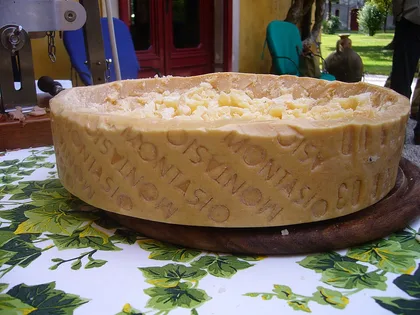 CheeseMontasioMontasio DOP is Friuli's cheese: cow's milk, semi-cooked curd, wheels of 6 to 8 kilos and an ageing ladder…Pasta and breadPolenta TaragnaPolenta taragna is the dark alpine polenta of Lombardy: cornmeal cut with buckwheat flour, stirred for the…
 Cured meatsSalsicciaCoarsely ground pork, salt, pepper, wine and usually garlic, packed into natural hog casing and sold raw.
 Cured meatsProsciutto di San DanieleProsciutto di San Daniele DOP is made in one town in Friuli from two ingredients: pork leg and sea salt.
 SweetsTiramisuNothing here goes near an oven. Savoiardi dipped in cold espresso, raw egg yolk whipped with mascarpone…
 WineProseccoProsecco is made from Glera grapes by the Martinotti tank method, not the traditional bottle method used for…
 SweetsGubanaA long strip of enriched leavened dough rolled around walnuts, raisins, pine nuts and grappa, then coiled…
 Cured meatsMortadellaThe white cubes are not just any fat: they are jowl, the firmest part of the pig, and they stay whole…