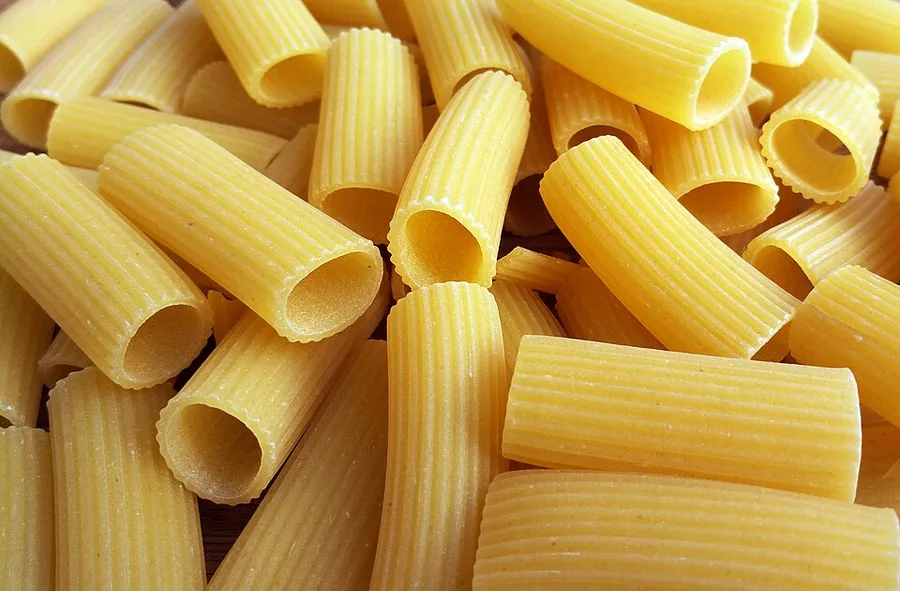
What is Rigatoni?
Rigatoni is dried durum wheat pasta extruded as a cylinder with ridges running parallel to its axis, then cut at a right angle. Outside diameter runs 12 to 15mm, length 40 to 45mm, wall thickness 1.2 to 1.5mm. The name comes from rigato, ridged.
Each of those numbers does a job. The thick wall lets the tube hold its own shape when cooked, while a thin-walled tube flattens under a fork and becomes a ribbon. The wide bore lets sauce move into the tube while you toss it in the pan, and stay there. The ridges, usually twelve to twenty on a standard rigatone, add roughly 25% more contact surface than a smooth tube of the same gauge, and more importantly they create channels where sauce parks instead of washing off.
The straight cut is the detail nobody thinks about and the one that matters most. A tube cut at a right angle presents two round, fully open mouths and sauce enters from both. A tube cut on the diagonal, like penne, presents two ellipses that tend to point downward in the pan and drain themselves. That is why the same carbonara tastes richer on rigatoni than on penne with an identical sauce.
What does it taste like?
Rigatoni is about chew and volume rather than flavour. A properly cooked one gives real resistance, because the thick wall means there is a lot of pasta between your teeth, and each piece carries a mouthful of sauce inside it, so the eating rhythm is very different from a long strand: bite, then a small flood.
The wheat flavour depends on the maker. Slow-dried bronze-cut rigatoni tastes nutty and faintly sweet and holds a chalky centre at the wall. Fast-dried supermarket pasta tastes of very little, though on a heavy ragù you will notice it less than you would on a bare olive-oil sauce.
The visible difference is worth knowing: pick up a piece of good rigatoni after tossing and the ridges should still be coated, with sauce visible inside the tube. If the sauce has run off and pooled in the bowl, either the pasta is smooth-surfaced or the sauce is too thin for the shape.
How to use it
Use plenty of water, four quarts per pound, because the shape is bulky and the tubes wedge inside each other when crowded. Salt once it boils.
Drain two minutes short of the box time and finish in the pan with a ladle of pasta water. On this shape that step is not a flourish, it is when sauce actually gets inside the tubes. Move the pan back and forth rather than stirring with a spoon, which cracks the walls.
The sauces that suit rigatoni have two components: something creamy and something in small pieces. Carbonara, where the egg and pecorino emulsion grips the ridges while strips of guanciale end up inside the tubes. Amatriciana and gricia for the same reason. Rigatoni con la pajata, the Roman classic made with milk-fed veal intestine that thickens into a sauce as it cooks. Umbrian norcina with crumbled sausage and cream. Pork ragù, provided the meat is cut small enough to enter the bore.
Baked, rigatoni is hard to beat: the ridges hold béchamel, the tubes fill with ragù and the thick wall survives forty minutes in the oven. What it does not suit is anything thin: aglio e olio, clam sauce, a loose pesto. A sauce without body runs straight off the ridges and sits at the bottom of the bowl.
How long it keeps
Sealed, in a cupboard away from light, heat and damp, a pack of dry rigatoni runs to the date printed on the box, usually two or three years out. That date belongs to the maker; what you can observe is that the smell of wheat fades over time and the pasta tastes of less. The cupboard directly above the hob is the worst spot in the kitchen, because heat and steam get into the box. Once the pack is open, tip it into an airtight jar: open bags in a warm kitchen are where pantry moths get in during summer.
Cooked and dressed, rigatoni keep two days in the fridge at 4 C under a cover, and they keep drinking the sauce, swelling and softening a little each day; a spoonful of water in a hot pan brings them back. Unlike long pasta, the shape survives the freezer once cooked and dressed, since the tubes hold their walls, and it reheats in a 180 C oven. An assembled but unbaked tray freezes too and goes in straight from frozen with twenty minutes added.
Spot the real thing
Hold a piece up to the light. The ridges should be deep and sharp with a live crest rather than a rounded one, and the mouths of the tube should be true circles with a clean edge: ovalled or squashed ends come from a bad cut and stay shut in the water. Pinch the wall between two fingers, since anything under a millimetre collapses when tossed with sauce. The colour is matt ivory and the surface leaves a floury trace on your fingertips; bright glossy yellow points to a teflon die.
On a foreign shelf rigatoni sits next to shapes that are not the same: penne rigate are cut on the angle to a point, tortiglioni have ridges that spiral, and in the United States a similar tube is often sold as mostaccioli. On the label, bronze die (trafilata al bronzo) tells you the surface will be rougher, and protein around 13 percent or more usually means pasta that stays firm in the pot. A handful of tubes split lengthways in the pack points to aggressive drying. Bronze-die imports cost two to three times own-label.
How to pronounce Rigatoni
ree-gah-TOH-nee
Four syllables, stress on the third. The 'g' is hard as in 'go', never the soft 'j' of 'gigantic'. Roll the 'r' lightly if you can and keep the 'o' pure, closer to 'toe' than to 'taw'. It is already plural: one tube is a rigatone, so 'a rigatoni' is like saying 'a spaghettis'.
Rigatoni compared
vsPenne rigate
Both are ridged tubes, and the difference is the cut and the calibre. Penne are narrower, thinner-walled and cut on a diagonal into a quill point; rigatoni are wide, thick-walled and cut square. The diagonal cut is the reason penne so often arrive with the sauce at the bottom of the bowl: the angled ends turn downward when tossed and the tube empties. Rigatoni's open round mouths trap sauce and hold it. Penne are better for thin tomato sauces and cold pasta salads, where you do not want a mouthful of sauce trapped inside; rigatoni are better for anything creamy, fatty or chunky.
| This | Penne rigate | |
|---|---|---|
| Cut | Square, both ends open and round | Diagonal quill, ends narrow to a point |
| Diameter | 12-15mm | 8-10mm |
| Wall | 1.2-1.5mm, holds its shape | 0.9-1.1mm, softer |
| Cook time | 11-14 minutes | 10-12 minutes |
| Sauce retention | High, fills the tube | Moderate, drains when tossed |
| Best for | Carbonara, pajata, ragù, baked dishes | Tomato and vodka sauces, pasta salad |
vsMezze maniche
Literally 'half sleeves': the same tube, the same ridges, the same straight cut, at roughly half the length. In Rome the two are used interchangeably for carbonara and gricia, and the choice is about the rhythm of eating rather than about the sauce. Mezze maniche distribute more evenly through a bowl and are easier on a fork; rigatoni give a bigger bite and carry more sauce per piece. Do not confuse mezze maniche with mezzi rigatoni, which some producers use for the same object and others for a narrower one.
| This | Mezze maniche | |
|---|---|---|
| Length | 40-45mm | 20-25mm |
| Diameter | 12-15mm | 12-15mm, identical |
| Ridges | Yes | Yes |
| Bite | One big mouthful | Two or three per forkful |
| Best for | Baked dishes, chunky ragù, pajata | Carbonara, gricia, soups with legumes |
vsTortiglioni
Tortiglioni are rigatoni whose ridges spiral around the tube instead of running straight along it. The claim that spiral ridges 'trap more sauce' is mostly marketing: the surface gain is minimal. What the spiral genuinely does is add torsional stiffness, so a tortiglione resists being crushed and holds up better in a long bake or a rough toss. Straight ridges channel sauce along the length of the tube and towards the ends, which suits a creamy sauce you want driven inside.
| This | Tortiglioni | |
|---|---|---|
| Ridge direction | Parallel to the axis | Spiralled around the tube |
| Structural strength | Good | Better, resists crushing |
| Sauce channelling | Along the tube, into the ends | Around the tube, held on the surface |
| Cook time | 11-14 minutes | 12-14 minutes |
| Interchangeable | Yes, in almost every recipe | Yes |
Rigatoni substitutes
- Mezze maniche
The same tube at half the length and the closest thing to an exact swap. Roman kitchens treat the two as one shape. Cook time drops by about a minute.
1:1 - Tortiglioni
Ridged tubes with a spiral instead of straight lines, same calibre and same wall. Slightly sturdier in baked dishes, indistinguishable on the plate.
1:1 - Paccheri
Much wider smooth tubes from Campania. They hold far more sauce per piece but have no ridges, so they need a sauce with body, a ragù or a fish stew, rather than a light cream. Add two minutes to the cook time and use fewer pieces per portion.
1:1 by weight - Penne rigate
Widely available and acceptable, with the caveat that the diagonal cut drains sauce. Reduce the sauce a little more so it clings, and toss for longer in the pan.
1:1 - Gluten-free rigatoni
Rummo Senza Glutine and Jovial's brown rice tubes hold their walls better than most; corn-and-rice blends from Barilla and Garofalo are stocked almost everywhere. Stop a minute early, because gluten-free tubes go from firm to collapsed with no warning, and skip the long pan-toss, finishing them off the heat.
1:1
Where to buy it
In the US, De Cecco and Barilla rigatoni sit in every supermarket at $1.50 to $3 a pound. The worthwhile step up is Rummo, Garofalo, Montebello or Mancini at $4 to $6. Bronze-cut Gragnano IGP and artisan producers (Faella, Setaro, Gentile, Afeltra, Verrigni, Benedetto Cavalieri, Rustichella d'Abruzzo) run $7 to $14 a pound through Eataly, Gustiamo, Market Hall Foods and Amazon.
In the UK, Waitrose, Ocado and Sainsbury's carry De Cecco and Garofalo at £2 to £4.50 per 500g, so £4 to £9 per kilo; Natoora, Vorrei, Vallebona and Seggiano ship artisan Gragnano at £8 to £18 per kilo. Italian prices run €1.10 to €2.20 a kilo for supermarket brands and €6 to €14 for artisan.
On the pack, check two things: 'trafilata al bronzo' or 'bronze cut', and the look of the ridges through the window, which should be sharp-crested and deep rather than soft and rounded. Pale matte tubes with a dusting of semolina in the bag are the ones you want.
Where to eat it in Italy
Rome, and specifically Testaccio. The district grew around the municipal slaughterhouse that opened in 1891, and its cooking is built on the quinto quarto, the offal cuts paid to the workers as part of their wages. Rigatoni con la pajata is the emblem of that kitchen, and the old trattorie between Via Galvani and Via Marmorata still serve it the traditional way. The same streets are the right place for carbonara on rigatoni.
Pigneto and San Lorenzo, on the eastern side of the city, are where the younger Roman kitchens work, usually with named artisan pasta and often with rigatoni as the default for carbonara and amatriciana.
For the pasta rather than the dish, Gragnano near Naples is the trip worth making: the historic factories along Via Roma run tours and sell direct, and their rigatoni has a noticeably thicker wall and a longer cook time than northern industrial pasta.
Recipes with it
Frequently asked questions
What is the difference between rigatoni and penne?
The cut and the calibre. Rigatoni are cut square, are wider and have thicker walls; penne are cut on a diagonal and are narrower and thinner. The square cut keeps both ends open so sauce enters the tube, while penne's angled ends tend to point down and drain.
What are the ridges on rigatoni for?
They add contact surface and create channels that hold sauce in place. Without them a creamy sauce simply slides off the wall, which is why smooth rigatoni has all but disappeared from shelves.
How do you pronounce rigatoni?
ree-gah-TOH-nee, stress on the third syllable, with a hard g as in 'go'. One tube is a rigatone; the word is already plural.
Why do my rigatoni split open while cooking?
Usually micro-cracks from fast industrial drying, which give way once water gets into the wall. A crowded pot and vigorous stirring with a wooden spoon make it worse. Slow-dried pasta almost never splits.
Related foods
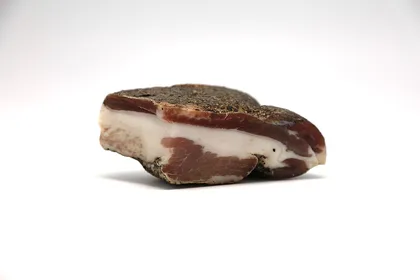 Cured meatsGuancialeGuanciale is cured pork jowl: unsmoked, rubbed with salt and pepper, aged for one to three months.
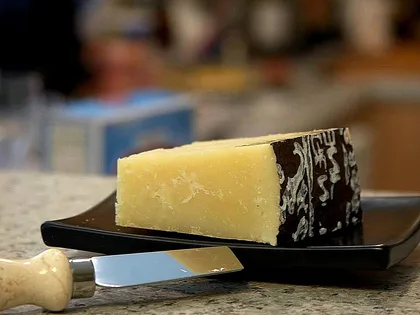 CheesePecorino RomanoPecorino Romano DOP is a hard, dry-salted sheep's milk cheese aged at least five months, made in Sardinia…
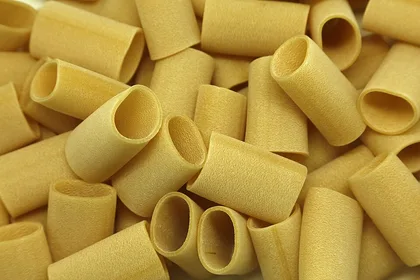 Pasta and breadPaccheriPaccheri are large smooth tubes of durum wheat pasta from Campania: 4-5 cm long, 3-4 cm across, with a thick…
 Pasta and breadSpaghettiA solid round strand of durum semolina and water, 1.7 to 2.0mm across. It looks like the most neutral pasta…
 Pasta and breadBucatiniBucatini are thick spaghetti with a hole running through the middle.
 Pasta and breadPinsa RomanaIt is not pizza, and the difference starts with the flour: wheat, rice and soy blended together, hydration…
 Pasta and breadPizza al TaglioPizza al taglio is Roman pizza by the slab: a very wet dough baked in an oiled rectangular pan, sold by…
 Pasta and breadSupplìSupplì are Rome's fried rice croquettes: rice cooked in tomato sauce, moulded around a plug of mozzarella…