What is Mostaccioli?
Neapolitan mostaccioli, mustacciuoli in dialect, are rhombuses of spiced dough about two centimetres thick, baked briefly and then coated in tempered dark chocolate. The shell is glossy and snaps; the inside stays soft and faintly damp, carrying a spice load that arrives immediately and lingers.
The dough is flour, sugar or honey, cocoa, ground almonds, candied peel and a spice blend Naples calls pisto: cinnamon, cloves, nutmeg, star anise, coriander. It is sold loose in the spice shops of the old town through December and it is the signature of the whole Neapolitan Christmas repertoire.
The leavening is neither yeast nor ordinary baking powder but ammonium bicarbonate, baker's ammonia, which gases off completely in the oven and leaves a porous crumb that stays soft for weeks. It is why a mostacciolo bought in early December is still good in mid-January.
One warning for American readers: mostaccioli is also the name of a smooth tubular pasta widely sold in the US Midwest, where baked mostaccioli is a standard church-hall dish. The two share only a name and a diamond-cut logic. This page is about the Neapolitan sweet.
The word also travels within Italy. In Soriano Calabro, in Calabria, mostaccioli are rock-hard honey-and-flour figures shaped into horses, fish and hearts; in Umbria and Abruzzo they are dry spiced biscuits. The soft chocolate-covered rhombus is the Campanian version and the one the Italian market means by default.
What does it taste like?
Spice first, and more of it than any northern European Christmas biscuit delivers. Cloves and star anise lead, cinnamon fills in behind them, and the nutmeg shows up at the end. It is warm rather than hot, and it does not taste of ginger at all, which is the main surprise for anyone approaching from gingerbread.
Underneath the spice there is cocoa in the dough as well as on the outside, plus toasted almond and small bursts of candied citrus. The sweetness is moderate and the dark chocolate coating pulls it down further, adding a clean bitterness that keeps the whole thing from turning into confectionery.
Texture is the other half. The chocolate shell breaks with a dry snap, then the crumb underneath is soft, dense and slightly moist: closer to a chewy brownie edge than to a biscuit. There is no crunch inside unless the almonds have been left coarse.
One mostacciolo weighs sixty to a hundred grams and is a full portion. Two is a lot.
How to use it
Eat them at room temperature, one per person, after a meal or with afternoon coffee. They are dense and heavily spiced, and a single one is a genuine portion.
Never serve them cold. Refrigeration hardens the crumb and dulls the chocolate, and the condensation that forms as they warm up leaves white streaks across the shell that never go away.
Do not try to cut them with a knife: the coating cracks and the crumb crumbles. Break them by hand along the diagonal if you need to share.
Crumbled, they are excellent: over ricotta semifreddo or fiordilatte gelato, where they add spice, almond and chocolate in one move, or in place of a third of the savoiardi in a Christmas tiramisu.
The traditional Neapolitan way to finish the leftovers is to break one into a bowl of hot milk on the morning of 26 December.
How long it keeps
Three or four weeks at room temperature in a tin or a closed box is the working span, which is long for a baked sweet. The reason is the raising agent: ammonium bicarbonate leaves an open, porous crumb that holds on to its own moisture instead of drying out. The refrigerator is the place to avoid. Cold stiffens the crumb and pulls cocoa butter to the surface of the chocolate as pale streaks and patches, a change in appearance that does not reverse once it has happened.
Humidity acts on these the opposite way round from most Christmas baking: it does not soften them, it makes the coating tacky and takes the shine off the chocolate, which is the argument for a genuinely airtight container. Above about 25 degrees the shell softens and the diamonds glue themselves to each other, so in warm weather they go into the box with baking paper between the layers. They freeze well, and best before the coating goes on: bare baked biscuits hold three months and are dipped after thawing. Boxed ones follow the date and the baker.
Spot the real thing
In American shops the word is a trap: mostaccioli there is usually a tube pasta close to penne, and the biscuit sits in Italian bakeries around Christmas under mustacciuoli or mostaccioli napoletani. The real thing is a diamond with sharp edges and an even height; rounded or domed shapes come from a wet dough or a hot oven. The chocolate coating should be thin, glossy and true dark chocolate, snapping dry when you break it. A thick, dull shell that gives under a fingertip at room temperature is normally a compound glaze made without cocoa butter, and it leaves a waxy film in the mouth.
Inside, the crumb should be soft and moist rather than dry or powdery, with small cubes of candied peel visible at the break; a uniform paste with nothing in it is a simplified industrial version. The spice blend, the Neapolitan pisto, should arrive as one thing, with no single spice standing above the others, so a dominant cinnamon or anise means it was unbalanced. Calabrian mostaccioli are a different biscuit entirely: honey-based, shaped into figures, no chocolate.
How to pronounce Mostaccioli
mos-taht-CHOH-lee
Four syllables, stress on the third. The 'cci' is a soft 'ch' as in 'chocolate', and the double 't' before it is held. Never 'moss-ta-SEE-oh-lee'. Americans who know the pasta usually say 'MUSS-ta-cho-lee', which is the same word worn down by a century of English: the Italian pronunciation of both is identical. The singular is mostacciolo, mos-taht-CHOH-loh.
Mostaccioli compared
vsPanpepato
The two great Italian spiced Christmas sweets, and they diverge on structure rather than flavour. Panpepato, from Tuscany and Umbria, is a dense medieval-descended cake of honey, nuts, dried fruit, pepper and cocoa, pressed into a low round and sliced into thin wedges to share. Mostaccioli are individual portions, leavened, softer, and defined by their chocolate coating. Panpepato has almost no flour holding it together and keeps for months; a mostacciolo is a baked good with a proper crumb that keeps for weeks. If you want something to slice onto a cheeseboard, that is panpepato; if you want something to hand to each guest with coffee, that is a mostacciolo.
| This | Panpepato | |
|---|---|---|
| Region | Campania, above all Naples | Tuscany and Umbria |
| Format | Individual rhombus, 60-100 g | Round cake, cut into thin wedges |
| Structure | Leavened dough with a crumb | Nuts and fruit bound by cooked honey |
| Nuts | Ground almonds in the dough | Whole almonds and hazelnuts, visible |
| Heat | Sweet spices, no pepper | Black pepper is structural |
| Coating | Tempered dark chocolate | Bare, or dusted with sugar and spice |
| Keeps | Three to four weeks | Several months |
vsGingerbread
The comparison most English speakers reach for, and it misleads in one specific way: there is no ginger in a mostacciolo. Both are spiced, honey-adjacent Christmas doughs descended from the same medieval spice trade, but the Neapolitan blend is built on cloves, star anise and cinnamon, and it carries cocoa and almonds that gingerbread does not. Texture differs too: British gingerbread biscuits are crisp, German Lebkuchen is soft but uncoated, and the mostacciolo sits between them with a hard chocolate shell over a soft centre. Elisenlebkuchen, the nut-heavy chocolate-coated German grade, is by far the closest relative.
| This | Gingerbread | |
|---|---|---|
| Ginger | None | The defining spice |
| Lead spices | Cloves, star anise, cinnamon, nutmeg | Ginger, cinnamon, treacle notes |
| Cocoa | In the dough and on the outside | Rare |
| Nuts | Ground almonds, always | Usually none |
| Leavening | Baker's ammonia | Bicarbonate of soda |
| Texture | Soft crumb under a snapping shell | Crisp (UK) or soft and bare (Lebkuchen) |
vsRoccocò
The sibling in the same Neapolitan Christmas box, and the one people confuse it with in Naples itself. Both carry pisto, both appear on the same tray from 8 December, and both are sold by weight in the same pastry shops. The roccocò is a flat ring, brutally hard, packed with whole toasted almonds and left uncoated: it is designed to be dunked in vermouth, sweet wine or coffee, and eating one dry is a genuine risk to a filling. Take the mostacciolo if you want soft and chocolate-covered, the roccocò if you want to dunk.
| This | Roccocò | |
|---|---|---|
| Shape | Rhombus | Flat ring |
| Texture | Soft, yielding | Very hard, meant for dunking |
| Almonds | Ground into the dough | Whole, throughout |
| Coating | Dark chocolate | None, sometimes egg-washed |
| Eaten | As it comes | Dunked in wine or coffee |
Mostaccioli substitutes
- Elisenlebkuchen
The closest thing sold outside Italy, and often chocolate-coated already. The German grade has the highest nut content and the least flour, which puts it very near the mostacciolo in texture. It is missing the star anise and the cocoa in the dough, so it reads sweeter and rounder.
1:1 by weight - Pisto substitute: mixed spice plus star anise
The spice blend is the one thing you cannot buy outside Naples, but it rebuilds easily. Use four parts ground cinnamon, two parts cloves, two parts nutmeg, one part star anise and one part coriander seed, all ground fine. Star anise is not optional: it is what makes the blend taste Neapolitan rather than generically festive.
10 g of blend per 500 g flour - Baking powder for baker's ammonia
Ammonium bicarbonate is what keeps these soft for a month, and it is sold in Italian and northern European groceries as ammoniaca per dolci or hirschhornsalz. Baking powder works as a stand-in but gives a tighter crumb that hardens within days, so eat them sooner.
1.5 g baking powder per 1 g ammonia - Candied orange peel for cedro
Traditional recipes use candied citron, which is milder and more floral than orange. Good candied orange peel is the easy swap and is better than a tub of cheap mixed peel, which brings artificial colour and no citrus at all.
1:1 - Honey for the sugar
Older Neapolitan recipes sweeten with honey alone, which is closer to the medieval original and gives a darker, chewier result that keeps longer. Reduce the liquid in the dough to compensate.
800 g honey per 1 kg sugar, minus 10% of the added liquid
Where to buy it
In Naples, from any pastry shop in the old town between 8 December and Epiphany, at 18 to 30 euro a kilo. They are sold by weight, usually mixed on a tray with roccocò, susamielli and raffiuoli. A single piece is 2 to 3.50 euro. Artisan versions with real couverture chocolate and a high almond percentage reach 32 to 38 euro a kilo.
Read the coating before you pay. Real dark chocolate is thin, glossy and snaps; a thick matte layer that goes soft under your fingers is a cocoa-butter substitute, and it leaves a greasy film in the mouth.
Abroad, Italian delis stock them in December at roughly 14 to 24 dollars a pound in the US and 25 to 40 pounds a kilo in the UK. Online Neapolitan pasticcerie ship them, and they travel well because they are built to keep.
The most useful thing to order from Naples is the pisto itself: a few euro a packet from the spice shops of the centro storico, and the one ingredient a home baker cannot approximate blind.
Where to eat it in Italy
The old town of Naples in December, where the historic pasticcerie around Piazza San Domenico Maggiore and along Spaccanapoli put out trays of all four Christmas sweets from the feast of the Immaculate Conception onwards. Scaturchio, on the piazza, is the best-known window if you want a fixed point.
Walk via San Gregorio Armeno while you are there, the street of the nativity-scene workshops. It is impassable with crowds in December and it is also where the Neapolitan Christmas is visible all at once: the figurine shops, the grocers selling pisto loose, the sweet stalls.
Outside the city, the tradition is strong in Torre del Greco, Nola and across the agro nolano, where village pastry shops make a rougher, less sweet version.
For the widest possible contrast, detour to Soriano Calabro in Calabria, where mostaccioli are hard hand-modelled honey figures sold at the San Domenico fair: same name, same Roman ancestor, an entirely different sweet.
Further reading
Frequently asked questions
Are Italian mostaccioli the same as the pasta?
No. In the US, mostaccioli is a smooth penne-shaped pasta used in baked dishes. The Italian mostacciolo is a Christmas biscuit from Naples: a spiced rhombus coated in dark chocolate. They share a name derived from the same diamond-cut idea and nothing else.
Why are they called mostaccioli?
From the Roman mustaceum described by Cato, a cake of flour kneaded with grape must, anise and cumin and baked on bay leaves. Must was the sweetener, and the name survived long after sugar replaced it.
Do mostaccioli taste like gingerbread?
They belong to the same spiced-Christmas-dough family but contain no ginger. The blend is cloves, star anise, cinnamon, nutmeg and coriander, plus cocoa and ground almonds. German Elisenlebkuchen is a much closer match than British gingerbread.
How long do mostaccioli keep?
Three to four weeks in a tin at room temperature, thanks to the baker's ammonia in the dough. Do not refrigerate them: the crumb hardens and the chocolate blooms white. Undipped, they freeze for three months and can be coated after thawing.
How do you pronounce mostaccioli?
mos-taht-CHOH-lee, stress on the third syllable, with the 'cci' as a soft 'ch'. One of them is a mostacciolo, mos-taht-CHOH-loh.
Related foods
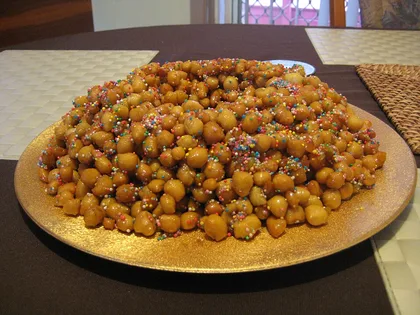 SweetsStruffoliStruffoli are tiny balls of fried dough tumbled in warm honey, heaped into a ring and scattered with candied…
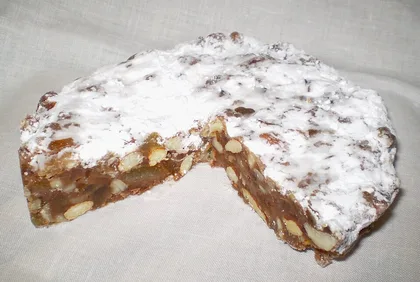 SweetsPanfortePanforte is a dense, chewy Sienese disc of candied fruit, almonds, honey and spices, only 2-3 cm thick and…
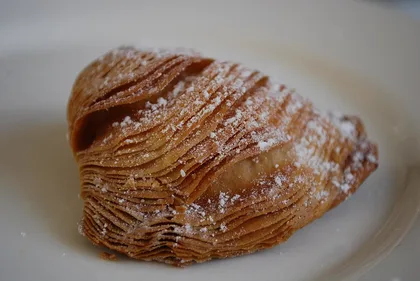 SweetsSfogliatellaThe sfogliatella is Naples' hardest pastry to make and its easiest to recognise: a shatteringly crisp fan of…
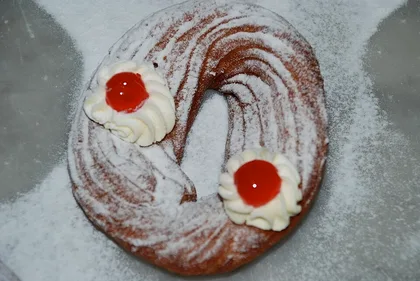 SweetsZeppoleZeppole are Naples' feast-day pastry for Saint Joseph on 19 March: a piped choux ring, fried or baked, filled…SweetsTorroneHoney and sugar go over a water bath and stay there for hours, sometimes twelve, while someone keeps stirring.
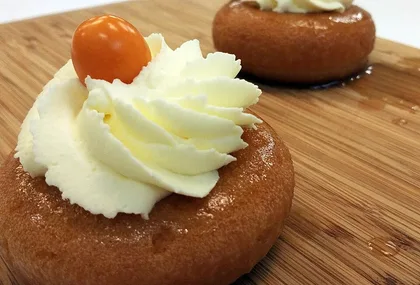 SweetsBabàBabà is a yeasted, egg-and-butter-rich cake baked in a mushroom shape, dried out, then soaked in warm rum…
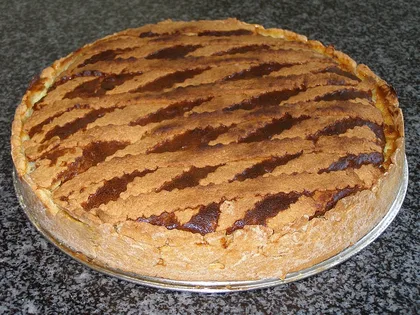 SweetsPastieraPastiera is the Easter tart of Naples: a shortcrust case filled with sheep's-milk ricotta, wheat berries…
 Pasta and breadSpaghettiA solid round strand of durum semolina and water, 1.7 to 2.0mm across. It looks like the most neutral pasta…