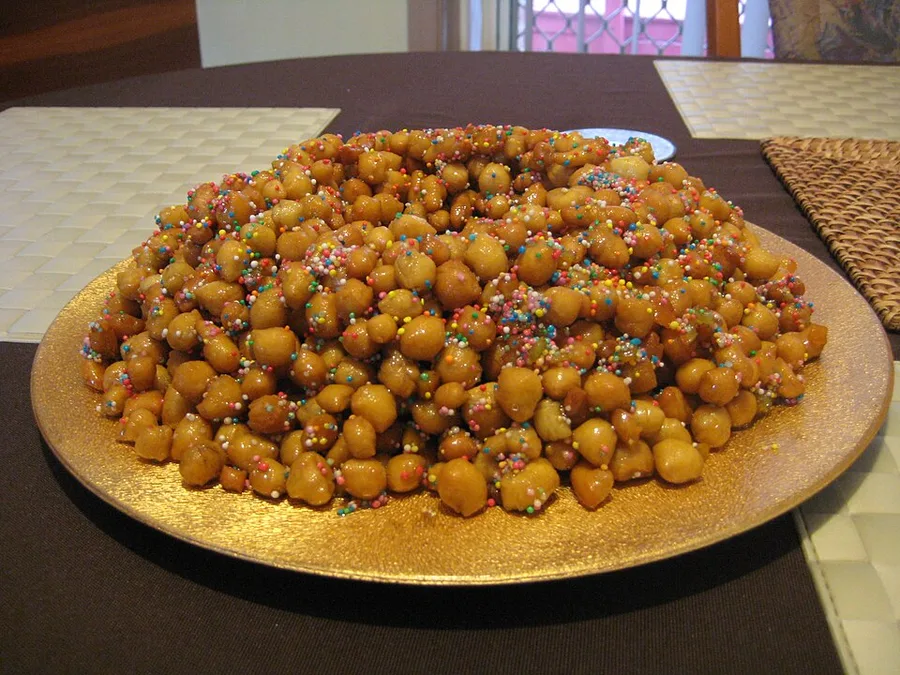
What is Struffoli?
Struffoli are small spheres of sweet dough, chickpea-sized or barely larger, deep-fried and then tossed in honey warmed with citrus peel. They are piled into a ring or a cone on a serving plate and decorated with cubes of candied fruit, toasted almonds and diavulilli, the tiny multicoloured sugar nonpareils that are as essential to the look as the honey is to the taste.
This is not a fork dessert. You take them with your fingers, one or two at a time, and the plate stays on the table from the Feast of the Immaculate Conception on 8 December through to Epiphany on 6 January, shrinking a little each day.
The dough is unleavened: flour, whole eggs, a little butter or lard, a spoonful of sugar, grated lemon and orange zest, and a splash of anise liqueur or rum. It does not puff. It dries out in the fryer and stays small, which is exactly what makes the ratio of crisp surface to honey work.
The texture that results is specific and hard to fake: a thin crisp shell under a film of honey, and a dense, faintly chewy centre that is never dry.
What does it taste like?
Honey and citrus, in that order, over something that eats like a very small doughnut. The honey is the dominant flavour and it is not diluted, since struffoli are coated rather than soaked, so the quality of the honey shows immediately. Orange and lemon zest run through both the dough and the honey and are what keep the whole thing from being flatly sweet.
Underneath is fried dough: rich, eggy, slightly savoury from the butter or lard, with a faint aniseed lift from the liqueur in the mix. The almonds add bitterness and crunch, the candied peel adds chew, and the sprinkles add nothing but colour and a faint sugary grit, which is the point of them.
Eating them is oddly compulsive. Each ball is a single mouthful, so there is no natural stopping point, and Neapolitan families are candid about the fact that a kilo does not last as long as anyone plans.
By day four they soften. The shell gives way to the honey and they become chewier: different, and to some people better.
How to use it
Struffoli are assembled rather than cooked, but the timing matters more than the technique.
Roll the dough into pencil-thin ropes, cut them into half-centimetre pieces, and roll each between floured fingers. Half a kilo of flour produces several hundred balls, which is why in Naples this is done by two or three people around a table with the radio on.
Fry at a moderate temperature, around 170°C, a small handful at a time, stirring so they colour evenly. Too hot and the outside browns while the inside stays raw.
Warm the honey gently with a strip of citrus peel and a spoonful of sugar. Never let it go past about 110°C: above that it caramelises, turns bitter, and sets the balls into a single solid block instead of glazing them individually. Tip the warm, drained struffoli in and fold from the bottom with a wooden spoon.
Shape the ring with lightly oiled hands while everything is still warm. An oiled glass placed in the centre of the plate and removed at the end makes the hole. Decorate immediately: candied fruit, almonds and sprinkles only stick while the honey is soft.
To work ahead, fry the balls up to three days early and keep them bare in an airtight tin, or freeze them for a month. Honey them on the day you serve.
How long it keeps
At room temperature, on the serving plate under a dome or a loosely laid sheet of foil, struffoli hold four or five days. The honey coat slows things down, but each day the thin crust gives up a little more and the balls soften: on day three they still have a centre with some bite, by day six the texture has gone the other way entirely.
The fridge is the wrong place. Cold crystallises the honey and stiffens the fat in the dough, so they come out hard and dull, and warming them does not reverse it.
To work ahead, split the job. Fried balls without honey keep three days in an airtight container at room temperature, or freeze for up to a month and come back with five minutes in a 160°C (320°F) oven. Warm the honey and dress them on the day. Struffoli already coated do not freeze: as they thaw the honey draws out water and the balls slump and lose their shape.
Spot the real thing
Start with size. Well made Neapolitan struffoli are small, barely bigger than a chickpea, and slightly irregular, because they are cut by hand from a rope of dough. Balls the size of hazelnuts, all identical, mean an industrial batch or a domestic shortcut: they change the ratio of crust to crumb and the dessert turns heavy.
The balls should still come apart. If the mound is a solid block that breaks in shards, the honey was heated too far and caramelised. One struffolo should lift away between two fingers, carrying a thread of honey and nothing else. The colour is a warm, even gold: pale patches mean an overcrowded fryer, dark ones mean tired oil. Read the candied peel the way you would on a cassata, translucent and soft rather than glassy and unnaturally bright. The sprinkles are coloured sugar by definition and belong to the look.
American bakeries sell the same thing as honey balls, sometimes as pignolata, which in Sicily is a larger, often chocolate-glazed sweet. Greek loukoumades are bigger, softer and soaked in syrup.
How to pronounce Struffoli
STROOF-foh-lee
Three syllables, stress firmly on the first. The double 'f' is held slightly longer than a single one. The 'u' is the 'oo' of 'food', never the 'uh' of 'stuff', so not 'STRUFF-uh-lee'. The final 'i' is a clear 'ee'. Singular: struffolo, STROOF-foh-loh. The Neapolitan sprinkles are diavulilli, dyah-voo-LEEL-lee.
Struffoli compared
vsPignolata (Messina)
Sicily's version parted ways with Naples entirely. Messina's pignolata glassata is covered in two set glazes (white lemon on one half, dark chocolate on the other) and the pieces are elongated rather than round. No honey is involved at all in the Messina style.
| This | Pignolata (Messina) | |
|---|---|---|
| Coating | Warm honey | Set lemon and chocolate glazes |
| Shape of pieces | Small round balls | Elongated nuggets |
| Presentation | Ring or mound, loose | Two-toned mound, halved by colour |
| Decoration | Candied fruit, almonds, sprinkles | None: the glaze is the finish |
| Season | Christmas | Carnival, though sold year-round |
| Texture | Crisp shell, sticky | Firmer, drier, glazed |
vsCicerchiata
The version of central Italy: Abruzzo, Umbria, Le Marche. Same idea, plainer execution: bigger balls, always formed into a ring, bound in honey, often with chopped almonds, and none of the candied fruit or coloured sprinkles that define the Neapolitan look.
| This | Cicerchiata | |
|---|---|---|
| Ball size | Chickpea-sized | Hazelnut-sized or larger |
| Shape | Ring or cone | Always a ring |
| Decoration | Candied fruit and diavulilli | Chopped almonds, sometimes nothing |
| Liqueur in dough | Anise, rum or limoncello | Often none |
| Season | Christmas | Carnival |
| Name from | Greek strongýlos, 'rounded' | Cicerchia, a local pulse the balls resemble |
vsLoukoumades
The Greek relative, and probably the ancestor. Both are fried dough in honey, but loukoumades are yeasted, much larger, hollow inside and served hot and drenched. Struffoli are unleavened, tiny, dense, and served at room temperature over weeks.
| This | Loukoumades | |
|---|---|---|
| Leavening | None: eggs and flour only | Yeasted batter |
| Size | 1 cm balls | 3–4 cm puffs |
| Interior | Dense, slightly chewy | Hollow and airy |
| Honey | Coated, tossed | Drenched, syrup pooling |
| Served | Room temperature, from a shared plate | Hot, in individual bowls |
| Keeps for | 4–5 days | Minutes |
Struffoli substitutes
- Mild wildflower or acacia honey
Neapolitan cooks use a light honey so the citrus can still be tasted. Chestnut, buckwheat or manuka honey will dominate everything and turn the dish bitter. If mild honey is unavailable, cut a stronger one with golden syrup.
250 g honey per 500 g flour - Butter for strutto (lard)
Traditional recipes use lard in the dough, which gives a shorter, sandier crumb. Butter is the standard modern substitute and works directly, though the result is slightly softer.
1:1 - Nonpareils or hundreds and thousands for diavulilli
Diavulilli are simply tiny multicoloured sugar balls. Any nonpareils sold for cake decorating are the same product. Avoid large sugar pearls, which will not stick to the honey and read as wrong.
1:1 - Grated citrus zest plus vanilla for the liqueur
For an alcohol-free version, replace the spoonful of anise liqueur, rum or limoncello with extra lemon and orange zest and a few drops of vanilla. Adding a pinch of ground fennel seed recovers the aniseed note.
Zest of 1 extra orange + ½ tsp vanilla per 1 tbsp liqueur - Candied orange peel for mixed candied fruit
Good candied orange peel alone beats a tub of cheap mixed peel every time. If you can find candied citron, better still. Neon glacé cherries are the one decoration worth skipping entirely.
1:1 - Vegetarian and vegan notes
Made with butter rather than lard, struffoli are vegetarian. A vegan version is harder: the eggs are structural. Substituting them with a thick flour-and-oil dough works but produces a harder ball, and honey needs replacing with agave or golden syrup.
Where to buy it
In the US, Italian-American bakeries make struffoli through December, especially in New York, New Jersey, Philadelphia, Boston and Chicago, though some list them as 'honey balls' or 'honey clusters', which is the same thing. Expect 18 to 35 dollars per pound for a decorated tray. Order a week ahead in the fortnight before Christmas.
They travel poorly and are genuinely easy to make, so buying the ingredients is often the better move. Mild honey, candied orange peel and nonpareils are the only things worth being fussy about.
In the UK, struffoli are rare outside Italian delicatessens in London and a handful of Neapolitan-run bakeries, at roughly 25 to 45 pounds per kilo in December. Imported tins and shrink-wrapped trays appear in Italian food shops from late November; check whether the coating is honey or glucose syrup, which is the standard industrial shortcut and immediately obvious in the taste.
Whatever you buy, avoid anything refrigerated. Cold crystallises the honey and hardens the dough, and it never recovers.
Where to eat it in Italy
Naples in December, and nowhere else quite works. From the middle of the month every pastry shop window in the old centre carries rings of struffoli alongside roccocò, mostaccioli and susamielli: the whole Neapolitan Christmas repertoire on display at once.
Via San Gregorio Armeno, the street of the nativity-figure workshops, is at its most crowded and most Neapolitan in the same weeks, which makes it the right setting as well as the right season. The neighbourhood bakeries of Vomero and the Rione Sanità often make better struffoli than the tourist-facing names on the main streets.
Out in the province (Torre del Greco, Pozzuoli, the Vesuvian towns) you find the older school: smaller balls, more honey, less decoration.
Outside Campania, Neapolitan pastry shops in Rome, Milan and Turin make them in December, and the Neapolitan diaspora keeps the tradition alive abroad more faithfully than almost any other. If you are invited to a Neapolitan family's home between Christmas and Epiphany, the plate will be on the table.
Frequently asked questions
What are struffoli?
Small balls of fried sweet dough coated in warm honey, piled into a ring and decorated with candied fruit, almonds and coloured sugar sprinkles. They are the traditional Christmas sweet of Naples, eaten with the fingers from a shared plate.
How do you pronounce struffoli?
STROOF-foh-lee, with the stress on the first syllable and the 'u' as in 'food'. The singular is struffolo, STROOF-foh-loh.
Why do struffoli sometimes set into one solid lump?
Because the honey was heated too far. Above about 110°C honey caramelises, turns bitter and sets hard on cooling, cementing the balls together. Warm it only until it flows easily.
How long do struffoli keep?
Four or five days at room temperature under a loose cover. Never refrigerate them: cold crystallises the honey and hardens the dough permanently. To prepare ahead, fry the balls in advance and add the honey on the day.
Are struffoli the same as Greek loukoumades?
They are related but not the same. Loukoumades are yeasted, much larger, hollow and served hot in syrup. Struffoli are unleavened, tiny, dense and served at room temperature with only a coating of honey. The Greek version is almost certainly the older ancestor.
Related foods
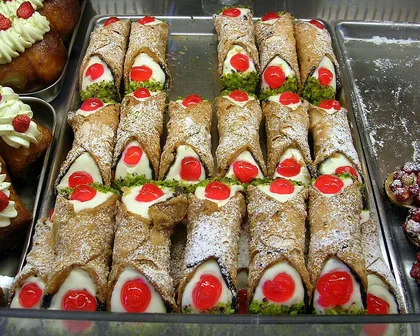 SweetsCannoliIt has to be filled when you order it, and anywhere that fills them in advance has already lost: the fried…
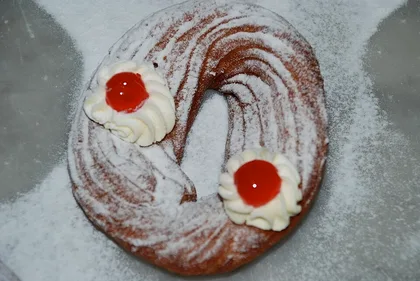 SweetsZeppoleZeppole are Naples' feast-day pastry for Saint Joseph on 19 March: a piped choux ring, fried or baked, filled…
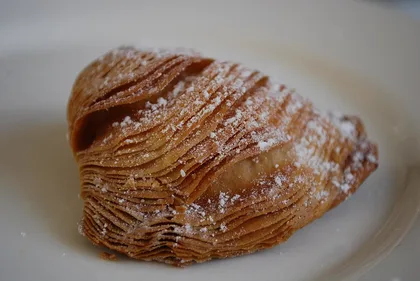 SweetsSfogliatellaThe sfogliatella is Naples' hardest pastry to make and its easiest to recognise: a shatteringly crisp fan of…
 SweetsBabàBabà is a yeasted, egg-and-butter-rich cake baked in a mushroom shape, dried out, then soaked in warm rum…SweetsMostaccioliDiamond-shaped spiced biscuits under a shell of dark chocolate, soft inside and heavy with cinnamon, cloves…
 SweetsPastieraPastiera is the Easter tart of Naples: a shortcrust case filled with sheep's-milk ricotta, wheat berries…
 Pasta and breadSpaghettiA solid round strand of durum semolina and water, 1.7 to 2.0mm across. It looks like the most neutral pasta…